

The Hoarding Tenant: Health, Safety, and Fair Housing
You found a hoarding tenant at inspection. In Florida it's both a lease problem and, often, a protected disability. Here's how to enforce safety without a fair-housing claim.

You let yourself in for a routine inspection, and the door only opens partway. Newspapers stacked to the windowsills. A path through the living room barely wide enough to turn sideways. The kitchen counters gone under boxes, takeout containers, things you can't even name. Your stomach drops. You're already running the math on an eviction and a turnover — and you're already wondering if you're even allowed to.
Here's the first thing to know: you're not in a fight. Not yet. A hoarding tenant is one of the few crisis situations where the fastest move — file to evict — is also the one most likely to get you sued. Hoarding disorder is a recognized disability, and that changes the playbook. But it doesn't strip you of your right to a safe, code-compliant property. The trick is enforcing the right thing the right way.
What you can and can't do with a hoarding tenant in Florida
| Move | Detail | Authority |
|---|---|---|
| You CANNOT evict for the hoarding itself | Hoarding disorder is a disability; the diagnosis can't be your legal ground | Fair Housing Act / FL Stat. 760.23 |
| You CAN enforce health and safety obligations | Clean and sanitary, garbage removed, building/housing/health codes met | FL Stat. 83.52 |
| You must offer a reasonable accommodation | Extra time, a step-by-step plan, allowing third-party help | FL Stat. 760.23(9)(b) |
| Your enforcement tool is the 7-day notice to cure | For curable noncompliance — "failing to keep the premises clean and sanitary" is listed | FL Stat. 83.56(2)(b) |
| You may escalate only if the safety violation goes uncured | And only on an individualized assessment of a real threat — never fear or stereotype | HUD/DOJ direct-threat standard |
Is hoarding a disability under fair housing law in Florida?
Usually, yes. Since 2013, the American Psychiatric Association has classified hoarding disorder as its own condition, and it affects roughly 2 to 3 percent of people. Under the federal Fair Housing Act and the Florida Fair Housing Act, a tenant whose hoarding stems from that disorder is generally protected — which means you can't evict them for the hoarding itself.
Why does that matter so much? Because the disability triggers a duty. Florida Statute 760.23(9)(b) makes it unlawful to refuse a reasonable accommodation for a person with a disability when that accommodation lets them keep using and enjoying their home. It's the same legal category that governs assistance animals — the duty to accommodate doesn't care whether you find the request convenient. If you've ever worked through an emotional support animal request under Florida law, you already know the shape of this: real obligations on your side, real limits on theirs.
So no — "my tenant is a hoarder" is not, by itself, a reason a Florida court will let you end the tenancy. Now here's where landlords miss the other half.
Can a Florida landlord evict a hoarding tenant?
Yes — but only for a health or safety lease violation, never for the diagnosis. The hoarding is protected. The blocked fire exit, the rotting garbage, the pest harborage, the code violation? Those are enforceable, because Florida Statute 83.52 obligates every tenant to keep the unit clean and sanitary, remove garbage, and comply with building, housing, and health codes.
Read that distinction twice, because it's the whole game. You are not enforcing "stop being a hoarder." You're enforcing "the unit has to meet basic safety and sanitation standards." One is a fair-housing violation waiting to happen. The other is a clean, defensible lease enforcement that any tenant — hoarder or not — would be held to.
For an investment landlord weighing the numbers, that distinction is also financial. A contested eviction plus a packed-unit turnover is expensive and slow. A professional hoarding cleanup in Florida runs anywhere from $1,000 to $3,000 for a mild case up to $6,000 to $12,000 or more for a severe one — and if you push to eviction and lose, you're paying for the unit to sit empty on top of legal fees. Compare that to keeping a long-term tenant who, with structure and time, brings the unit back into compliance. Often the accommodate-and-keep path is the cheaper one. And Florida law gives you a backstop: if the same clean-and-sanitary violation recurs within 12 months of your notice, you can move to eviction without serving a fresh cure notice. You get one good-faith cycle. After that, the leash shortens.
What is "The Document-and-Accommodate Move"?
It's the five-step sequence that lets you fix the safety problem and stay on the right side of fair housing: document the conditions objectively, engage the tenant, offer an accommodation alongside a 7-day notice to cure, re-inspect, and escalate only if the safety violation isn't fixed. Each step builds the record that protects you.
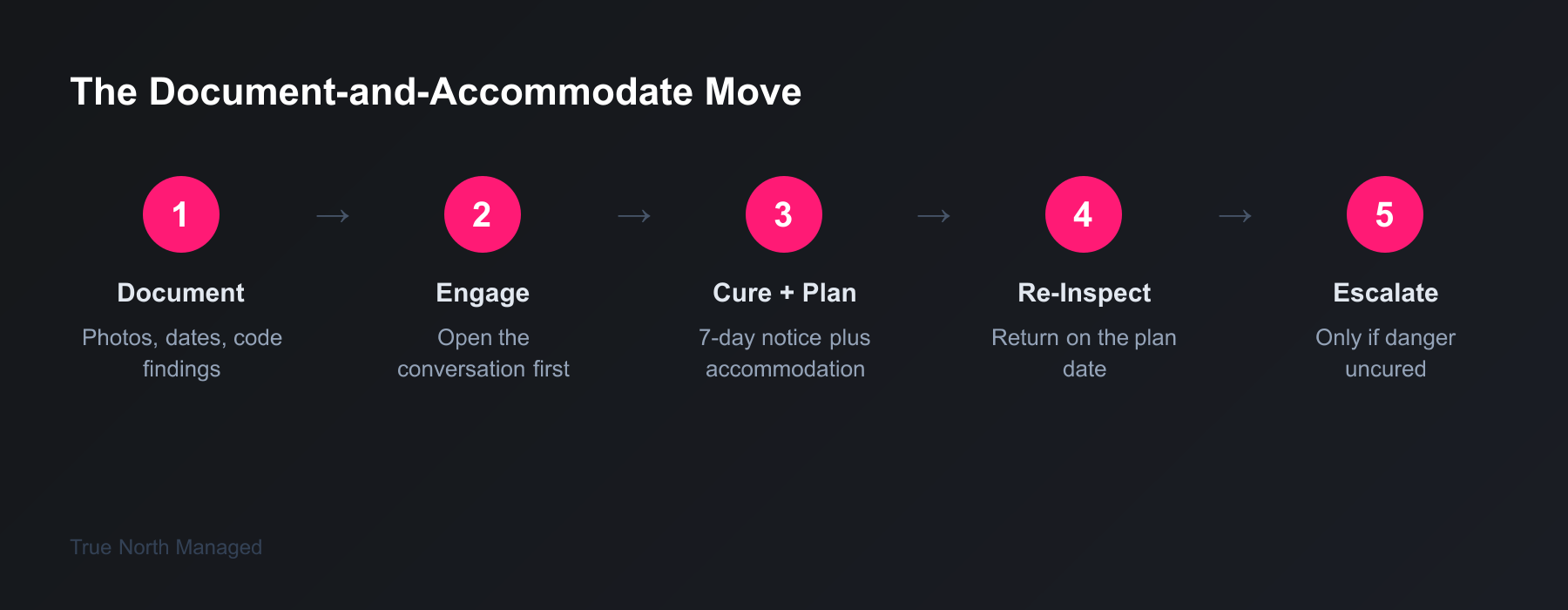
1. Document objectively. Photos, dates, and specifics — not adjectives. "Egress blocked at the rear exit by stacked storage" beats "the place is a disaster." If you got in for a lawful inspection, you already understand the access rules; if you didn't, our guide to a Florida landlord's right of entry and the 7-day cure process covers the 24-hour notice and how to handle a tenant who won't let you in. Pull in objective third parties where you can: a fire marshal noting blocked egress, a code enforcement officer citing a violation. Their findings are worth more in court than your opinion.
2. Engage the tenant — don't just paper them. When a disability is obvious, fair-housing guidance says you can't sit back and wait for a formal written request; you're expected to start the conversation. There's a known standoff here. The one thing a person with hoarding disorder often genuinely can't do on their own is the cleanup — that's the disorder. So you make the first move with a specific, dated proposal, and you write down every offer and every response.
3. Offer the accommodation and serve the 7-day cure together. Your enforcement tool is the notice for curable noncompliance under Florida Statute 83.56(2)(b) — the statute literally lists "failing to keep the premises clean and sanitary" as a curable example. The notice gives 7 days to correct it. The accommodation layers on top: more time than the bare 7 days when the cleanup realistically needs it, a written plan with milestones, and permission for case managers or a cleanup crew to come in. The notice cites the sanitation and code violation. It does not say "because you're a hoarder."
4. Re-inspect. Go back on the date in the plan. Take the same photos from the same angles. If the egress is clear and the unit's sanitary, you're done — log it and move on. Progress, even partial, is what a court wants to see you acknowledging.
5. Escalate only if the safety violation is uncured. If the tenant won't engage and the danger remains, eviction is back on the table — but it has to rest on the unresolved health and safety violation. If you're leaning on a "direct threat" to justify removal, the HUD and DOJ joint guidance is strict: it has to be an individualized assessment based on real, objective evidence of current conduct, considering whether more accommodation would reduce the risk. Not a hunch. Not a stereotype about what hoarders "are like."
When does clutter become a health and safety violation you can act on?
Clutter crosses into an actionable violation when it creates a genuine danger or breaks a code: blocked exits and fire load, pest infestation, structural or systems damage, or a documented building, housing, or health code citation. A messy unit isn't a violation. A unit you can't safely exit in a fire is.
The big four to look for and document:
- Blocked egress and fire load. Exits and windows you can't get out of, piles of combustible material near heat sources. This is the one that turns a fire marshal's head — and the most common ground that holds up.
- Pest harborage. Stacked clutter gives roaches and rodents places to nest. If an infestation traces back to the tenant's conditions, you've got both a sanitation violation and a documentation question. Our breakdown of pest control responsibility for Florida landlords walks through when the cost shifts to the tenant and how to prove it.
- Property damage. Moisture trapped under piles, urine, rot, damage to floors or walls. Once clutter becomes destruction, you're in different territory — see our guide on recovering for tenant property damage in Florida for the deposit and documentation mechanics.
- Code violations. A notice of violation from City of Orlando or Orange County code enforcement (or Hillsborough County for Tampa) gives you an independent, dated record. They typically issue a deadline of 10 to 30 days, then re-inspect — a timeline that can run alongside your own cure process.
If none of those are present — if it's hoarding that's contained, ugly but not dangerous — you may not have an enforceable violation at all. That's frustrating, but it's also the line the law draws.
What reasonable accommodation should you offer a hoarding tenant?
The most common and effective accommodation for hoarding is time plus structure: extra days beyond the standard 7-day cure to fix the violation, a written plan with achievable milestones, and your permission to bring in third-party help. You're not expected to clean the unit yourself — you're expected to give a realistic path to compliance.
What that looks like in practice:
- Extended time. Seven days clears a few violations; it rarely clears a severe hoard. A staged plan — clear the egress in week one, the kitchen by week three — is more likely to actually work, and it shows good faith.
- A written, dated plan. Specific milestones with dates both sides sign off on. Vague goals fail. "The unit will be clean" is a wish; "rear exit and both bedroom windows clear by March 17" is a plan.
- Allowing third-party help. Case managers, social workers, family, professional cleanup crews. Let them in. Some tenants only make progress with that support, and allowing it is itself a reasonable accommodation.
Stay flexible enough to absorb a setback, firm enough to require a finish. Document each proposal and each response. That record is the thing that wins if it ever lands in front of a judge.
Hoarding-tenant mistakes Florida landlords make
- Naming the disability as the eviction reason. The single most expensive mistake. A notice that says "vacate because of your hoarding" hands the tenant a HUD fair-housing complaint on a silver platter. Anchor every notice to the sanitation or code violation under 83.52 — never the diagnosis.
- Rushing to file without engaging. Skipping the interactive step and the accommodation offer is exactly what a HUD investigator looks for. Engage first, document the offer, then escalate.
- Ignoring it because it feels awkward. Looking away doesn't make the fire risk or the pests go away — it just lets the damage and the liability compound. Hoarding gets worse, not better, when no one engages.
- Refusing every accommodation. "I just want them out" isn't a position the law protects. You have to genuinely consider time and a plan before removal is defensible.
- Leaning on "direct threat" without an assessment. The safety exception is real, but it's not a shortcut. Without an individualized, evidence-based assessment, it collapses.
- Self-help. Don't change the locks, haul the belongings to the curb, or shut off utilities. That's illegal in Florida regardless of how bad the unit looks, and it converts the tenant's problem into yours.
If you own from out of state and a manager is handling this for you, those mistakes are also your audit checklist. Ask to see the dated photos, the accommodation offer in writing, and the 7-day notice citing the lease — not the diagnosis. A clean paper trail is what protects a remote owner if this ever turns into a dispute.
Frequently asked questions
Can you evict a hoarding tenant in Florida?
Not for the hoarding itself, which is a protected disability. You can evict for a health or safety lease violation — blocked egress, pests, code violations, or failure to keep the unit clean and sanitary under Florida Statute 83.52 — but only after offering a reasonable accommodation and a 7-day notice to cure, and only if the violation stays uncured.
Is hoarding a disability under the Fair Housing Act?
Generally yes. Hoarding disorder has been a recognized condition since 2013, and the federal Fair Housing Act and Florida Statute 760.23 treat it as a disability. That means a landlord must consider a reasonable accommodation — usually extra time and a cleanup plan — before pursuing eviction for the resulting condition.
What is a reasonable accommodation for a hoarding tenant?
The most common one is extra time beyond the standard 7-day cure period to fix the violation, paired with a written step-by-step plan and your permission to allow case managers, family, or professional cleaners to help. The goal is a realistic path back to a safe, sanitary unit.
What notice do I serve a hoarding tenant in Florida?
A 7-day notice to cure under Florida Statute 83.56(2)(b), which covers curable noncompliance and specifically lists failing to keep the premises clean and sanitary. The notice must cite the sanitation or code violation, not the hoarding diagnosis. Pair it with a reasonable-accommodation offer.
What if the hoarding tenant won't let me inspect?
Florida gives you a right of entry for inspections with proper notice, and a tenant can't unreasonably refuse lawful access. If they block you after proper notice, the same 7-day cure process applies. The right-of-entry rules and the steps for handling refusal are covered in our Florida right-of-entry guide.
Can I make a hoarding tenant pay for the cleanup or pest control?
Sometimes. If pests or damage trace directly to the tenant's conditions and you can document it, Florida Statute 83.52 supports holding the tenant responsible for the cost. Without that documentation, the cost is harder to shift. Photos and dated records are what make the difference.
A hoarding tenant feels like a five-alarm problem, and the conditions can be genuinely dangerous. But the path through it is calmer than the panic suggests: document the real safety violation, engage the person, offer time and a plan, give the 7-day cure, and keep eviction in reserve for a danger that won't get fixed. Enforce the lease, not the diagnosis. That's how you protect the property and stay clear of a fair-housing claim. For more crisis playbooks like this one, our Florida owner's guide pulls the toughest tenant situations into one place.
If you own a rental in Orlando or Tampa and a situation like this has landed on your plate — you don't need a portfolio to get help, we manage single properties too — request a free rental analysis and we'll walk through your property and how these calls get handled, documentation and all.