
Your Insurer Dropped Your Florida Rental — Now What?
A carrier just dropped your Orlando or Tampa rental. Here's the exact order to shop new coverage, why you can't let it lapse, and where Citizens actually fits.

The letter shows up, and your stomach drops. "We will not be renewing your policy." If you own a rental in Orlando or Tampa, a Florida landlord insurance non-renewal is one of the most stressful pieces of mail you can get, because the property still has tenants, a mortgage, and a clock that's already running.
Quick answer: Don't panic, and don't let your coverage lapse. You usually have at least 120 days of written notice under Florida law — 45 if a takeout carrier assumes your Citizens policy, or if the state approves an insurer's plan for early cancellation or nonrenewal. Use that window to shop admitted carriers first, then surplus lines, with Citizens as your true last resort. The one mistake that costs the most is doing nothing and getting hit with lender force-placed insurance.
Here's the part most landlords don't realize: getting dropped doesn't mean you did something wrong. The Florida market has been re-sorting itself for two years, and even well-maintained rentals get non-renewed when a carrier exits a region or tightens its rules. Let's break down why it happens, exactly what to do, and how to make sure it doesn't happen again.
Why did my Florida insurer drop my rental?
Carriers non-renew Florida rentals for a handful of predictable reasons: an aging roof, too many prior claims, a market exit by the insurer, or a 4-point or wind-mitigation finding that pushes your property outside their underwriting box. Most of these are about risk math, not a personal judgment on you as a landlord.
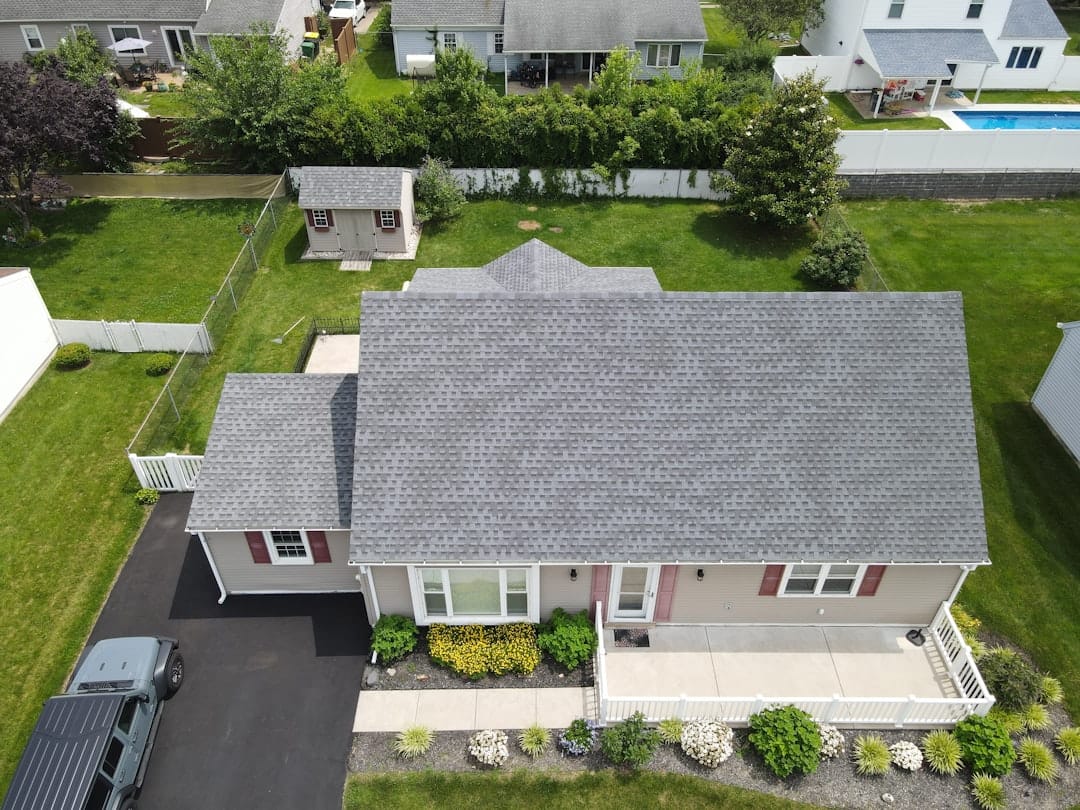
The classic Florida trigger is roof age. Read past the headline of Florida Statute 627.7011: subsection (6)(a) says the section “does not… apply to policies not considered to be ‘homeowners’ policies.’” Every operative sentence in subsection (5) says the same thing — it protects “a homeowner’s policy,” not any policy. A tenant-occupied rental is normally written on a dwelling-fire form, usually a DP-3, so that protection does not reach it. What is worth asking your agent, in writing, is their roof-age cutoff and whether they will accept an inspection report — those are carrier decisions, not statutory ones. The practical advice is unchanged either way: a 16-year-old shingle roof is a non-renewal waiting to happen, and the replacement year is something you can schedule. Becoming uninsurable is not.
Claims history is the second big one. Insurers pull a CLUE report at renewal, which is a five-to-seven-year record of claims tied to both you and the property. Too many claims, even small ones, and a carrier may decide you're not worth renewing. That history follows the property, so claims a previous owner filed can come back to bite a rental you bought years later.
Then there's the market itself. When a carrier shrinks its Florida book or pulls out of a county, it non-renews everyone there, regardless of how clean your file is. For older homes, a required 4-point inspection (roof, electrical, plumbing, HVAC) on properties 20 to 25 years and up can surface aluminum wiring, polybutylene pipes, or an aging panel that knocks you out of eligibility.
None of these mean you're uninsurable. They mean you need to know what flagged you so you can fix it or shop around it.
Florida landlord insurance non-renewal vs. cancellation: how much warning do you get?
Florida requires your insurer to give at least 120 days' advance written notice for a non-renewal, and the notice must state the reason. That's your shopping window, and it's protected by Florida Statute 627.4133. The notice period changes if the carrier is cancelling mid-term instead of declining to renew.
There's a real difference between the two words, and it matters for your timeline:
- Non-renewal: Your policy runs to the end of its term, then stops. The carrier owes you at least 120 days' written notice before that expiration date, with the reason in writing.
- Cancellation (standard): The policy ends early. For most reasons, the carrier still owes you 120 days' notice.
- Mid-term cancellation in the first 60 days: For reasons other than non-payment, only 20 days' notice is required during the first 60 days a new policy is in force, and not even that in every case: FS 627.4133(2)(b)2. requires “at least 20 days’ written notice of cancellation or termination accompanied by the reason therefor … unless there has been a material misstatement or misrepresentation or a failure to comply with the underwriting requirements established by the insurer.” After 60 days, under 627.4133(2)(b)3., “the policy may not be canceled by the insurer unless there has been a material misstatement; a nonpayment of premium; a failure to comply, within 60 days after the date of effectuation of coverage, with underwriting requirements established by the insurer before the date of effectuation of coverage; or a substantial change in the risk covered by the policy or unless the cancellation is for all insureds under such policies for a given class of insureds.” Outside nonpayment, that cancellation still carries the 120-day notice.
- Non-payment of premium: Just 10 days' notice. This is the one that catches landlords who miss an autopay or a mailed invoice.
So if you get a non-renewal, you've got a real runway. If you get a cancellation notice, read it closely to figure out which bucket it falls in, because that tells you how many days you actually have. Either way, treat the date on that letter as a hard deadline, not a suggestion. Your goal is new coverage that starts the day the old one ends, with no gap in between.
What should I do first when I get a non-renewal notice?
The first move is the simplest and the most important: do not let your coverage lapse. Call your current agent to understand the exact reason for the non-renewal, then start shopping for a replacement policy right away. A gap in coverage on a mortgaged rental triggers lender force-placed insurance, which is the worst-case outcome here.
Here's why force-placed insurance is the trap to avoid. When your coverage lapses, your lender buys a policy for you and bills it back to your loan. Worse, it usually covers only the structure. No liability protection. No loss-of-rent coverage. No contents. You pay a premium price for a fraction of the protection, and you don't choose the carrier.
So your first 72 hours look like this:
- Read the letter for the reason and the date. The reason tells you what to fix or shop around. The date is your deadline.
- Call your agent. Ask whether the non-renewal can be withdrawn (sometimes a fresh inspection or a roof repair reverses it) and what specifically flagged the property.
- Start shopping immediately. Don't wait for the policy to get close to expiring. Earlier is better, and being early gives you room to fix issues that come up during a new carrier's inspection.
If you manage the property yourself from out of state, this is where an independent agent earns their keep. They shop your risk across a panel of carriers, and because the carrier pays their commission, the premium is the same to you whether you use them or not. For an out-of-state owner who can't drive around getting quotes, one agent working a dozen carriers is the fastest path back to coverage.
How do I find a new policy — and where does Citizens fit?
Shop in order: admitted carriers first, then surplus lines, then Citizens as the genuine last resort. Each step trades something away, so you want to exhaust the better options before moving down the ladder. Florida's market is actually healthier than it was a couple of years ago, which means you likely have more choices than you'd expect.
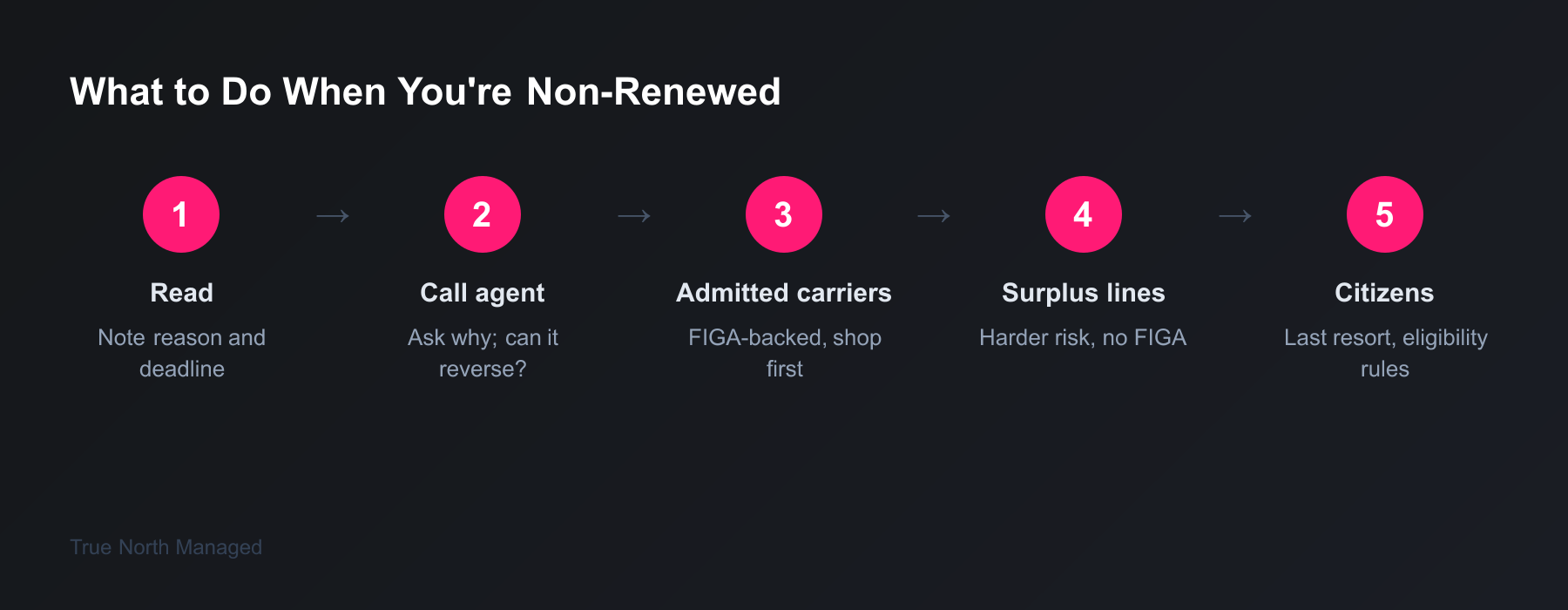
Step one: admitted carriers. These are insurers licensed by the state and backed by the Florida Insurance Guaranty Association (FIGA), which pays your claims if the carrier goes insolvent. That backstop is real protection, so admitted carriers are always your first call. The market has loosened up here. Citizens has shrunk from a peak near 1.41 million policies in late 2023 to 278,246 as of June 30 2026, and new carriers have entered Florida since the 2022–2023 reforms, according to Citizens' monthly policies-in-force report. More carriers competing means more doors to knock on.
Step two: surplus lines (E&S). If admitted carriers turn you down, surplus lines, also called excess and surplus or E&S, can write harder-to-place risk. These carriers are non-admitted, so they have more flexibility on older roofs and unusual properties. The tradeoff is significant: E&S policies are not backed by FIGA, so if that insurer fails, there's no state guaranty fund behind your claim. You'll sign a disclosure acknowledging that. In Florida, a surplus lines carrier generally can only write your policy after admitted carriers have rejected it, so by the time you're here, you've usually confirmed the standard market won't take you.
Step three: Citizens. Citizens Property Insurance is the state-backed insurer of last resort, and it's built to be exactly that. Two things to know for 2026. First, Citizens is more competitive than it used to be: regulators approved an average 8.8% cut on multiperil policies and 5.5% on wind-only, with every personal lines policyholder getting at least a 2% reduction, effective July 1, 2026. Second, the eligibility rules still make it a last resort. You generally can't get Citizens if a private carrier offers comparable coverage at a premium that isn't more than 20% above the Citizens rate. Read that rule carefully if you own a rental. The statute defines the term for the whole Citizens subsection: “‘Primary residence’ means the dwelling that is the policyholder’s primary home or is a rental property that is the primary home of the tenant, and which the policyholder or tenant occupies for more than 9 months of each year” (§627.351(6)(c)2.a.(III)). A long-term rental your tenant lives in for more than 9 months a year is a primary residence, so it falls under §627.351(6)(c)5.a, where only an offer “from an authorized insurer” counts against your Citizens eligibility. A vacant, seasonal or otherwise non-primary rental falls under 5.b, where an offer “from an approved surplus lines insurer at the rate approved by the office as part of such surplus lines insurer’s take-out plan” counts too. Citizens does write landlord policies on tenant-occupied single-family homes and condos, but it excludes short-term rentals like Airbnb and VRBO, so if your rental is a vacation property, this door is closed.
The takeaway: work the ladder top to bottom. Most Orlando and Tampa landlords find admitted coverage if they start early and shop wide. For more on how premiums differ between the two metros, our breakdown of insurance costs in Orlando versus Tampa shows why the same rental can cost very different amounts depending on which side of I-4 it sits on.
How do I stop this from happening again?
The best defense against a future non-renewal is making your property cheaper and easier to insure, then keeping your claims record clean. A few moves do most of the work, and several of them lower your premium at the same time.
Get a wind-mitigation inspection. This is the highest-return move in Florida. A licensed inspection is typically a low-hundreds expense, uses the state's OIR wind-mitigation form, and carriers generally honour it for several years. It documents features like a hip roof, secondary water resistance, and strong roof-to-wall connections. The credits apply only to the windstorm portion of your premium, but that portion is large in coastal Florida. A property with a documented, well-built roof is also far more attractive to underwriters.
Stay ahead of the roof. Since roof age is the number-one non-renewal trigger, track yours. If it's approaching 15 years, get an inspection and, if the useful life is running out, plan the replacement before a carrier forces the issue. A new roof can drop your premium sharply and reset the clock on the biggest red flag a Florida underwriter looks for. Our hurricane prep guide for rentals covers the roof and structural steps that hold up best when a storm actually hits.
Raise your deductible and bundle where it makes sense. A higher all-perils deductible lowers your premium, which can keep you eligible when budgets are tight. Just keep enough cash reserved to cover it. And remember that named-storm deductibles are separate and run 2% to 5% of your dwelling coverage, so a $300,000 rental could carry a hurricane deductible of $6,000 to $15,000. Plan for that number, not just the small one.
Protect your claims history. Every claim lands on your CLUE report. For small losses, especially anything close to your deductible, paying out of pocket can be cheaper than filing, because a claim today can cost you a renewal tomorrow. Save the claims for the losses that actually need them.
One more thing worth knowing: your landlord policy and your flood policy are two different things. A standard landlord policy doesn't cover flood, even after a hurricane. If your rental sits in or near a flood zone, read our guide to flood insurance for Florida rentals so a non-renewal scramble doesn't leave you exposed on the one peril Florida sees most.
Common mistakes Florida landlords make after a non-renewal
Three errors turn a manageable non-renewal into an expensive mess. Avoid these and you'll come out the other side with better coverage than you started with.
Waiting too long to shop. The 120-day notice feels like plenty of time until a new carrier's inspection turns up a problem and you're suddenly racing the clock. Start the day the letter arrives, not the week before expiration.
Treating Citizens as the easy button. It's the last resort by design, with eligibility rules that may bounce you back to the private market anyway. Always exhaust admitted carriers and surplus lines first. A good independent agent will check the whole market before pointing you to Citizens.
Letting the policy lapse "just for a few weeks." Even a short gap can trigger force-placed insurance from your lender, and once that's on your loan it's painful to unwind. There is no acceptable gap on a mortgaged rental. The whole point of the 120-day window is to make sure you never have one.
A non-renewal isn't the end of the road. It's a deadline, and Florida gives you enough runway to beat it if you move early and shop in the right order. For the bigger picture on coverage types, limits, and what a solid landlord policy should include, start with our complete guide to landlord insurance in Florida.
If you'd rather have someone handle the shopping, the inspections, and the renewal calendar so a non-renewal never sneaks up on you, that's what we do every day for owners across Orlando and Tampa. Request a free rental analysis and we'll review your property, your coverage exposure, and what it would take to keep your rental insured and earning.