
Florida Landlord Insurance Costs: Orlando vs. Tampa Comparison
Orlando vs. Tampa landlord insurance, side by side: DP-3 premiums, wind, flood, and why coastal Tampa runs 10–20% higher than inland Orlando.
Insurance is one of the biggest line items on a Florida rental's expense sheet — and Orlando and Tampa, two markets in the same state, don't price it the same way. Orlando sits inland. Tampa sits on the Gulf. That one difference shapes everything from your wind premium to whether you carry flood coverage at all. Here's the side-by-side, with what's actually changed in the 2026 market.
What to know before you budget for insurance
- A standard Florida DP-3 landlord policy averages about $2,208/year, with most landlords paying between roughly $2,100 and $4,000 depending on the property.
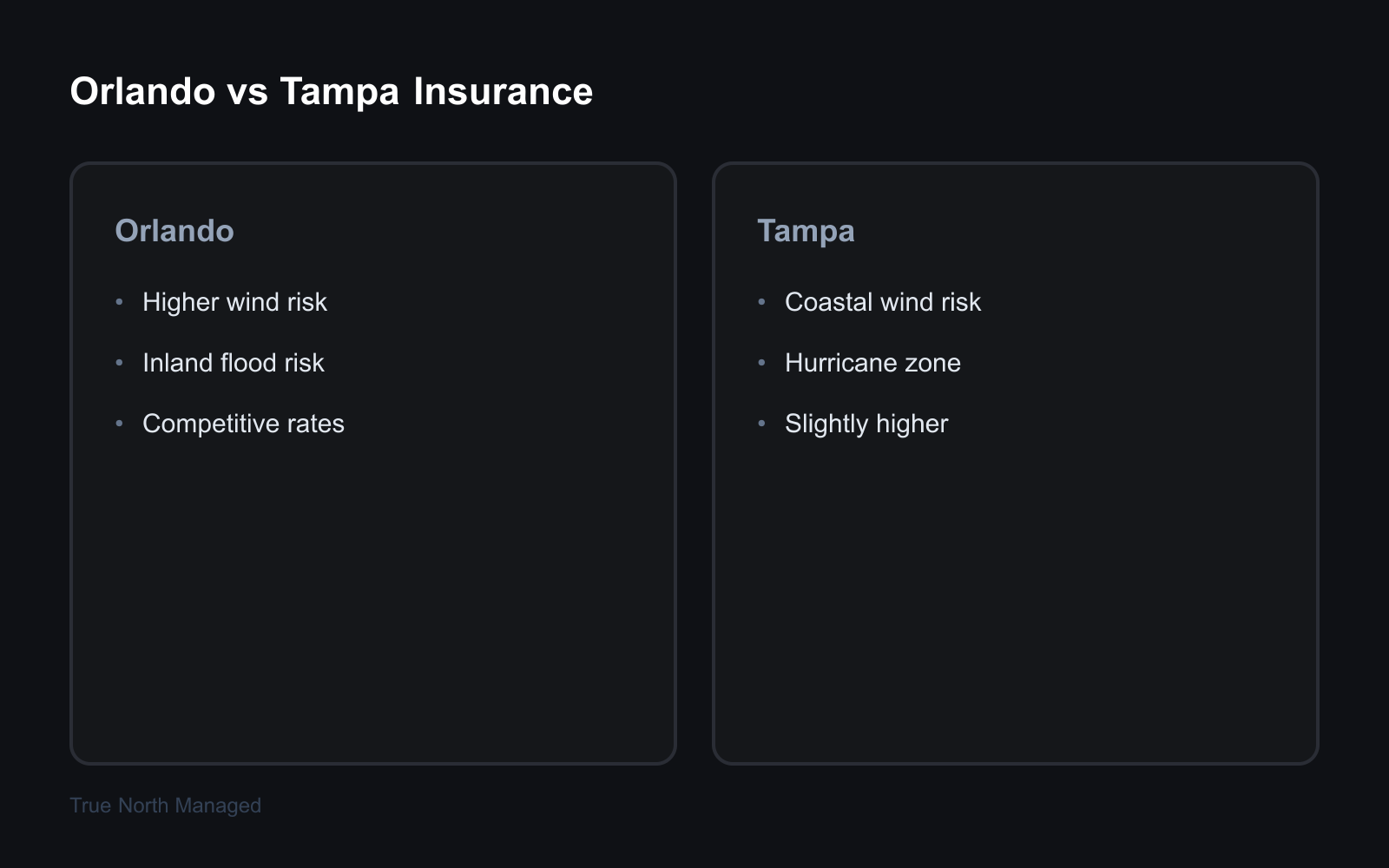
- Tampa typically runs higher than Orlando — usually 10–20% for a comparable property — driven by coastal wind exposure and flood risk, not by the law.
- Flood is separate from your landlord policy. Orlando is largely outside high-risk zones; much of Tampa Bay is not. Check the FEMA flood map for the exact address.
- Get a wind mitigation inspection. It costs roughly $75–150 and can cut a premium by 15–45% in either market.
How do Orlando and Tampa landlord insurance costs compare?
Orlando and Tampa carry similar policy structures, but Tampa's Gulf-coast exposure typically pushes premiums 10–20% higher for a comparable property. A standard Florida DP-3 landlord policy averages around $2,208 a year statewide; inland Orlando rentals often land $1,000–$3,000, with Tampa generally above that.
The gap isn't a rule on a page — it's geography. Both counties price above Florida's quietest inland areas, but Tampa adds two cost drivers Orlando largely doesn't: serious coastal wind and widespread flood exposure. A useful benchmark: a $300,000 single-family rental might run roughly $2,000–$3,500 a year in Orlando versus $2,200–$4,000 in Tampa — estimates that swing hard on roof age, construction, and the property's exact flood zone.
Two takeaways before you go further. First, every figure here is a planning estimate — Florida insurance is quoted address by address, and a few miles can change the number meaningfully. Second, get quotes for the specific property, not the ZIP code.
Why does Tampa cost more than Orlando to insure?
Tampa costs more because of coastal wind and flood exposure. As a Gulf-coast metro, Tampa Bay sits in the path of hurricane wind and storm surge, and much of it falls in FEMA flood zones. Orlando's inland position means lower wind risk and far fewer properties needing flood coverage — the single biggest driver of the gap.
Break it into the pieces that move the premium:
- Wind. Both markets need windstorm coverage, but Tampa's proximity to the Gulf raises the wind quote. Distance from open water, construction type, and roof age all factor in.
- Flood. This is the real separator. In Orlando, many rentals never need flood insurance. In Tampa Bay, a large share do — and storm surge is a genuine threat, not a paperwork formality.
- Wind deductibles. Coastal Florida policies often carry hurricane deductibles of 2–5% of the dwelling value. On a $300,000 home, a 5% deductible is $15,000 out of pocket before coverage starts.
For how wind pricing works in detail, see our windstorm insurance guide for Florida landlords.
Does an Orlando or Tampa rental need flood insurance?
Flood insurance is required when a property sits in a FEMA-designated high-risk flood zone and carries a federally backed mortgage. Most Orlando rentals fall outside those zones; a significant share of Tampa Bay properties fall inside them. A standard landlord policy never covers flood — it's always a separate policy.
This is the line item that catches landlords off guard. Your DP-3 policy excludes flood damage entirely. Coverage comes through the National Flood Insurance Program or a private flood carrier, and whether you need it depends entirely on the zone.
In Orlando, many properties are outside the high-risk zones and flood coverage is optional — though low-lying or lakeside parcels are exceptions worth checking. In Tampa, treat flood as a default assumption to verify, not an afterthought. Check the property's zone on the FEMA Flood Map Service Center before you buy, and read our breakdown of Tampa Bay flood zones for landlords. For the NFIP-versus-private decision, our flood insurance guide for Florida rentals covers it.
What coverage beyond wind and flood should a landlord carry?
Beyond wind and flood, a Florida landlord should carry liability coverage, loss-of-rent coverage, and often an umbrella policy. Liability protects you if a tenant or visitor is injured. Loss-of-rent replaces income if a storm makes the unit uninhabitable. An umbrella adds excess liability, usually for $200–400 a year.
- Liability. Covers injury claims from a tenant or guest. Costs are broadly similar statewide; the variables are your coverage limit and carrier.
- Loss of rent. The most-overlooked coverage in Florida. If a hurricane makes the unit unlivable, this replaces the rent you'd otherwise lose during repairs — which, after a major storm, can mean months.
- Umbrella. Excess liability above your base policy, typically $200–400 a year for a $1 million layer. Cheap insurance against a worst-case lawsuit.
Orlando carries one risk Tampa largely doesn't: sinkholes. Central Florida's limestone geology means catastrophic ground cover collapse coverage is included in Florida policies, while broader sinkhole loss coverage is an optional endorsement worth considering in parts of Orange County. For the full coverage checklist, see our statewide landlord insurance guide.
How can a landlord lower insurance costs in either market?
The fastest savings come from a wind mitigation inspection — roughly $75–150, and it can cut a premium 15–45%. Properties built to the post-2002 Florida Building Code often score well automatically. Adding impact windows, hurricane shutters, or reinforced roof connections moves an older property into a lower rate tier.
A few moves that pay back, in both Orlando and Tampa:
- Get the wind mitigation inspection. It documents your roof shape, opening protection, and roof-to-wall connections. The credits usually cover the inspection cost within a year or two.
- Upgrade the roof and openings. Impact-resistant windows, hurricane shutters, and updated roof straps all earn credits — especially on older homes.
- Shop carriers every year. Florida's market shifted hard. Rates vary widely between carriers, and last year's best quote may not be this year's.
- Review your dwelling limit. Construction-cost inflation means an old policy can leave you underinsured. Check that the rebuild figure is current.
Is Florida's insurance market getting better in 2026?
Yes — for the first time in over a decade, Florida's property insurance market is stabilizing. Citizens, the state-backed insurer, proposed a statewide average rate cut, 17 new carriers have entered since legal reforms passed, and Citizens' policy count has fallen sharply as private insurers absorb properties. More competition is nudging rates down.
This is the freshest and most useful context for any landlord budgeting right now. After years of climbing premiums, the trend has turned:
- Citizens proposed its first rate decrease in more than a decade — a roughly 2.6% statewide average, with nearly half of personal-lines policyholders seeing an average cut around 11.5%.
- 17 new insurance carriers have entered Florida since the litigation and oversight reforms, adding competition that pushes prices down.
- Citizens' policy count has dropped sharply — down roughly 73% from its peak — as private carriers take on properties through depopulation.
What this means practically: if you're on Citizens, or haven't shopped in a year or two, do it now. A market with new carriers competing is a market where re-quoting can genuinely lower your bill. The improvement isn't uniform — coastal Tampa still prices above inland Orlando — but the direction has reversed in both. See our Tampa landlord insurance guide for the local picture.
Factor insurance into the numbers
Insurance is a major input in any honest rental pro forma, and the Orlando-versus-Tampa gap is real enough to change a deal's math. Budget for a Florida DP-3 policy in the low thousands, add flood where the zone calls for it, and revisit the quote every year now that the market is finally moving in landlords' favor.
If you own one Florida rental and you're trying to pin down what insurance — and everything else — actually costs on your property, you don't have to model it alone. A free rental analysis puts real numbers, insurance included, against your specific address. You don't need a portfolio to want a clear picture. We manage single properties too.