

Advance Rent vs Security Deposit: The Florida Rule Most Landlords Miss
If you collect first, last and security, you're holding two kinds of regulated money — and the exemption most small Florida landlords rely on doesn't cover the part that matters.

You collected first month, last month, and a security deposit. Three amounts, one bank run, and — if you're like most Florida landlords — one of them went straight into your operating account as income.
That third one is the problem.
Florida Statute 83.49 is titled "Deposit money or advance rent." Both are in the title because both are in the statute. Last month's rent, collected at signing, is not early income. It is regulated money you are holding on someone else's behalf, and the rules for holding it are the same ones you already follow for the deposit.
Is last month's rent a security deposit in Florida?
Not exactly. Different label, same section of the statute. FS 83.43(4) defines "deposit money" as money held on the tenant's behalf "including, but not limited to, damage deposits, security deposits, advance rent deposit, pet deposit." Advance rent is named in the list. The holding rules in FS 83.49(1) apply to it.
What counts as advance rent under Florida law?
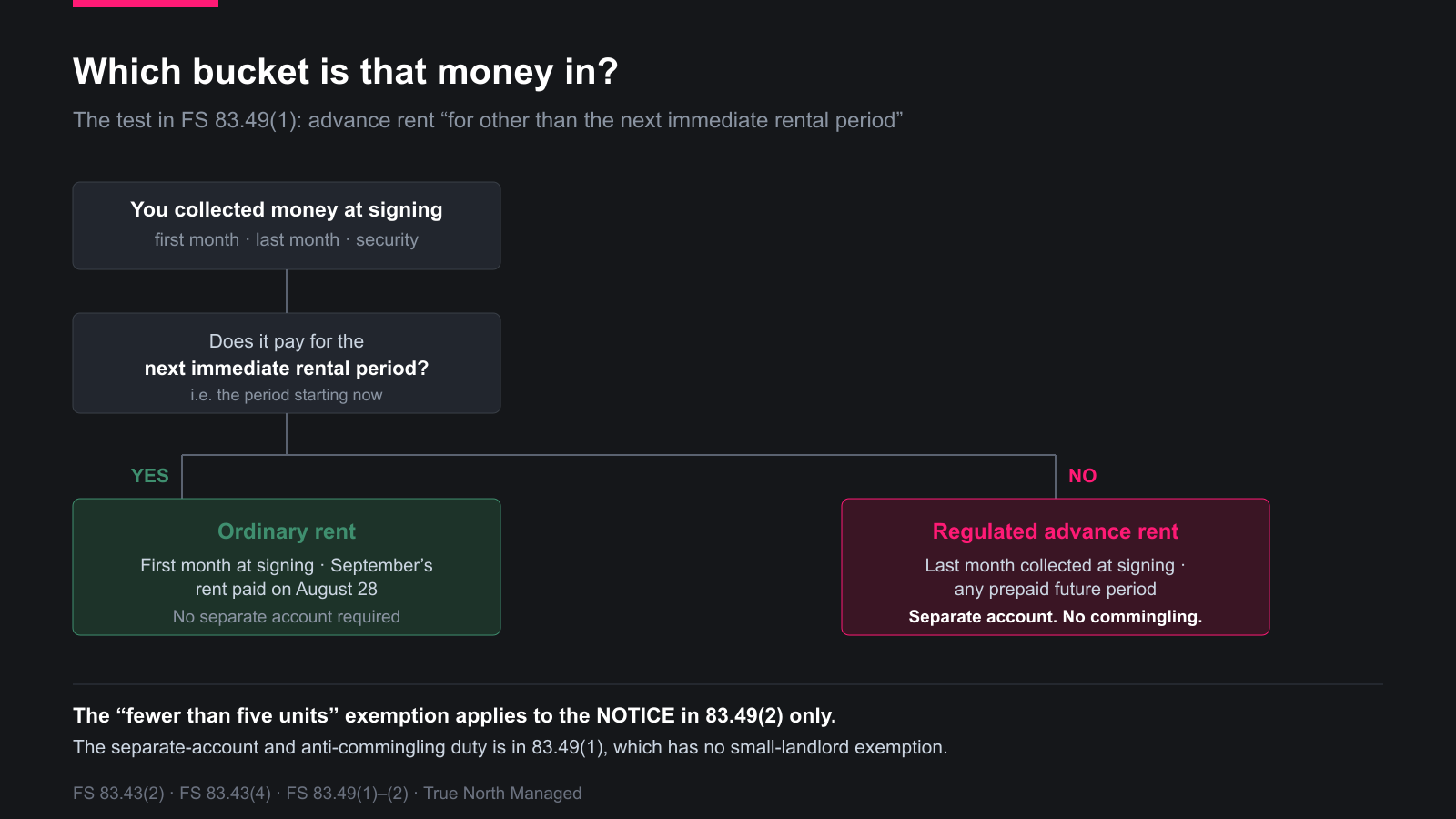
One clause decides it, and it's worth reading slowly.
FS 83.43(2) defines advance rent as "moneys paid to the landlord to be applied to future rent payment periods, but does not include rent paid in advance for a current rent payment period." FS 83.49(1) narrows it further: the section is triggered by advance rent "for other than the next immediate rental period."
Put those together and you get a clean test:
| Money you took | Is it regulated advance rent? | Why |
|---|---|---|
| Last month's rent, collected at lease signing | Yes | It's for a future period, not the next immediate one |
| September's rent, paid on August 28 | No | That's the next immediate rental period |
| First month's rent at signing, tenancy starts that month | No | Current period |
| Six months of rent prepaid at signing | Yes, for everything past the first period | Same clause, more of it |
Same dollars, opposite treatment, and the difference is which period the money buys. A tenant who pays early is paying rent. A tenant who hands you the final month at signing has given you something you must hold.
How must a Florida landlord hold advance rent?
Exactly three ways, and your own checking account isn't one of them.
Under FS 83.49(1) you must do one of the following with the total of the deposit and the advance rent:
- A separate non-interest-bearing account at a Florida financial institution, held for the tenant's benefit.
- A separate interest-bearing account at a Florida financial institution, with the tenant receiving at least 75% of the annualized average rate on the account, or 5% simple interest — your choice.
- A surety bond filed with the clerk of the circuit court, in the amount you hold or $50,000, whichever is less, plus 5% simple interest to the tenant.
Whichever you pick, the statute's next sentence is the one that bites: "The landlord shall not commingle such moneys with any other funds of the landlord or hypothecate, pledge, or in any other way make use of such moneys until such moneys are actually due the landlord."
"Until such moneys are actually due" is the operative phrase. Last month's rent becomes yours in the last month. Not before. Spending it in month three is using money that isn't yours yet, and no amount of intending to have it available later changes that.
Does the "fewer than five units" exemption cover me?
This is the one that costs people.
There is a small-landlord exemption in FS 83.49. It sits inside subsection (2), and its own words are: "This subsection does not apply to any landlord who rents fewer than five individual dwelling units."
This subsection. Subsection (2) is the written notice — the disclosure telling your tenant which bank holds the money and whether it earns interest. If you rent fewer than five units, you're excused from sending that notice.
You are not excused from subsection (1). The separate-account requirement and the anti-commingling rule are in (1), and (1) contains no small-landlord exemption of any kind.
So the owner with one rental house who read "under five units, doesn't apply to me" and dropped last month's rent into their personal account has managed to comply with the part they were exempt from and breach the part they weren't. It's a genuinely easy mistake — the exemption is real, it's just three sentences narrower than it reads at a glance.
What has to be in the written notice, if it applies to you?
If you rent five or more units, FS 83.49(2) requires written notice in the lease agreement itself, or within 30 days of receiving the money. The lease option is the easier path for the initial disclosure — though if you later change where or how you hold the money, you still owe the tenant notice within 30 days of that change.
The statute lists four things that notice must do, and the two most often missed are the first and the last. It must be given in person, or delivered by mail or e-mail in accordance with FS 83.505 — and e-mail is not simply available because you have the tenant's address. That section requires both parties to sign an addendum to the lease, in substantially the form the statute sets out, each electing e-mail and giving an address, with a conspicuous notice that the election is voluntary and revocable. It must name the depository and its address, or say you've posted a surety bond. It must state whether the tenant earns interest. And it must contain a specific block of disclosure language that the statute writes for you, beginning "YOUR RENTAL AGREEMENT REQUIRES PAYMENT OF CERTAIN DEPOSITS" and running through the tenant's 15-day objection window and the attorney-fee rule.
That last one is where most homemade notices fail. It is not a summary you can paraphrase — subsection (2)(d) sets out the text, in capitals, and a notice without it is not the notice the statute asked for. Copy it from the statute rather than from a template you found, and re-read it whenever you change your lease.
One carve-out worth knowing: you don't need to send a fresh notice just because your bank merged, changed its name, or was acquired.
One trap: under FS 83.49(6), a lease renewal counts as a new rental agreement, and a deposit carried forward counts as a new deposit. If the notice applies to you, a renewal is a fresh trigger — fold it into whatever checklist you already run at lease renewal time, because it's the kind of obligation that quietly lapses on the third or fourth renewal with the same tenant.
Does the fee-in-lieu-of-deposit option change any of this?
Not for advance rent. That's a gap you want to see before you rely on it.
Florida's FS 83.491 lets a landlord offer a tenant a recurring fee in lieu of a security deposit — no lump sum held, an insurer behind it instead. It's a real option and we cover how it works in our guide to security deposit alternatives.
Read the section's first line, though: the option exists "if a rental agreement requires a security deposit." The word "advance rent" does not appear anywhere in FS 83.491. The fee replaces the deposit. It does nothing to the other bucket.
So the landlord who moves to a fee program, stops holding a deposit entirely, closes the escrow account as no longer needed — and still collects last month's rent at signing — is holding regulated advance rent with nowhere compliant to put it. The program that was supposed to simplify things has removed the account the statute still requires. If you're running a fee program and taking last month up front, you need the separate account anyway.
What happens if you get it wrong?
Not what you may have read. Florida does not award triple damages for mishandled deposit money, and if a source tells you otherwise, check the statute. Here's what the law actually does.
Start with the deadline most owners get slightly wrong. Under FS 83.49(3)(a), if you are not claiming anything, the deposit goes back within 15 days after the termination of the rental agreement. If you are claiming, you have 30 days after termination to send written notice of that claim — by certified mail to the tenant's last known address, or by e-mail under FS 83.505. Note the trigger in both: termination of the rental agreement. Usually that lands with the tenant handing back the keys at the end of the term, and the two dates are the same. On an early abandonment or a holdover they can come apart, and exactly when the agreement terminated becomes a fact question rather than a date you can read off a calendar. If you're in that situation, pin down the termination date before you start counting — both clocks run from it.
Miss the 30-day notice and you "forfeit the right to impose a claim upon the security deposit and may not seek a setoff against the deposit." You have to return the money. You can still sue separately for damages — but you've given up the leverage of holding the funds — which, in practice, is most of what you had.
One narrow relief, and read the whole of it. Unless your written lease says otherwise, FS 83.49(5) requires a tenant who vacates or abandons — before the term ends, or out of a week-to-week, month-to-month, quarter-to-quarter or year-to-year tenancy — to give at least 7 days' written notice with an address where they can be reached. If they don't, that failure "relieves the landlord of the notice requirement of paragraph (3)(a)" — and there the relief stops. The same sentence continues: it "does not waive any right the tenant may have to the security deposit or any part of it." So a tenant who disappears without notice may cost you the obligation to send the claim letter; they do not thereby forfeit the money. Treat it as relief from a deadline, never as permission to keep a deposit.
Then the tenant has 15 days to object. If they don't, you deduct and send the balance within 30 days of your notice date. And under (3)(c), if either side goes to court over the deposit, the prevailing party gets costs and attorney fees. On a disputed month's rent, the fees can exceed the money.
Worth being exact about scope: subsection (3) opens by letting you move advance rent to your own account "when the advance rental period commences and without notice to the tenant," and then says "For all other deposits:" before (a) through (d). The claim-notice machinery above is the security deposit's. Advance rent becomes yours when its period starts — the discipline it demands is the separate account until then, not a claim letter after.
If you hold a license under FS 509.241, subsection (8) adds fines, suspension, or revocation by the Division of Hotels and Restaurants on top.
Our Florida security deposit guide walks the deduction mechanics and the claim letter in detail — this guide stops at which bucket the money sits in and how you're required to hold it. The 30-day clock is also the reason a documented move-out inspection matters more than most owners think: the deadline runs whether or not you've finished working out what you're claiming.
Setting it up properly takes about an hour
The compliance version of this is unglamorous and mostly one-time.
Open one separate account at a Florida institution and use it for nothing else. Non-interest-bearing is the simplest choice and it's fully compliant — the interest-bearing option only makes sense if you want the tenant earning 75% of the annualized average rate or 5% simple — and note that under subsection (9), wherever interest is owed — the interest-bearing account or the surety-bond option, which carries its own 5% — you must pay it to the tenant directly or credit it against rent at least once a year, and the surety bond mainly suits portfolios large enough to justify the filing.
Then fix the lease. Put the FS 83.49(2) disclosure in the lease itself rather than mailing it separately, name the depository, and state whether the money earns interest. If you rent fewer than five units you're exempt from that notice — but putting it in anyway costs you a paragraph and removes the question entirely if you ever cross five units.
Last, label the ledger. Write down which of the three amounts is last month's rent. Then don't touch it until the last month arrives. Most of the trouble in this section of the statute isn't landlords deciding to spend money that isn't theirs. It's landlords who genuinely never registered that one of the three deposits they took was different from the others.
What if you sell the property while holding advance rent?
The money goes with the property. So does the paperwork — and that's the part people skip.
FS 83.49(7) requires that all security deposits and advance rents held for tenants transfer to the new owner or agent, with any earned interest and an accurate accounting showing the amounts credited to each tenant account. Once you've transferred the funds and records and received a written receipt, you're released from the subsection (1) holding obligation.
Read the presumption carefully on the buy side, because it points at you. The statute presumes that a new owner or agent received the deposits from the previous owner — meaning you are presumed to be holding the tenant's money and answerable for it — though that presumption is capped at one month's rent. It is rebuttable, but the burden lands on you. If the seller was holding first, last and security and transferred none of it, you can still be on the hook up to that cap. Verify the transfer and get the written accounting at closing rather than assuming it happened.
The practical version
If you take first, last and security, you're holding two regulated amounts, not one.
- Last month's rent collected at signing is advance rent and lives under FS 83.49 with the deposit. Rent paid early for the next period is not.
- Put both in a separate account — non-interest-bearing, interest-bearing, or bonded. Don't commingle, and don't spend advance rent before the period it pays for.
- The under-five-units exemption covers the notice only. The separate-account rule applies whatever your size. (Subsection (4) does carve out transient hotel and motel rentals and units whose rent or deposit is set by a public program — Section 8 among them — but that is a different exemption from the one about counting your doors.)
- If the notice does apply, put it in the lease — that handles the initial disclosure, and it must carry all four elements, including the capitalized block subsection (2)(d) writes for you. Changing where you hold the money starts a fresh 30-day clock.
- Return it within 15 days if you're claiming nothing; send the claim notice within 30 — both run from termination of the rental agreement. Missing the 30-day notice forfeits the claim, and the loser of a deposit lawsuit pays the winner's attorney fees.
None of this requires a lawyer to set up. It requires one more bank account and knowing which of the three amounts on your ledger isn't yours yet.
Want someone to hold it properly and send the notices on time? We manage rentals across Orlando and Tampa and the trust accounting is part of the job.