
Late Rent Every Month: When "Always Pays Eventually" Isn't Good Enough
Pattern of late payment, enforcement options, cash flow impact. When accepting late rent waives your rights. Non-renewal vs. eviction.

They always pay. Just never on time. The 1st becomes the 5th, then the 10th, then the 15th. You need that rent for the mortgage. A pattern of late payment isn't just annoying; it's a cash flow problem and a signal. Here's what Florida landlords can do.
The 3-Day Notice: Your Tool Each Time
Florida Statute 83.56 requires a 3-day notice to pay or vacate each time rent is late.You can't skip it or assume the tenant knows. Orlando and Tampa tenants who pay late repeatedly need the same notice every time -- or you waive your rights.
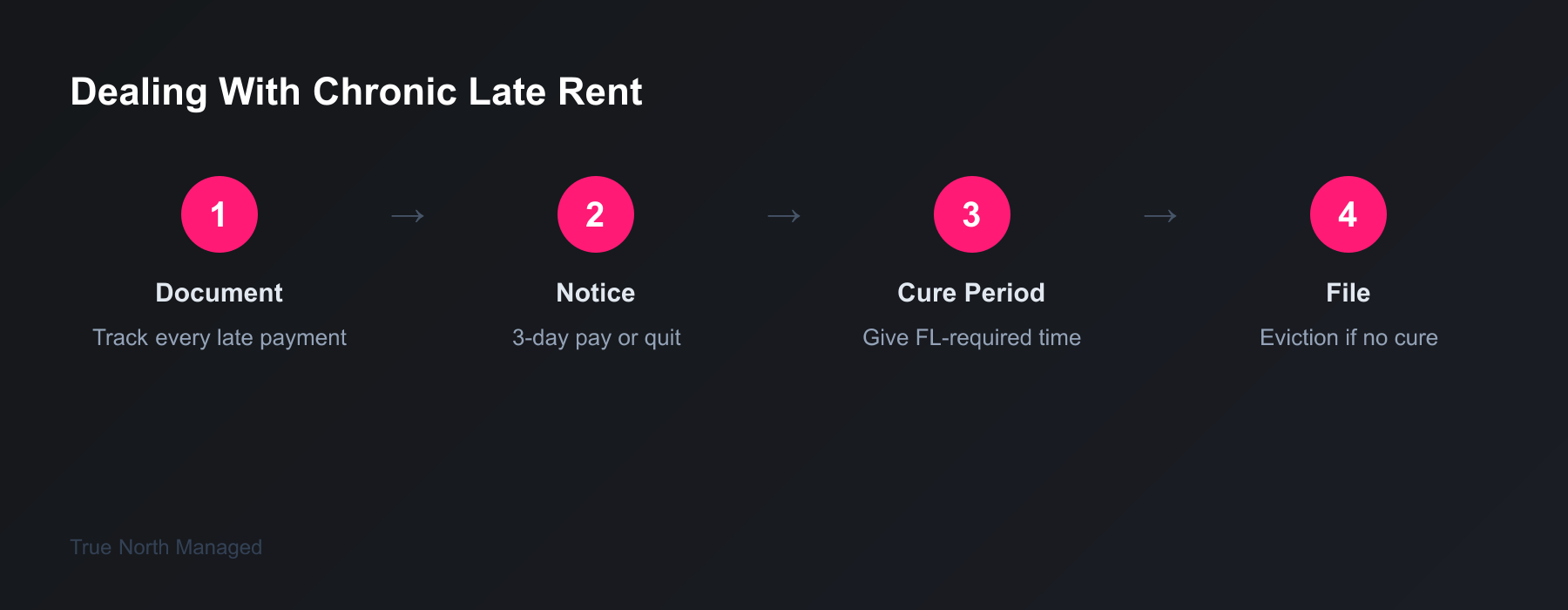
UnderFlorida Statute 83.56, when rent is late you serve a 3-day notice to pay or vacate. The weekend exclusion isn't a matter of interpretation. It's in the statute: "If the tenant fails to pay rent when due and the default continues for 3 days, excluding Saturday, Sunday, and legal holidays, after delivery of written demand by the landlord for payment of the rent or possession of the premises, the landlord may terminate the rental agreement. Legal holidays for the purpose of this section shall be court-observed holidays only." So the tenant's three days start when the notice is delivered and skip weekends and court holidays. If they pay, the tenancy continues. If they don't, you can file for eviction. Serve the notice every time rent is late. Don't skip it because "they always pay eventually." The notice protects your rights and documents the pattern.
When Accepting Late Rent Waives Your Rights
Accepting late rent without a 3-day notice can waive your right to evict for that month.Florida courts interpret this strictly. Partial rent works differently. FS 83.56(5)(a): "However, a landlord does not waive the right to terminate the rental agreement or to bring a civil action for that noncompliance by accepting partial rent for the period. If partial rent is accepted after posting the notice for nonpayment, the landlord must: 1. Provide the tenant with a receipt stating the date and amount received and the agreed-upon date and balance of rent due before filing an action for possession; 2. Place the amount of partial rent accepted from the tenant in the registry of the court upon filing the action for possession; or 3. Post a new 3-day notice reflecting the new amount due." If you take part of the rent after serving the notice, the statute requires one of those three steps.
If you accept rent after the 3-day period expires but before you file for eviction, you may have waived your right to evict for that month. Florida courts can find that accepting late payment reinstates the tenancy. The clean approach: serve the notice, and if they don't pay within the three days, file. Don't accept late payment once the notice period has passed unless -- you're explicitly reinstating with a written agreement.
Cash Flow Impact
Chronic late rent hits cash flow and increases eviction risk.One late payment is manageable; a pattern is a problem. Document everything and decide: work with them or non-renew.
Chronic late payers disrupt your ability to pay the mortgage, insurance, and maintenance. One late tenant can force you to float costs. Track the pattern. If they're late six months in a row, that's a business decision: is this tenant worth the stress? Ourrent collection guidecovers systems that reduce late payments; sometimes the best fix is a different tenant.
Lease Non-Renewal vs. Eviction
Lease non-renewal is often cleaner than eviction when the tenant pays eventually.You're not waiving rent -- you're choosing not to renew. Florida allows non-renewal at end of term with proper notice; for month-to-month, Florida Statute 83.57(3) requires "not less than 30 days' notice prior to the end of any monthly period". Serve it mid-month and the tenancy runs to the end of the next monthly period, not 30 days from the day you serve it.
You don't have to evict to end the relationship. At lease end, give proper notice of non-renewal. Florida requires 30 days for month-to-month; check your lease for term leases. You're not required to renew. If the tenant has been chronically late, non-renewal is often cleaner than eviction. No court, no sheriff. Just a move-out date. See ourlease renewal strategy guidefor when to renew and when to let go.
Documentation
Document every late payment, payment plan, and notice.Dates, amounts, and what you did. If you end up in eviction court, your documentation is your defense.
Keep a log: due date, paid date, notice served, outcome. If you ever need to evict or defend a security deposit deduction, that record matters. Our48-hour action plan for non-paymentcovers the immediate steps; for chronic late payers, the same notice process applies each month.
Chronic late rent is a choice. Enforce consistently or accept the pattern. If you're in Orlando or Tampa and want help with rent collection and tenant quality,get a free rental analysisand we can discuss how professional management handles this.
The 3-Day Notice Pattern
The 3-day notice pattern: issue it every time rent is late.Don't skip it because "they always pay." Florida courts require it. One missed notice can cost you the eviction.
Each late payment requires a 3-day pay-or-vacate notice underFL 83.56before you can file for eviction. There's no shortcut for chronic late payers. Document every instance: the date rent was due, when it was paid, and whether you had to send a notice. A pattern of late payments with repeated notices strengthens your case if you eventually terminate the tenancy.
Pattern Documentation
Pattern documentation: log each late payment, notice sent, and outcome.After 3-4 late payments, you have a clear record for non-renewal or eviction.
Keep a log: due date, payment date, notice sent (yes/no), and amount paid. If you accept partial payments, document that too. Partial payment can reset the 3-day clock depending on how you handle it. Consistency matters. If you eventually move to non-renewal or eviction, this record supports your decision. See ourrent collection guidefor systems that reduce late payments.
When to Terminate
Terminate when the pattern is clear and you've documented it.Either non-renew at lease end or proceed with eviction if they're in breach. Florida doesn't reward landlords who delay.
If late payments continue despite notices and conversations, you can non-renew at the end of the lease term. Consult an attorney before terminating. Ourtenant not paying rent guidecovers the eviction process. For late fee rules, seelate fees for Florida landlords.