

Florida HOA Rental Restrictions: Can You Still Rent?
Already own a home in a Florida HOA? See when a newer rental rule can bind you, which limits reach existing owners, and what to verify before leasing.

You already own the house. Now you're ready to rent it, and a set of Florida HOA rental restrictions shows up that you haven't seen before: rental cap, minimum lease term, tenant approval required. Does that rule apply to you?
Sometimes. Under Florida Statute 720.306(1)(h), a governing document or amendment enacted after July 1, 2021 that prohibits or regulates rental agreements generally applies to owners who took title after it became effective and owners who consented to it. But the statute has exact exceptions, and small associations follow a separate rule. Grandfathering follows the owner and the amendment date. It isn't a permanent exemption attached to the house.
This guide is for people who already own the property. If you're still deciding whether to buy, assume a restriction already in effect may bind you and verify it before your contingency expires or you close.
Before you advertise or sign a lease
- Collect the recorded governing documents and current rental materials. Compare your acquisition date, the amendment's effective date, and any consent record.
- Ask the association to confirm in writing whether the property is eligible to rent and whether a cap slot is available or must be reserved.
- Get the current application, required charge and cited authority, approval criteria, lease addendum, renewal rules, and submission steps.
- Finish your own tenant screening separately. Don't release keys or possession before any required written association approval.
Can Florida HOA rental restrictions stop you from renting your house?
An HOA may be able to stop or limit a rental when the restriction already bound the property, the owner consented to a later amendment, or a statutory exception applies. For many post-July 1, 2021 amendments, the first questions are when you took title, when the restriction became effective, and whether you consented.
That isn't the same as saying every existing owner is exempt. You need the actual text, its adoption record, the association type, and the timing. If any of those facts are disputed, treat your eligibility as unresolved until a Florida community-association attorney reviews it.
Start with the recorded declaration and amendments from the official records office for the county where the home sits. Then collect the articles, bylaws, current rules, rental application, fee or charge documentation, and any required lease rider from the association. The recorded documents establish the legal text and dates; the operating materials tell you how the association currently processes a rental.
Can an HOA change rental rules after you buy?
Yes, an HOA can amend its governing documents after you buy. Whether a new rental amendment binds you is a separate question. For a post-July 1, 2021 amendment, Florida law generally looks at your title date, the amendment's effective date, and whether you consented individually or through a representative—subject to the statute's exceptions.
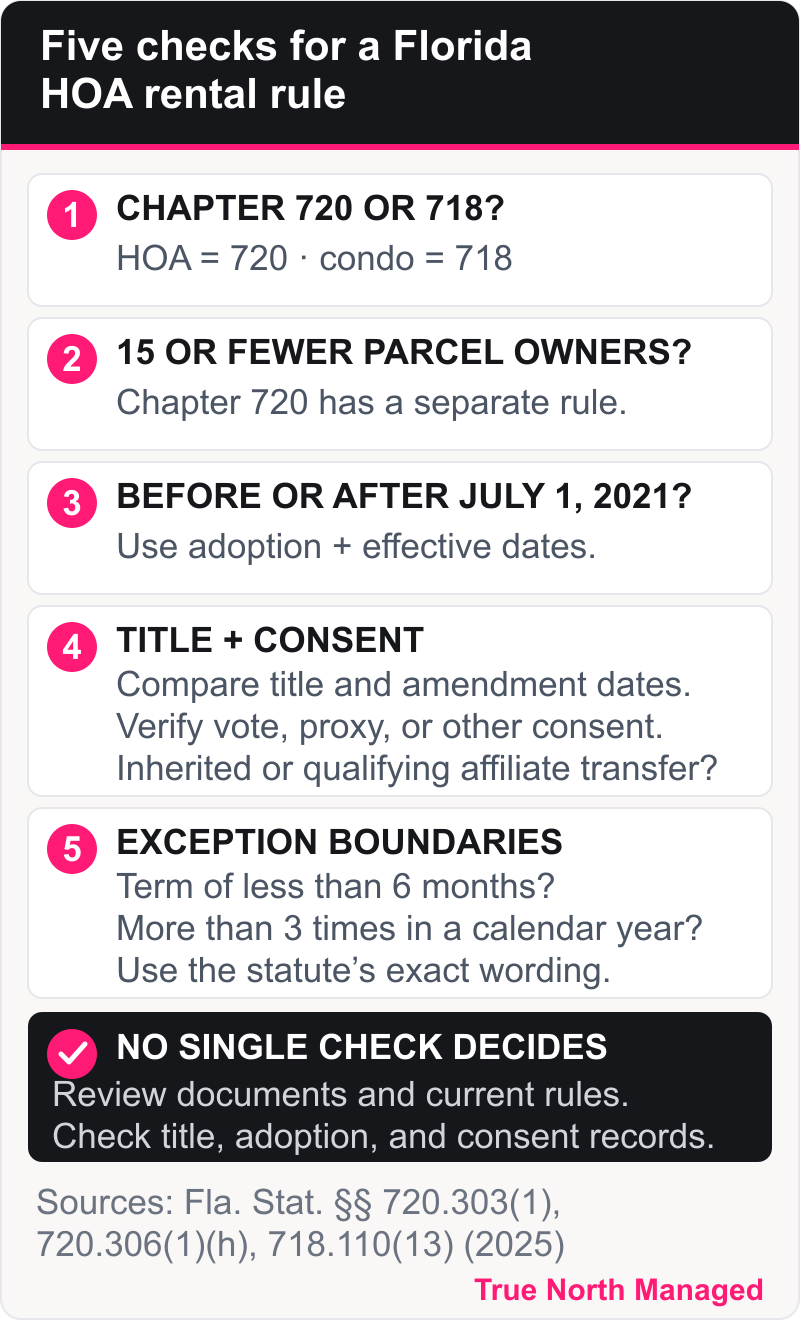
Keep the word consent intact. The statute doesn't reduce that question to “Did you vote yes?” Review the association's vote, proxy, and consent records instead of assuming silence or nonattendance answers it.
Inheritance also matters. Section 720.306(1)(h) says a change of ownership does not occur when an heir becomes the parcel owner. A qualifying transfer to an affiliated entity may also avoid a change of ownership when beneficial ownership stays the same, but the entity must certify the relationship and provide supporting organizational documents if requested.
Small-association exception: Section 720.306 preserves the separate rule in Florida Statute 720.303(1). An association of 15 or fewer parcel owners may enforce only deed restrictions established before the affected owner purchased. Confirm the number of parcel owners from the association's records; don't substitute the number of lots or homes.
| Check | What to verify | Why it matters |
|---|---|---|
| Association type | HOA under Chapter 720 or condo under Chapter 718 | The statutes do not use the same rental-amendment rule |
| Association size | Whether the HOA has 15 or fewer parcel owners | Small associations have a separate deed-restriction rule |
| Amendment timing | Enacted after July 1, 2021 and effective date | The Chapter 720 grandfather provision is date-specific |
| Owner timing and consent | Title date plus vote, proxy, or other consent record | The amendment may attach through later title or consent |
| Exact restriction | Lease term, frequency, cap, waiting period, or approval | The less-than-six-month and frequency exceptions need separate analysis |
Which short-term and frequency limits can apply to every owner?
A Florida HOA may amend its governing documents to regulate rental agreements for a term of less than six months and may prohibit renting a parcel more than three times in a calendar year. Those amendments can apply to all parcel owners under Section 720.306(1)(h), apart from the separate small-association rule.
The boundaries matter. “Less than six months” does not mean “six months or less.” And “more than three times” does not create a statewide rule limiting every owner to fewer than three rentals. Florida isn't imposing either restriction by default; the statute allows an association to adopt those amendments and apply them broadly.
A city or county short-term-rental permit answers a public-law question. It doesn't erase a private association restriction. If you plan stays shorter than six months, check both layers. Our guide to Florida short-term rental laws for property owners covers the government side.
How do rental caps and HOA approval for renters work in Florida?
Rental eligibility, cap availability, and tenant approval are three different decisions. An owner may have the right to rent but no current cap slot. A cap slot may exist while the tenant application is still incomplete. And association approval never replaces the landlord's own lawful screening or lease process.
A percentage cap added through a post-July 1, 2021 governing-document amendment is analyzed under the same title-date and consent framework, but the statute doesn't name every possible cap or decide your documents for you. Ask the association to cite the controlling provision, its adoption date, and the current cap calculation.
Then request the operating details:
- The current rental application and submission instructions
- Any charge, the document authorizing it, and when it is due
- Approval criteria and who has authority to decide
- Whether a cap slot must be reserved and how long it stays open
- The required lease addendum, tenant acknowledgment, renewal, and reapplication rules
- The expected date for a written decision
Do not rely on “rentals are allowed” in a phone call. Get the association's current position in writing and compare it with the recorded documents. That response is useful evidence, not a legal safe harbor if the documents say something else.
Run our Florida tenant screening process separately. Association approval does not shift responsibility for the tenant's pets, parking, guests, amenity use, or other violations away from the owner. Give the tenant the applicable rules before signing, collect any required acknowledgment, and keep the final approval with the lease.
How are Florida condo rental restrictions different?
Florida condos use Chapter 718, not Chapter 720. Under Florida Statute 718.110(13), an amendment that prohibits rentals, changes the rental term, or limits rental frequency applies only to owners who consent and owners who take title after the amendment becomes effective.
That condo provision does not contain Chapter 720's carve-out for terms under six months or more than three rentals per calendar year. But don't stretch one subsection into a blanket answer about every condo application, rule, or enforcement question. Identify the legal structure first, then review the declaration and the exact restriction.
If the property is a condo, our guide to Florida condo and association risks covers the broader ownership issues without mixing the two statutes.
Your pre-listing HOA file
Build a dated evidence file before the listing goes live. It should show which restriction controls, what the association currently requires, what was submitted, and who issued the decision. This matters even more when you manage the property from outside Florida and cannot inspect an association office in person.
| Keep this | Get it from | What it proves |
|---|---|---|
| Recorded declaration, amendments, articles, and bylaws | County official records and association | Governing text and effective dates |
| Current rules, forms, charge documentation, criteria, rider, and renewal process | Association portal or management | Current operating process |
| Deed, title date, and consent records | Owner files, county records, and association | Timing and consent facts |
| Written eligibility position and cap or waitlist status | Association or authorized manager | The association's current position |
| Submission receipt and written tenant decision | Association or authorized manager | What was submitted, when, and the result |
| Signed lease, HOA addendum, and tenant acknowledgments | Owner or property manager | The continuing compliance file |
Your Florida lease agreement for landlords should address the tenant's duty to follow applicable association rules and the documents they received. Have Florida counsel review any clause that makes the lease contingent on association approval or allocates costs after a violation.
If you own remotely, verify that the association has your current mailing address, email, and portal account. Put one person in charge of monitoring and forwarding notices about rule changes, amendments, hearings, renewals, and reapplications. “I never saw the portal message” is a poor place to start a dispute.
A written request you can send
Please identify the current provision governing rentals for my property, including its adoption and effective dates; any vote, proxy, or consent record attributed to me; the property's current rental eligibility; cap or waitlist status and any reservation requirement; the current application, required charge and authority, approval criteria, lease addendum, renewal requirements, submission steps, decision-maker, and expected date of written decision.
Save the response, but compare it with the recorded instruments. If the association's answer conflicts with those documents, pause the listing and ask a Florida community-association attorney to review the file.
Penalties for violating an enforceable restriction
Under Florida Statute 720.305, an association or member may bring an action at law or in equity over noncompliance. The statute also permits reasonable fines and suspensions, but it sets specific notice, hearing, committee, amount, and cure rules that matter.
Unless the governing documents provide otherwise, a fine may not exceed $100 per violation or $1,000 in the aggregate. A fine of less than $1,000 may not become a lien. That does not mean a fine of exactly $1,000 automatically becomes one.
Before a fine or suspension is imposed, the owner has a right to at least 14 days' written notice and a hearing. The notice must describe the alleged violation and the action required to cure it when applicable. A committee must confirm the proposed fine or suspension, and a cured violation cannot be fined under the procedure described in the statute.
An association may also ask a court to enforce the restriction, and the prevailing side may recover attorney fees. Section 720.305 does not make lease termination automatic; the available remedy turns on the governing documents, the violation, and any court order.
What can you do if the HOA says you cannot rent?
Ask the association to put its position in writing and cite the exact provision, adoption date, effective date, and consent record it relies on. Compare those facts with your deed and the current statute. If the answer still conflicts with the recorded documents, get legal advice before you create a tenant problem on top of an HOA dispute.
Do not try to “get around” a valid restriction by changing the listing language, using serial short leases, hiding an occupant, or calling rent something else. That creates more evidence against you without changing the governing documents.
A property manager can gather the file, track the application, preserve receipts, and coordinate the lease-up around the association's written process. A manager should be able to show you the cited provision and final decision rather than merely say the property is fine to rent. Questions about amendment validity, consent, grandfathering, or a disputed denial belong with a Florida community-association attorney.
Frequently Asked Questions
These answers are general information, not a legal opinion about a specific declaration, amendment, vote, transfer, or denial. When the association's position and the recorded documents conflict, have Florida counsel review the file before you advertise the home or commit to a tenant.
Can an HOA change rental rules after I buy in Florida?
Yes. The association may amend its governing documents, but a post-July 1, 2021 rental amendment generally applies to owners who take title after it becomes effective and owners who consent, subject to the exact statutory exceptions. Compare your title date, amendment date, consent record, association size, and restriction before relying on grandfathering.
If I inherited a house in a Florida HOA, did ownership change?
For the rental-amendment rule in Section 720.306(1)(h), a change of ownership does not occur when an heir becomes the parcel owner. That does not decide every document or restriction. Keep the probate and title records, confirm the association's position, and get counsel if it treats the inheritance as a triggering transfer.
Can a Florida HOA limit how many homes are rented?
An HOA may adopt a percentage cap through its governing documents. A cap added by a post-July 1, 2021 amendment is analyzed under the title-date and consent framework, but the statute does not decide your particular cap. Verify the amendment, current calculation, waitlist, slot-reservation process, and the property's eligibility in writing.
Does a six-month minimum lease apply to every existing HOA owner?
Section 720.306(1)(h) allows an HOA amendment regulating rental agreements for a term of less than six months to apply to all parcel owners, apart from the small-association rule. A six-month term sits on the boundary, so read the amendment's exact words rather than paraphrasing it as “six months or less.”
Can an HOA limit rentals to three times per year?
The statute allows a governing-document amendment that prohibits renting a parcel more than three times in a calendar year to apply to all parcel owners, apart from the separate small-association rule. It does not itself impose a statewide three-rental limit; the association must have adopted the restriction.
Do I need HOA approval for every new tenant?
Only when the governing documents or enforceable rules require it. Get the current application and written process directly from the association, including the charge and its authority, required addendum, criteria, submission instructions, renewal rules, and decision-maker. Keep association approval separate from your own consistent, fair-housing-compliant tenant screening.
Can an HOA fine me for an unauthorized rental?
An HOA may levy reasonable fines for violations under Section 720.305, subject to the governing documents and statutory procedure. Default limits are $100 per violation and $1,000 aggregate unless the documents provide otherwise. At least 14 days' written notice, a hearing opportunity, committee confirmation, and the cure rules also apply.
Once your eligibility is clear, True North Managed can help an Orlando or Tampa owner coordinate the association application with listing, screening, lease, and move-in. We manage single properties too. You can request a free rental analysis, or use the Owner's Guide for Florida landlords to plan the rest of the lease-up.