
Tampa Section 8 Housing: What Hillsborough County Landlords Should Know
The Tampa Housing Authority process, Hillsborough payment standards, HQS inspections, Section 8 vs VASH, and the pros and cons for Tampa landlords.

Section 8 — the federal Housing Choice Voucher program — is administered for the Tampa area by the Tampa Housing Authority. If you're weighing whether to accept vouchers for your Hillsborough County rental, you need to understand the process, the payment standards, and what changes once a tenant has a voucher.
It isn't the right fit for every property. But for the right landlord, Section 8 can mean stable, partly guaranteed rent and long-tenured tenants. Here's how it works in Tampa.
• Screen the applicant yourself — income, criminal history, rental history — exactly as you would any other tenant. A voucher does not waive your screening.
• Submit a Request for Tenancy Approval (RTA) with the proposed lease to the Tampa Housing Authority.
• Pass the Housing Quality Standards (HQS) inspection before move-in, and again every year.
• Sign the Housing Assistance Payments (HAP) contract before the subsidy starts.
• Set rent at or near the payment standard for the bedroom size and ZIP code — the authority must find the rent reasonable.
Do Hillsborough County landlords have to accept Section 8?
Not under state law — no Florida statute makes a landlord take a Housing Choice Voucher. The local picture is less settled. House Bill 1417 — in effect since July 1, 2023 and codified at Florida Statute 83.425 — says "[t]he regulation of residential tenancies, the landlord-tenant relationship, and all other matters covered under this part are preempted to the state." Whether a local source-of-income rule like the Hillsborough County ordinance’s still binds landlords under that language is unsettled. Federal fair-housing law applies either way; check with the county before you rely on that rule or ignore it.
What’s shifted lately isn’t the law, it’s the math. Tampa apartment vacancy hit a multi-year high entering 2026, and in a softer market a subsidy that lands on time every month looks different than it did when units leased themselves. Worth weighing your options before you decide.
How does the Tampa Housing Authority process work?
The Tampa Housing Authority (THA) runs the Housing Choice Voucher program for Tampa and the surrounding region. A tenant applies through THA and receives a voucher when they reach the top of the waitlist; the voucher specifies the bedroom size and the maximum subsidy. From there, the steps are predictable and take roughly two to four weeks.
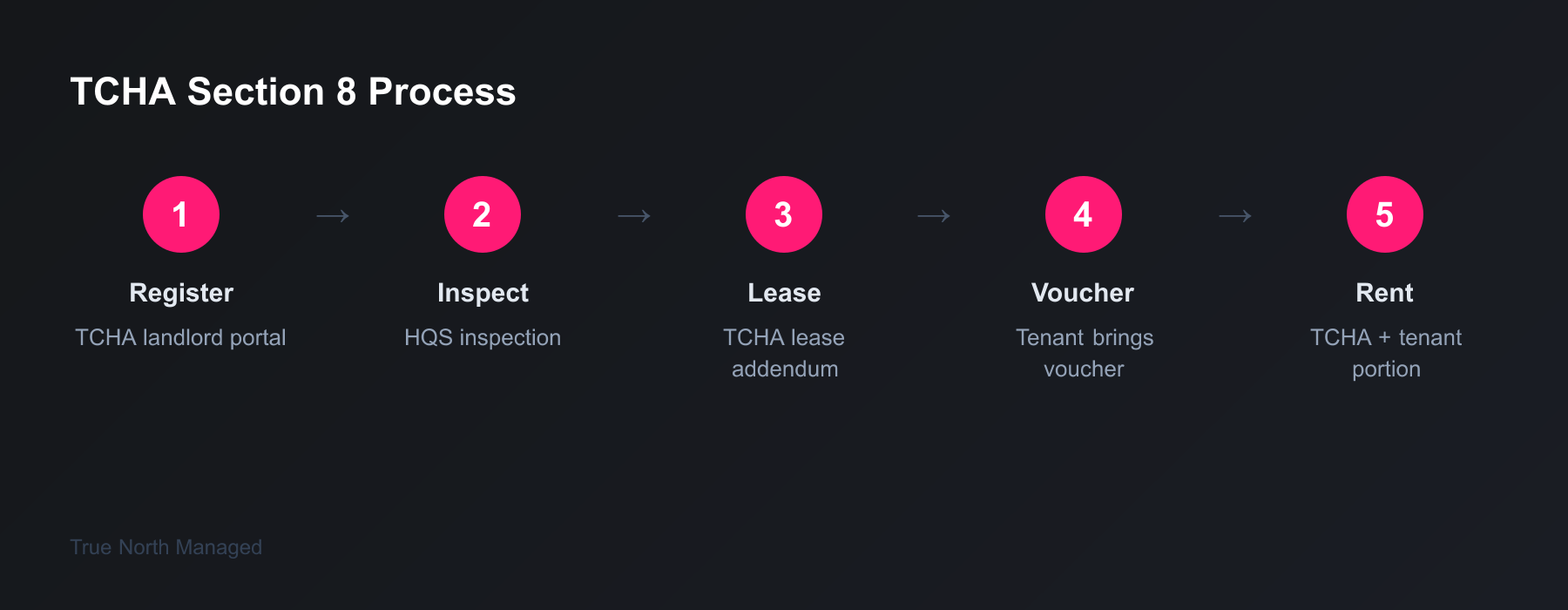
The tenant finds your unit and applies. You screen them like any other applicant, and if you approve them, you submit a Request for Tenancy Approval (RTA) to THA along with the lease. THA inspects the unit against Housing Quality Standards. Once it passes, you sign a Housing Assistance Payments (HAP) contract and you're in the program — THA pays its share of the rent directly, usually by the 5th of the month, and the tenant pays their portion. Note that the voucher waitlist itself is often closed; that affects tenants applying, not landlords listing a unit.
What are the Hillsborough County payment standards?
Payment standards set the maximum subsidy THA will pay for each bedroom size, and they're based on HUD fair market rents that vary by ZIP code. A 2-bedroom in South Tampa carries a higher standard than a 2-bedroom in Brandon, so the number you can count on depends on where the property sits.
Check HUD's fair market rent data and THA's current published payment standards before you set rent. If your rent exceeds the payment standard plus the tenant's portion — usually 30% of their income — the tenant has to cover the difference, which shrinks your applicant pool. Most landlords set rent at or slightly below the standard to keep the unit attractive to voucher holders. The authority also runs a rent reasonableness review and won't approve rent above market, so have comparable rents ready if you're pricing near the top.
Here’s how to put real numbers on it. THA pegs its payment standards to HUD’s Fair Market Rents (FMRs), and HUD says all Housing Choice Voucher programs in the Tampa–St. Petersburg–Clearwater metro "will use Small Area FMRs as defined by ZIP Codes." Under 24 CFR 982.503(c), a basic-range payment standard is "any dollar amount that is in the range from 90 percent up to 110 percent of the published FMR for a unit size." In other words, each ZIP’s standard normally sits within 10% of that ZIP’s own FMR, not the metro figure. For scale, these were the metro-wide Fair Market Rents for HUD’s FY2026 cycle:
| Unit size | Tampa metro Fair Market Rent (FY2026) |
|---|---|
| Studio | $1,593 |
| 1 bedroom | $1,696 |
| 2 bedroom | $1,977 |
| 3 bedroom | $2,527 |
| 4 bedroom | $3,077 |
Treat those as a baseline, not a quote. THA’s current payment standards took effect November 1, 2025 and are set ZIP by ZIP, so a high-cost Tampa ZIP can run above these and a cheaper one below. Pull your exact ZIP’s figure from THA’s payment-standards map before you price the unit. The practical rule: list a three-bedroom well above the standard and the tenant has to cover the gap out of pocket, which thins the pool of voucher holders who can afford it. Price near the standard and your unit moves.
Two things about that number that catch owners out. First, the payment standard is a ceiling on the subsidy, not a rent target — the Tampa Housing Authority says so in capital letters on its own payment-standards page, because contract rent still has to clear a separate rent-reasonableness test against comparable unassisted units. Pricing a unit at the payment standard because the payment standard exists is the most common Section 8 pricing mistake we see.
Second, under 24 CFR 982.505 the standard that applies is the lower of two figures: the standard for the family's voucher size, or the standard for the size of the unit they actually rent. A family holding a two-bedroom voucher who rents your one-bedroom brings the one-bedroom standard with them, not the two-bedroom one. If you are working out what a smaller unit can support, use the unit's bedroom count, not the voucher's.
One timing note for mid-2026: THA’s Housing Choice Voucher waitlist is closed to new tenant applicants, while its Project-Based Voucher list reopened in spring 2026. A closed waitlist slows the flow of brand-new voucher holders shopping for units — it doesn’t stop you from renting to someone who already holds a voucher, and plenty do.
What do HQS inspections cover?
Housing Quality Standards cover safety, habitability, and basic condition: working heat and cooling, no lead hazards, secure windows and doors, functioning plumbing and electrical. THA inspects before initial approval and then annually for as long as the tenant stays.
Inspectors are thorough — they'll flag missing outlet covers, non-working smoke detectors, and damaged windows. Fail an inspection and you get a set window to correct the problems; until you pass, the subsidy can be withheld. The practical move is to walk the unit against the HQS checklist and fix the small stuff before the inspector arrives, so a missed outlet cover doesn't delay your lease start. Our statewide Section 8 pros and cons guide covers the broader framework; Tampa follows HUD rules with local administration.
One dated change worth putting in your calendar. HUD is replacing Housing Quality Standards with NSPIRE — the National Standards for the Physical Inspection of Real Estate — and the inspection criteria are not identical. For the Housing Choice Voucher program the compliance date has now been pushed back three times; the current one is February 1, 2027. Until then HQS is what your unit is inspected against, so nothing about the checklist above changes this year. But if you are planning capital work on a voucher unit for 2027, it is worth asking THA which standard your next annual inspection will run under before you scope the job.
What is the difference between Section 8 and VASH vouchers?
VASH (Veterans Affairs Supportive Housing) vouchers serve veterans experiencing or at risk of homelessness. They run through the same landlord process as a standard Housing Choice Voucher — RTA, HQS inspection, HAP contract — but VASH vouchers usually come with VA case management attached to the tenant.
For a Tampa property near MacDill Air Force Base, VASH tenants transitioning to stable housing are a realistic part of the renter pool. The added VA support can make a VASH tenancy a strong, stable fit if you're open to renting to veterans. Our guide to renting to military tenants near MacDill covers the wider military-housing context in South Tampa.
What are the pros and cons for Tampa landlords?
Section 8's appeal is predictability: THA's portion of the rent is paid directly and usually on time, the tenant has been pre-screened for income eligibility, and voucher tenants often stay for years, which cuts your turnover. Those are real advantages in a high-turnover market.
The tradeoffs are process. HQS inspections add a yearly compliance step, rent increases need THA approval, and turning a unit can take longer when a new inspection has to clear first. You're also still responsible for collecting the tenant's portion — THA only pays its share, so a late tenant payment is yours to chase. Some landlords value the stability; others prefer the flexibility and ceiling of the private market. Know your numbers and your tolerance for the paperwork before you commit.
Is Section 8 worth it for a Tampa landlord right now?
It comes down to your vacancy risk. With Tampa apartment vacancy at a multi-year high entering 2026 and concessions creeping back into the market, a voucher tenant — the housing authority covering most of the rent, on time, every month — carries more appeal than it did two years ago. If you’re staring at a unit that won’t lease, a steady subsidized tenant can beat chasing a market-rate lease that keeps stalling.
That doesn’t erase the tradeoffs above — the inspection, the lead time, the paperwork — it just changes the weighting when vacancy is the bigger threat. For the full statewide breakdown of where the program helps and where it bites, read our guide to the pros and cons of Section 8 for Florida landlords. What’s specific to Hillsborough is the local process here, the payment standards above, and the open question over the county’s source-of-income rule.
How do you screen and onboard a Section 8 tenant?
A voucher does not replace your screening. The tenant brings the voucher and proof of income; you still verify criminal history, rental history, and their ability to pay their own portion of the rent. If you do accept a voucher tenant, your screening criteria should be the same consistent, written standards you apply to everyone.
Once you approve the applicant, submit the RTA with the lease and wait for the HQS inspection. After approval, set up direct deposit for THA's payments — they typically arrive by the 5th — and track the tenant's portion separately so a shortfall is obvious. The same Tampa tenant screening and rent increase notice rules apply to voucher tenancies.
Section 8 works in Tampa when the process fits your property and your systems. Want help deciding whether voucher tenants make sense for a specific Tampa rental — and what it could earn either way? Get a free rental analysis and we'll walk through the market and the payment standards with you.