
Winter Park Q3 2026 Pulse: The Yield Problem in 32789
Winter Park is the only Orlando ZIP we track whose home value rose meaningfully this year — up 5.6%, against rent up 4.9%. Run the division and it is the lowest rent-to-value ratio on the board. Which is good news or bad news depending entirely on whether you already own there.

Winter Park's home value rose 5.6% over the past year — the only Orlando ZIP we track that rose by anything worth mentioning. Rent went up too, 4.9%. Every headline about that calls it strength, and for one kind of owner it is. For the other kind it's a bill.
Quick answer: 32789 sits at $2,187 in rent on an $811,947 home value (both August 2026 vintage), a rent-to-value ratio near 3.2% a year against 5.8% in Avalon Park. Because value grew faster than rent, that ratio fell over the year. Buying in, underwrite the ratio. Already holding, the appreciation is yours and the ratio isn't your decision.
Why does a rising home value hurt a Winter Park buyer?
Because rent and price are a fraction, and Winter Park grew the wrong half of it faster. Rent rose 4.9% over the year; value rose 5.6%. That gap lands entirely on whoever writes the next check — the house got more expensive faster than the rent it produces.
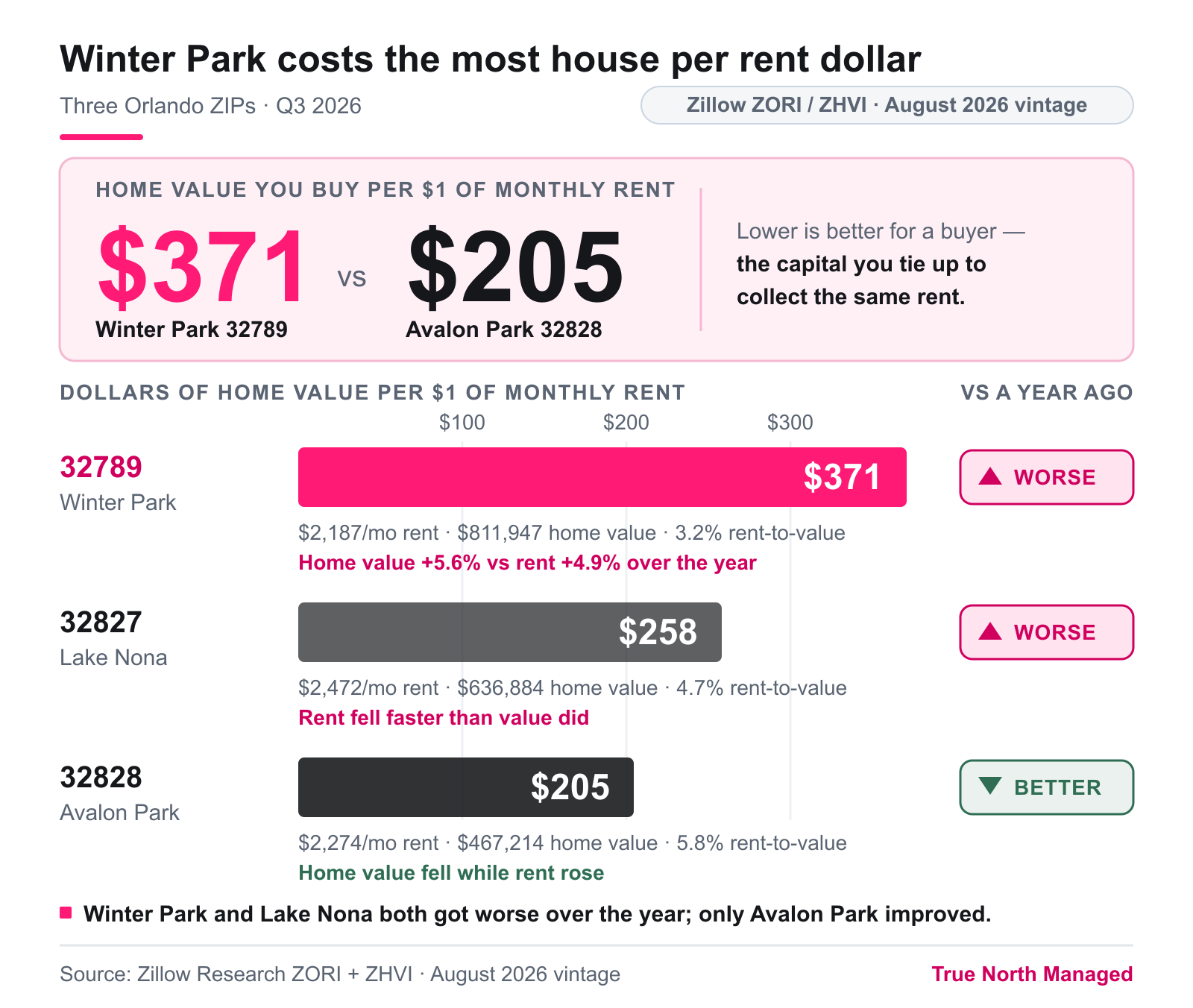
Here's the division, on August 2026 figures from Zillow Research. In 32789, $2,187 a month against $811,947 is 0.269% a month. Lake Nona (32827) runs 0.388%. Avalon Park (32828) runs 0.487% — nearly double Winter Park's, on a rent check only $87 bigger. Put it in dollars and it gets concrete: in Winter Park you buy roughly $371 of house for every dollar of monthly rent, against about $205 in Avalon Park. Collecting that same $2,187 at Avalon Park's ratio would take about $449,300 of property — around $363,000 less capital for the same $2,187.
One caution before you lean on those numbers: this isn't your yield. Zillow's rent index includes apartments that its mid-tier home-value index leaves out, so the two sides of the fraction aren't the same basket of property. And the gap between the two baskets isn't the same everywhere — it moves with how much of a ZIP's rental stock is apartments and how wide its price range runs. Treat the comparison as directional, not as a line in your pro forma. The dollars-of-house-per-rent-dollar figures above have the same caveat and the same use.
The direction is what moved over the trailing year. Avalon Park's ratio improved on the year, because its value fell while rent rose. Lake Nona's got worse — its rent fell faster than its value did. Winter Park's got worse too, and for the opposite reason: its value climbed faster than its rent. (Inside Q3 itself both the July and August prints went the other way in 32789 — rent rose faster than value — so this is a twelve-month claim, not a three-month one.) And nothing else on the board is close: run the same division across every Orlando ZIP we track and 32789's 3.2% is the lowest of them, with the next-lowest — Baldwin Park — sitting at 4.2% and Kissimmee at the far end near 7.4%. Our September Orlando market update — written on the July print — put it plainly: "Winter Park is the only one up meaningfully at +4.7% on the year (Audubon Park is technically up too, at +0.2%), and at $806,099 it's also the priciest ZIP on the board."
Call it the Holder/Buyer Split. One print, two opposite instructions. If you inherited a house near Park Avenue, appreciation is money in your column. If you're shopping 32789 this fall, that same appreciation is the toll at the gate. A "Winter Park is strong" headline serves neither of you.
What did 32789 and 32792 do in Q3 2026?
32789 rent sat at $2,187 in August, up 4.9% on the year. The ZIP next door that shares the Winter Park name, 32792, sat at $1,643 on a home value of $394,154, down 0.2%. That's a $544 monthly gap between two Winter Park mailing addresses.
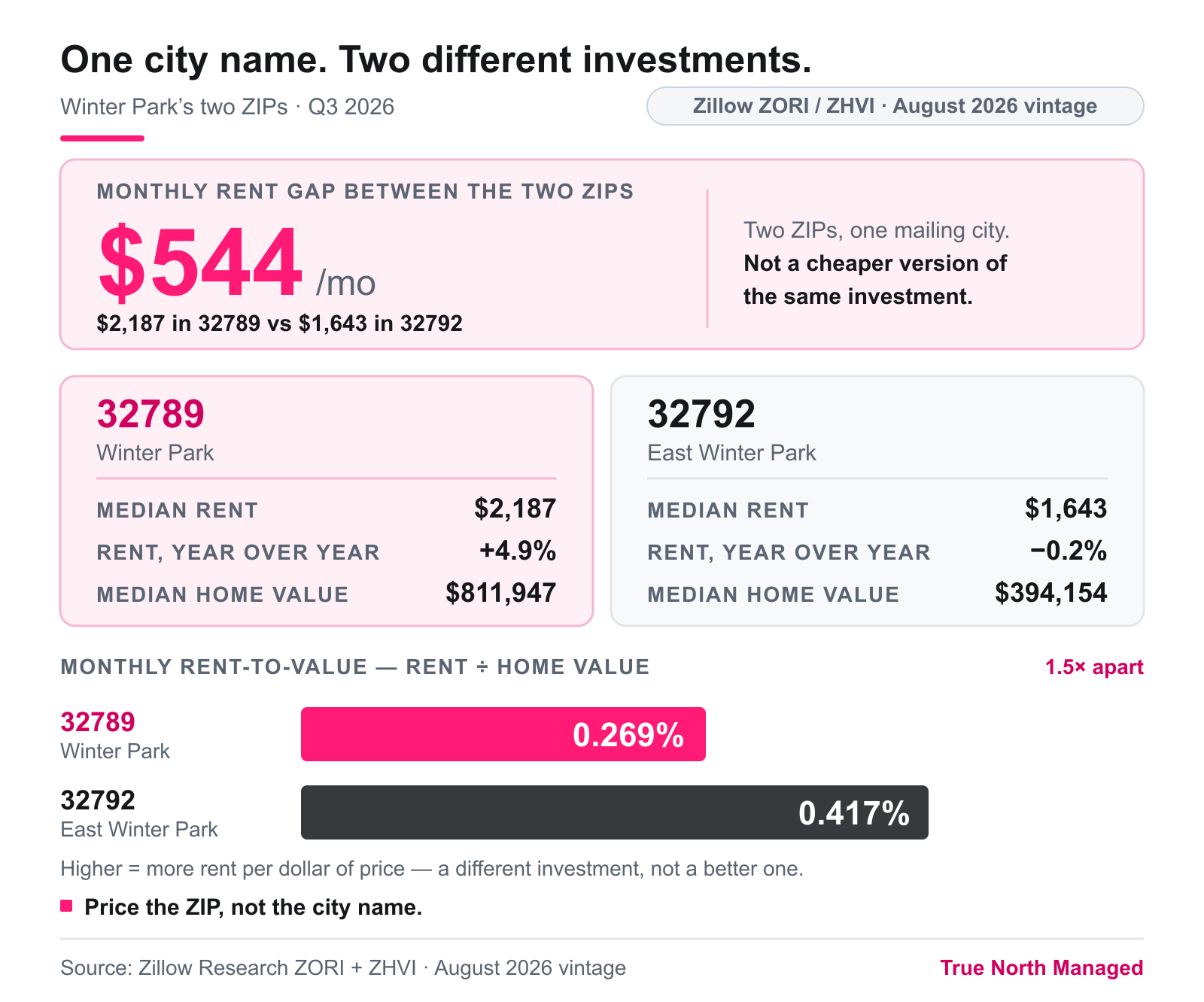
The ratios underneath that gap are what you price off: 0.269% a month in 32789 against 0.417% in 32792. One of those is a cash-flow property; the other is an appreciation bet wearing the same city name. We named this pattern in our Apopka rental market guide, where two ZIPs under one city moved opposite ways. Apopka's at least shared a ratio. Winter Park's sit 1.5 times apart, which makes the city name close to useless as a pro forma input. Price the ZIP.
On the ground, Park Avenue finally looks like a street again — the city's project page logged wall caps installed and planters delivered on September 9, on the $2.5 million CRA-funded Webster-to-Garfield stretch. The walkability that pays arrives when all three phases are through; this quarter it's a sidewalk. Borrowing costs did move. Freddie Mac's survey for the week ending September 24 put the 30-year fixed at 7.03%, above both the prior week's 6.95% and the 6.30% of a year earlier.
What does the November property tax amendment do to a Winter Park rental?
Not what you think. The exemption everyone is talking about skips you — but a second piece of the same measure doesn't, and it's the piece nobody puts in a headline. Florida voters decide CS/HJR 1-F on November 3, and it needs 60% to pass, not a majority. The resolution bundles several changes and the headlines carry one of them, so a landlord who reads only the marquee item votes on the wrong information.
Read what the exemption grants. From the Legislature's summary of CS/HJR 1-F, for "persons who maintained permanent residence as of December 31, 2026, and have established or will establish homestead":
"Beginning on January 1, 2027, up to $150,000 of the assessed value" … "Beginning on January 1, 2028, up to $250,000 of the assessed value" … applied to "non-school ad valorem levies."
— Florida Senate bill summary, CS/HJR 1-F. Every person who, "on or after January 1, 2027, has the legal or equitable title to real estate and maintains thereon the permanent residence of the owner, or another legally or naturally dependent upon the owner, who had not maintained a permanent residence in this state as of December 31, 2026" (the enrolled resolution), gets, from non-school levies and in the bill summary's words, "up to $50,000 of assessed value," and "Beginning with the fifth year of the exemption, such persons may be exempted up to the amount of the exemption available to persons who maintained homestead on or before December 31, 2026." The $250,000 and $50,000 amounts are adjusted annually for positive inflation growth; the ellipses above drop those clauses and the summary's other bullets.
Every word of that is conditioned on homestead, and a rental you don't live in gets none of it. But the same resolution does something else. In the Senate summary's own words, it "reduces the amount of annual growth that is allowed for assessments of non-homestead residential and non-residential real property from 10 percent to 5 percent." The cap bullet carries no date of its own; the resolution as a whole takes effect January 1, 2027 if voters approve it. A Winter Park rental is non-homestead residential property. That half does reach you, and our guide to the 10%-to-5% cap works through what it's worth.
What it's worth depends on your own parcel, and not in the obvious way. The ceiling governs your assessed value, and under Florida Statute 193.1554(3) a year's change "may not exceed 10 percent of the assessed value of the property for the prior year" — the prior assessed value, not whatever the market did. So the cap does most work on a parcel that has been capped for years, and it resets the moment you buy: subsection (5) puts the property "at just value as of January 1 of the year following a change of ownership or control." The reader most likely to be shopping 32789 is the one this half of the amendment does least for. Your TRIM notice carries the number it actually turns on — nothing in a rent index will tell you.
The exposure that doesn't go away is the city's budget. Spectrum News 13 reported in July that Winter Park's commission was reviewing a roughly $247 million tentative FY27 budget on a millage unchanged for nineteen years and the lowest in Orange County, with staff projecting the amendment could restrict city revenues by an estimated $76 million over ten years. Orange County publishes its own impact estimates. The same measure also restricts what counties and cities may spend ad valorem revenue on — it constrains how the money is used, and it does not stop anyone raising the rate. Nobody can tell you today what any taxing authority does about a hole that size. So read the ballot as two separate questions: an exemption your rental never sees, and a cap that may or may not be worth something depending on a number printed on your TRIM notice.
Did the fall dorm show up in the numbers?
Not in the ZIP index — and the ZIP index was never going to settle it. Last quarter we argued that Rollins' 297 East End beds, replacing an 80-bed hall for roughly 217 net, would price into the summer leases before they showed in any vacancy report. Those leases are signed now. 32789 went up.
So the claim needs a narrower boundary. Zillow's index blends houses, condos and apartments into one ZIP number, and Winter Park's is carried by single-family stock no dorm competes with. A near-campus studio giving back $60 disappears inside an average dragged around by $800,000 houses. The lead indicator shows up in the unit type that competes, not in the ZIP average — so if you own a small unit within walking distance of campus, your own comps are the test and ours aren't. Our Q2 Winter Park pulse has the argument in full.
What should a Winter Park landlord do this quarter?
- Read the November measure as a rental owner, not a homeowner. Two different things are on that ballot and only one of them is in the headlines. The $150,000/$250,000 exemption is homestead-only, so your rental gets none of it; the cut in the non-homestead assessment cap, 10% to 5%, is the half that reaches you. Pull your assessed value off your TRIM notice, check which of your Orange County properties carry homestead, and read the cap change against your own assessed value before you mark a ballot. It needs 60% to pass.
- Buying into 32789 — underwrite the ratio. A 3.2% rent-to-value ratio can be a fine trade for land you believe in, as long as you make it deliberately. Run the carry at your real investor quote; Freddie Mac's 7.03% surveys owner-occupied conforming loans and yours prices above it. If the deal only works on appreciation, write that sentence down and see whether you still like it.
- Already holding it — the ratio isn't your decision. Your capital went in at a basis you can't change, and the 5.6% sitting in your equity is real money. Your live question is rent versus sell, which a ratio computed off today's price doesn't answer. Don't let a number you can't act on talk you out of a house that's paying you.
- Owning from out of state — know what a screen can't show you. Everything above is verifiable from your desk. Whether your block reads as Park Avenue walkable or as car-dependent Winter Park is not, and our Winter Park rental investment guide explains why that line decides your rent. The rest of Central Orlando gives you the comps around it.
Winter Park Q3 2026 rental market: quick questions
What is the average rent in Winter Park (32789) in 2026?
Zillow's rent index for 32789 sat at $2,187 a month on the August 2026 vintage, up 4.9% year over year. It blends houses, condos and apartments, so a single-family home on a Park-adjacent block rents well above it. The 32792 ZIP east of it ran $1,643. Zillow has restated the index's earlier months as of its August 2026 release, so our Q1 and Q2 pulses' $2,065 for March and May now reads $2,107 and $2,109.
Is Winter Park a good rental investment in 2026?
It carries the lowest rent-to-value ratio of any Orlando ZIP we track, and it is the only one whose home value rose meaningfully this year. At $2,187 against an $811,947 median value, annual rent runs near 3.2% of value versus 5.8% in Avalon Park. That's an appreciation trade — sound if you're buying land and location on purpose and can carry the gap, and a bad one dressed up as cash flow if you aren't.
Does the Florida property tax amendment help landlords?
Not through the homestead exemption — that part is owner-occupant only, so a rental you don't live in receives none of the $150,000 in 2027 or $250,000 in 2028. But the same amendment lowers the annual assessment-growth cap on non-homestead property from 10% to 5%, and if it passes, that does reach your rental from its January 1, 2027 effective date. It slows how fast your assessed value can climb; it doesn't cut your rate, and under FS 193.1554(5) it resets to just value the January after you buy — so it is worth most to a long-held property and least to a fresh purchase.
If you own in 32789, the number we can give you is whether it still pays to rent at today's rent. If you're looking at a Winter Park listing, we'll price the carry before you write the offer.