
Orlando Landlord Insurance: Orange County Coverage Specifics
Orange County rentals are priced by sinkholes and inland flooding, not the coast. What built-in coverage misses and what Orlando landlords should add.

Most insurance advice for Florida rentals reads like it was written for a beach house. Wind deductibles, storm surge, named-storm exclusions, hurricane straps. That story is real for a duplex in South Tampa or a condo on the Gulf. It is also mostly the wrong story for a rental in Orange County.
Orlando landlord insurance in Orange County is priced by the ground under the property, not the water beside it. Orlando sits inland, an hour from either coast, in the middle of what geologists call sinkhole alley. The two risks that actually move an Orlando rental's premium and decide whether a claim gets paid are sinkhole activity and shallow inland flooding off the lakes and wetlands. Neither shows up in a coastal insurance guide, because neither matters on the coast.
If you already understand the basic policy tiers, the broad shape of a Florida dwelling policy, and what changes when you convert a home you used to live in into a rental, our statewide landlord insurance guide covers that ground. This post does the part that guide can't: what Orange County's geology does to your coverage, your premium, and your claim.
Why does sinkhole risk drive Orlando landlord insurance?
Orange County is one of Florida's highest sinkhole-activity counties. Every Florida property policy automatically includes a narrow form of ground coverage. Broader sinkhole loss coverage is a separate purchase under Florida Statute 627.706.
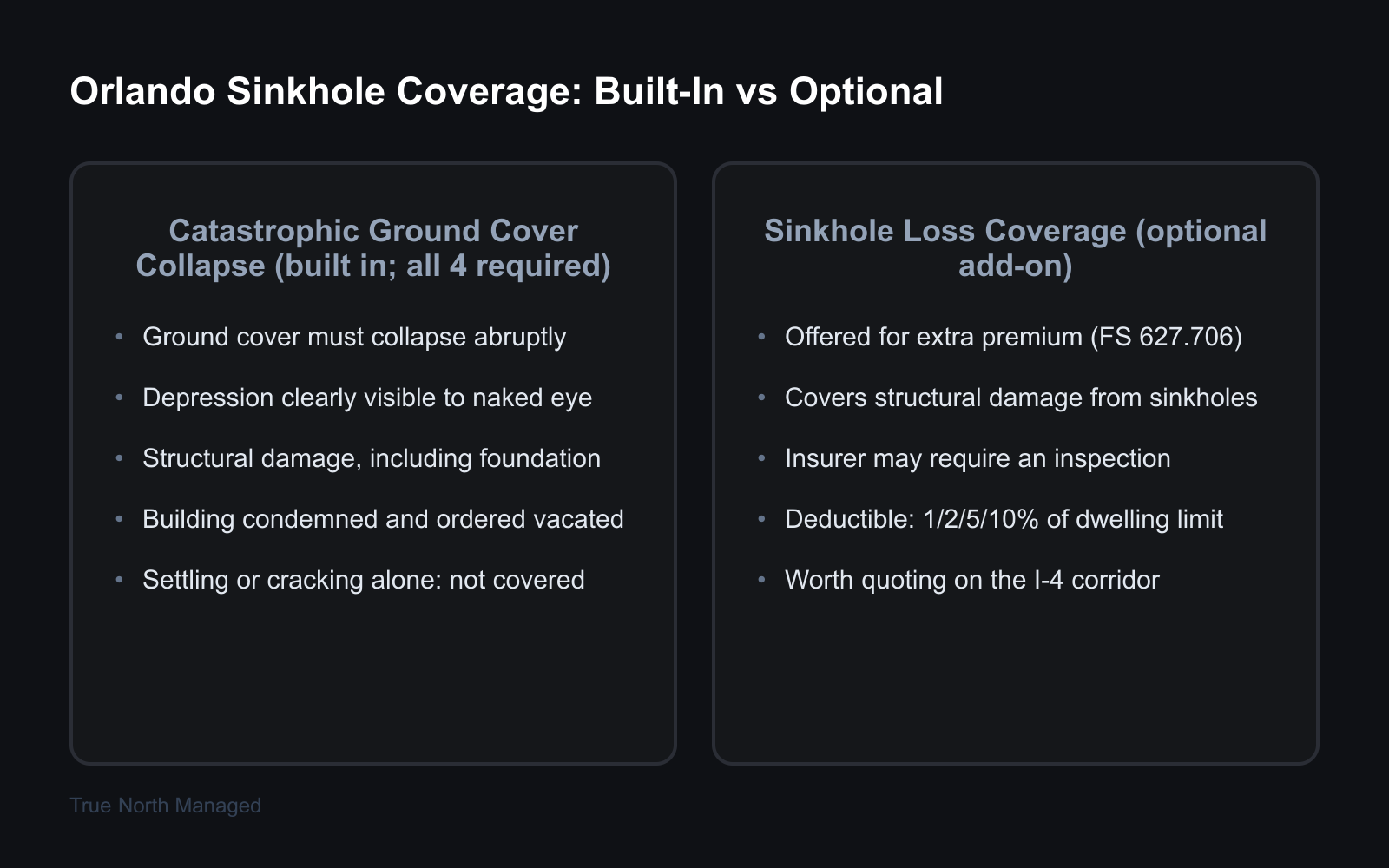
Here is the trap. The coverage that comes built into your policy is called catastrophic ground cover collapse, and it sets an extremely high bar. Florida Statute 627.706(2)(a) defines it as geological activity that results in all of the following: "1. The abrupt collapse of the ground cover; 2. A depression in the ground cover clearly visible to the naked eye; 3. Structural damage to the covered building, including the foundation; and 4. The insured structure being condemned and ordered to be vacated by the governmental agency authorized by law to issue such an order for that structure." In plain terms, the ground has to visibly cave in, the building has to be structurally damaged, and a government agency has to order it emptied. The same subsection adds that "damage consisting merely of the settling or cracking of a foundation, structure, or building does not constitute a loss resulting from a catastrophic ground cover collapse." A slab that cracks, a wall that separates, a foundation that drops two inches because the limestone underneath dissolved? None of that meets the catastrophic standard.
The coverage built for that slower damage is sinkhole loss coverage, and under Florida Statute 627.706, the insurer "shall make available, for an appropriate additional premium, coverage for sinkhole losses on any structure, including the contents of personal property contained therein, to the extent provided in the form to which the coverage attaches," and it may require an inspection before issuing it. The same paragraph lets a residential policy carry a sinkhole deductible of 1, 2, 5 or 10 percent of the dwelling limit, so price the deductible along with the premium. The next paragraph lets the insurer "restrict catastrophic ground cover collapse and sinkhole loss coverage to the principal building, as defined in the applicable policy," so check which buildings the policy includes. Read what it covers, though. The statute defines a sinkhole loss as "structural damage to the covered building, including the foundation, caused by sinkhole activity," and gives "structural damage" its own narrow definition, so a crack on its own doesn't automatically qualify. Declining the add-on to keep the quote low is a defensible call for a property in a low-activity part of the state. It is a much riskier call in Orange County.
The activity is not spread evenly. The bulk of Orange County's sinkholes appear along the I-4 corridor, north of State Road 408 and around the Maitland Boulevard interchange, then up into Seminole County. Orange ranks around eighth in the state for sinkhole frequency; neighboring Seminole and Lake counties land ninth and tenth. So before you decline the add-on, the question isn't "is sinkhole coverage worth it in Florida." It's "is this specific address sitting on the corridor, or off it." A geological lookup on the specific address answers that before you quote, and it can flip the recommendation.
Is Orlando really a flood risk if it's inland?
Yes. Most of metro Orlando sits in flood Zone X, which lenders treat as low risk and many owners read as no risk, but inland Orlando floods on rainfall and overflowing lakes, not storm surge. Nationally, FEMA says 1 in 3 flood insurance claims come from low- and moderate-risk zones, outside the high-risk Special Flood Hazard Area. Zone X is not flood-free. It is just lower-odds.

The proof is recent and local. When Hurricane Ian crossed Central Florida in September 2022, it dropped more than 14 inches of rain on Orlando. Lake Ivanhoe overflowed three to four feet deep into North Orange and Magnolia Avenues. College Park, Delaney Park, Lake Davis, and neighborhoods all the way west to Carver Shores flooded. Crews rescued more than 250 people by boat, including 91 from a single apartment complex off West Colonial. Almost none of that was coastal surge. It was rain and rising lakes in a city that markets itself as the safe, inland alternative to the coast.
Orlando's lake-and-wetland geography is the reason. Properties anywhere near the Butler Chain of Lakes, Lake Ivanhoe, Lake Eola, or the Little Econlockhatchee River sit in basins that fill during heavy rain and stay full for days. A landlord buying in Windermere on the Butler Chain is looking at a different flood profile than one buying a few miles away on higher ground, even though both may technically be Zone X.
Standard landlord policies exclude flood, full stop. So the move in Orlando is rarely "buy a high-cost AE-zone flood policy." It is "buy the cheap Zone X flood policy anyway." Outside the high-risk area, an NFIP policy often runs roughly $400 to $800 a year, and a rental, as a non-primary residence, also carries a $250 federal surcharge. Against the downside Ian demonstrated, that is one of the most efficient dollars an Orlando landlord can spend. Inland is cheaper to insure against flood precisely because the risk is lower, which is a reason to buy it, not to skip it.
Does Orange County qualify for a flood insurance discount?
Yes, but how much depends on which side of a city line the property sits. On FEMA's Community Rating System list effective October 1, 2026, unincorporated Orange County is Class 5, worth a 25 percent discount on NFIP flood policies, and the City of Orlando is Class 6, worth 20 percent.
The Community Rating System rewards communities that exceed the minimum federal floodplain standards with tiered premium cuts, in 5 percent increments. Unincorporated Orange County's Class 5 rating sits at the 25 percent tier. You don't apply for it; FEMA's rating engine attaches the discount using the community's identification number when the policy is written. Cities hold their own classes, though: Apopka is Class 8, worth 10 percent, and Winter Park and Windermere don't appear on FEMA's list at all.
What this means in practice: in unincorporated Orange County, that cheap Zone X flood policy gets a quarter knocked off its premium before you ever see the price. The discount is one more piece of evidence that buying flood coverage in Orlando is the rational move, not the cautious one.
Did Citizens' 2026 rate cut reach Orlando-area dwelling policies?
For multiperil dwelling policies (DP-1 and DP-3), yes, and by more than it reached South Florida. Citizens Property Insurance, Florida's insurer of last resort, cut its approved 2026 rates for DP-1 and DP-3 dwelling policies in Orange County by an average of 6.1 percent, effective July 1, 2026, for new policies and at renewal.
Under the rates regulators set in March, Citizens' multiperil DP-1/DP-3 policies fell 4.0 percent on average in Miami-Dade, 3.6 in Broward and 3.4 in Palm Beach, against 6.1 in Orange and 7.7 in Seminole. South Florida's wind-only dwelling policies went up instead. Two cautions before you count the savings. An average is an average: Citizens' own table shows 5,696 of Orange County's 7,894 dwelling policies getting a decrease, so not all of them did. And the cut belongs to a bucket. Citizens' commercial-residential policies moved the other way the same July 1, with multiperil up 7.2 percent and wind-only up 14.4 percent on statewide average, both excluding condo associations. Pull the declarations page and confirm which kind of policy the rental is actually on before you assume the headline applies to it.
The rate table still isn't the whole bill. It prices the base policy, and the two risks this guide is about sit outside it: flood is excluded entirely, and broad sinkhole coverage is an add-on with its own premium. So don't assume inland is automatically the cheap insurance market. The actual premium comparison between the two metros lives in its own breakdown.
What does an older Orlando home do to your insurance?
It can push you straight onto Citizens and a four-point inspection, especially in Orlando's historic cores. Citizens requires a four-point inspection on applications for any property more than 20 years old, and combined with sinkhole-alley geography, an older home in College Park or Winter Park is the classic Orlando case that private carriers won't write.
The four-point inspection is a licensed inspector's report on four systems: electrical, plumbing, HVAC, and roof. Roofs older than 25 years for shingle, or 50 for tile and metal, need documentation showing at least five years of useful life remaining.
This hits Orlando unevenly because Orlando's housing stock is uneven. A 2015 rental in Lake Nona sails through. A 1948 bungalow in Winter Park's historic core carries old wiring, an aging roof, and a sinkhole-corridor address all at once, which is exactly the combination private carriers decline and Citizens accepts at a higher price. If you're buying older Orlando stock for the charm and the rents, budget for the inspection, the likely Citizens premium, and a roof or panel upgrade that turns a decline into an approval. The math on an older Orlando rental has to include the insurance penalty, not just the purchase price.
What does an Orlando landlord policy actually need to cover?
The core dwelling, liability, and loss-of-rents structure is the same statewide, but in Orlando three line items decide whether the policy fits the property. Build the base policy off the statewide dwelling-policy tiers, then check these three Orlando-specific items before you bind.
First, the sinkhole decision. Decide deliberately whether to add the broad sinkhole loss endorsement under 627.706, based on the address's position relative to the I-4 corridor, not a blanket assumption. Don't let the built-in catastrophic coverage lull you into thinking you're covered for sinkhole damage short of a collapse, because you are not.
Second, the flood decision. Buy the Zone X flood policy in almost every case, take whatever Community Rating System discount your community has earned, and pay special attention to properties near the lake chains and the Little Econ. A landlord policy's flood exclusion is absolute, so flood is always a separate purchase. Florida Statute 627.351(6)(aa) makes flood "a condition of coverage of a personal lines residential risk," and its schedule says Citizens policyholders "must have flood coverage in place for policies effective on or after: a. January 1, 2024, for a structure that has a dwelling replacement cost of $600,000 or more. b. January 1, 2025, for a structure that has a dwelling replacement cost of $500,000 or more. c. January 1, 2026, for a structure that has a dwelling replacement cost of $400,000 or more. d. January 1, 2027, for all other personal lines residential property insured by the corporation." Inside a FEMA special flood hazard area it already applies, and it doesn't reach "Policies that do not provide coverage for the peril of wind" or "Policies that provide coverage under a condominium unit owners form." In plain terms: if your rental house is on a Citizens policy that covers wind, flood is already required on any policy taking effect now when the house is in a FEMA special flood hazard area or its replacement cost is $400,000 or more, and on any policy taking effect on or after January 1, 2027 when neither applies. Our flood insurance guide for Florida rentals covers the rest.
Third, the loss-of-rents line. The endorsement that replaces your rent while a covered claim makes the unit unlivable is a separate limit from the dwelling coverage, and it's routinely dropped when a homeowners policy converts to a rental policy. We cover how to size it in our loss-of-rental-income coverage guide; just make sure it's actually on the Orlando policy and not assumed.
And know your exit. If a carrier non-renews you over a sinkhole claim, a roof, or a flood loss, that's a process with a playbook, not a dead end; our walkthrough on what to do when a Florida carrier drops or non-renews you covers the moves.
The discipline that ties all of this together: quote insurance address by address, never by ZIP code or by reputation. Two rentals on the same street can sit on opposite sides of the sinkhole corridor and opposite sides of a lake basin. The geology is that specific, and so is the premium. Get the real quote for the real address before you assume Orlando is the cheap, safe, inland insurance market.