
Your Tenant Filed Bankruptcy: The Automatic Stay in Florida
Your tenant filed bankruptcy mid-eviction. The automatic stay just froze your case. Here's what it freezes, what it doesn't, and the one detail that sets your timeline.

A letter shows up in the mail: "Notice of Bankruptcy Case Filing." Your tenant's name is on it. You're three weeks into an eviction, the writ was almost in sight, and now every county-court deadline you were counting on just stopped cold.
The worst thing you can do right now is keep pushing. The moment your tenant filed, a federal court order called the automatic stay went into effect — and continuing the eviction anyway can flip you from the landlord owed money to the landlord writing a check.
• It's instant. Under 11 U.S.C. § 362(a), the stay freezes your eviction the second the petition is filed — no hearing, no notice to you required. Stop the state-court case now.
• The Judgment Line. Did you get a judgment for possession before they filed? Then § 362(b)(22) may let you continue. No judgment yet? The stay holds, and you'll need the bankruptcy court's permission first.
• Two kinds of rent. Rent owed before the filing becomes a claim you file in the case. Rent that comes due after the filing is still owed and isn't wiped out.
• Don't go it alone. Don't change the locks. Don't file a federal motion yourself. Verify the bankruptcy first, then get a bankruptcy attorney or property manager on it.
Here's the thing most landlords get wrong about a tenant bankruptcy eviction in Florida: bankruptcy almost never kills the eviction. It pauses it. How long that pause lasts comes down to one fact — whether you'd already won possession when the tenant filed. This is federal bankruptcy law sitting on top of Florida's Chapter 83 eviction rules, and Florida cases run through the U.S. Bankruptcy Court for the Middle District of Florida, which covers both the Orlando and Tampa divisions. Let's walk through what actually happens.
What is the automatic stay in a tenant bankruptcy?
The automatic stay is a federal court order that stops almost all collection and eviction activity the instant a tenant files bankruptcy. Under 11 U.S.C. § 362(a)(3), it bars "any act to obtain possession of property" — which includes continuing your Florida eviction. It needs no hearing and no notice to you. It's live the second the case is filed.
So the stay reaches more than the eviction itself. It freezes collection calls, demand letters, garnishment, and the entry of any judgment in your county case. Your 3-day notice, your filed complaint, the hearing you had on the calendar — all of it pauses.
And the penalty for ignoring it is real. Under § 362(k), an individual tenant injured by a willful violation can recover actual damages, court costs, attorney's fees, and sometimes punitive damages on top. "Willful" doesn't mean you meant to break the rule — it means you knew about the filing and acted anyway. Courts have hit creditors with significant damage awards for running a post-petition eviction without permission. That's the same instinct behind a self-help eviction under Florida law: the shortcut that feels justified is the one that costs you. Once you know about the filing, the locks stay as they are and the eviction stops.
Does bankruptcy stop my Florida eviction for good?
Usually no. A tenant's bankruptcy pauses your Florida eviction — it rarely ends it. The state eviction doesn't vanish; it sits frozen until the bankruptcy court lifts the stay, or until a built-in 30-day clock runs out, depending on one thing: whether you already had a judgment for possession when the tenant filed.
I call that the "Judgment Line." It's the single fact that decides your whole path from here. On one side of the line, you may be able to keep moving in a matter of weeks. On the other, you're filing a motion in federal court and waiting on a judge. Same statute, two very different timelines. Figure out which side you're on before you do anything else.
What if I already had a judgment for possession before they filed?
If you obtained a judgment for possession before the tenant filed, the automatic stay generally does not bar you from continuing the eviction. That's the exception in 11 U.S.C. § 362(b)(22). But there's a catch built for residential tenants: the exception doesn't kick in until 30 days after the petition is filed, and the tenant can extend it by curing what they owe.
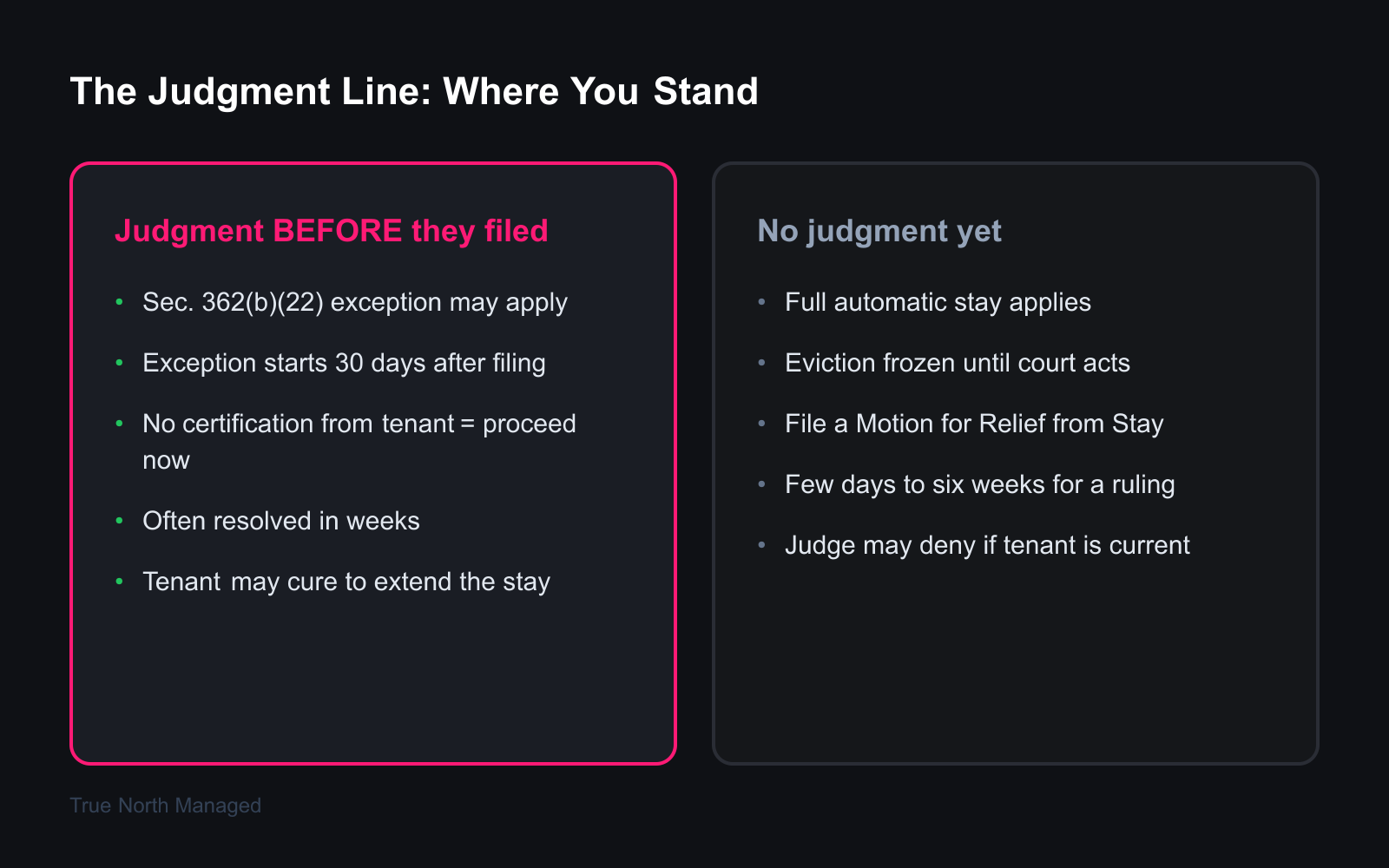
Here's how that 30-day window plays out under § 362(l), depending on what the tenant does:
- The tenant files nothing. Under § 362(l)(4), if the tenant files neither required certification, the (b)(22) exception applies immediately — you don't need the court's permission to keep going, and the clerk sends you a certified copy showing nothing was filed.
- The tenant files the first certification. The tenant can certify, under penalty of perjury, that state law would let them cure the entire default after the judgment and that they've deposited the next 30 days' rent with the court clerk. That holds the exception off for 30 days.
- The tenant cures within 30 days. If they then file a second certification that the full default is cured, the exception doesn't apply and they get to stay — unless the court says otherwise.
The whole thing hinges on a Florida-law question: does state law actually let your tenant cure a rent default after a possession judgment? That's not a clean yes-or-no, and it's exactly the kind of question where you want a bankruptcy attorney reading your specific judgment and docket. Don't assume the exception is automatic just because you won downstairs.
What if I don't have a judgment yet?
If you hadn't won possession when the tenant filed, the full automatic stay applies and you cannot move your Florida eviction another inch until the bankruptcy court lets you. The way you ask is a Motion for Relief from the Automatic Stay — a request filed in the bankruptcy case asking the judge to lift or modify the stay so your county eviction can resume.
This is the part where out-of-state owners and one-property landlords get nervous, and they should — it's a federal court filing, not a county-clerk form. You file the motion, the tenant gets a chance to respond, and a judge decides. Bankruptcy judges grant these often, especially for nonpayment, but a judge may deny the motion if the tenant is current on rent and keeping up. How long it takes runs anywhere from a few days to six weeks depending on the court and the judge; in the Middle District of Florida, tenant-eviction relief motions are often resolved within a few weeks.
Do not try to draft and file this yourself. A bankruptcy attorney handles the motion, and a property manager can coordinate the whole thing for you if you'd rather not learn federal procedure under deadline pressure. If your eviction started over a string of broken promises, our guide on handling chronic late rent in Florida covers the pattern that often leads here.
Can I still collect the rent my tenant already owes?
The rent your tenant owed before they filed — "pre-petition" rent — becomes a claim in the bankruptcy, not a bill you can chase directly. To get in line for any money, you file a proof of claim with the bankruptcy court. Under Federal Rule of Bankruptcy Procedure 3002, that claim is generally timely if filed within 70 days of the petition date in a Chapter 7, 12, or 13 case.
Be honest with yourself about what that claim is worth. Pre-petition rent usually sits as a general unsecured debt, near the back of the line. In many no-asset Chapter 7 cases the court actually tells creditors not to bother filing a proof of claim unless assets turn up later — so read the notice you received, and don't assume there's a check coming. What you can't do is call the tenant demanding the back rent. That's a collection act, and the stay covers it.
For the steps before bankruptcy ever entered the picture, our Florida action plan for a tenant who isn't paying rent walks through the 3-day notice and the eviction filing the right way.
What about rent that comes due after they filed?
Rent that comes due after the bankruptcy filing — "post-petition" rent — is a brand-new obligation. It isn't covered by the stay the way old debt is, and it isn't wiped out by the bankruptcy. Your tenant is supposed to keep paying it while they live there, and if they stop, that's fresh grounds to go back and ask for relief from the stay.
Post-petition rent is generally still owed and is not discharged by the filing. A residential tenant in Chapter 7 gets a limited window — 60 days under § 365(d)(1) — to assume or reject the lease; if they don't assume it, it's deemed rejected. So a tenant can't file bankruptcy, stay in your unit for free, and call it protected. If post-petition rent stops, you have a clean reason to ask the court to let the eviction proceed.
Whether that post-petition rent gets paid ahead of other creditors as an "administrative expense" or just stacks up as another claim gets fact-specific fast, and courts don't all agree on it. That's a question for bankruptcy counsel, not a blog post. The plain takeaway for you: post-petition rent is still owed, and a tenant who quits paying it hands you your opening. If the tenant would rather just leave, our guide to early lease termination in Florida covers a cleaner exit for both of you.
Chapter 7 vs Chapter 13 — what's the difference for me?
Both Chapter 7 and Chapter 13 trigger the same automatic stay the moment your tenant files. The difference is what happens after. Chapter 7 is liquidation, and the tenant's residential lease usually gets rejected. Chapter 13 is a repayment plan, and the tenant may try to cure the back rent over time and stay in your unit.
In a Chapter 7, the trustee or tenant has 60 days to assume or reject the lease, and for a residential rental they almost always let it go. The pre-petition rent typically gets discharged, and your recovery — if any — runs through that proof of claim. Practically, Chapter 7 often clears the path to get your unit back, just on the bankruptcy court's clock instead of the county's.
Chapter 13 is the one that keeps a tenant in place. They propose a 3-to-5-year plan to cure the arrears, and as long as they keep current and the plan gets confirmed, they can stay. For you that means a slower resolution and a tenant who's supposed to be paying going forward. Either way, you don't get to pick which chapter your tenant files — you just need to read the notice and respond to the chapter you're handed.
How do I verify the tenant actually filed bankruptcy?
Don't take a tenant's word for it, and don't ignore a notice either. If the tenant told you they filed, ask for the case number and their attorney's name. If you were listed as a creditor, you'll get an official "Notice of Bankruptcy Case Filing" by mail. Then confirm it yourself on PACER, the federal court records system.
You can search filings by name at PACER; creating an account is free and pulling documents runs about ten cents a page. This matters most for remote owners — when you can't drive to the courthouse, a two-minute PACER search tells you exactly where the case stands. It also protects you. If you make a reasonable, documented effort to verify and the filing turns out to be fake or never happened, you're in a far stronger spot if you keep moving. A tenant "saying" they filed to stall an eviction is not the same as a filed case, but you confirm before you act — you don't guess.
The mistakes that turn a bankruptcy notice into a lawsuit
The dangerous moves after a bankruptcy notice are the ones that feel like taking control. They're also the ones that hand your tenant a damages claim under § 362(k). Here's what gets Florida landlords in trouble:
- Pushing the eviction anyway. Continuing the county case without a pre-petition judgment or relief from the stay is a stay violation, full stop.
- Changing the locks. A bankruptcy filing doesn't suspend Florida's self-help rules — it adds a second federal penalty on top of the state one.
- Calling to demand the old rent. Pre-petition rent is a claim now. A demand call is a collection act the stay prohibits.
- Ignoring the notice. Miss the 70-day proof-of-claim window and you give up your shot at any distribution.
- Assuming it's over and re-renting. Until the stay lifts or the (b)(22) clock runs, that tenancy is in legal limbo. Re-renting too early creates a mess.
- Filing the federal motion yourself. This isn't a small-claims form. A pro-se mistake in bankruptcy court costs more than the attorney would have.
A bankruptcy notice in the middle of an eviction feels like the floor dropping out. It isn't. It's a pause with rules — and the rules favor a landlord who slows down, verifies the filing, figures out which side of the Judgment Line they're on, and gets the right help on the federal piece. The landlords who get burned are the ones who treat the notice like an obstacle to bulldoze.
If you own one rental and a tenant bankruptcy just landed on top of your eviction, you don't have to untangle federal procedure alone. We coordinate evictions and the bankruptcy-court fallout for single-property and out-of-state owners — not just big portfolios. For the bigger picture on staying compliant as a Florida landlord, start with our Florida owner's guide, or get a free rental analysis →