

Small Claims Court for Florida Landlords: Suing Beyond the Deposit
A tenant moved out owing more than their deposit covers. Here is how small claims court works in Florida, what it costs, and the one thing that decides whether you ever see a dollar.

The tenant is gone. The deposit covered the carpet, but not the broken slider, the unpaid final month, or the cleaning bill that ran past anything you held. You have a real number owed and an empty unit. The question is whether small claims court for a Florida landlord is worth your afternoon, your filing fee, and the drive downtown.
Here is the honest version, and it is the part most guides skip: in Florida, winning a small claims case is the easy half. Collecting on it is the half that beats people. So before we walk through the forms and the fees, we are going to talk about the thing that actually decides the outcome, which is whether this particular tenant can ever be made to pay.
What is small claims court for a Florida landlord, and when do you use it?
Small claims court in Florida is the small claims division of County Court. It handles money disputes of $8,000 or less, not counting costs, interest, and attorney fees. For landlords, that means unpaid rent, damages that run past the security deposit, or losses from a broken lease, pursued after the tenant has moved out. It produces a money judgment, not possession of the unit.
That last sentence matters more than it looks. Small claims is for getting paid. Eviction is for getting the property back. They are separate cases, separate statutes, separate purposes, and they happen at different points in the story. While a non-paying tenant is still living in your unit, the tool is eviction, which runs under Chapter 83 of the Florida Statutes and ends in a writ of possession. We cover that road in detail in our guide on what to do when a tenant stops paying rent in Florida, so we will not retrace it here.
Small claims picks up where eviction leaves off. The tenant is out, but the debt is not. You evicted them and they left owing two months, or they moved out on their own and stuck you with damage the deposit could not absorb. The money is still owed, and the only way to turn that into something a court will enforce is a civil suit for the dollars. If your claim is over $8,000, you move up to county civil court, where the jurisdictional ceiling is $50,000 and the full Rules of Civil Procedure apply. Most landlord-versus-departed-tenant claims sit comfortably under the small claims line.
Should you sue at all? The collectability question comes first.
Before you file anything, answer one question: can this tenant actually be made to pay? In Florida, a money judgment is only as good as the assets behind it, and a typical residential tenant who just fell behind on rent is often what collection attorneys call judgment-proof. Decide collectability first. The filing fee and the afternoon are the cheap part; chasing an uncollectable judgment for two years is the expensive part.
This is where Florida law works against landlords, and you need to know it going in. The single biggest obstacle is the head-of-family wage exemption in Florida Statute 222.11. If your former tenant provides more than half the support for a child or another dependent, and their disposable earnings are $750 a week or less, their wages cannot be garnished at all. Above $750 a week, FS 222.11(2)(b) says a head of family's disposable earnings "may not be attached or garnished unless such person has agreed otherwise in writing." That waiver has to be a separate document in a form the statute prescribes, in at least 14-point type, and even with one, garnishment can't exceed the federal Consumer Credit Protection Act limit. A large share of the tenants who fall behind on rent meet this definition, which means a wage garnishment, the most common collection tool, is simply off the table.
So the suit makes sense when the math and the target line up. It is worth pursuing when the tenant is not a head of family and has a known employer (FS 222.11(2)(c) still caps that garnishment at the federal Consumer Credit Protection Act limit), when you know where they bank, or when they are young and asset-building and would not want a judgment lien shadowing their next mortgage. It is a much weaker bet when the tenant has skipped, has no garnishable income, owns no real property, and has nothing you can locate. None of that means you are powerless. A judgment in Florida is enforceable for 20 years and accrues interest, and it reports on the tenant's record, which carries real weight at their next rental application. But you should walk in knowing whether you are chasing a check or a public-record consequence, because they are not the same prize.
What does it cost to file a small claims case in Florida?
Filing fees in small claims are set by statute and scale with the size of your claim. Under Florida Statute 34.041, the county-court filing fee is "not to exceed" $50 for claims less than $100, $75 for claims of $100 to $500, $170 for claims over $500 up to $2,500, and $295 for claims over $2,500 up to $15,000, and the statute adds a $4 filing fee on top. Service of process is extra. Those amounts are current as of this writing, but fee schedules shift, so confirm the exact figure with your county clerk before you file.
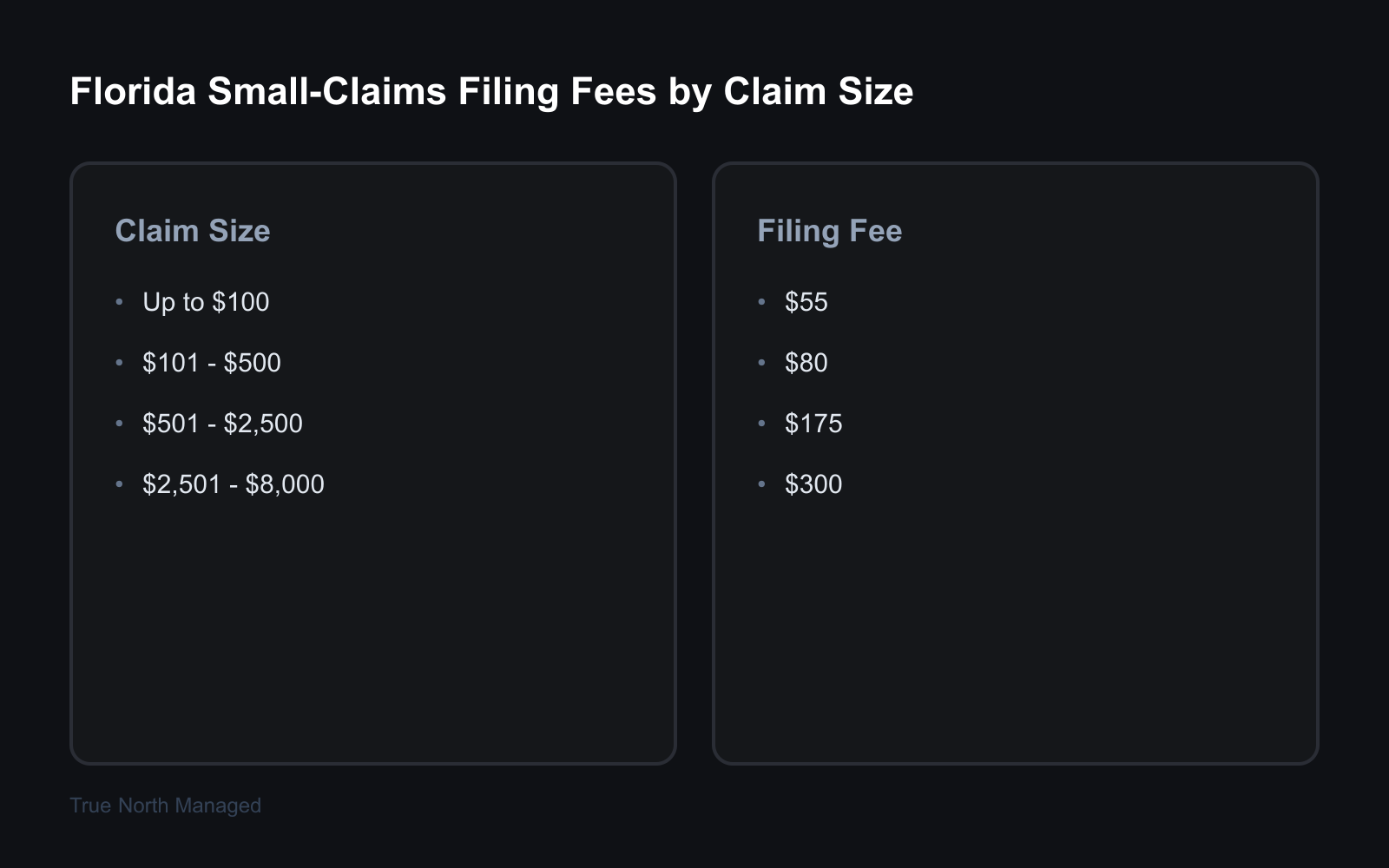
On top of the filing fee, you pay to have the tenant served. That runs the sheriff's fee, which FS 30.231 fixes at "$40 for each summons or writ to be served," or a private process server's charge, which varies with how hard the person is to find. If the tenant has moved and left no forwarding address, service gets harder and more expensive, and in some cases requires service by publication, which is both slower and costlier. Add it up before you file: on a $2,000 claim you might spend $174 in filing fees ($170 plus the $4 add-on), a $10 clerk charge to issue the summons, plus $40 for the sheriff to serve, and that is money you only recover if you both win and collect.
How does the small claims process work, step by step?
The process is built for people without lawyers, which is a genuine advantage. You start by filing a Statement of Claim with the Clerk of County Court in the county where the property sits. Because your claim is based on a written document, the lease, a copy of that lease has to be attached. The clerk then issues a summons, the tenant gets served, and you are routed first to a pretrial conference, where the clerk sets the date no more than 50 days out, then to mediation, and only after that to a hearing in front of a judge.

A few details are worth pinning down so the day does not surprise you:
- The pretrial conference is not your trial. It is a short appearance where the judge confirms both sides are present and sends you to mediation. Show up; missing it can cost you the case by default.
- Mediation comes before the judge. Florida small claims routinely tries to settle disputes through a mediator first. If you reach an agreement, it is written up as a stipulation and can be entered as a court order, which means a signed payment plan you can enforce later.
- Whoever appears must have authority to settle. If you send someone in your place, they need full authority to accept a deal on the spot.
- The hearing is about evidence, not eloquence. You will not be cross-examined like a courtroom drama. You will be asked to show what you are owed and prove it.
In Orange County, you file with the Clerk of Courts and report for mediation at the courthouse at 425 N. Orange Ave. in downtown Orlando; the clerk's Self Help Center can walk a first-timer through the forms. In Hillsborough County, the Clerk of Circuit Court and Comptroller handles County Court filings at the Edgecomb Courthouse at 800 E. Twiggs St. in Tampa. Both counties accept e-filing through the Florida Courts E-Filing Portal, so you do not always have to appear in person to start the case. The clerk's small claims page for your county is the most reliable source for current forms and fees.
How does the security deposit affect your small claims case?
The deposit and the lawsuit are linked, and getting the order wrong is the most common self-inflicted wound we see. Under Florida Statute 83.49(3)(a), if you intend to impose a claim on the deposit, you must, "within 30 days after the termination of the rental agreement, provide the tenant written notice by certified mail to the tenant's last known mailing address or by e-mail in accordance with s. 83.505 of his or her intention to impose a claim on the deposit and the reason for imposing the claim." Miss that 30-day window and you forfeit the right to impose a claim on the deposit at all. You cannot deduct, and you cannot take a setoff against it.
Here is the trap. Forfeiting the deposit claim does not end your right to the money the tenant actually owes, but the statute is specific about the sequence: you must return the deposit first, then file an action for damages. So a landlord who blows the 30-day notice cannot quietly keep the deposit and also sue cleanly for the rest. The forfeited deposit is simply gone as a setoff; the suit then has to stand on the full documented damages on its own. This is exactly why the deposit step has to be done right the first time, and it is why we treat the Florida security deposit law and the 30-day notice rule as a prerequisite, not an afterthought. Do that step correctly, and small claims becomes the clean recovery of what the deposit did not cover. Botch it, and you have handed the tenant an argument before you have filed a single page.
One more interaction worth flagging if your claim includes lost rent from a tenant who broke the lease early: your recovery is capped by your duty to re-rent. Florida expects you to make a reasonable effort to fill the unit, and a judge will not award you months of rent you could have mitigated. We break that down in our guide on the landlord's duty to mitigate damages in Florida, and it is a number a tenant's mediator will press on hard.
What evidence do you need to win?
A small claims hearing rewards organization, not argument. The landlords who win walk in with a tidy, chronological packet and hand the judge a clean copy of everything. The ones who lose show up with a story and a phone full of photos they cannot find. Bring the lease, the signed move-in and move-out condition reports, a dated rent ledger showing every charge and payment, the certified-mail receipt for your deposit notice, repair invoices and receipts, and dated photos of the damage. Bring two copies of each: one for the judge, one for the tenant.
The condition report is the quiet hero of these cases. A signed move-in inspection that documents the unit's state, paired with a move-out report showing the difference, turns a "he said, she said" over a damaged wall into a documented before-and-after the judge can see at a glance. If you only take one lesson from this section, make it the habit of photographing and signing the unit's condition at both ends of every tenancy. That paperwork is what converts a plausible claim into a winning one.
You won. Now how do you actually collect?
A judgment is a court order that says you are owed money. It is not a check, and Florida does not collect it for you. That work is yours, and the law makes it deliberately difficult against an ordinary residential tenant. This is the judgment you can't collect problem, and it is why collectability belonged at the front of this guide rather than the back.
Your three main tools each have a real limit. Wage garnishment is the most direct, but the head-of-family exemption we covered earlier shields most tenants who support a dependent on $750 a week or less, so it often goes nowhere. A bank account levy through a writ of garnishment can work, but only if you know where the tenant banks, and FS 222.11(3) says earnings "that are exempt under subsection (2) and are credited or deposited in any financial institution are exempt from attachment or garnishment for 6 months after the earnings are received by the financial institution if the funds can be traced and properly identified as earnings," adding that "Commingling of earnings with other funds does not by itself defeat the ability of a head of family to trace earnings." So a head of family's traceable pay deposited in the last six months is off-limits. And a judgment lien, which you create by filing a Judgment Lien Certificate with the Florida Department of State, attaches to the tenant's personal property for five years and is renewable once; recording a certified copy with the county clerk reaches real property for ten years. The catch is that most tenants own no real property, and Florida's homestead protection shields a primary residence from most judgment liens anyway.
That is a sobering list, but it is not a dead end. A young tenant who later buys a home, opens a traceable bank account, or takes a higher-paying job can be pursued, because the judgment stays alive and growing for two decades. And even when direct collection fails, the recorded judgment follows the tenant into the next landlord's screening. For some owners that consequence, plus the satisfaction of putting a real number on the record, is reason enough. For others, the time and cost are not worth a judgment they will likely never collect. There is no shame in either choice, as long as you make it with your eyes open rather than discovering the collection problem after you have already won. For the bigger picture of where small claims fits among your rights as a Florida landlord, our Florida owner's guide maps the legal terrain.
The bottom line
Small claims court is a genuinely useful tool for Florida landlords recovering money a departed tenant owes beyond the deposit. It is cheap to enter, designed for people without lawyers, and capped at a size that keeps most landlord claims in its lane. But the filing is the beginning of the work, not the end. Decide collectability before you decide to file, handle your deposit notice correctly so you are not suing from a weakened position, walk in with a clean evidence packet, and know in advance whether your prize is a payment or a public-record consequence. Do that, and small claims becomes a clear-eyed business decision instead of an expensive afternoon spent winning a judgment you can never cash.