
Baldwin Park 2025 Year in Review: What Changed for Landlords in 32814
Baldwin Park's office market read above 93%, and the price-rent gap widened. Here's what the 2025 reads mean for 32814 landlords heading into 2026.

Baldwin Park's 2025 wasn't a year of headlines. It was a year of thresholds. Two of them moved at once — office occupancy and the price-to-rent gap — and for landlords in 32814, the combined reading is more useful than any single news item would've been.
Here's the short version. The office submarket's most recent reads sit north of 93% occupancy, and median sale prices ran +10% or better YoY while rents drifted slightly down. Cap rates compressed against the math the Baldwin Park investment pillar lays out, and HOA board composition just became the variable to watch in 2026.
What actually changed in Baldwin Park in 2025?
Two things, and they pull in different directions.
The office market read above 93%. Current brokerage marketing for the last remaining build site, the 0.82-acre lot at 4787 New Broad St, cites Baldwin Park office occupancy near 93.4%. For landlords, that's a good thing on the demand side. Daytime population means tenant demand from professionals who want to live inside the Walk Score 74 footprint.
Prices kept appreciating. Rents didn't. Redfin's neighborhood read had median Baldwin Park sale prices running +10% to +12% YoY through 2025, with the band widening from $650K on the low end past $1.2M on the high end. RentCafe's apartment-median rent for Baldwin Park drifted slightly negative for the year — somewhere in the −0.5% to −1% range, with median sitting near $2,300. SFR rents held in the $3,100–$3,400 band. The math: prices climbed, rents flattened. That's the squeeze.
What does the rent vs. price math look like now?
Whatever cap rate your 2024 deal cleared at, end-of-2025 math is tighter. Same property, higher value, same-or-lower rent, same-or-higher expenses.
Quick worked example, end-of-2025. Take a $787,000 SFR renting at $3,300/month — $39,600 gross. Non-homestead property tax at the City of Orlando's highest 2025 total millage, 19.2844 mills (the city's tax districts run 18.0878–19.2844 mills, per the Orange County Property Appraiser), is about $15,200 on the full $787,000 — the appraiser's assessed value may come in lower. Add HOA in the $300/month range for a mid-tier property, insurance around $250/month (an example assumption), and maintenance budgeted at 1% of property value. That puts hard expenses around $29,600/year before you add vacancy, management, and reserves. Before those, NOI lands near $10,000, about 1.3% of the price. Assume 5% vacancy and 8% management and NOI falls to about $5,000 — a cap rate of roughly 0.6%. Brokers will quote you a higher number by stripping vacancy, management, and reserves out of the math; the conventional NOI cut is the one that matters when you're holding the property, not selling it. Either way, you're not in cash-flow territory — you're in appreciation-and-tenant-quality territory.
The pillar guide already framed Baldwin Park as a premium play. What 2025 did was push the yield equation past the comfortable range for anyone who underwrote with cash flow as the primary thesis. If you bought for appreciation and tenant quality, you're still in the trade. If you bought for yield, you're working at margin.
Why does the HOA matter more now than it did a year ago?
New-urbanist HOAs are designed around an owner-occupant majority — once that majority slips below half, and especially once it slips below a third, the rules that govern rental activity get reconsidered. Rental caps. Lease registration fees. Short-term rental restrictions. Architectural-review tightening. None of these are inevitable. All of them become more likely. One limit matters for anyone who already owns here. For the ROA, Florida Statute 720.306(1)(h) says: "1. Except as otherwise provided in this paragraph, any governing document, or amendment to a governing document, that is enacted after July 1, 2021, and that prohibits or regulates rental agreements applies only to a parcel owner who acquires title to the parcel after the effective date of the governing document or amendment, or to a parcel owner who consents, individually or through a representative, to the governing document or amendment. 2. Notwithstanding subparagraph 1., an association may amend its governing documents to prohibit or regulate rental agreements for a term of less than 6 months and may prohibit the rental of a parcel for more than three times in a calendar year, and such amendments shall apply to all parcel owners." In plain terms, a rental cap or rental rule enacted after July 1, 2021 binds an owner who already held title only if that owner consents, while a rule on leases shorter than 6 months or on renting more than three times a year binds every owner; the same paragraph goes on to say which transfers, such as to an affiliated entity or an heir, don't count as a change of ownership.
Here's where to actually look, because "watch the HOA" isn't useful advice on its own.
Baldwin Park's residential governance runs through the Residential Owners Association (ROA), with Sentry Management as the management company. Governing documents — the Amended and Restated Declaration of Covenants, Conditions and Restrictions, design guidelines, and association-level filings — are housed on the Baldwin Park Community Network at baldwinparknetwork.com under Association Information. Start there to see what's actually in effect, who's on the board, and how the umbrella ROA relates to the townhome service-area committee and the condo sub-associations. Owners with a Sentry account can pull additional documents directly.
The practical 2026 monitoring sequence:
Annual meeting notice and candidate slate. Florida statute 720 requires annual-meeting notice to all members. The notice packet includes the candidate slate for any open board seats. The slate is the highest-signal document of the year — it tells you whether candidates running lean owner-occupant or investor-aligned. Two consecutive cycles of owner-occupant-only candidates is the early signal that an investor-restrictive rule package is being assembled.
Sentry account access for current owners. If you own in 32814, get your Sentry portal credentials current. That's where assessment, architectural-review, and association-correspondence access live for residential owners. Board agendas and approved minutes are obtained through that channel or the association office; if you can't find what you need on the public network site, the management company is the next stop.
The 32814 owner Facebook group. Soft signal, but rule-change rumors surface here 60–90 days before they hit a board agenda. Not authoritative, but useful as a leading indicator. Cross-check anything you read there against the actual ROA documents before acting.
The point isn't to attend every meeting. It's to be a member who can recognize a rental-rules proposal in time to respond — through written comment, through a proxy, or through the candidate slate the following cycle.
What should a 32814 landlord do in 2026?
Three cuts depending on when you bought.
If you bought before 2023: You've ridden most of the appreciation. The yield math is tighter than your 2022 underwriting. There's a real spring-2026 question — do you sell into a market that's still showing +10% YoY comps, or hold another twelve months at compressed cap rate and bet that prices haven't peaked? No universal answer. But the question is worth running, not assuming.
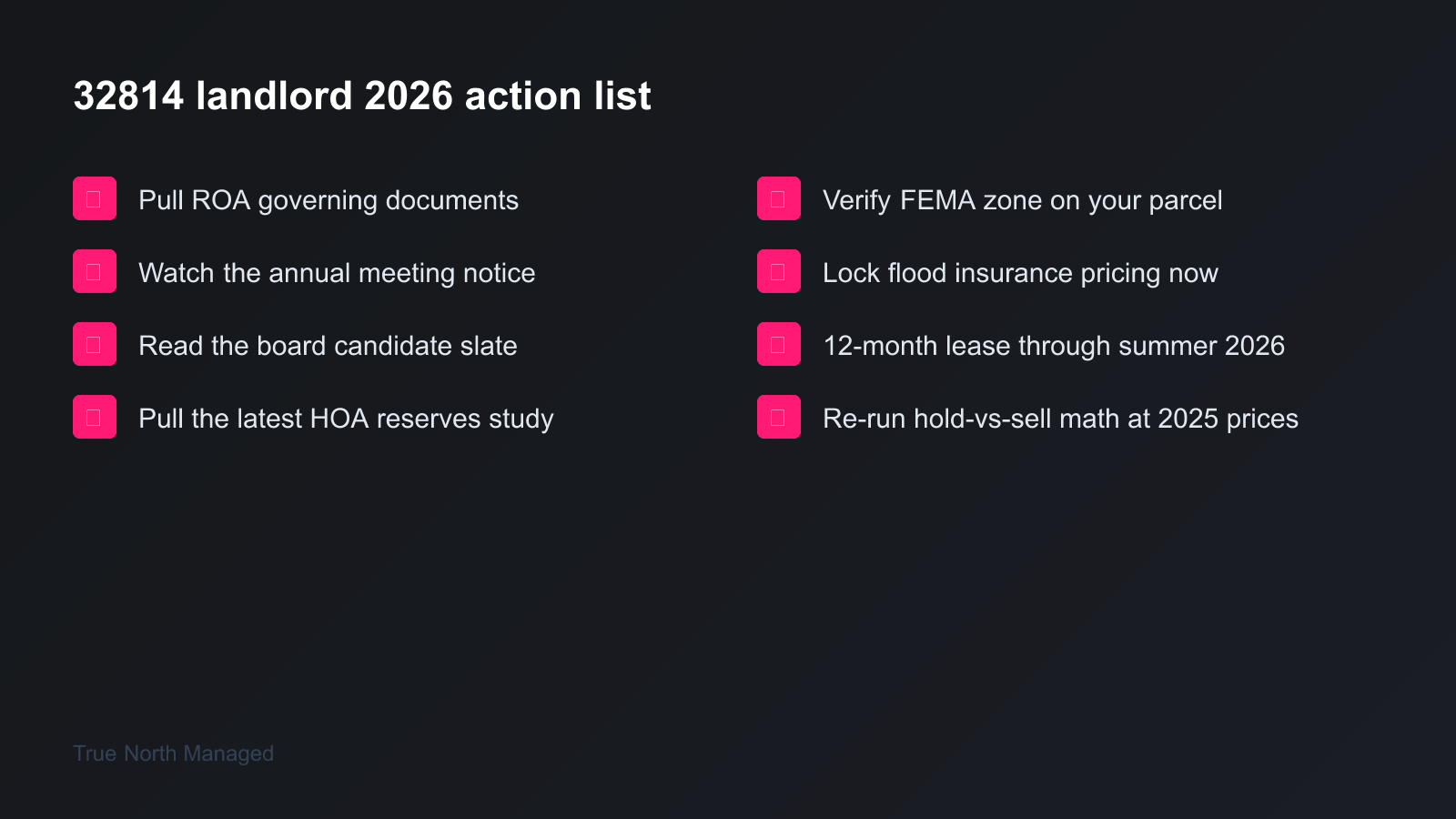
If you bought in 2024 or 2025: You're holding at compressed cap rate. Protect the downside. Pull the latest HOA reserves study before you renew anything. Lock in flood insurance pricing while you can — Baldwin Park is mostly Zone X, but verify your specific parcel on the FEMA flood map portal. Get your tenant on a 12-month lease running through summer 2026; appraisers in this market are reading move-in-ready leased properties more favorably than vacant ones right now.
Across the board: Read the ROA governing documents and watch the annual meeting notice when it lands. Two cycles of advance notice is the difference between adjusting strategy and being caught flat.
For out-of-state landlords specifically: office occupancy, HOA fee schedules, FEMA zone, and tax assessments are all things you can verify from a thousand miles away through the Orange County Property Appraiser and the Baldwin Park Community Network. What you can't verify remotely is board-meeting body language — whether candidate slates are starting to skew owner-occupant, whether the management company is fielding more rental-related correspondence. The annual meeting notice and the candidate slate that lands in your mailbox are the closest substitute. Read them; don't toss them.
What's the 2026 setup for Baldwin Park?
A few things to watch as the year unfolds. Spring sale comps tell us whether the +10% YoY price trend held or started to roll over — and whether rents finally responded to the price gap or stayed flat. The first ROA annual meeting notice of the year sets the tone for what's on the rental-rules table for 2026.
The through-line: Baldwin Park isn't a rent-growth play anymore, and it hasn't been for a while. It's a HOA + tenant-quality + downside-protection play, and 2025 was the year the math confirmed that read. For more context on how Baldwin Park fits the broader corridor, see the Central Orlando submarket guide and the latest Orlando market update. For comparison numbers on similar Central Orlando product, the College Park investment guide covers a different yield profile with older inventory.
Want the 2026 numbers run for your Baldwin Park unit?
If you own in 32814 and want a real read on what your unit would rent for in 2026 — and what your hold-vs-sell math actually looks like at end-of-2025 prices — get a free rental analysis. We'll pull the comps, run the expenses, and tell you whether you're holding the right property at the right number.