

The Real Cost of Self-Managing Your Florida Rental
The management fee you skip is the only cost you can see. Here's how to put a real dollar figure on the four costs you can't — using your own numbers.

You decided to manage your own rental, and the logic is hard to argue with. Why hand a property manager 8 to 12 percent of your rent every month when you can field the calls and schedule the repairs yourself? That math is real. The fee you skip is money in your pocket.
But that fee is the only cost you can see. The cost of self-managing rental property in Florida is mostly made up of expenses that never show up as a line item — the hours you spend, the extra weeks a unit sits empty, the retail rate you pay for an emergency repair, and the legal mistakes that turn into forfeited money. None of those mail you an invoice. They just quietly come out of your return.
This guide isn't here to talk you out of self-managing. Plenty of landlords do it well. It's here to help you put a real number on what it actually costs you, so you're comparing the right two figures instead of the easy one. By the end, you'll have a worksheet you can run with your own rent, your own time, and your own property. We'll work the examples on a $2,000-a-month single-family home in Orlando, but the method is yours to plug your own numbers into.
What does it really cost to self-manage a rental property?
The real cost of self-managing a rental is the sum of four hidden line items: your time, longer vacancies, retail-priced maintenance, and legal-risk exposure. On a typical Florida single-family rental, those four together usually run well past the management fee you skipped — but the figure is personal, not a statewide average. You have to calculate yours.
Here's the trap. When landlords compare self-managing to hiring out, they compare against one number: the management fee. Skip the fee, save the money, done. That comparison feels complete, and it's wrong, because it values your time at zero and assumes nothing goes sideways.
Think of self-managing less like a service you're getting for free and more like an insurance deductible. Most months, it costs you almost nothing — a few phone calls, a rent payment to record, a filter to change. The cost lives in the bad month: the slow turnover, the emergency AC failure on a holiday weekend, the eviction, the deposit dispute you mishandle. Hiring a property manager doesn't just buy you convenience. It caps that downside. Self-managing leaves it uncapped.
So let's walk the four costs one at a time and build your number as we go.
How much is your time actually worth as a landlord?
Your time is the largest hidden cost, and most landlords price it at zero. Self-managing landlords spend somewhere between 8 and 20 hours a month on a single property during normal stretches, and a lot more during a turnover or a problem tenant. Multiply your honest hourly worth by those hours and you have line item number one.
Take the middle of that range — say 12 hours a month. That's tenant calls, coordinating a plumber, showing the unit when it's vacant, lease paperwork, and keeping your books clean enough that tax season doesn't ruin your April. Twelve hours is conservative if you've ever had a leak or a late payment.
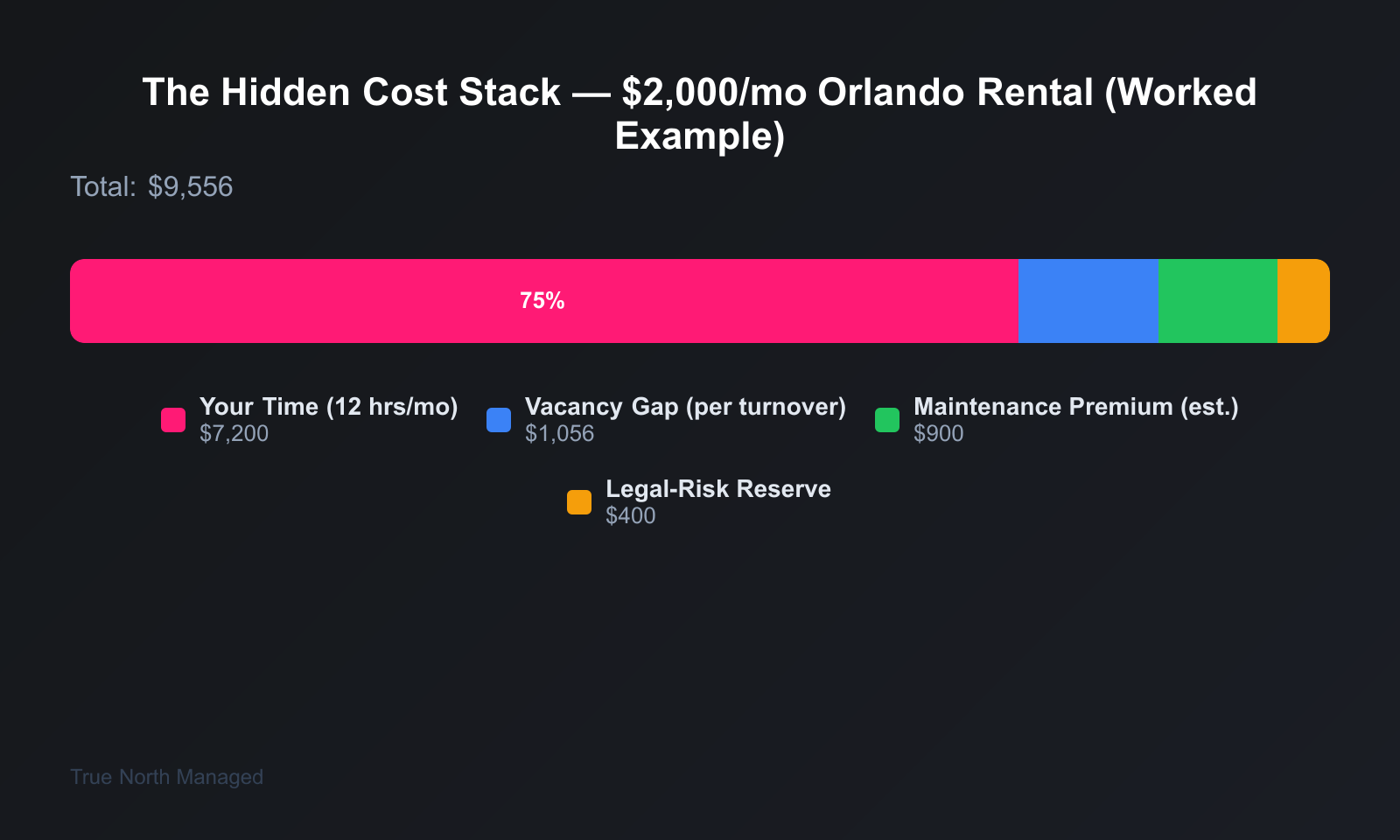
Now price those hours. If you hold a salaried job, your time has a market value, and it's almost certainly more than zero. Say it's worth $50 an hour. Twelve hours a month at $50 is $600 a month — $7,200 a year — that you're spending on management whether or not you ever write a check for it.
Compare that to the fee. A property manager on a $2,000 rental charging 10 percent costs you $200 a month, or $2,400 a year. So the honest comparison isn't "save $2,400." It's "spend $7,200 of your own time to save $2,400." Framed that way, the savings can flip to a loss the moment your hourly worth clears about $17.
This is the input that's truly yours. A retiree with time and a paid-off duplex values those hours very differently than a traveling consultant with two kids and a W-2. Run your own rate, your own hours. That's the first number on your worksheet.
What does a longer vacancy really cost a self-managing landlord?
Vacancy is the cost that hides in plain sight, because the days you lose feel like nothing in particular. On a $2,000 rental, every extra week empty is about $460 gone — and that gap shows up on every turnover.
A vacant unit doesn't just stop earning rent. You're still paying the mortgage, the insurance, the property taxes, and the HOA dues if you have them. On a $2,000-a-month rental, the rent alone works out to roughly $66 a day.
Run the gap. Sixteen extra days empty at $66 a day is about $1,056 lost on a single turnover. If your tenant turns over every couple of years, that's a recurring cost you can amortize across the lease. Plug your own rent in: divide your monthly rent by 30 to get your daily number, then multiply by however many extra days you think a slower process costs you.
The gap comes from three things self-managers genuinely struggle with, and none of them are about effort:
- Pricing. Set the rent too high and the unit sits; set it too low and you leave money on the table for the entire lease. Someone pricing dozens of units a month knows the sweet spot for your ZIP code down to the dollar. You're guessing once every year or two.
- Marketing reach. A single Zillow listing isn't the same as syndication across a dozen platforms with a standing pipeline of applicants. Thin reach means fewer leads and slower fills.
- Showing speed. If you can't show the unit at 5:30 on a Wednesday because you're at work, the qualified applicant books with the landlord who can. Speed loses you the good tenants first.
That's your second number. Be honest about whether your process is closer to two weeks or six.
How much more do self-managers pay for maintenance?
Self-managers usually pay retail — and sometimes emergency rates — because they don't have a vendor network. A property manager coordinating repairs across many doors negotiates volume pricing with licensed, insured contractors, and that relationship absorbs the worst of an after-hours call. The exact gap depends on the job, so treat this one as a tendency, not a fixed figure.
Here's how it plays out. Your tenant calls on a Saturday with no AC, in August, in Florida. You're self-managing, so you call whoever Google surfaces first and whoever can actually come out. You pay the emergency premium and the retail rate because you have no standing relationship and no pricing power. A manager with a hundred-plus doors has an HVAC vendor who treats that call as routine and prices it accordingly.
Florida is unusually hard on this line item. The humidity wears out air handlers. Storm season brings water intrusion and insurance claims. Pest control isn't a one-time fix — it's a recurring cost down here. Across a year of repairs, the difference between negotiated pricing and retail-plus-emergency pricing adds up, even after a manager's maintenance coordination markup.
There's a quieter version of this cost too: deferred maintenance. Self-managing landlords often miss the early warning signs — the slow drain that becomes a slab leak, the soft spot that becomes a roof claim — because nobody's doing routine eyes-on inspections. Catching small problems early is cheaper than fixing big ones late. Put a realistic annual figure here based on your property's age and systems. That's number three.
What's the legal-risk cost of self-managing in Florida?
This is the cost that's nearly zero until it's enormous. Florida's landlord-tenant statutes have hard deadlines, and missing one can cost you real money — a forfeited deposit claim, a thrown-out eviction, a penalty. Self-managers trip these wires because they're reading the law once instead of working it every week.
Start with the security deposit, because it's the most common and the most expensive mistake. Under Florida Statute 83.49, when a tenant vacates at the end of the tenancy, you have 15 days after the termination of the rental agreement to return the deposit, with any interest owed, if you're not keeping any of it — or 30 days after the termination to send written notice "by certified mail to the tenant's last known mailing address or by e-mail in accordance with s. 83.505" of your intent to make a claim against it and "the reason for imposing the claim." The statute is blunt about what happens if you blow the deadline: "If the landlord fails to give the required written notice within the 30-day period, he or she forfeits the right to impose a claim upon the security deposit and may not seek a setoff against the deposit but may file an action for damages after returning the security deposit to the tenant." Miss that window on a unit the tenant trashed, and the deposit stops being your cushion: it goes back in full, and recovering the damage means a separate lawsuit. We've written a full breakdown of how to handle the security deposit return process under Florida law without forfeiting a dime — it's worth reading before your first move-out.
Then there's eviction, the line item self-managers underprice the most because they assume their tenants will always pay. When one doesn't, the bill is layered. Direct filing, court, and service fees run a few hundred dollars. Then add the part that actually hurts: the rent you lose before you regain possession. How long that takes after filing depends on service, whether the tenant answers or deposits rent into the court registry, and the court's calendar, and it can stretch to months when the tenant fights it. A self-manager who botches the notice — serves it too early, counts the days wrong — restarts that clock and adds weeks of lost rent. If you've never run one, read how the Florida eviction process works step by step before you need to, not during.
For your worksheet, you don't budget eviction at full cost every year. You budget the probability. If there's a one-in-ten chance in a given year of a $4,000 all-in eviction-and-turnover event, that's $400 a year in expected legal-risk cost — a real number, just a probabilistic one. That's line item four.
How do you calculate your own self-management cost?
Add the four hidden line items to whatever cash you're already spending, then compare that total to the management fee you'd pay instead. The point isn't a scary statewide average — it's your number, built from your rent, your hours, and your property. Here's the worksheet.

Run these five lines:
- Your time. Honest monthly hours × your hourly worth × 12. (Example: 12 hrs × $50 × 12 = $7,200/yr.)
- Vacancy gap. (Monthly rent ÷ 30) × extra empty days per turnover, divided across your typical lease length. (Example: $66/day × 16 days ≈ $1,056 per turnover.)
- Maintenance premium. Your realistic annual repair spend × the share you overpay for lacking a vendor network. Add a line for deferred-maintenance risk on older systems.
- Legal-risk reserve. Annual probability of an eviction or major dispute × its all-in cost. (Example: 10% × $4,000 = $400/yr.)
- The fee you'd pay instead. Monthly rent × management rate × 12. (Example: $2,000 × 10% × 12 = $2,400/yr.)
Now compare line 5 against the sum of lines 1 through 4. For a lot of working Florida owners, the hidden costs clear the fee on the strength of the time line alone — and that's before a single bad month. For an owner with genuinely free time, a stable long-term tenant, and a handyman in the family, self-managing can pencil out just fine. The worksheet tells you which owner you are.
If your number says self-managing costs you more than it saves, the next question is what hiring out actually buys you and where the breakeven sits. We laid that out in our honest comparison of self-managing versus hiring a property manager, which picks up exactly where this worksheet leaves off. And if you're earlier in the process and want the full lay of the land, the Florida Owner's Guide walks through the rest of the fundamentals.
The bottom line on self-management costs
Self-managing your Florida rental is a legitimate choice — it's just not a free one. The management fee is the cost you can see, and it's usually the smallest of the five numbers on this page. The real expense is your time, the vacancies you fill slower, the repairs you overpay for, and the legal deadlines that turn a routine month into an expensive one.
So don't compare yourself to a property manager on the fee alone. Run the worksheet. Price your hours, scale your vacancy gap, reserve for the bad month. If the number still favors doing it yourself, do it with your eyes open and your calendar marked — especially that 30-day deposit deadline. And if it doesn't, you'll know exactly what you're paying to keep doing it.