

What Can a Landlord Change Mid-Lease in Florida?
Your landlord wants to raise the pet rent halfway through your lease. Can they? What a Florida landlord can and can't change mid-term — and the one lawful time to change anything.

Your tenant is eight months into a one-year lease. You look at the numbers, realize you underpriced the pet rent, and decide to bump it from $25 to $50 a month. You print a new pet addendum and ask them to sign. Can you make that stick?
No. Not the pet rent, not the base rent, not a new no-smoking rule — none of it, unless your tenant signs off. A signed lease is a binding contract for its full term, and Florida hands landlords no "change-it-later" button. What a landlord can change mid-lease in Florida is a short, specific list — and it catches landlords and tenants off guard for opposite reasons.
This is one of the most common questions we get from Orlando and Tampa owners. Here's how it actually works, what the three exceptions are, and the one clean moment when you can change the terms.
Can a Florida landlord change the terms of a signed lease mid-term?
No. During a fixed-term lease, a Florida landlord can't unilaterally change the rent, the fees, or the rules. The lease is a binding contract, and the Florida Residential Landlord Tenant Act (Chapter 83, Part II) prevails over any side demand. The only ways in: a signed addendum, a right the lease already reserved, or a genuine legal obligation.

Most people expect a statute here — some line that says "a landlord shall not change lease terms mid-term." There isn't one. The protection is simpler and stronger than that. A lease is a contract, and neither side gets to rewrite a contract partway through just because they'd like better terms. The Florida Bar's consumer guide on tenant and landlord rights puts it plainly: the Act "prevails over what the lease says," and a rental agreement binds both parties whether it's written down or not.
Call it the Mid-Lease Freeze. Once the lease is signed, every material term — rent, deposits, pet fees, late fees, house rules — is frozen until the lease ends. Three things can thaw it, and we'll get to each. Everything else stays exactly as written.
One myth worth killing right now: Florida has no rent control. The 2023 Live Local Act permanently banned local rent caps statewide, so there's no ceiling on what you can charge. But "no cap" describes what you can set at renewal — it says nothing about changing rent in the middle of a term you already agreed to. Those are two different questions, and people mix them up constantly.
What can't a landlord change in the middle of a lease?
In a fixed-term Florida lease, a landlord can't raise the base rent, add or increase pet rent or pet fees, tack on new late fees, move the rent due date, or impose new house rules like a smoking ban or a stricter occupancy limit — not without the tenant's signature. If it isn't already in the signed lease, it isn't enforceable mid-term.
Run down the list, because owners try all of these:
Base rent. Unless your lease contains an escalation clause that spells out the increase, the rent is fixed for the term. A tenant who keeps paying the original amount is in the right — you can't enforce a mid-term hike that the lease never authorized. The full picture on timing and notice lives in our guide to Florida rent increase notice rules.
Pet rent and pet fees. This is the one that lights up landlord forums. You can't start charging pet rent, or raise it, in the middle of the term — even if you feel like you left money on the table. Pet terms are lease terms. If you want to change them, you're asking the tenant to agree to a new deal. Our Florida pet policy guide covers how to set these correctly from day one so you're not stuck.
Late fees and due dates. A late fee that isn't written into the lease can't be collected, and you can't raise the one that is until the term ends. Same with the due date — you can't shift rent from the 1st to the 5th, or vice versa, mid-lease.
House rules that change the deal. A new no-smoking clause, a fresh pet ban, a lower occupancy cap — these change what the tenant agreed to. You can't drop them in mid-term through an email, a portal notice, or a "new community rules" flyer. They need a signature.
The pattern is consistent. If a change costs the tenant money or takes away something the lease gave them, it waits.
So what can a landlord change mid-lease?
Three narrow things. A change both sides sign as a written addendum. Anything the lease already reserved — an escalation clause, a utility pass-through, HOA rules the lease folds in. And genuine health, safety, and code compliance, because a landlord's repair duties run the whole tenancy no matter what the lease says.
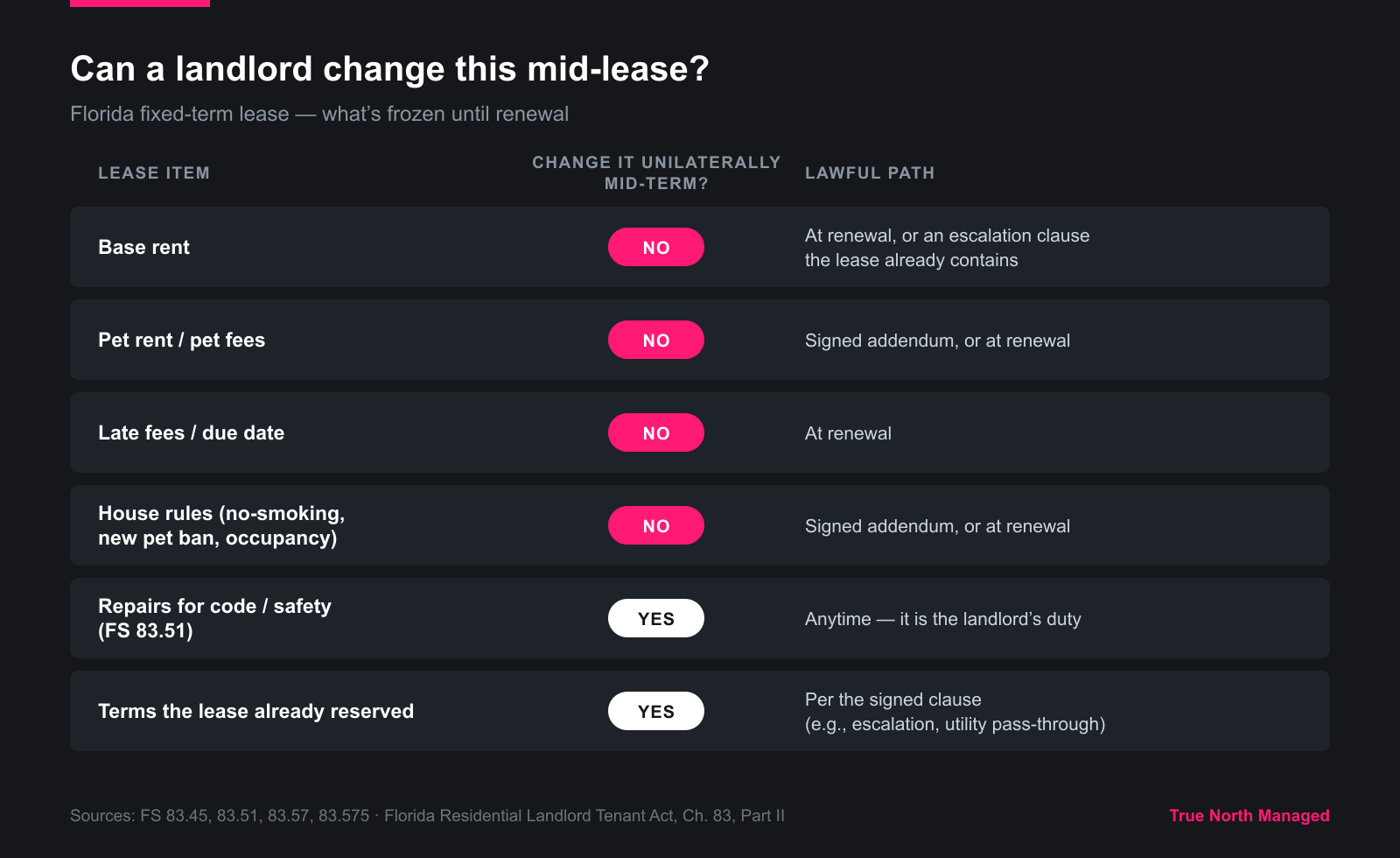
A mutual signed addendum. This is the clean path. You and the tenant agree to change something — maybe they want to add a dog and you agree on pet rent, or you both want to extend the term. Put it in writing, both sign, both date it. Now it's part of the lease. The key word is mutual: the tenant can say no, and if they do, the original terms stand.
Rights the lease already reserved. If the signed lease contains an escalation clause — a defined mid-term rent bump tied to a date, a percentage, or a CPI figure — that's enforceable, because the tenant agreed to it upfront. Same with a written utility pass-through or a clause incorporating the HOA's rules. The change was baked in; you're not adding anything new. One guardrail: Florida's unconscionability statute, FS 83.45, lets a court refuse to enforce a lease provision it finds unconscionable, so a reserved right has to be reasonable, not a trap.
Legal and safety compliance. Some obligations sit above the lease entirely. Under Florida Statute 83.51, the landlord has to keep the property up to building, housing, and health codes for the whole tenancy — you don't need the tenant's permission to make a required repair, and you can't sign that duty away in most cases. The tenant carries matching obligations under FS 83.52 to keep their unit clean and sanitary, regardless of what the lease says. If a new law or code takes effect mid-term, complying with it isn't a lease change at all. You're following the law the lease already sits under.
Fixed-term vs. month-to-month: why it's the whole ballgame
Month-to-month is where change becomes legal. Part II of chapter 83, Florida's residential landlord-tenant law, sets no rent-increase notice period for a month-to-month tenancy. What Florida Statute 83.57 sets is the notice to end one: a tenancy without a specific duration "may be terminated by either party giving written notice in the manner provided in s. 83.56(4)", and for a month-to-month tenancy that means "by giving not less than 30 days' notice prior to the end of any monthly period". That's a rule for ending the tenancy, not for raising the rent. The conservative practice is to give any rent increase or other change the same way — in writing, delivered as 83.56(4) allows, at least 30 days before the end of a monthly period, or longer if your lease requires it. A fixed-term lease has no such lever until it expires.
That's the whole distinction. A month-to-month tenancy renews itself every month, so every month is a tiny renewal where new terms can be offered. Give proper notice, and the tenant either accepts the new rent or moves. FS 83.57 sets the termination notice periods: seven days for week-to-week, 30 days for month-to-month, 60 days for year-to-year. Note that 30-day number — the rule used to be 15 days, and Florida changed it in 2023. Plenty of old templates still say 15. They're wrong.
A fixed-term lease is the opposite. You traded flexibility for certainty — the tenant is locked into the rent, and so are you. If you're not sure which one you have, our guide to month-to-month tenancy in Florida walks through how a fixed lease becomes month-to-month when it expires and the tenant keeps paying.
When is the right time to change lease terms?
Renewal. That's the clean, lawful moment to raise rent, add pet rent, or tighten a rule — the old contract ends, a new one begins, and the tenant agrees to the new terms by signing or stays month-to-month under whatever notice applies. Everything you couldn't do mid-term, you can do here.
Timing is where owners trip. For a fixed-term lease, Florida Statute 83.575, subsection (1), says: "A rental agreement with a specific duration may contain a provision requiring the tenant to notify the landlord within a specified period before vacating the premises at the end of the rental agreement, if such provision also requires the landlord to notify the tenant in a manner prescribed by s. 83.56(4) within such notice period if the rental agreement will not be renewed. A rental agreement may not require less than 30 days' notice or more than 60 days' notice from either the tenant or the landlord." In other words, a clause requiring the tenant's notice only works if it also binds you to give any non-renewal notice within that same notice period. The 15-day rule most landlords miss is a separate one, in subsection (2): "A rental agreement with a specific duration may provide that if a tenant fails to give the required notice before vacating the premises at the end of the rental agreement, the tenant may be liable for liquidated damages as specified in the rental agreement if the landlord provides written notice to the tenant specifying the tenant's obligations under the notification provision contained in the rental agreement and the date the rental agreement is terminated. The landlord must provide such written notice to the tenant in a manner prescribed by s. 83.56(4) within 15 days before the start of the notification period contained in the rental agreement. The written notice must list all fees, penalties, and other charges applicable to the tenant under this subsection." Skip that notice and you can't hold a tenant who leaves without notice to the lease's liquidated damages.
Get the notice out on time, put the new terms in writing, and deliver it a way you can prove — certified mail or hand delivery. Email counts only if you and the tenant signed a separate electronic-notices addendum under Florida's 2025 e-delivery law. For the full renewal playbook — when to raise, how much, when to let a tenant go — see our lease renewal strategy guide.
What if you're handed a new addendum mid-lease?
If you're the tenant, you can say no. Keep paying the original rent, and the terms you signed stay in force — an unsigned change doesn't bind you. If you're the landlord, don't push it. An unsigned change is unenforceable anyway, and threatening eviction to pressure a signature is retaliation risk under Florida Statute 83.64.
We see this from both chairs. Tenants email us panicked because their landlord handed them a new addendum and implied they'd be out if they didn't sign. And owners ask, in good faith, why they can't just fix a pricing mistake mid-term. The answer for the owner is the same as the protection for the tenant: the deal is the deal until it ends. If a tenant refuses a mid-lease change, your options are to live with the original terms or decline to renew when the lease is up — not to force it. Trying to strong-arm a signature turns a pricing problem into a legal one.
Common mistakes landlords make
Treating a portal update as a signed change. Posting new "community rules" or updating the tenant portal isn't a lease amendment. If it changes a material term, it needs a signed addendum. Otherwise it's decoration.
Confusing month-to-month freedom with a fixed lease. Changing terms on notice is a month-to-month tool. Apply it to a fixed-term tenant and your increase is dead on arrival.
Missing the renewal notice window. Even when you do everything right at renewal, skipping the FS 83.575(2) notice — due within the 15 days before the lease's notice period starts — can cost you the liquidated damages if the tenant leaves without notice. Mark the date the moment the lease is signed.
The bottom line
A signed lease means what it says for as long as it runs. Mid-term, a Florida landlord's real options are narrow: agree with the tenant in writing, use a right the lease already reserved, or meet a legal duty. Everything else waits for renewal — and renewal, done on time and in writing, is where you make the changes you actually need.
If you'd rather not track non-renewal windows and addendum wording yourself, that's a lot of what we do. Get a free rental analysis and we'll look at your lease, your timing, and where your rent should be at the next renewal — before a mid-lease guess turns into an unenforceable mess. You can also browse the full Florida Owner's Guide for more on leases, notices, and staying compliant.