

Managing Multiple Rental Properties in Florida Without Losing Your Mind
Systems for managing three to ten Florida rentals: software, standardized processes, contractor networks, accounting, and when to hire a property manager.

You've got three rental properties. Or five. Or ten. Each one is manageable on its own — but together they quietly turn into a second job. Phone calls, maintenance requests, contractor scheduling, bookkeeping, and turnover all stack up at once. Without systems, you burn out.
The landlords who scale across Orlando and Tampa without losing their minds aren't working harder than you. They've built repeatable systems — the same process for every property — so the portfolio runs on rails instead of memory. Here's how to do it.
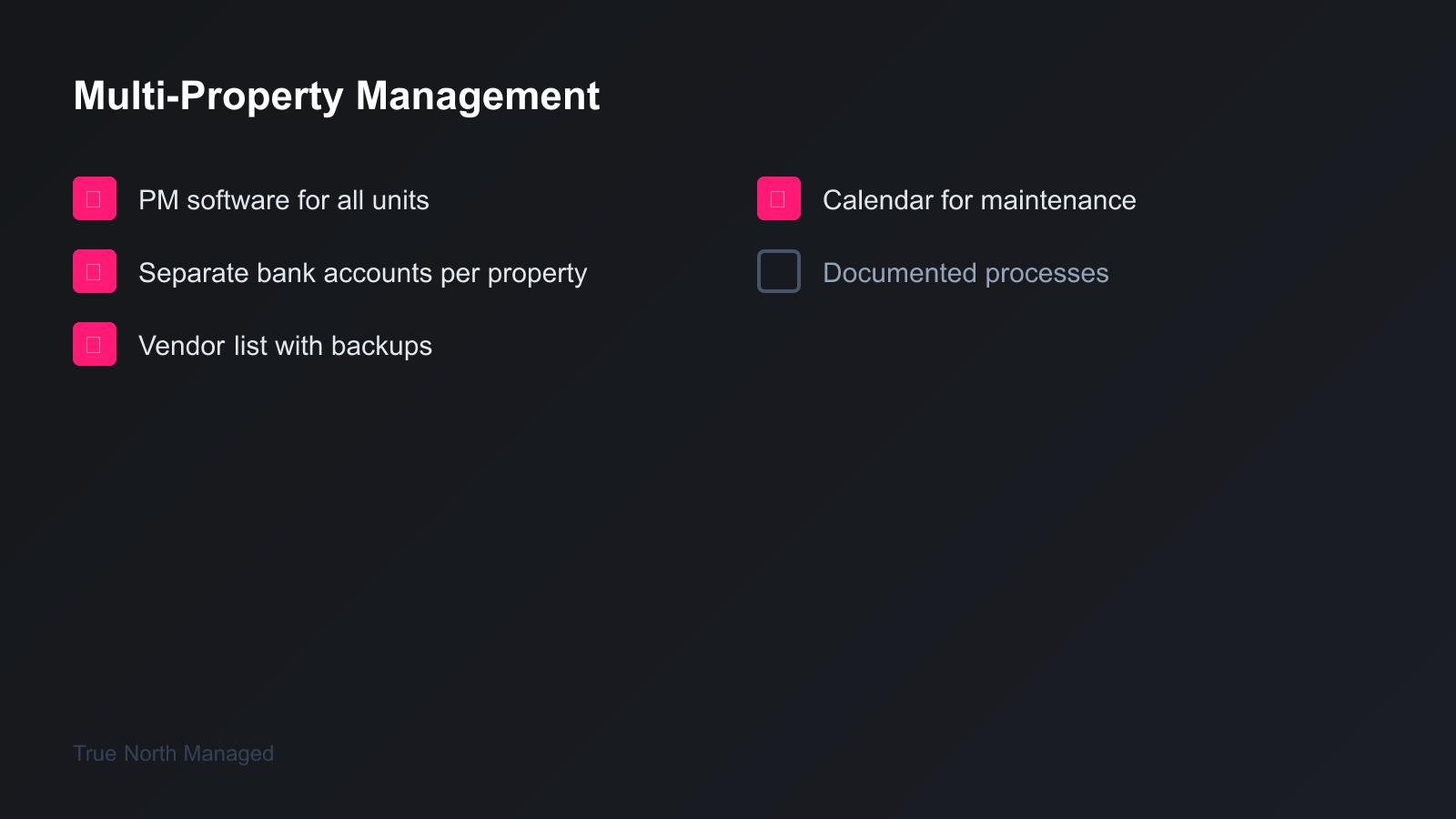
• Pick one property management software and run every property through it — no scattered spreadsheets and email threads.
• Standardize every process — leases, move-in and move-out checklists, maintenance forms — so each property follows the same steps.
• Build a vetted contractor bench (HVAC, plumbing, electrical, general) before you need it.
• Keep clean books by property — track income and expenses per property for Schedule E and depreciation.
• Run the property manager math once you cross 4–5 doors — at 8–10% of rent it often buys back 15+ hours a month.
Why do multiple rentals need systems?
One rental is manageable with a spreadsheet and a good memory. Three or more is a different game. After-hours calls, turnover coordination, and vendor management start eating 10–15 hours a month, and the landlords who scale past that point are the ones who replace heroics with repeatable systems before the workload forces the issue.
A system just means the same process every time — the same rent-collection routine, the same maintenance workflow, the same screening criteria. That doesn't mean every property is identical; a Lake Nona single-family and a Seminole Heights duplex have different tenant profiles and maintenance needs. But the core processes behind them should be the same. Templates, checklists, and a shared calendar do most of the work.
What property management software should you use?
Run rent collection, maintenance requests, lease storage, and accounting through one platform. AppFolio, Buildium, and TenantCloud are the common choices for a small Florida portfolio — pick one and commit. Scattered spreadsheets and random apps don't scale past a couple of doors.
The biggest win is automated rent collection. ACH and online payments beat chasing checks, and late fees should calculate automatically — set the rule once and stop doing manual math. Tenants who pay online tend to pay on time, because the payment is one tap instead of a trip to the mailbox. A single platform also keeps every lease, photo, and maintenance ticket in one searchable place, which matters the day a tenant dispute lands and you need the paper trail fast.
How do you standardize processes across properties?
Create a template for everything repeatable: lease agreements, move-in checklists, move-out inspections, maintenance request forms. When a tenant gives notice, you shouldn't be improvising — you follow the same steps you followed at the last turnover. Our 30-day property turnover checklist gives you a template to start from.
Write a one-page "what to do when" for the scenarios that come up across every property — late rent, a maintenance request, a lease renewal. With five units, you won't remember what you agreed to with the tenant in unit three, so the process has to live on paper, not in your head. Documented processes also make delegation possible: a vendor, a bookkeeper, or a future property manager can step in and follow the same playbook.
How do you build a contractor network?
Build relationships with HVAC, plumbing, electrical, and general contractors before you need them — not at 9 PM when a tenant's AC has failed. With multiple properties, you need contractors who respond quickly and consistently, and that relationship takes time to earn.
Vet each one properly: license, insurance, references, and a small test job before you hand them anything urgent. Our guide on finding and vetting reliable Florida contractors covers the checks that matter. A good bench of three or four trades you trust turns every emergency into a phone call instead of a scramble — and consistent vendors who know your properties do better, faster work.
How should you handle accounting for multiple rentals?
Keep rental money completely separate from personal money, and track income and expenses by property. At tax time you'll need depreciation schedules, repair records, and rent logs broken out per property for your federal Schedule E. Commingling funds creates both accounting headaches and legal exposure.
How you structure the accounts depends on your setup. If each property sits in its own LLC, use one bank account per LLC to keep the liability protection clean. If the properties are held personally, a single dedicated rental account with disciplined per-property bookkeeping inside your software works fine — the key is that every dollar is tagged to a property. A CPA who specializes in rental real estate is worth the fee once you're past two or three doors; our guide to rental property bookkeeping in Florida covers the day-to-day system.
How do you batch tasks across a rental portfolio?
Batching is the single biggest time-saver for a multi-property landlord. Instead of reacting to each property as something happens, you group similar tasks and handle them together — which cuts both drive time and the mental cost of constantly switching contexts.
Do all rent collection on the same day. Schedule routine maintenance for one day a week. Group inspections by neighborhood so one trip covers three properties. Set a recurring weekly block for rent follow-up and vendor coordination, and review your financials on the same day each month. Your time is worth more when you're not jumping between unrelated tasks all week — batching turns a portfolio's scattered demands into a predictable routine.
How do you delegate without losing control?
You can't personally do everything across five-plus units, and trying to is how landlords burn out. Delegate maintenance to vendors, bookkeeping to an accountant, and tenant screening to a property manager or your software — but stay on top of the numbers yourself. Review financials monthly, every month.
The trick is alerts. Rent not received by the 5th? Alert. Maintenance ticket open more than 48 hours? Alert. You don't need to touch every task, but you do need to know the moment something is off track. Delegation with monitoring lets the portfolio run without you, while you stay the one accountable for it.
When should you hire a property manager?
Most landlords hit a wall between three and five doors. After-hours calls, turnover coordination, and vendor management start consuming 10–15 hours a month, and at that point a full-service property manager at 8–10% of collected rent often pencils out cleanly.
The math is simple: if you're spending 10–15 hours a month on your properties and your time is worth more than the management fee, hiring out is the better deal. You free up the hours and get professional handling of tenant communication, screening, and maintenance. Compare Orlando property management costs and Tampa PM costs before deciding, and see our framework on when to hire a property manager. For owners running a portfolio remotely, local presence matters even more — our out-of-state landlord playbook covers why most remote owners hand off the day-to-day.
What are the most common multi-property mistakes?
A few mistakes show up again and again as portfolios grow:
- Mixing personal and rental finances. One audit trail, one set of books, money tagged to a property. Commingling is an accounting and legal headache waiting to happen.
- Treating every property the same. Standardize the process, not the property — a Tampa condo and an Orlando single-family have different tenant pools and maintenance needs.
- Skipping documentation. With five units you won't remember what you agreed to with each tenant. Put everything in writing.
- Scaling before systems. Get accounting, communication, and maintenance workflows solid at two or three doors. Buying door four with no system just multiplies the chaos.
Florida's landlord-tenant law — Chapter 83 of the Florida Statutes — governs most of what you'll handle: notice requirements, timelines, and documentation rules. A well-documented process protects you when a dispute arises. Cities and counties have limited room to add to those rules: FS 83.425 provides that "The regulation of residential tenancies, the landlord-tenant relationship, and all other matters covered under this part are preempted to the state." That preemption reaches only matters covered under that part of Chapter 83; it doesn't switch off local building, housing, or health codes, so in Orlando and Tampa check those for each property.
Systems before scale. Build the routines, document the processes, and lean on a property manager when the math flips. Ready to hand off the day-to-day across your portfolio? Get a free rental analysis and see what full-service management would look like for your properties.