

Orlando Property Management Fees: What You Actually Pay
Orlando property management fees typically run 8-10% of monthly rent. Here's what that covers, what's extra, and where to watch for hidden charges.

You're not just paying a percentage.
When you're shopping for property management in Orlando, the first number you'll see is usually "8% of monthly rent" or "10% of collected rent." That sounds straightforward. But it's only one part of the picture. Leasing fees, setup costs, maintenance markups, and lease renewal charges can add up fast — and some companies bury fees in the fine print.
Here's what Orlando landlords actually pay. The real numbers, based on published fee research and typical fee structures.
What Does Orlando Property Management Cost?
Orlando property management companies typically charge around 8–10% of collected monthly rent for the base management fee. The most recent published fee survey we could find, iPropertyManagement's industry fee research (page last updated September 7, 2022), found that Florida companies that disclosed a management fee averaged 9.04% of collected rent, against 8.49% nationally. Ask for current quotes. For a single-family home renting at $1,800/month, 8–10% is $144–$180 per month.
Some companies offer flat fees instead. Flat fees can work well if your rent is high — a $2,500/month property at 10% would cost $250, so a $199 flat fee saves you money. But if you're renting at $1,400, a flat fee might cost more than a percentage. Run the math for your property.
What's included in the base fee? Typically: rent collection, tenant communication, maintenance coordination, financial reporting, and lease enforcement. Some companies bundle annual inspections; others charge per visit. Some include eviction coordination in the base fee; others add legal fees on top. Get a clear list before you compare quotes.
The Fee Breakdown: What You'll Actually Pay
Beyond the monthly percentage, you'll pay several other fees. Here's how they typically add up in Orlando.
Monthly management fee. 8–10% of collected rent is standard. Some companies charge on "rent due" (the set monthly amount) even when the property is vacant. Others charge only on "rent collected." The latter is better for you — you don't pay when the unit sits empty.
Leasing fee (tenant placement). When you need a new tenant, expect 50–100% of one month's rent. On an $1,800/month rental, that's $900–$1,800 per placement. This fee usually covers advertising, showings, tenant screening, and lease execution. If you're comparing quotes, ask whether the fee includes listing on multiple sites. Some companies charge extra for premium placement.
Lease renewal fee. When a tenant renews, many companies charge $200–$300 per renewal. Some charge 25–50% of monthly rent. Renewals are less work than new placements — no marketing, no showings, no full screening — so flat fees in the $250 range are common and fair. If a company wants 50% of rent for a renewal, that's worth questioning.
Maintenance markup. Many property managers add a percentage on top of repair and maintenance invoices. They coordinate the work, vet vendors, and handle quality checks — so a markup isn't unreasonable. A $500 AC repair with a 10% markup costs you $550. Over a year with a few repairs, that can add $100–$300. But some companies charge no markup and pass through vendor costs directly. That can save you hundreds per year on a property with regular maintenance. Ask upfront.
Eviction handling. If you ever need to evict a tenant, expect legal and administrative fees on top of court costs and lost rent. Florida evictions take as long as service, the tenant's response (an answer or rent paid into the court registry), and the court's calendar allow. Your property manager handles the paperwork, filing, and sheriff coordination — but you still pay the court fees and any attorney costs. The real cost of an eviction is often 1–3 months of lost rent plus turnover expenses. A manager who knows the process can minimize that timeline.
Setup and onboarding. Many companies charge a setup fee when you first bring a property under management. That covers the initial inspection, adding the property to their systems, creating the listing, and getting everything ready for tenants. It's a one-time cost, but it's worth asking what's included — some companies bundle photography and marketing; others charge extra.
What a Typical Year Costs
For a typical Orlando single-family home renting at $1,800/month, here's what year one looks like with a full-service management company:
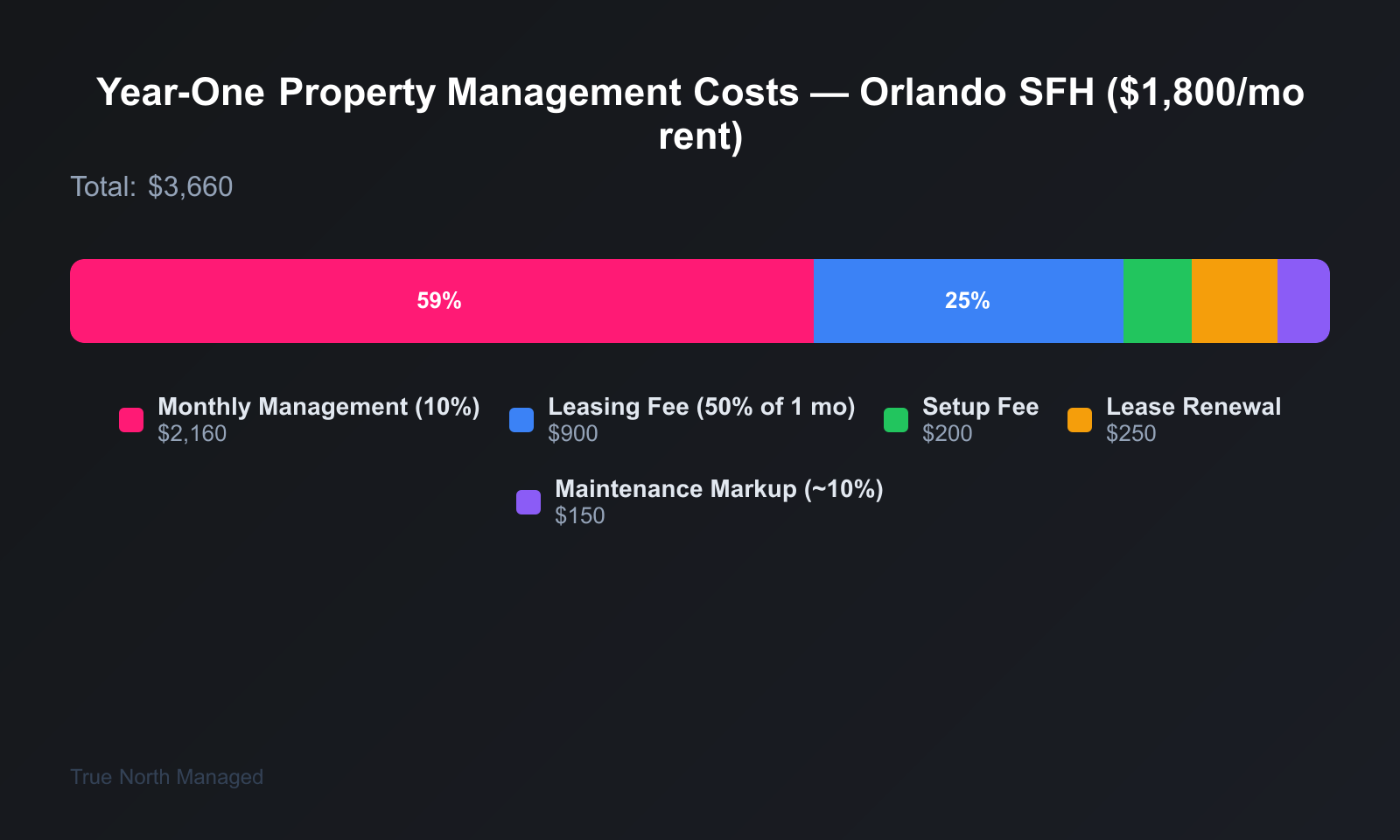
- Monthly management: 10% × $1,800 × 12 = $2,160
- Leasing fee: 50% of one month's rent = $900 (one-time)
- Setup fee: about $150 (one-time)
- Lease renewal: $250 (if your tenant renews)
- Maintenance markup: ~10% on repairs — typically $100–$200/year depending on your property
Total first-year cost: roughly $3,500–$4,000 before you've paid a single repair bill or vacancy loss. That's about 16–18% of your gross rent for the year.
Hidden Fees to Watch For
Not every company is transparent upfront. Here's what to ask about before you sign.
Vacancy fees. Some managers charge you the full monthly management fee even when the property is empty. You're already losing rent — paying 10% of $0 is still $0, but some contracts charge a minimum fee during vacancy. Negotiate this if you can.
Technology or admin fees. A monthly charge for "platform access" or "software fees" shows up in some contracts. If it's not bundled into the base fee, ask what it covers.
Inspection fees. In iPropertyManagement's Florida sample, companies that charge for inspections averaged $120.50 each. Some companies include one or two annual inspections in the base fee; others charge per visit. Clarify before the first inspection.
Early termination fees. Many contracts require 30–90 days notice and charge a fee if you cancel early. Read the termination clause. Some companies waive the fee if you're moving to another property they manage.
Advertising and marketing. If the leasing fee doesn't explicitly include listing costs, ask. Some companies charge extra for premium placement on Zillow or Apartments.com.
Emergency or after-hours fees. A burst pipe at 2 a.m. might trigger an extra coordination fee. Not every company charges this, but it's in some contracts.
Self-Managing vs. Hiring a Manager: The Real Comparison
On paper, self-managing looks cheaper. No 10% fee. No leasing fee. No setup fee. But the hidden costs add up.
Your time. Self-managing landlords typically spend 10–20 hours per month per property. Tenant screening, maintenance coordination, rent collection, lease renewals, inspections. If you value your time at $50/hour, that's $500–$1,000/month in opportunity cost alone.
Maintenance overcharges. Without established vendor relationships, you may overpay for repairs. Property managers often have negotiated rates and volume discounts.
Legal and compliance risks. Miss a deadline on security deposits, skip a required disclosure, or run afoul of Fair Housing — and you could face fines, legal fees, or worse. A property manager who knows Florida landlord obligations reduces that risk.
Eviction costs. If you ever need to evict, doing it yourself can take longer and cost more in mistakes. A manager who knows the eviction process can get you through it faster. Add court filing fees, process server fees, potential attorney costs, and lost rent, and a single eviction gets expensive. A manager who handles it correctly the first time can save you both money and stress.
Tenant quality. Poor screening leads to late rent, property damage, and evictions. A property manager with a solid tenant screening process reduces that risk. One bad tenant can wipe out a year of "savings" from self-managing.
When It Makes Financial Sense to Hire
Property management becomes worth it when:
- You're out of town or don't have time for 10–20 hours of landlord work per month
- You have multiple properties — the economies of scale and systems make a manager more efficient than you
- You inherited a rental and aren't sure where to start — renting vs. selling is a big decision, and a manager can help you evaluate
- You've had a bad tenant and want professional screening and eviction support next time
- Your vacancy rate is high — a good manager can often reduce downtime enough to justify the fee
The math that matters. If you're losing two extra weeks of rent every turnover by self-managing, that's $900 on a $1,800/month property. Do that twice in five years and you've "spent" $1,800 in vacancy loss. A manager who cuts turnover time in half can offset a big chunk of their fee through faster re-rentals alone. The same logic applies to maintenance — negotiated vendor rates and faster response times can reduce repair costs. It's not just about the percentage you pay; it's about what you keep.
When self-managing might work. If you live near the property, have flexible time, and enjoy the work, self-managing can make sense for a single rental. You'll need good systems for screening, rent collection, and maintenance — and you'll need to stay current on Florida landlord responsibilities. Many accidental landlords start here and hire help later when life gets busier.
Verify Your Manager Is Licensed
In Florida, a property management company must be a licensed real estate broker, and its managers need at least a sales associate license under that broker, both issued through the Florida Department of Business and Professional Regulation. There's no separate "property management license." Apart from narrow exemptions in s. 475.011, anyone managing rentals for compensation on behalf of another person needs a real estate license. Before you sign, verify your manager's license online at MyFloridaLicense.com. Unlicensed management can make the manager's fee contract invalid (s. 475.41) and expose you to liability if something goes wrong.
The Bottom Line
Orlando property management typically runs 8–10% of monthly rent plus leasing fees, setup fees, and lease renewal charges. For a $1,800/month property, expect roughly $3,500–$4,000 in management costs in year one. That's not cheap — but it buys you time, compliance, faster tenant placement, and someone who handles the hard stuff when you'd rather not.
If you're weighing the numbers for your own property, a free rental analysis can show you what your home could earn in rent — and what management would cost in real dollars.