

Rental Property Bookkeeping: The Florida Landlord's Monthly System
The landlords who lose money usually lose it through sloppy records. Here's what to track, how long to keep it, and the mistakes that trip up even experienced property owners.

Most landlords don't set out to become accountants. You bought a rental, tenants pay rent, and suddenly you're staring at a shoebox of receipts wondering what the IRS actually wants. Florida rental property bookkeeping doesn't have to be complicated. Here's a monthly system that keeps you organized and ready for tax season.
Why a Monthly System Matters
Rental income and expenses go on IRS Schedule E. The IRS expects you to report gross rent, subtract allowable expenses, and arrive at net rental income or loss. If you wait until April to sort through a year of transactions, you'll miss deductions and invite audit risk. A monthly routine takes 30 minutes and saves hours of stress later.
What to Track Every Month
Income: Rent received, late fees, pet rent, application fees (if non-refundable), laundry income. Record the date, amount, and tenant. If you use a property manager, their monthly statement is your income source.
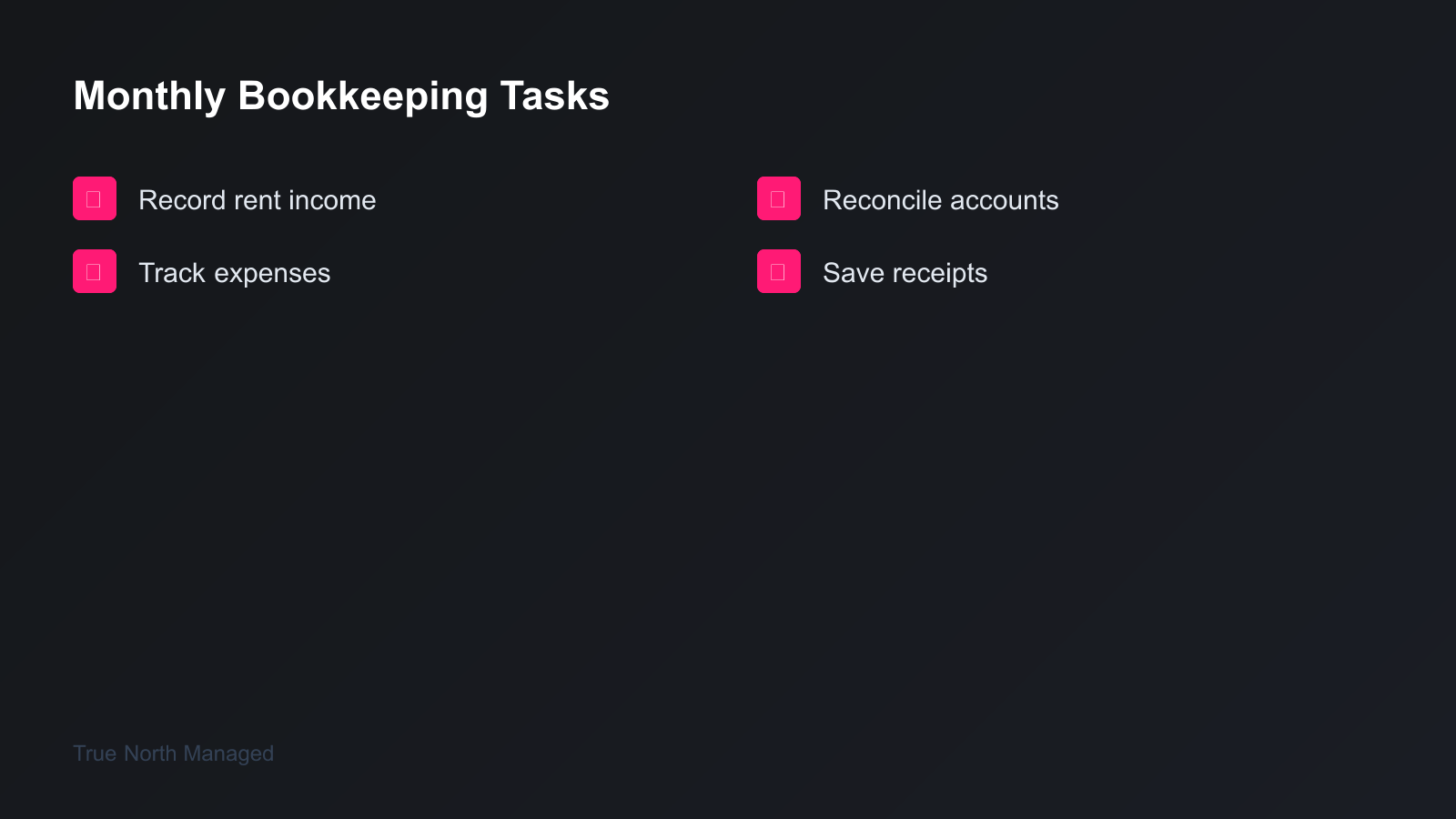
Expenses: Mortgage interest, property tax, insurance, repairs, maintenance, utilities (if landlord-paid), HOA fees, property management fees, advertising, legal fees, and professional services. Every dollar you spend on the rental should have a category.
Mileage: The IRS allows you to deduct miles driven for rental activity. Trips to the property, hardware store runs, meetings with contractors or tenants. Log the date, miles, and purpose. The IRS rate changes annually.
Expense Categories That Matter for Florida Landlords
Repairs vs. improvements: Repairs (fixing a broken AC, patching a roof leak) are deductible in the year incurred. Improvements (new roof, full kitchen remodel) must be depreciated over 27.5 years. The line matters. A repair restores the property to its prior condition; an improvement adds value or extends life.
Property management fees: If you use a property manager in Orlando or Tampa, their monthly fee is fully deductible. Same for leasing fees, eviction costs, and maintenance coordination.
Insurance: Landlord insurance, flood, windstorm, and umbrella policies are all deductible. Florida's insurance market is volatile; keep premium records for every policy year.
Software Options
QuickBooks: Full-featured, integrates with banks and property management software. Overkill for one or two doors but scales well.
Stessa: Built for rental investors. Auto-categorizes income and expenses, tracks depreciation, generates Schedule E reports. Free tier for small portfolios.
Baselane: Banking and bookkeeping in one. Good for landlords who want separate accounts per property.
Spreadsheets work if you're disciplined. The key is consistency: same categories, same cadence, same level of detail.
Receipts and Documentation
Keep receipts for every expense over $75. For smaller amounts, a credit card or bank statement is usually sufficient. Store digitally: photograph receipts, use a cloud folder or app. The IRS says to keep records for 3 years after filing in most cases, and for 6 years "if you do not report income that you should report, and it is more than 25% of the gross income shown on your return." Records on the rental itself are different: "Generally, keep records relating to property until the period of limitations expires for the year in which you dispose of the property." Those are the records behind your depreciation and your gain or loss on sale.
Tax Prep Checklist
By January, you should have: 12 months of income totals, 12 months of expense totals by category, mileage log, depreciation schedule (if you have improvements), and records of any large repairs or capital expenditures. Your CPA or tax software will need this. See our Florida rental property tax guide for more on deductions. Whether you self-manage or use a property manager, clean books make tax season predictable. If you're in Orlando or Tampa and want help with the operational side so you can focus on the numbers, get a free rental analysis and we can walk through what a managed property looks like on paper.
Software vs. Spreadsheet
Spreadsheets work for 1–2 properties. Beyond that, consider QuickBooks, Stessa, or Buildium. They categorize transactions, generate reports, and export to Schedule E format. Expect $15–50/month depending on features. The time savings usually justify the cost. IRS Schedule E instructions list what to report. Match your categories to the form.
Common Bookkeeping Mistakes
Mixing personal and rental expenses. One audit trail. Another mistake: not tracking mileage. The IRS allows a per-mile deduction for rental activity. Use a log or app. Forgetting to depreciate. Rental property depreciation is a major deduction. Finally, losing receipts. The IRS can disallow deductions without documentation. Scan or photograph every receipt and file by property and year.
When to Hire a CPA
If you have multiple properties, depreciation recapture, or a 1031 exchange, hire a CPA. A one-time setup fee plus annual filing often runs $500–1,500. They catch deductions you'd miss and handle audit risk. For a full tax deductions checklist, see our guide.
Need help with the numbers? Get a free rental analysis to see your property's income and expense breakdown.
Bottom line: monthly routine beats April panic. Categorize every transaction, track mileage, and keep receipts. Software pays for itself at 3+ properties. Schedule E matches your categories—use them. A CPA is worth it for multiple properties or complex situations.
Reconcile bank statements monthly. Catch errors and categorize transactions while they're fresh. Waiting until tax season means guessing at old receipts. A clean set of books also makes it easier to sell a property or bring in a partner—they'll want to see the numbers.
Set a monthly reminder. The 5th of each month: reconcile, categorize, file. Thirty minutes then saves hours at tax time. Consistency beats cramming. Your future self will thank you when April arrives and the books are already done.
If you own a rental in Orlando or Tampa and want a clear picture of what it could earn, get a free rental analysis. No obligation—just real numbers.