
The 30-Day Property Turnover Checklist for Florida Landlords
When one tenant leaves and the next one hasn't signed yet, every empty day costs you. Here's a week-by-week plan to turn your Florida rental in 30 days.
Most checklists treat a turnover like a to-do list: scrub, paint, photograph, list, repeat. After years of turning Orlando and Tampa rentals, we've come to see it differently. The 30-day clock isn't really about speed. It's about sequence — the order in which you start the deposit claim, schedule the make-ready, and get the unit in front of renters. Owners don't lose money because they're slow. They lose it because they run the steps in the wrong order, and the leaks all hide in the gaps between them.
The day your tenant hands back the keys, you're up against two clocks. One is the leasing clock: every empty day, you're paying the mortgage, taxes, and insurance with no rent coming in. The other is the legal clock under Florida's deposit law, which counts from the day the lease ends and does not pause while you wait on a contractor's invoice. A good rental turnover checklist for Florida landlords runs both clocks side by side instead of letting one trip the other. A well-run turnover from move-out to new-tenant keys takes about 30 days in Orlando and Tampa — faster when the unit's in good shape and the market's hot, longer when repairs pile up or screening drags.
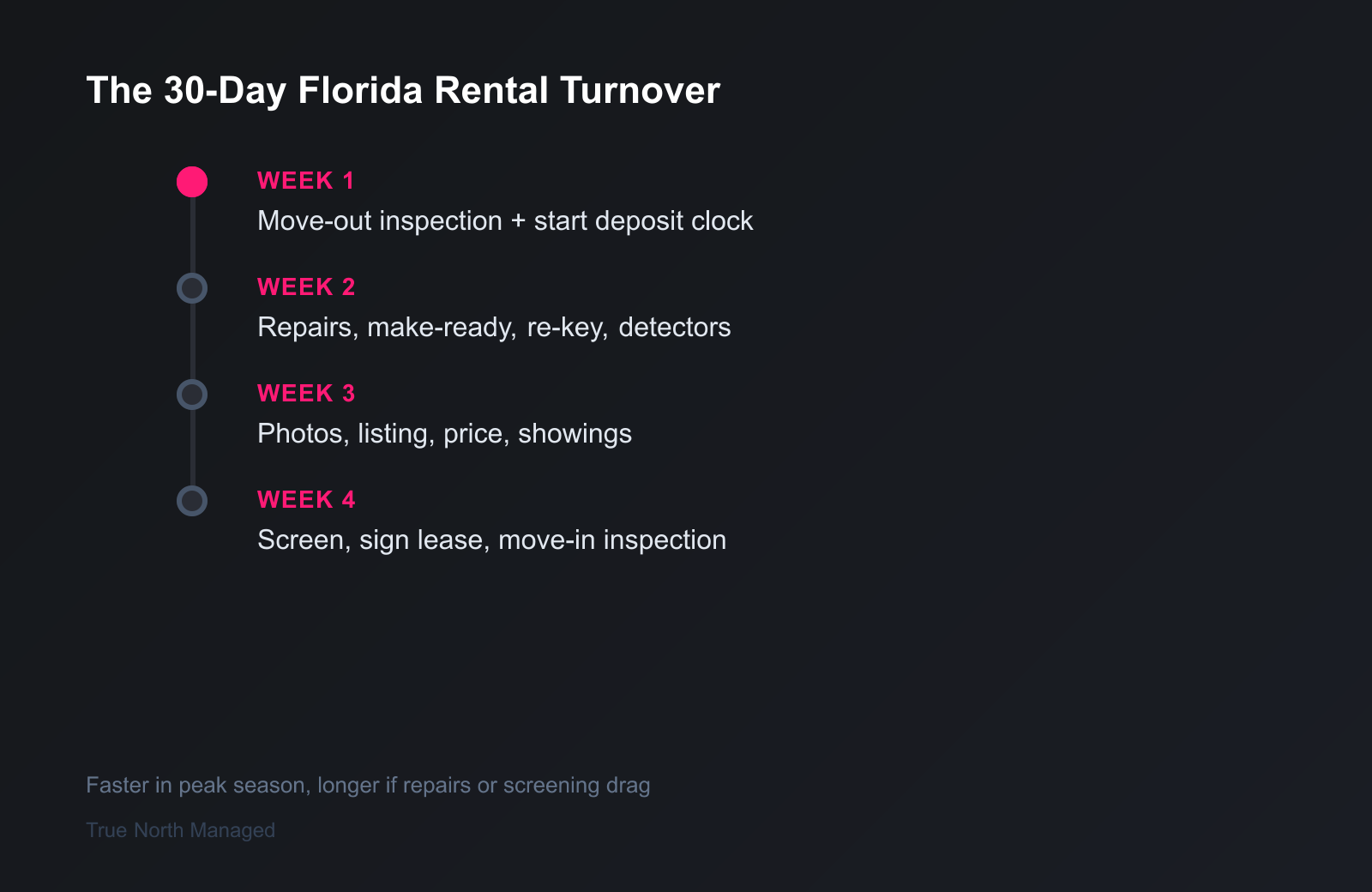
We'll walk it day by day, in the order that actually protects your money: inspection and the security deposit decision in Week 1, repairs and make-ready in Week 2, listing and showings in Week 3, screening and lease signing in Week 4. Print it, tape it to the fridge, and check the boxes as you go.
Why does a 30-day turnover plan matter?
A 30-day turnover plan matters because vacancy is the most expensive thing that happens to a rental — and because Florida's deposit deadline is a hard wall that punishes a sloppy sequence. The cost of an empty unit goes well past the rent you're missing. You keep paying the mortgage, taxes, and insurance the whole time, and across the industry a single turnover commonly lands somewhere near one and a half to two times a month's rent once you add it all up.
Walk the math. If your Tampa rental brings in $2,100 a month, that's roughly $70 in lost rent for every day it sits empty, before you've spent a dollar on paint or cleaning. Drag a 30-day turnover out to 50 days because nobody scheduled the make-ready, and you've handed back most of a month's profit. Spend time on r/landlord or BiggerPockets and you'll see the same confession over and over: a unit that "sat empty six weeks" because the owner ordered repairs late, or a make-ready bill that "came in double what I expected" because the scope wasn't scoped before the tenant left. Those aren't bad-luck stories. They're sequence failures.
Here's the part generic checklists bury at the bottom: the deposit clock is the one deadline in the whole turnover that does not bend. Most turnover articles you'll find list the deposit return as one task among forty, somewhere near "replace air filters." We put it first, on purpose, because Florida law puts a hard deadline on it and missing that deadline costs you the right to deduct anything from the deposit — not a portion, the whole claim. The deposit goes back in full, the damage becomes a separate lawsuit, and if either side takes the deposit to court and the tenant prevails, you can owe their attorney fees too. A plan exists to keep the legal clock and the leasing clock running in lockstep, so the make-ready never quietly eats the days you needed to file your claim. If you want the strategy layer on top of this checklist, our guide to keeping turnover vacancy short in Florida covers the moves that shave days off the front end before the tenant even leaves.
Week 1: What do you do the moment the tenant moves out?
In Week 1 you inspect the unit, document its condition, and — this is the step owners skip — start the security deposit paperwork the same day, not after the repairs are priced. This is the week that protects you legally, so move quickly and write everything down.
Day 1 — Tenant vacates. Collect every key, fob, garage remote, and mailbox key. Confirm the unit is empty and utilities are still on in your name or theirs. Walk through once to gauge the scope of work ahead.
Day 1–2 — Move-out inspection. Do a full walkthrough with your camera. Photograph every room, appliance, wall, and floor, and compare it against the move-in report you took at the start of the tenancy. Normal wear and tear is on you; actual damage beyond that can come out of the deposit. If you want a room-by-room version of this step, our move-out inspection checklist for Florida rentals breaks down exactly what to look for and how to document it so it holds up.
Day 2–5 — Handle the security deposit. This is where Florida law gets specific, and where a lot of landlords get it wrong. Get the timeline right and you're protected. Get it wrong and you can forfeit your whole claim against the deposit.
How long do you have to return a security deposit in Florida?
Under Florida Statute 83.49, you have 15 days to return the deposit in full if you're not keeping any of it, or 30 days to send written notice if you are making a claim. There is no "15 to 60 day" window, despite what a lot of online checklists say.
Here's the structure under Florida Statute 83.49, the deposit law:
- No deductions: If you're returning the full deposit, you must send it within 15 days after the lease ends.
- Making a claim: If you're keeping any of it for damages or unpaid rent, you must send the tenant written notice by certified mail (or by e-mail "in accordance with s. 83.505," which applies only if you and the tenant both signed an e-delivery addendum and gave valid e-mail addresses, and neither of you has revoked it) within 30 days after the lease ends, stating the amount you're claiming and why.
- Tenant's response: Once they get that notice, the tenant has 15 days to object to the deduction in writing.
- The penalty: Miss the 30-day notice and the statute is specific: "If the landlord fails to give the required written notice within the 30-day period, he or she forfeits the right to impose a claim upon the security deposit and may not seek a setoff against the deposit but may file an action for damages after returning the security deposit to the tenant." You'd return every dollar and have to sue separately for the damage. You can also end up owing the tenant's attorney fees.
In our experience managing Orlando and Tampa rentals, this is the turnover step that actually trips owners up — and it almost never trips them the way they expect. Nobody forgets the deposit exists. What they do is wait. They hold the claim letter until the drywall contractor's invoice lands so they can put an exact number on it, the invoice slips a week because the vendor's booked, and suddenly day 30 is behind them. The law does not care that you were waiting on paperwork. Send the written notice with your best documented estimate inside the window and reconcile the final dollars afterward; a defensible claim sent on day 28 beats a perfect one sent on day 33. Mark the deadline on your calendar the day the lease ends, and treat certified mail with a tracking number as non-negotiable proof you sent on time.
For remote owners: if you're managing from out of state, this is the week you can't phone in. Have someone you trust physically walk the unit and send you timestamped photos the same day, so your deposit decision rests on evidence, not a tenant's word — and so your claim letter goes out on the calendar, not whenever the photos finally arrive.
Week 2: How do you get the unit rent-ready?
In Week 2 you fix what the inspection turned up, deep clean, and handle the Florida-specific make-ready items that generic checklists skip. The goal is a unit that's move-in ready by the end of the week — but the goal underneath the goal is to scope this work in Week 1 so the Week 2 invoices don't surprise you the way they surprise the landlords venting online.
Order repairs the day after your inspection. If the work is more than minor touch-ups, get quotes early; vendors book out, and a week-long wait on a handyman is a week of vacancy you're paying for. Sequence the make-ready so trades don't trip over each other: repairs first, then paint, then carpet or floor cleaning, then the final deep clean. Run it out of order — clean before you patch drywall — and you pay to clean twice.
A solid make-ready covers:
- Repairs from the inspection — drywall, fixtures, hardware, anything flagged in Week 1.
- Paint — a fresh coat on scuffed walls does more for showings than almost anything else.
- Deep clean — floors, baseboards, appliances inside and out, bathrooms, windows, and the often-forgotten range hood and dryer vent.
- HVAC service — replace filters and service the AC if it's due. In Florida, the air conditioner is the hardest-working system in the house. Our HVAC maintenance guide for Florida rentals covers what to schedule and when.
What Florida-specific tasks do most landlords forget?
The make-ready items most landlords forget in Florida are re-keying the locks, testing the smoke and carbon monoxide detectors, and keeping the AC running while the unit sits empty. These three protect you from liability, code violations, and mold — and they're exactly the items the national checklists leave out, because they're not national problems.
Re-key the locks. Florida doesn't strictly require it between tenants, but Florida Statute 83.51, in subsection (2)(a), says: "Unless otherwise agreed in writing, in addition to the requirements of subsection (1), the landlord of a dwelling unit other than a single-family home or duplex shall, at all times during the tenancy, make reasonable provisions for" a short list that includes "Locks and keys." So outside a single-family home or duplex, working locks are your duty unless the lease says otherwise. Either way, re-keying is a basic security step that limits your liability. Here's the practitioner read on it: the old tenant handing back two keys proves nothing about how many copies got cut at the hardware store over a two-year lease. If a former tenant or their guest still has a working key and something happens, "they returned their copies" is not the defense you want to be making. A locksmith can re-pin most locks for a fraction of replacement cost, or a re-keyable deadbolt lets you do it yourself.
Test the detectors. For smoke detectors, Florida Statute 83.51(2)(b) says: "Unless otherwise agreed in writing, at the commencement of the tenancy of a single-family home or duplex, the landlord shall install working smoke detection devices." For any unit, the building, housing, and health codes that 83.51(1)(a) makes your duty can add their own requirements. For carbon monoxide, Florida Statute 553.885 says: "Every separate building or addition to an existing building, other than a hospital, an inpatient hospice facility, or a nursing home facility licensed by the Agency for Health Care Administration, constructed on or after July 1, 2008, and having a fossil-fuel-burning heater or appliance, a fireplace, an attached garage, or other feature, fixture, or element that emits carbon monoxide as a byproduct of combustion shall have an approved operational carbon monoxide alarm installed within 10 feet of each room used for sleeping purposes in the new building or addition, or at such other locations as required by the Florida Building Code." In plain terms, the statute reaches homes built, or added onto, on or after July 1, 2008 that have a gas appliance, a fireplace, an attached garage, or another carbon monoxide source. Swap batteries or replace any 10-year sealed unit that's aged out. A non-working detector is both a code problem and a safety one.
Keep the AC on. This is the Florida tax nobody warns you about, and it's the one that turns a routine turnover into a remediation bill. An empty unit with the AC off in July is a mold farm waiting to happen, because the real culprit isn't heat — it's humidity. The AC isn't just cooling the air; it's pulling moisture out of it. Switch it off and indoor humidity equalizes with the swamp outside within a day. Once relative humidity climbs past about 60%, drywall and carpet become a breeding ground, and mold can take hold in 24 to 48 hours. Set the thermostat to roughly 76 to 80 degrees while the unit's vacant so the system cycles enough to dehumidify — not 85, which saves a few dollars but doesn't run the compressor often enough to do the job. The handful of dollars in electricity beats remediation and a delayed move-in every time. We've watched owners try to save twenty dollars on a vacant unit and hand back a four-figure mold problem.
A mid-market make-ready often runs a few hundred to a couple thousand dollars depending on the unit's condition, so budget for it as a real line item rather than an afterthought. The cleaner the prior tenant left it, the cheaper and faster this week goes — which is another argument for documenting condition obsessively in Week 1.
Week 3: How do you list and show the rental?
In Week 3 you photograph the finished unit, write the listing, price it against current comps, and start showings. The unit looks its best right now, so this is the week to get it in front of renters.
Take your listing photos the moment the make-ready is done and the unit is empty and bright. Shoot in daylight, open the blinds, and lead with the kitchen and living space. Then write a listing that names the specifics renters search for: bedrooms, baths, square footage, parking, pet policy, and the neighborhood.
Price it against what's actually renting right now, not what you got two years ago — and price it at the submarket level, not the metro level, because Tampa and Orlando rents swing hard from one neighborhood to the next. A three-bedroom in Carrollwood's 33618 ZIP (the Carrollwood Village core), where Zillow's rent index put the typical asking rent at about $1,623 in August 2026, does not list at the same number as one in South Tampa, and renters know it. Pull recent comparable listings in the same submarket and bed count, and price at or just under the going rate to move it faster. Post where your market actually rents: Zillow, Apartments.com, and the local Facebook groups for the neighborhood. For the full playbook on getting eyes on the unit, our guide on marketing a vacant rental in Florida walks through the listing-to-leased pipeline.
Schedule showings in tight blocks rather than one-offs. Grouping showings creates a little urgency among applicants and saves you trips, and it gets the unit leased faster. Start collecting applications as people tour, so you're not waiting until the end of the week to begin screening.
Week 4: How do you screen applicants and sign the lease?
In Week 4 you screen applicants, pick your tenant, sign the lease, and do the move-in inspection. This is the week that determines whether the next 12 months are smooth or stressful, so don't rush the screening to save a day. A turnover sequence that protects your deposit and your make-ready budget falls apart if you hand the keys to the wrong person to save 48 hours.
Run a full screen on every adult applicant: credit, criminal background, eviction history, and income and employment verification. Most screening reports come back in one to three days, though a tougher case can take longer, so submit them as applications arrive rather than batching them at the end. Knowing the warning signs speeds this up; our breakdown of tenant screening red flags in Florida covers the patterns worth a second look before you approve.
Once you've picked your tenant:
- Send the lease and give them a clear deadline to sign.
- Collect the deposit and first month's rent before handing over a single key.
- Do the move-in inspection together — walk the unit with the new tenant, photograph its condition, and have both of you sign the report. This is the document that protects you at the next turnover, so treat it as the first step of the next cycle, not an afterthought.
- Hand over keys and confirm the new tenant has put utilities in their name.
That move-in report closes the loop. The condition you document today is the baseline you'll compare against when this tenant eventually leaves, which is exactly where Week 1 of your next turnover begins — and the better you document it now, the faster and cleaner your next deposit decision goes.
What if the turnover runs longer than 30 days?
If your turnover runs past 30 days, the usual culprits are slow repairs, a soft rental season, or screening delays, and each has a fix. Thirty days is the target, not a guarantee, and a few situations stretch it.
In a hot leasing season — often spring and early summer in Central Florida — a clean unit can lease in a week or two and your whole turnover finishes ahead of schedule. In a slower stretch, usually late fall and winter, plan for the listing phase to run longer and price accordingly. The fix is the same in both cases: stay ahead of the calendar. Order repairs the day after the inspection, line up your make-ready vendors before you need them, and start screening as applications come in instead of waiting.
The single biggest delay is starting late — and "late" almost always means starting the sequence at the wrong end. A turnover that begins the day the tenant leaves is already behind one a savvy landlord started the moment they got the non-renewal notice. Notice that the delay and the deposit risk share a root cause: an owner who reacts to the empty unit instead of running a sequence they set in motion weeks earlier. For the deeper strategy on overlapping the old lease and the new one to cut vacancy to near zero, lean on the Florida tenant turnover playbook.
The bottom line on Florida rental turnovers
A turnover is a 30-day project with four moving parts: inspect and decide the deposit, make the unit ready, list and show, then screen and sign. But the order is the whole game. Run the four parts as a sequence — deposit work started day one, make-ready scoped before it's ordered, pricing set at the submarket — and you protect both your legal footing and your bottom line. Run them as a loose pile of tasks and vacancy eats your margin one empty day at a time while the deposit deadline slides past in the background.
The Florida-specific pieces are what separate a clean turnover from an expensive one: start the security deposit claim on day one instead of waiting on invoices, re-key the locks, keep the AC running so the empty unit doesn't grow mold, and never hand over keys before the deposit and first month's rent are in hand. For the full library of landlord operations guidance, our Florida Owner's Guide ties the whole rental lifecycle together.
Do that, and the next time a tenant hands back the keys, you won't be scrambling to react. You'll be running a sequence — checking boxes in the order that keeps the money where it belongs.