
How to Vet and Hire Contractors for Your Florida Rental
A bad contractor on your rental can cost you twice. Here's how to verify a license, compare bids, check insurance, and protect yourself from a construction lien.
The AC quits during an Orlando July. A pipe lets go at 2 a.m. in a Tampa duplex. Your tenant texts a photo of water spreading under the kitchen sink. You need a repair, you need it now, and there's a name in your phone you've never actually checked out.
Here's the thing most guides get backwards. They tell you to verify the license first, and they're right that you should. But the license check is the easy part. Run a name through a state portal, two minutes, done. The part that actually costs Florida landlords money is the part those guides skip past: the construction lien that lands at your closing table after you already paid in full, and the uninsured injury your own policy quietly declines. Those don't show up the day of the repair. They show up months later, at sale, at refinance, or in a denied claim, when it's far too late to fix the paperwork you didn't collect.
That's the moment this guide is for. Not building a long-term bench of vendors, but vetting the one contractor standing between you and a fixed problem, the right way, so a $2,000 repair doesn't turn into a $20,000 problem you don't see coming. Get it wrong and a bad hire costs you more than the repair. They drag the job out, do work that fails in six months, or leave you on the hook when they're unlicensed and someone gets hurt. Florida's construction lien law can also make you pay for the same job twice if you handle the money carelessly.
Vetting contractors for a Florida rental property comes down to four things you do before any cash changes hands: confirm the license, get real bids, verify insurance, and protect yourself against a lien. The first one is quick. The last two are where the real exposure lives. Here's how each one works.
Why does contractor vetting matter more on a rental than your own home?
A rental is a business asset, and the stakes run higher than they would on the house you live in. You carry a legal duty to keep the unit habitable under Florida law, which means repairs can't sit while you find someone trustworthy. At the same time, every dollar and every liability funnels through you, the owner. There's no homeowner exemption to lean on, no "I did it myself" path that's actually legal on a property you don't occupy. If a contractor's worker gets hurt on your rental and there's no coverage in place, the bills can land on your desk. If a subcontractor goes unpaid, your property can get liened even when you paid the main contractor in full.
So vetting isn't bureaucracy. It's the cheapest insurance you'll buy on the whole job. Ten minutes of checking up front saves you from the three expensive failure modes: shoddy work, an uninsured injury, and a surprise lien. The owners who get burned almost always skipped one of the steps below because the repair felt urgent. Urgent and reckless aren't the same thing. We see the same pattern over and over: the panic of a leaking unit talks an owner into saying yes to the first person who answers the phone, and the cost of that yes surfaces long after the leak is dry.
How do you verify a contractor's license in Florida?
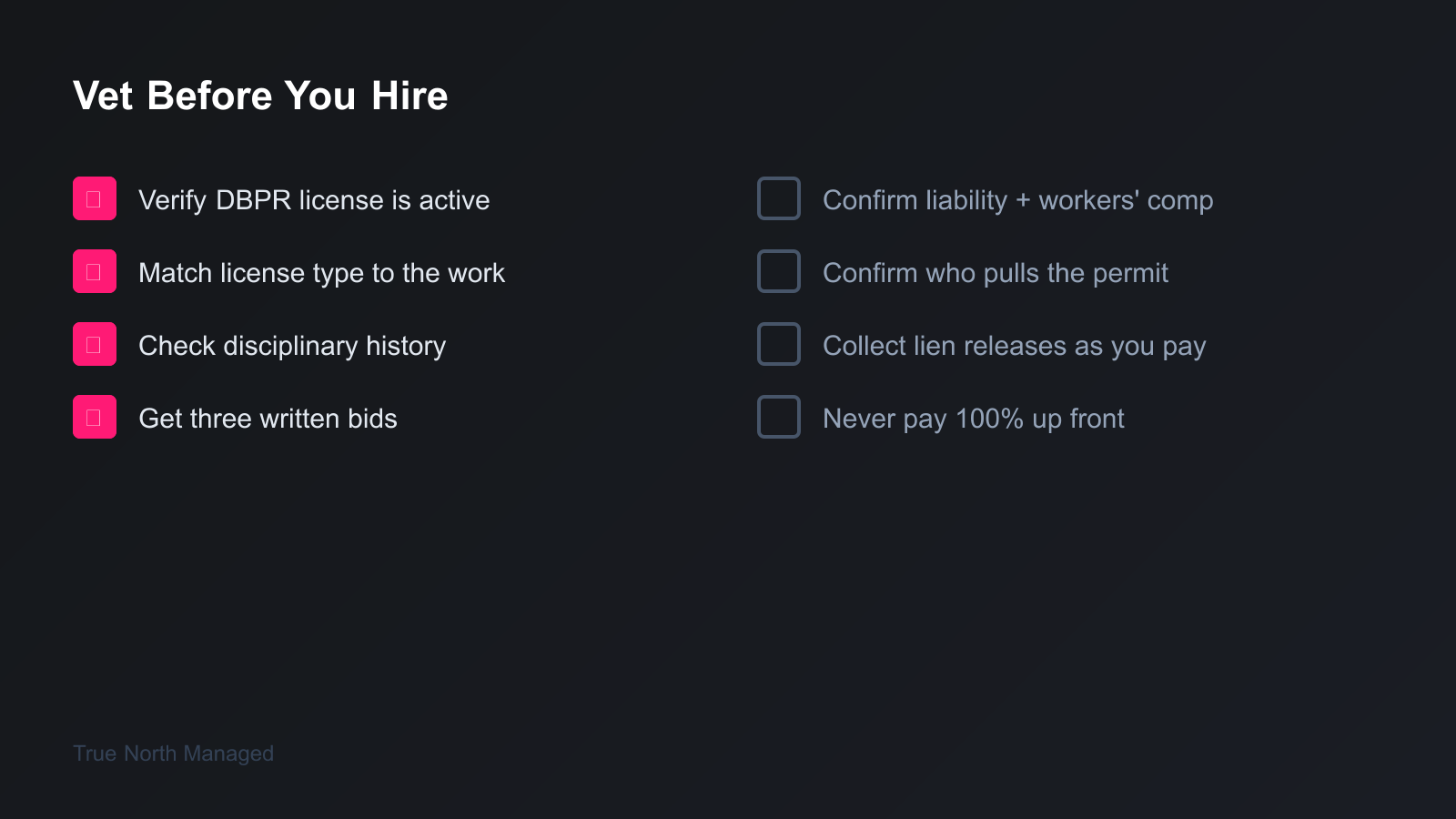
Before anyone touches the property, confirm the license at the Florida Department of Business and Professional Regulation. Search the contractor's name or license number on the DBPR licensee verification portal, check that the license is active and in good standing, and make sure the category matches the work.
In Florida, construction contracting is regulated under Chapter 489 of the statutes. Electrical, plumbing, HVAC and mechanical, roofing, and general or building work all require a state-certified or registered license. The license type matters: a general contractor's certificate doesn't authorize someone to rewire a panel, and an HVAC license doesn't cover a re-roof. The DBPR search shows you the exact category, the status, and any disciplinary history.
A few people will tell you they don't need a license. Be careful with that. The owner-builder exemption under FS 489.103 lets an owner act as their own contractor on a one- or two-family home, but only for a residence they occupy and don't offer for sale or lease, and the owner has to personally sign the permit. It is not a workaround for a rental. The other line you'll hear is that the job is too small to need a license. Truly minor, inconsequential work can fall below the licensing line, but the moment a job needs a building permit or touches electrical, plumbing, HVAC, or structure, a license is required no matter how small the dollar figure looks.
Red flag: A contractor who says "I'm licensed" but can't give you a number, or whose record shows disciplinary action, is a walk-away. Florida's FS 489.128(1) says contracts "entered into on or after October 1, 1990, by an unlicensed contractor shall be unenforceable in law or in equity by the unlicensed contractor," and 489.128(3) says the section "shall not affect the rights of parties other than the unlicensed contractor to enforce contract, lien, or bond remedies." So the unlicensed contractor can't enforce the deal against you, and you keep your own remedies, but chasing someone with no license or insurance for bad work is slow going.
This is the step most online guides stop at, as if the license check were the whole job. It isn't. It's the fast, free, do-it-from-anywhere step that everyone agrees on. For out-of-state owners that's a gift: ask for the license number by text or email, run it yourself in two minutes, and screenshot the result for your file. You don't need to be standing in the driveway. But don't mistake the easy step for the protective one. The two steps that actually shield your equity come later, and they're the ones the generic checklists rush through.
Where do you actually check a license and permit in Orlando and Tampa?
The DBPR portal covers the statewide trade license. Permits are local, and the office depends on which side of a city line your rental sits on. This trips up owners constantly, because the property tax bill says "Orlando" or "Tampa" while the permit lives somewhere else.
In the Orlando metro, a property inside city limits permits through the City of Orlando's Permitting Services Division on South Orange Avenue, while a rental in unincorporated Orange County, common across the Lake Nona corridor and the newer subdivisions, goes through Orange County Building Safety on South Rosalind Avenue. They're different systems with different records. An owner-builder permit, the one you can't legally use on a rental anyway, has to be signed in person, which is the county's own way of slowing down exactly the move you shouldn't be making.
The Tampa side has the same split with a sharper trap. Hillsborough County runs its permits through the HillsGovHub online portal, but a county search alone can miss a permit pulled with the City of Tampa, which handles its own construction services on North Boulevard. So a Seminole Heights or Carrollwood owner who searches only the county database and sees nothing might conclude the prior work was unpermitted when it was actually filed with the city, or the reverse. Search the right jurisdiction for where the property physically sits, not where the mailing address says.
The local-contractor reality matters here too. Tampa's unlicensed pool is not theoretical. Hillsborough County's sheriff has run repeated undercover stings, including the multi-house "Operation House Hunters" sweep and a separate operation in Sun City Center, and pulled in scores of people working without a license each time. The cheap guy who showed up fast and quoted half of everyone else may be exactly the kind of operator those stings exist to catch. Checking the license isn't an insult to a good contractor. It's the difference between a vendor and a defendant.
How many bids should you get, and how do you compare them?
For any repair beyond a few hundred dollars, get at least three written bids. In Orlando and Tampa, labor rates swing by trade and by neighborhood, so three quotes tell you what the job actually costs instead of what one contractor hopes you'll pay.
The trick is comparing apples to apples. Hand every bidder the same scope: the same problem, the same fix, the same grade of materials. A bid for a "new AC" is useless if one contractor priced a builder-grade unit and another priced a high-efficiency system with a new line set. Spell out what you want so the numbers mean something.
Then read the spread. If two bids cluster and one comes in far below, ask why before you celebrate. Sometimes it's an honest mistake. More often the low bidder left something out, plans to cut a corner, or intends to "discover" extra costs once the walls are open. Landlords on the investing forums tell the same story on a loop: the contractor who underbid to win the job, took the deposit, and either vanished or stretched a two-week job into a three-month standoff. One owner described a contractor disappearing two weeks into a job on a Tampa investment property after starting strong. The cheapest number on the page is rarely the cheapest job by the time it's done.
Get every bid in writing with a clear scope, a price, a rough timeline, and what's excluded. A contractor who won't put the work on paper is telling you how the rest of the job will go.
What insurance and permits should you confirm before work starts?
Two documents protect you here: a certificate of insurance and a pulled permit. Skip either and you've quietly taken on a risk that should have been the contractor's.
Ask for a current certificate of insurance showing general liability and workers' compensation, with you listed as the certificate holder so the insurer notifies you if coverage lapses. This isn't paperwork for its own sake. Standard landlord and homeowner liability policies commonly exclude injuries tied to knowingly hiring an unlicensed or uninsured contractor, and an insurer can deny a claim or even void your coverage when a defect traces back to unlicensed work. If a worker with no workers' comp gets hurt on your property, the medical and lost-wage costs can roll uphill to you. A few minutes confirming a certificate is far cheaper than that conversation.
The gotcha that bites owners: In our experience managing Orlando and Tampa rentals, the contractor mistake that actually costs owners isn't the bad repair, it's the paper they didn't collect. An uninsured contractor's injury can leave your own liability policy unwilling to pay. Unpermitted work doesn't stay hidden either: it surfaces at sale, at refinance, or during an inspection, and the fix can mean tearing out finished work to re-permit it. The savings from skipping a permit are always smaller than the cost of undoing the problem later, and the bill lands at the worst possible moment, the closing table.
When a job needs a permit, the licensed contractor should pull it in their name, not yours. A contractor who wants you to pull an owner-builder permit for work you're not supervising is shifting liability onto you, and on a rental that permit isn't even legal in your hands. That's a signal to slow down and ask why. The undocumented AC swap that "saved" a few hundred dollars in permit fees is the same swap a buyer's inspector flags two years later, and now you're re-permitting and possibly re-doing finished work to close a sale.
How does Florida's lien law let you pay twice, and how do you stop it?
This is the part most landlords never see coming, and it's the single most expensive thing the generic hiring guides gloss over. Under Florida's construction lien law in Chapter 713, a subcontractor or supplier who doesn't get paid can place a lien on your property, even if you paid your general contractor in full. The plumber's supply house or the framing sub can come after your rental for money you already handed over once. You paid. They didn't get paid by the person you paid. The lien is on you anyway.
Florida's own statutory Notice to Owner spells out the danger in capital letters: "YOUR FAILURE TO MAKE SURE THAT WE ARE PAID MAY RESULT IN A LIEN AGAINST YOUR PROPERTY AND YOUR PAYING TWICE." The same notice tells owners exactly how to protect themselves, instructing you to "obtain a written release from us every time you pay your contractor." That language is right there in FS 713.06.
The trap is that the Notice to Owner arrives looking like junk mail, and a busy landlord files it under "deal with later." Later is the closing table, where the title search turns up a lien you could have prevented with one piece of paper. The notice isn't a threat from a deadbeat sub. It's the law handing you the warning and the remedy in the same envelope.
So collect lien releases. Get a partial release for each progress payment and an unconditional final release from the contractor, and ideally the subs, before you hand over the final check. On a larger job, ask who the subs and suppliers are so a Notice to Owner doesn't arrive as a surprise. The releases are the paper that proves you paid and closes the door on a second bill. This is the discipline that separates owners who get burned from owners who don't, and it has nothing to do with how good the contractor's reviews were.
Payment timing protects you too. Don't pay the whole job up front. Tie payments to milestones: a reasonable deposit, a progress payment, and a final payment held until the work passes and the releases are in hand. Florida law backs the cautious approach here. Under FS 489.126, a contractor who receives, "as initial payment, money totaling more than 10 percent of the contract price for repair, restoration, improvement, or construction to residential real property must: 1. Apply for permits necessary to do work within 30 days after the date payment is made, except where the work does not require a permit under the applicable codes and ordinances, and 2. Start the work within 90 days after the date all necessary permits for work, if any, are issued, unless the contractor has just cause for failing to apply for the necessary permits, starting the work, or refunding the payment, or unless the person who made the payment agreed, in writing, to a longer period to apply for the necessary permits or start the work or to longer periods for both." In plain terms, a first payment above 10 percent puts the contractor on a permit-and-start clock, unless the job needs no permit, the contractor has just cause, or you agreed in writing to more time. A contractor demanding 100 percent before they've lifted a tool is showing you a pattern that ends badly.
What are the red flags that should end the conversation?
Some warning signs are worth memorizing because they cluster on the worst hires:

- No written contract, or a refusal to put scope and price on paper
- Cash only, no receipt, no invoice
- Pressure to pay in full before any work begins
- No proof of insurance or workers' comp when you ask
- A license number they "can't find right now" or that doesn't match the work
- Vague estimates like "we'll figure out the cost as we go"
- Refusal to pull a permit when the job clearly needs one
Any one of these is a reason to pause. Two or more together, and you've found someone who will likely leave you holding the bag, the exact someone the investing forums are full of stories about. There is always another contractor. The pressure you feel to say yes is usually the repair talking, not the right decision. We've watched owners override every one of these signals because a tenant was waiting and the contractor was available right now. The availability was the warning, not the solution.
How do you keep a good contractor once you've found one?
The vetting is front-loaded, but the payoff is repeat work. Once a contractor clears all of this and does the job well, hold onto them. Pay on time, communicate clearly, and bring them back for recurring work so they learn your properties and your standard. A contractor who already knows your duplex beats the lowest bidder on a cold call every time, and you never have to re-run the gauntlet of license, bids, insurance, and lien releases from scratch.
That's how a single good hire becomes the start of a reliable vendor network for your rental property, the bench of trusted trades you call without re-vetting each time. The same names then handle the recurring jobs on your preventive maintenance calendar, turning emergency scrambles into scheduled work. Vetting one contractor carefully is the first deposit in that account.
For the bigger picture on what Florida law actually requires you to maintain, and how repair duties drive these hiring decisions, start with your responsibilities as a Florida landlord and the rest of the Florida Owner's Guide.
The bottom line
Vetting a contractor for your Florida rental isn't complicated, but it is non-negotiable, and the order of operations isn't what the checklists imply. The license check is the easy ten-minute step, not the protective one. Verify the DBPR license and match it to the work, then spend your real attention where the money actually leaks: confirm general liability and workers' comp before anyone starts, collect lien releases as you pay, and never pay the whole job up front. The lien and the uninsured injury are the failures that follow you to the closing table; the bad license is the one you can catch in two minutes. Do the checking while the problem feels urgent, and you'll be glad you slowed down when the work is done right, the bills stop at one, and nothing surfaces years later to undo it.