

Florida vs. Other States for Rental Investment: Why Landlords Choose the Sunshine State
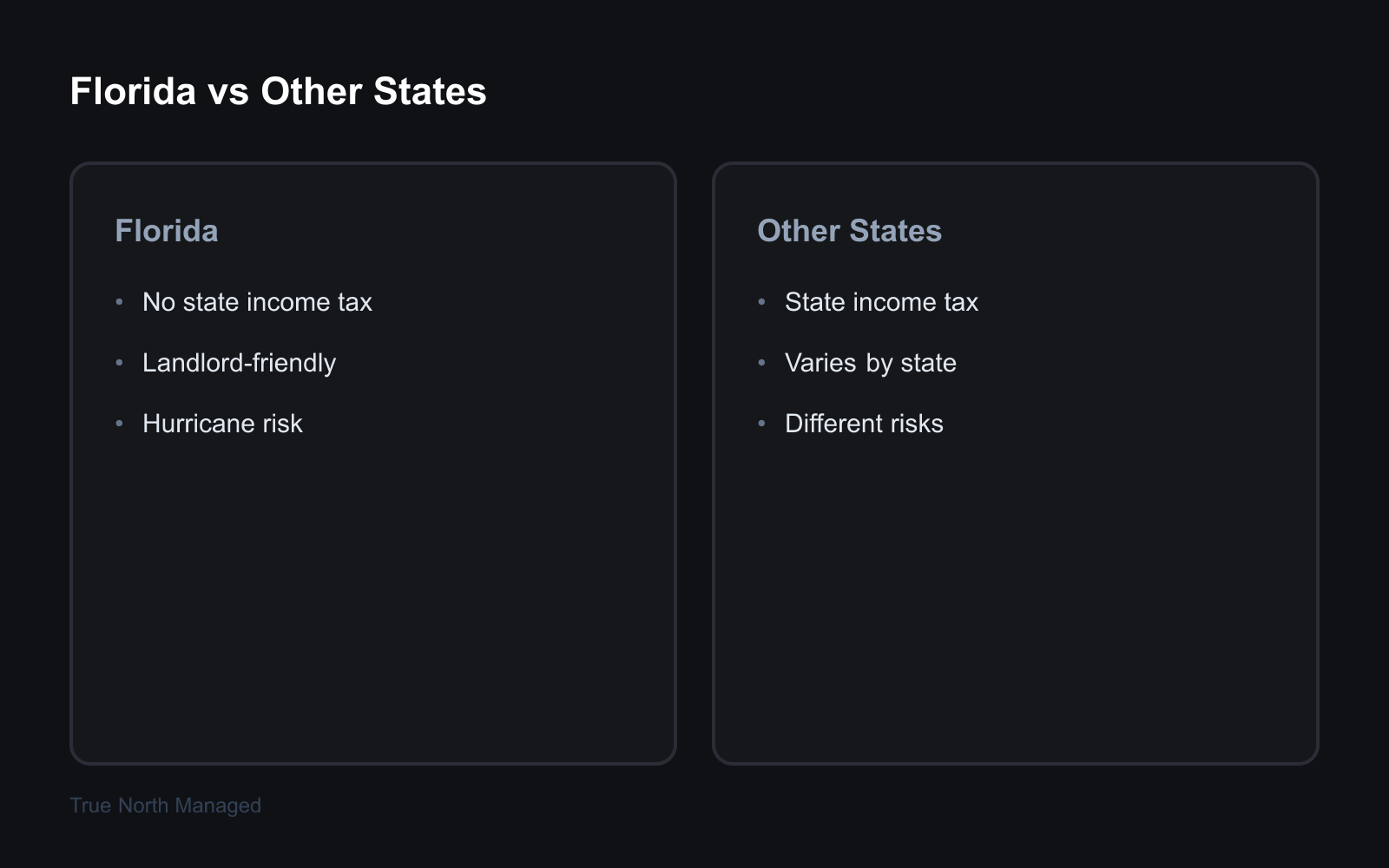
Florida advantages: no state income tax, population growth, landlord-friendly laws. Compare to Texas, Georgia, Tennessee, Ohio. Downsides: insurance, hurricanes.

Out-of-state investors keep buying Florida rentals. The state has no income tax, strong population growth, and landlord-friendly laws. But insurance costs and hurricane risk are real. How does Florida compare to other popular rental markets?
No State Income Tax
Florida has no state income tax. Rental income, capital gains, and dividends aren't taxed at the state level. That's a meaningful advantage over states that tax investment income. Texas and Tennessee also have no state income tax. Georgia and Ohio do. For high-income investors, Florida's tax treatment can add several percentage points to net returns.
Population Growth
Florida has been one of the fastest-growing states for decades. More people mean more renters. Job growth in healthcare, tourism, and professional services supports demand. Texas sees similar growth. Georgia's Atlanta metro is strong. Tennessee and Ohio have pockets of growth but less overall momentum than Florida and Texas.
Landlord-Friendly Laws
Florida's landlord-tenant law favors property owners. Eviction timelines are relatively short. Security deposit rules are clear. No rent control. Compare that to states with longer eviction processes, stricter just-cause requirements, or rent stabilization. Florida isn't the only landlord-friendly state, but it ranks near the top. See our eviction process overview for how it works in practice.
Tourism Economy
Orlando's theme parks and Tampa's beaches drive tourism. That supports short-term rental demand and spillover into long-term rentals for workers. Not every market has that. Ohio and Tennessee have less tourism-driven demand. Georgia has Atlanta; Texas has diverse economies. Florida's tourism creates a unique demand layer.
The Downsides: Insurance and Hurricanes
Insurance is expensive. Windstorm, flood, and rising premiums have squeezed cash flow. Hurricanes are a real risk. Properties need to be built to code and insured properly. Texas has its own weather risks. Georgia and Tennessee generally have lower insurance costs. Ohio has minimal hurricane exposure. The tradeoff: Florida's tax and growth advantages versus higher operating costs.
Orlando and Tampa Specifically
Within Florida, Orlando and Tampa offer different profiles. Orlando is inland, with sinkhole risk but less flood exposure. Tampa is coastal, with higher wind and flood costs. Both have strong fundamentals. Our Orlando guide and Tampa guide cover market-specific details. For out-of-state investors, see our remote owner playbook.
Florida isn't perfect, but for many investors the math works. If you're comparing markets and considering Orlando or Tampa, get a free rental analysis and we can run the numbers for your scenario.
Tax Advantages
Florida has no state income tax, which benefits out-of-state investors who receive rental income. No state tax on capital gains from property sales. Property taxes are levied at the local level, with homestead exemption for primary residences. Investment properties don't get homestead, but the overall tax burden is often lower than in high-tax states. See our Florida landlord tax guide for filing details.
Market Growth
Population growth in Orlando and Tampa drives rental demand. Strong job markets, military presence, and retiree migration support rents. Our Orlando vs Tampa comparison breaks down the two markets. For insurance costs across markets, see insurance costs Orlando vs Tampa.
Common Mistakes to Avoid
One of the biggest mistakes we see: skipping the written notice. Florida law is strict about documentation. If you don't have a paper trail—or email trail—you can lose an eviction or deposit dispute. Document everything.
Another mistake: underbudgeting for turnover. A typical Florida turnover runs $1,500–$3,000 when you include paint, carpet, cleaning, and minor repairs. If you're only setting aside 5% of rent for maintenance, you're short. Plan for 8–12% in year one until you know your property.
Third: treating every tenant the same. A military family near MacDill has different needs than a UCF grad student. Screen for fit, not just credit score. The right tenant in the right property stays longer and costs you less.
Florida-Specific Considerations
Florida Statute 83 applies to residential tenancies. Know the notice requirements: 3 days for non-payment, "excluding Saturday, Sunday, and legal holidays" (FS 83.56(3)); 7 days for cure or vacate for lease violations; and to end a month-to-month tenancy, "not less than 30 days' notice prior to the end of any monthly period" (FS 83.57(3)). Wrong notice = delayed eviction.
Insurance is another Florida reality. Run quotes before you buy. A $200/month insurance difference changes your cash flow by $2,400/year.
Finally, property taxes. Homestead doesn't apply to rentals, so there's no homestead exemption. For a rental of nine or fewer units, FS 193.1554 caps the assessment for levies other than school district levies: "Any change resulting from such reassessment may not exceed 10 percent of the assessed value of the property for the prior year." But a purchase resets it: under FS 193.1554(5) the property "shall be assessed at just value as of January 1 of the year following a change of ownership or control." Appeal if your assessment seems high—many landlords overpay.
When to Get Help
If you're out of state, hire a local property manager. The 8–10% fee pays for itself in faster leasing, better screening, and someone who can show up when the AC dies at 10 PM. Self-managing from another state is a recipe for deferred maintenance and tenant frustration.
For legal issues—evictions, deposit disputes, lease breaks—consult a Florida-licensed attorney. Landlord-tenant law has traps. A $500 consult can save you $5,000 in a botched eviction. We've seen it.
Finally, for complex financial decisions—1031 exchanges, LLC structuring, depreciation—talk to a CPA who works with rental owners. The tax code rewards those who plan. Don't wing it.