

First-Time Landlord in Florida? Here's Your 30-Day Checklist
53% of today's independent landlords became landlords after 2021. If you just inherited a Florida property or can't sell your home, here's the 30-day plan that keeps you out of legal trouble and into cash flow.

You didn't plan for this. Maybe you inherited a duplex in Orlando from a relative who passed. Maybe the Tampa market dropped and selling your home would mean taking a loss. Maybe you bought a condo as an investment and now you're staring at an empty unit wondering what comes first.
You're not alone. According to Avail's 2026 independent landlord survey (4,055 respondents), 53% of today's landlords became landlords after 2021. That means more than half the people doing this job right now were where you are just a few years ago — overwhelmed, Googling "do I need a license to rent my house in Florida?" at midnight.
You don't need a license. But you do need a plan.
Here's the 30-day checklist that covers the legal setup, property prep, tenant screening, and move-in process — with the specific Florida statutes, Orlando and Tampa market data, and local ordinance requirements that national guides leave out.
Want the printable version? Download the 30-day landlord checklist — it's designed for your property management binder, with checkboxes you can mark off as you go.
What Legal Steps Do New Florida Landlords Need to Take First?
Before you list the property, before you take a single photo, you need to get the legal framework right. This is Days 1–7, and it's the foundation everything else sits on.
Read Florida Statute Chapter 83. This is the Residential Landlord and Tenant Act — the law that governs your relationship with every tenant. It covers security deposits (FL Statute 83.49), maintenance obligations, eviction procedures, lease requirements, and notice timelines. You don't need to memorize it, but you need to know the big rules. Our guide to Florida landlord responsibilities breaks down the key sections.
Get landlord insurance. Your homeowner's policy does not cover rental activity. You need a DP-3 landlord policy at minimum. If you carry a mortgage, your lender requires this. For a deeper look at what policies cover and what they don't, see our Florida landlord insurance guide.
Check your local ordinance. For landlord-tenant matters, state law now controls. Florida Statute 83.425 reads: "The regulation of residential tenancies, the landlord-tenant relationship, and all other matters covered under this part are preempted to the state. This section supersedes any local government regulations on matters covered under this part, including, but not limited to, the screening process used by a landlord in approving tenancies; security deposits; rental agreement applications and fees associated with such applications; terms and conditions of rental agreements; the rights and responsibilities of the landlord and tenant; disclosures concerning the premises, the dwelling unit, the rental agreement, or the rights and responsibilities of the landlord and tenant; fees charged by the landlord; or notice requirements." In practice, a county rule like Orange County's requirement to hand tenants a written fee list and a copy of its Tenant's Bill of Rights, or its notice rule for rent increases above 5%, doesn't bind you. What still needs a local check:
- Source of income (Hillsborough and Orange County ordinances): 83.425 doesn't name source of income, so whether these local protections survive is unsettled. Federal fair housing law applies either way, so ask the county before you rely on or ignore one.
- Tampa city: You need a city business tax receipt to legally operate a rental.
Set up a separate bank account. Florida doesn't legally mandate this for the business side, but it does mandate that security deposits be held in a separate account (FL 83.49). Keeping all rental income and expenses in one dedicated account makes tax time infinitely simpler and protects your LLC if you have one.
The LLC decision. Most first-time Florida landlords start under their personal name and add a $1 million umbrella insurance policy ($200–$400/year). Moving the deed to an LLC triggers documentary stamp tax (70 cents per $100 of property value), possible property tax reassessment, and mortgage due-on-sale clause risk. Talk to a CPA before deciding — but don't let this decision delay everything else.
How Should You Prepare the Property Before Listing?
Days 8–14 are about getting the property tenant-ready. This is where accidental landlords make their most expensive mistakes — listing a property that isn't fully prepared costs you in longer vacancy, lower rent, and maintenance emergencies during the first month.

Schedule a professional inspection ($300–$500). They'll catch the water heater that's 2 years past its lifespan, the HVAC capacitor that's about to fail, and the roof issue your insurance company will flag. Fix what they find. An HVAC breakdown in August is a legal headache — once AC is included in the rental, you must maintain it, and if a breakdown amounts to a material noncompliance with FL Statute 83.51(1), a tenant can withhold rent through Florida Statute 83.60(1)(b): "The defense of a material noncompliance with s. 83.51(1) may be raised by the tenant if 7 days have elapsed after the delivery of written notice by the tenant to the landlord, specifying the noncompliance and indicating the intention of the tenant not to pay rent by reason thereof." If you then file for possession and the tenant raises that defense, 83.60(2) requires the tenant to pay into the court registry "the accrued rent as alleged in the complaint or as determined by the court and the rent that accrues during the pendency of the proceeding, when due." So the written notice and the 7 days come first, and the withheld rent still ends up with the court.
Change all exterior locks and rekey the interior. Every prior key holder is an unknown variable.
Photo-document everything. Every room, every wall, every appliance, every surface. Shoot serial numbers on major appliances. Timestamps on. Take 200+ photos — it sounds excessive until you're in a deposit dispute and the tenant claims that scratch was there when they moved in. Cloud backup immediately. Our move-in inspection checklist walks through the full process.
Set your rent price. Zillow's rent index put the typical Orlando-metro rent at about $1,942 in August 2026 and Tampa at about $2,001. But medians don't set your rent — your specific neighborhood, condition, and unit size do. Check Zillow, Apartments.com, and Rentometer for comparable listings within a mile. The market has shifted from landlord-favorable to balanced, and overpricing by $100/month costs you more in vacancy than the difference.
Handle your disclosures. As of October 2025, you must provide a separate flood disclosure statement for leases of one year or longer (FL Statute 83.512). If the property was built before 1978, you also need a lead paint disclosure (federal Title X). Install working smoke detectors — Florida requires them at the start of each tenancy. And don't forget the radon disclosure — FL Statute 404.056(5) requires every Florida lease to include a specific radon notification statement. About 1 in 5 Florida homes have elevated levels above the EPA action threshold. Carbon monoxide alarms are required under FL Statute 553.885 in a building or addition "constructed on or after July 1, 2008, and having a fossil-fuel-burning heater or appliance, a fireplace, an attached garage, or other feature, fixture, or element that emits carbon monoxide as a byproduct of combustion." In an older rental with gas appliances or an attached garage, installing one anyway is cheap protection.
What Does Fair Housing-Compliant Tenant Screening Look Like?
Days 15–21. This is where you find your tenant — and the screening process is the single most consequential thing you'll do as a landlord. One unscreened tenant costs more than 3 months of vacancy.
Write your screening criteria before you advertise. Not after you meet applicants. Not while you're reviewing applications. Before. Write down: minimum credit score, income requirement (2.5–3x monthly rent is standard), no eviction history in the past 3–5 years, verifiable employment or income. Having written criteria before advertising is your strongest Fair Housing defense.
Apply those criteria identically to every applicant. Run: credit report, criminal background check, income verification (last 3 pay stubs or 2 years of tax returns for self-employed), and previous landlord references. Same process, same questions, same documentation requirements. No exceptions, no gut feelings. And if you deny an applicant based on their credit or background report, the Fair Credit Reporting Act requires an adverse action notice — in writing — that tells them which reporting agency provided the information and their right to dispute it. Skipping this step creates federal liability. For a deeper dive into how this works in practice, read our Florida tenant screening guide.
Know your Fair Housing obligations cold. You cannot discriminate based on race, color, national origin, religion, sex, disability, or familial status. Orange County's ordinance also lists source of income; as covered above, whether that local rule still applies is unsettled, so check with the county. Criminal history screening still carries Fair Housing Act risk: blanket bans can create disparate-impact liability (24 CFR 100.500), so no blanket bans — assess nature/severity/time elapsed, focus on recent serious offenses related to safety.
Emotional support animals are not pets. If an applicant or tenant presents an ESA request with reliable supporting information, you generally must accommodate. Florida Statute 760.27(2) says the person "may not be required to pay extra compensation for such animal," so you cannot charge pet fees, pet rent, or pet deposits for ESAs. Where the disability or the need for the animal isn't readily apparent, 760.27(2)(b)–(c) let you request reliable supporting information, which can come from a health care practitioner or a telehealth provider; for the disability itself, an out-of-state practitioner counts "only if such out-of-state practitioner has provided in-person care or services to the tenant on at least one occasion." And "Unless otherwise prohibited by federal law, rule, or regulation," you may deny a request if "such animal poses a direct threat to the safety or health of others or poses a direct threat of physical damage to the property of others, which threat cannot be reduced or eliminated by another reasonable accommodation." FL Statute 817.265 imposes criminal penalties for ESA fraud, but that's the tenant's problem — your job is to follow the accommodation rules.
Non-payment notices are still 3 days. SB 716, which would have made it 5, died in committee in March 2026. Florida Statute 83.56(3) still reads: "If the tenant fails to pay rent when due and the default continues for 3 days, excluding Saturday, Sunday, and legal holidays, after delivery of written demand by the landlord for payment of the rent or possession of the premises, the landlord may terminate the rental agreement." Keep your notice template at 3 days, counted without weekends or legal holidays. And remember — month-to-month termination now requires 30 days' written notice, not 15.
What Happens at Move-In? The Florida Security Deposit Checklist
Days 22–30. You've approved a tenant. Now close the deal, collect the money correctly, and set up your systems.
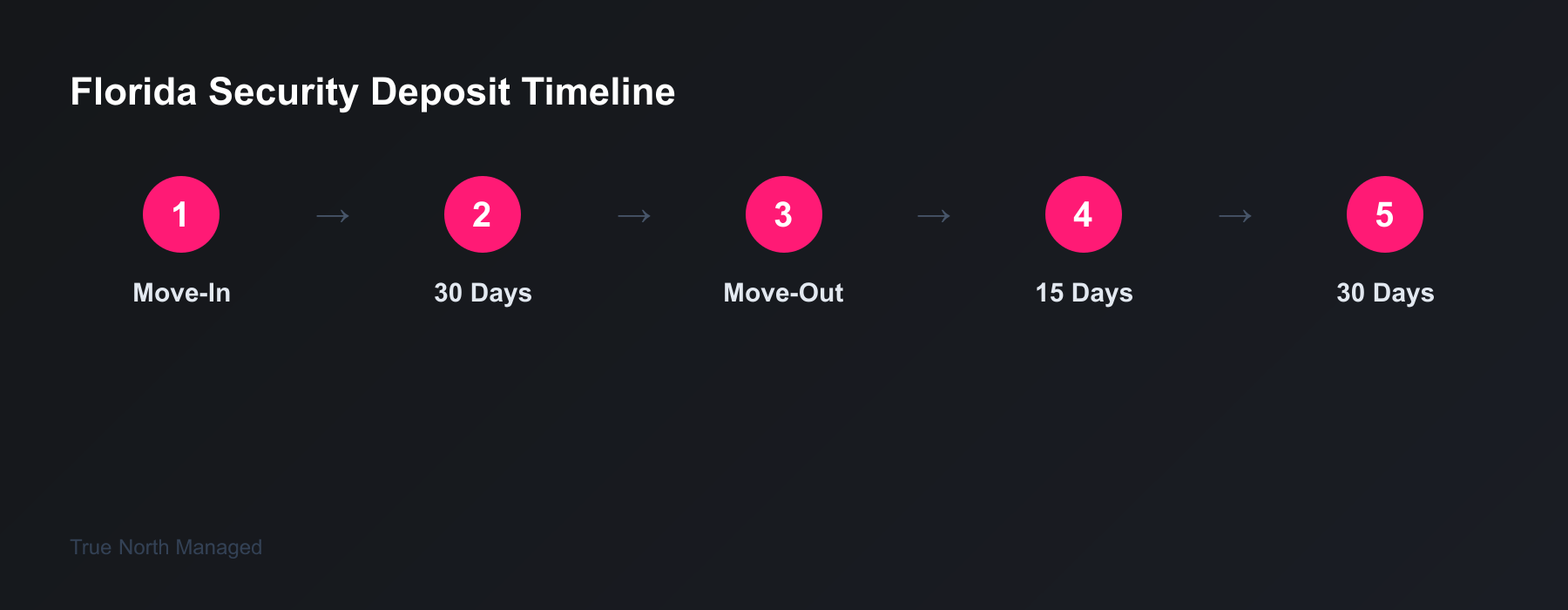
The move-in inspection is non-negotiable. Walk every room with your tenant present. Note existing damage, marks, and wear on a written condition report. Both of you sign it. This is your evidence when the lease ends — without it, security deposit disputes become expensive guesswork. Our security deposit guide covers the full legal framework.
Collect first month's rent and security deposit correctly. FL Statute 83.49 governs exactly how you handle this money:
- Option 1: Non-interest-bearing separate Florida bank account
- Option 2: Interest-bearing account (pay tenant 75% of annualized interest or 5% simple interest annually)
- Option 3: Surety bond from a licensed company
Florida Statute 83.49(2) says: "The landlord shall, in the lease agreement or within 30 days after receipt of advance rent or a security deposit, give written notice to the tenant which includes disclosure of the advance rent or security deposit." The same subsection adds: "This subsection does not apply to any landlord who rents fewer than five individual dwelling units." With fewer than five rentals you aren't required to send it, though putting it in the lease costs nothing. Deposit funds cannot be commingled with your personal or business funds.
Mark two deadlines on your calendar:
- 15 days after the rental agreement ends: full deposit returned if no deductions claimed
- 30 days after the rental agreement ends: your claim notice. Florida Statute 83.49(3)(a) requires "written notice by certified mail to the tenant's last known mailing address or by e-mail in accordance with s. 83.505 of his or her intention to impose a claim on the deposit and the reason for imposing the claim" — not text, not regular mail. And the statute spells out the cost of a miss: "If the landlord fails to give the required written notice within the 30-day period, he or she forfeits the right to impose a claim upon the security deposit and may not seek a setoff against the deposit but may file an action for damages after returning the security deposit to the tenant." You lose the deduction, not the right to sue for real damage, but only after the full deposit goes back. This is the #1 deposit mistake Florida landlords make.
Set up rent collection. ACH transfer through a free platform (Azibo, TurboTenant, or PayRent) is the best option — automated, no daily limits, creates a paper trail. Zelle works for smaller amounts but has daily limits. Never accept Venmo for rent — it violates their business terms of service.
Should You Self-Manage or Hire a Property Manager?
This is the question every new landlord eventually asks. Here's the honest framework:
Self-management works if you live within 30 minutes of the property, can respond to emergencies within hours, have 10–15 hours per week to dedicate, and are comfortable handling legal notices, tenant conflicts, and court appearances.
A property manager makes sense if you're out of state, own multiple properties, value your time above the 7–12% monthly management fee, or don't have a reliable vendor network for plumbing, electrical, HVAC, and general handwork. Before you decide, build your emergency contact list: a 24/7 plumber, a licensed HVAC contractor, an electrician, and a quarterly pest control service. If assembling that list feels overwhelming, that's your answer.
The question is whether self-managing makes sense for your specific situation, time, and risk tolerance.
If you own an Orlando or Tampa rental property and want to see what professional management looks like for your specific property — including projected rental income, recommended pricing, and a full service breakdown — get a free rental analysis.
Download the printable 30-day checklist and start working through it today. Every checkbox is one less thing to worry about when your first tenant moves in.