
Tenant Turnover Playbook: Minimize Vacancy Between Leases
Your tenant is moving out and you've got one rental to fill. Here's how a Florida owner turns the unit over fast — and keeps the vacant days down to a handful.
Your tenant just gave notice. One property, one income stream, and now a hole in it. Every day that unit sits empty is rent you'll never get back — and if you wait until the old tenant is gone to start thinking about the next one, you've already lost weeks.
Here's the short version. The way to minimize vacancy between tenants in Florida isn't to rush the make-ready — it's to start the next lease while the current one is still running. Get the move-out notice in writing, begin marketing before the unit is empty, run repairs and the listing in parallel, and you can shrink the vacant gap from six weeks down to a handful of days.
What you must do — and by when
A turnover has three hard deadlines. Miss them and you either lose money or hand a tenant a lawsuit.
- Non-renewal notice: If your lease has a non-renewal clause, Florida law sets it at 30 to 60 days — confirm what your lease says and hold both sides to it.
- Showing the unit: You can show an occupied unit to prospective tenants. Give the current tenant reasonable notice first — at least 24 hours.
- Security deposit: Once the tenant vacates, you have 15 days to return the full deposit, or 30 days to send an itemized claim if you're keeping any of it.
The rest of this playbook is about the days in between — and how to keep them few.
What is "The 90-Day Turnover Window"?
The turnover doesn't start when the keys come back. It starts the day you learn the tenant is leaving — usually 60 days out, sometimes more. Call that 60-to-90-day stretch "The 90-Day Turnover Window," because that's your runway to fill the unit with little or no gap.
Most one-property owners waste it. They wait until move-out day to look at the unit, then start calling cleaners, then take phone photos, then post the listing — a sequence that runs four to six weeks while the property earns nothing. A turnover in Florida already costs $2,000 to $5,000 once you add lost rent, the make-ready, and re-listing. Spent vacancy is the biggest piece, and it's the piece you control.
The fix is to stop treating turnover as a list of steps that happen one after another. Most of them can happen at the same time — and several can happen before the unit is even empty.
How early should you start marketing a rental?
Start marketing the day the tenant gives notice — not the day they leave. Florida Statute 83.53 lets you show an occupied unit to prospective tenants, and your current tenant can't unreasonably refuse. With reasonable notice — 24 hours is the standard — you can run showings while someone still lives there.
That's weeks of marketing you'd otherwise throw away. A unit that's already listed and getting inquiries before move-out day can have a signed lease waiting when the old tenant hands back the keys.
A few things make this work without friction. Tell the tenant early that you'll need to show the place, and offer to bundle showings into a couple of set windows so you're not knocking weekly. Most tenants cooperate — they want their own deposit back and a smooth exit. And get your listing right the first time: a unit priced correctly with good photos rents far faster than one you'll have to re-price after three quiet weeks. Our guide on how to market a vacant rental property in Florida covers the listing itself in detail.
How long should a make-ready take?
A standard make-ready should take three to seven days. It stretches to two weeks only when the unit needs new flooring or a full repaint — and even then, the delay usually comes from poor scheduling, not the work itself.
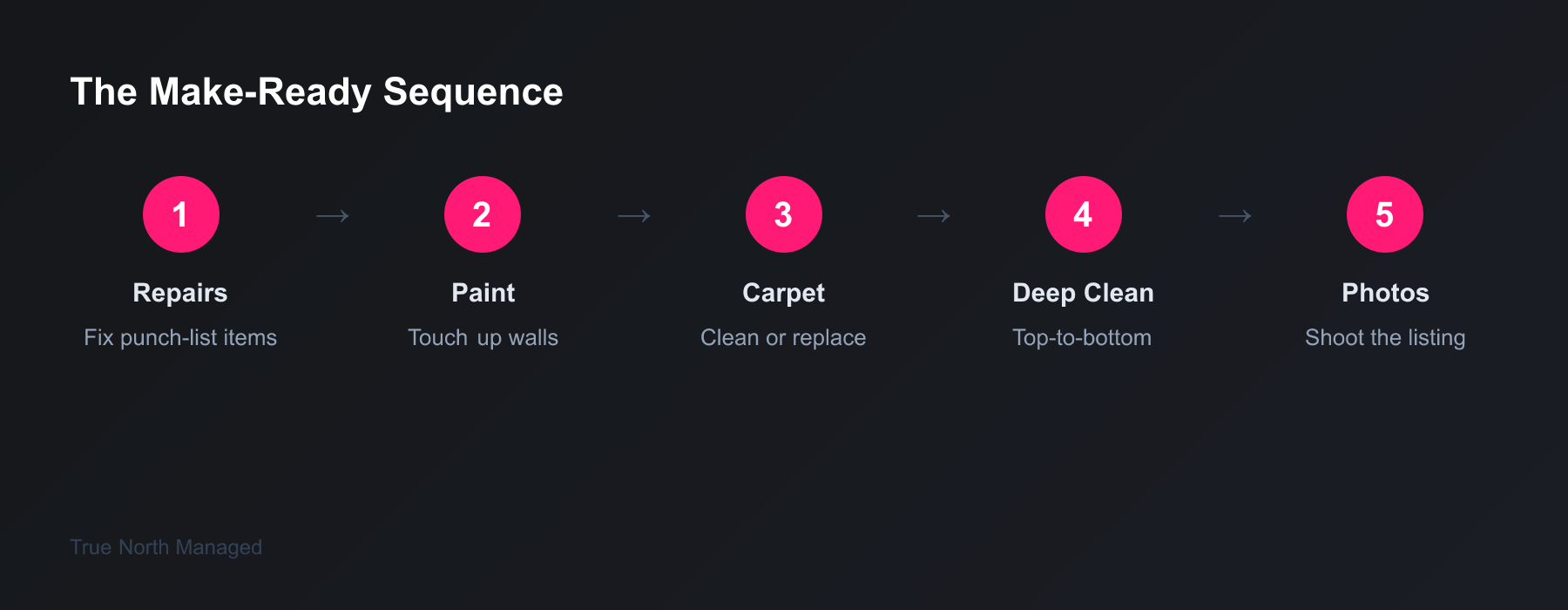
The make-ready is everything between the old tenant leaving and the new one moving in: repairs, paint touch-up, carpet cleaning, a deep clean, and fresh listing photos. The order matters. Repairs and paint go first, then carpet, then the deep clean, then photos — so you're not cleaning a room twice or photographing a wall you're about to patch.
Here's where a single-property owner loses days: lining up vendors one call at a time. The cleaner can't come until Thursday, the handyman not until the following Monday, the carpet crew the week after that. Each gap is dead rent.
Book your vendors during the 90-Day Window, while the tenant is still in the unit. You know the move-out date — schedule the handyman for the day after, the carpet crew for two days after, the cleaner for the day after that. When the keys come back, the calendar is already set. Our 30-day property turnover checklist breaks the make-ready into a day-by-day task list you can hand to your vendors.
How do you handle the move-out without losing the deposit?
Do the move-out inspection the day the tenant returns the keys — not next week. Under Florida Statute 83.49, the deposit clock starts when the tenant vacates, and you have 15 days to refund it in full or 30 days to send an itemized claim for any deductions.
Walk the unit with your move-in photos in hand. The job is to separate normal wear from actual damage, because you can only deduct for damage. Faded paint, carpet worn thin in the hallway, a few nail holes — that's ordinary use, and Florida won't let you charge for it. Burns in the carpet, holes punched in drywall, pet damage past basic shedding — that's a deduction.
Miss the deadline and the penalty is steep. A landlord who sends the itemized claim on day 34 doesn't just lose the right to that one deduction — they forfeit the whole deposit, and a court can order them to pay the tenant's attorney fees too. So inspect early, take photos, and send the certified letter inside the window. Our Florida move-out inspection checklist walks the whole walk-through step by step.
The inspection isn't only about the deposit. It's also your make-ready punch list. Whatever you flag on the walk-through is what the vendors you already booked will fix the next morning.
How do you schedule the new lease to start fast?
Set the new lease to start within a few days of the make-ready finishing — not a vague "sometime next month." If your make-ready is a clean three to seven days, the new tenant can move in inside a week of the old one leaving.
The trap here is promising a move-in date you can't hit. Tell an applicant they can move in on the 1st, then have the carpet crew run late, and you've got an angry new tenant before they've unpacked. So quote the new tenant a move-in date that assumes the make-ready takes its full window, with a day or two of cushion. If you finish early, you've under-promised and over-delivered. If a vendor slips, you've still got room.
One more piece of timing that protects you: the holdover. Florida Statute 83.575 says a tenant who stays past the lease end without proper notice owes you an extra month's rent. That's worth knowing, but don't count on it — don't schedule a new tenant assuming the old one might linger. Confirm the move-out date in writing, and if the tenant goes quiet, get clarity before you promise the unit to anyone else.
Does the local market change your timeline?
Yes — Orlando and Tampa are not turning over at the same speed in 2026, and your plan should reflect which market you're in.
Orlando is the tighter market. Vacancy is running near 8%, and a well-priced single-family rental in a suburban submarket like Avalon Park or Horizon West can lease in a couple of weeks. Tampa is looser: vacancy hit a record 10.7% entering 2026, a record, and listings were averaging around 47 days on market in early 2026 — roughly two and a half weeks longer than a year ago.
What that means in practice: a Tampa owner has to start earlier and price sharper. In a softer market, the unit that's listed and competitively priced before the old tenant leaves is the one that doesn't sit. The unit that's overpriced and listed late is the one that's still empty in July. If you're not sure where your rent should land, a renewal with your current tenant is sometimes the cheaper move — our Florida lease renewal strategy guide weighs renewing against turning the unit.
Common turnover mistakes
- Waiting until move-out day to start. The 90-Day Window is your runway. Marketing, vendor booking, and pricing can all happen while the tenant is still there.
- Booking vendors one at a time. Each "I can't come until next week" is dead rent. Schedule the whole make-ready crew in advance, back to back.
- Overpricing the relisting. A unit empty for six weeks at a higher rent loses more than one filled in a week at market rent. Price to the comps, not to hope.
- Doing the move-out inspection late. The deposit clock starts at vacate. A late itemized claim can cost you the entire deposit plus legal fees.
You don't have to run the turnover alone
A turnover is a project — vendors to schedule, a listing to write, showings to run, a legal deadline on the deposit — and for an owner with one property and a day job, it tends to land all at once. That's how a one-week gap becomes a two-month one.
This is exactly the kind of thing a property manager handles in the background. If you'd rather not coordinate the whole turnover yourself, our Free Rental Analysis is a no-pressure place to start — it tells you what your home should rent for in today's market and what handing off the turnover would actually involve. We manage single properties, not just portfolios. For the rest of the Florida landlord playbook, our Owner's Guide covers what comes before and after the turn.