

12 First-Time Landlord Mistakes That Cost Orlando Owners Thousands
The 12 most expensive mistakes Orlando landlords make in their first year — and how to avoid every one of them.

You didn't plan to become a landlord. Maybe you inherited a house, relocated for work, or bought a duplex as an investment. Now you're Googling "how to evict a tenant in Florida" at midnight and wondering why this feels so much harder than it looked on paper.
First-time landlord mistakes are expensive. A single bad tenant can cost you thousands in eviction fees, lost rent, and turnover. A security deposit slip-up can cost you the full deposit plus the tenant's attorney fees. Underpricing your rent by $200/month? That's $2,400 a year you'll never get back. We've managed hundreds of rentals across Orlando and seen the same patterns again and again — landlords who skip the fundamentals end up paying for it in court, in lost rent, or in stress that makes them want to sell at a loss just to be done.
Here are the 12 mistakes we see most often — and what to do instead.
Mistake 1: Rushing Tenant Screening
Bad tenant placement is the single costliest mistake a landlord can make. One eviction in Orange County means legal and filing fees plus lost rent for as long as the case runs, and how long that is depends on service, whether the tenant answers or deposits rent, and the court's calendar. Add turnover costs and potential property damage, and you're looking at thousands of dollars before you've even re-rented the unit. See our Orlando tenant screening guide for more.
The fix: Run a full tenant screening process — credit, income verification, rental history, eviction search, and criminal background — and apply it the same way to every applicant. "They seemed nice" isn't a screening criteria.
Mistake 2: Mishandling Security Deposits
Florida Statute 83.49 gives you 15 days after the lease terminates to return the full deposit if you're not claiming deductions. If you are, you have 30 days after the termination to send an itemized written claim, with the reason for it, "by certified mail to the tenant's last known mailing address or by e-mail in accordance with s. 83.505" (e-mail works only under a signed e-mail-notice addendum to the lease, with an address from each of you). Miss the 30-day deadline by one day and here is what the statute says happens: "If the landlord fails to give the required written notice within the 30-day period, he or she forfeits the right to impose a claim upon the security deposit and may not seek a setoff against the deposit but may file an action for damages after returning the security deposit to the tenant." Even if the tenant left real damage, the full deposit goes back first, and recovering the damage means a separate lawsuit. Orlando landlords have lost $3,000+ in disputes they should have won because the claim notice went out on day 32.
The fix: Read our security deposit guide and follow it to the letter. Set calendar reminders. Itemize every deduction with specific dollar amounts and receipts. Document the property at move-in with 200+ photos and a signed condition report. The statute doesn't care about your intentions. It cares about your calendar.
Mistake 3: Underpricing Your Rent
Leaving $100–200 per month on the table sounds harmless until you do the math. At $200 below market, you're losing $2,400 per year — every year — until you raise the rent at renewal. Underpricing often comes from fear of vacancy or not doing enough market research. But Orlando's rental market has cooled; you don't need to undercut to get tenants. Price at market and you'll attract qualified applicants who expect to pay fair rent.
The fix: Run comps. Use our Orlando rent pricing guide to understand what similar properties actually rent for in your neighborhood. Price within 3% of market and you won't leave money on the table.
Mistake 4: Skipping Move-In and Move-Out Inspections
If you didn't document the property's condition at move-in, you've got almost nothing to base deposit deductions on. Judges know this. Tenants' attorneys know this. Skipping inspections also means you miss deferred maintenance that becomes your problem later — a $50 leaky faucet can become a $2,000 water damage claim when ignored.
The fix: Do a walkthrough within a few days of move-in and again within 24–48 hours of move-out. Take timestamped photos of every room — we do 200+ per property. Get a signed condition report. That documentation is the difference between winning a deposit dispute and writing a check for the full amount. Without it, you're giving the deposit back regardless of what you find. And if you're claiming deductions, you need receipts or contractor invoices — handwritten estimates won't hold up in court.
Mistake 5: Using Homeowners Insurance on a Rental
Your homeowners policy is built for the house you live in. If you rent out the property and keep that policy, insurers can deny claims entirely — and they routinely do when they discover tenant occupancy. One documented case: a property burned down, loss exceeding six figures, claim denied because tenants were living there when only owner-occupied coverage was in place. See our Orlando landlord insurance guide for more.
The fix: Switch to landlord insurance before the first tenant moves in. A DP-3 dwelling policy covers the structure, liability for injuries, and lost rental income when the unit becomes uninhabitable.
Mistake 6: Ignoring Florida Landlord Responsibilities
Florida Statute 83.51(1) requires you to "Comply with the requirements of applicable building, housing, and health codes"; where there are no applicable codes, it lists the structure and "the plumbing in reasonable working condition" instead. Locks and keys, extermination and a few other items come from 83.51(2)(a), which applies "Unless otherwise agreed in writing" and only to "a dwelling unit other than a single-family home or duplex". If you rent out a single-family home or a duplex, your baseline is the code. Florida Statute 83.56(1) sets the clock: "If the landlord materially fails to comply with s. 83.51(1) or material provisions of the rental agreement within 7 days after delivery of written notice by the tenant specifying the noncompliance and indicating the intention of the tenant to terminate the rental agreement by reason thereof, the tenant may terminate the rental agreement." Seven days is the deadline to fix the problem, not just to respond or get started — and the tenant can also pursue damages in court.
The fix: Know your legal obligations as a Florida landlord. Required disclosures (radon, lead paint if pre-1978, flood history), right of entry (24 hours' notice and 7:30 AM–8 PM for repairs), smoke detectors, carbon monoxide detectors, pool safety — it's all in the statute. Florida's tropical climate adds specific risks: mold from deferred maintenance can void your insurance.
Mistake 7: Breaking Fair Housing Law During Screening
Fair Housing Act cases decided by a HUD administrative law judge can carry a civil penalty of up to $26,262 per discriminatory housing practice when the landlord has never been adjudged to have committed one before (24 CFR 180.671(a)(1)). Asking "do you have kids?" at a showing, applying a blanket criminal-history ban, or skipping the adverse action notice when you deny based on a credit report — each one can trigger a federal complaint.
The fix: Build a written screening policy and apply it identically to every applicant. Never ask about protected characteristics. Get written permission before pulling consumer reports. Send adverse action notices when you deny. Document every decision.
Mistake 8: Trying to Evict Without Going Through the Courts
Changing the locks, shutting off utilities, or removing a tenant's belongings yourself is prohibited under Florida Statute 83.67. A tenant locked out illegally can sue even if they owed you money, and under 83.67(6), "A landlord who violates any provision of this section shall be liable to the tenant for actual and consequential damages or 3 months' rent, whichever is greater, and costs, including attorney's fees." Three months' rent is the floor, not the ceiling. Only a judge can order a tenant removed, and only the sheriff can carry it out.
The fix: Follow the eviction process every time. Serve the 3-day notice correctly. File with the court. Let the sheriff execute the writ. And when the math works, consider cash-for-keys — sometimes paying $1,000–2,000 to get a tenant out voluntarily is cheaper than a contested eviction.
Mistake 9: Renting Inherited Property Without Running the Numbers
Inheriting a house comes with emotional weight and a lot of opinions. "Rent it — it's free money" sounds good until you factor in property taxes (you lose the homestead exemption), insurance, maintenance, vacancy, and management. A $385,000 inherited 3-bedroom in Orlando might net only $640/month after real expenses — a 2.0% return on the home's value. Add one $6,000 roof repair and most of your first year's profit vanishes.
The fix: Run the real math before you decide. Our rent vs. sell guide for inherited property walks through the tax implications, cash flow, and the five questions that actually decide this. Sometimes selling is the right call. Sometimes renting works. The answer depends on your numbers, not your cousin's advice.
Mistake 10: Converting Your Home to a Rental Without Switching Insurance and Taxes
You're relocating. You're going to rent out your Orlando house. But if you keep your homeowners policy, you're exposed. If you forget to notify the property appraiser about losing homestead, you're exposed. And if you don't understand how conversion affects your Section 121 capital gains exclusion when you eventually sell, you could owe tens of thousands more in taxes.
The fix: Follow a conversion checklist before you list. Switch to landlord insurance. Handle the homestead exemption. Set up security deposit handling correctly. Prep the property for tenants. The switch isn't just listing on Zillow — it's 4–8 weeks of legal, tax, and insurance work.
Mistake 11: Allowing Pets Without a Clear Policy — or Charging Fees for Assistance Animals
Pet-friendly rentals in Orlando can command higher rent and fill faster. But you need clear rules: pet deposits, pet rent, breed restrictions (if your insurance requires it), and a pet addendum. The mistake that gets landlords sued: charging pet fees for service animals or emotional support animals. Under the Fair Housing Act, you can't charge pet deposits, pet fees, or pet rent for assistance animals. That's a violation — and it's expensive.
The fix: Set a pet policy that distinguishes between pets (which you can charge for) and assistance animals (which you can't). Document everything in a pet addendum — pet identification, permission scope, tenant obligations, financial terms, and removal rights. If the disability isn't readily apparent, FS 760.27(2)(b) lets you "request reliable information that reasonably supports that the person has a disability" — such as a government disability determination or benefits, or "Information from a health care practitioner, as defined in s. 456.001; a telehealth provider, as defined in s. 456.47; or any other similarly licensed or certified practitioner or provider in good standing with his or her profession’s regulatory body in another state but only if such out-of-state practitioner has provided in-person care or services to the tenant on at least one occasion. Such information is reliable if the practitioner or provider has personal knowledge of the person’s disability and is acting within the scope of his or her practice to provide the supporting information.". Under 760.27(3)(c), an ESA "registration of any kind, including, but not limited to, an identification card, patch, certificate, or similar registration obtained from the Internet is not, by itself, sufficient information to reliably establish that a person has a disability or a disability-related need for an emotional support animal". So a letter from a Florida-licensed practitioner or a telehealth provider covered by s. 456.47 can qualify, an out-of-state practitioner's letter only after in-person care, and a bought certificate alone can't. Presenting false ESA documentation is a second-degree misdemeanor in Florida. Get it right and you'll tap into Orlando's pet-owning renters — and you can charge pet rent and deposits for those. Get it wrong and you're facing a Fair Housing complaint.
Mistake 12: Self-Managing When You Should Hire Help
Self-managing saves the 8–10% management fee. But it costs 10–20 hours per month per property. If you're out of state, unsure about Florida law, or drowning in tenant calls, the math often flips. Miss a security deposit deadline or run afoul of Fair Housing, and one mistake can wipe out a year of "savings."
The fix: Know when to hire. Our guide to hiring a property manager covers the signs you need one, how to evaluate them, and contract terms that matter. And our property management cost breakdown shows what you'll actually pay — typically $3,500–4,000 in year one for a $1,800/month Orlando rental. For many landlords, that buys time, compliance, and peace of mind worth more than the fee.
The Checklist That Saves You Money
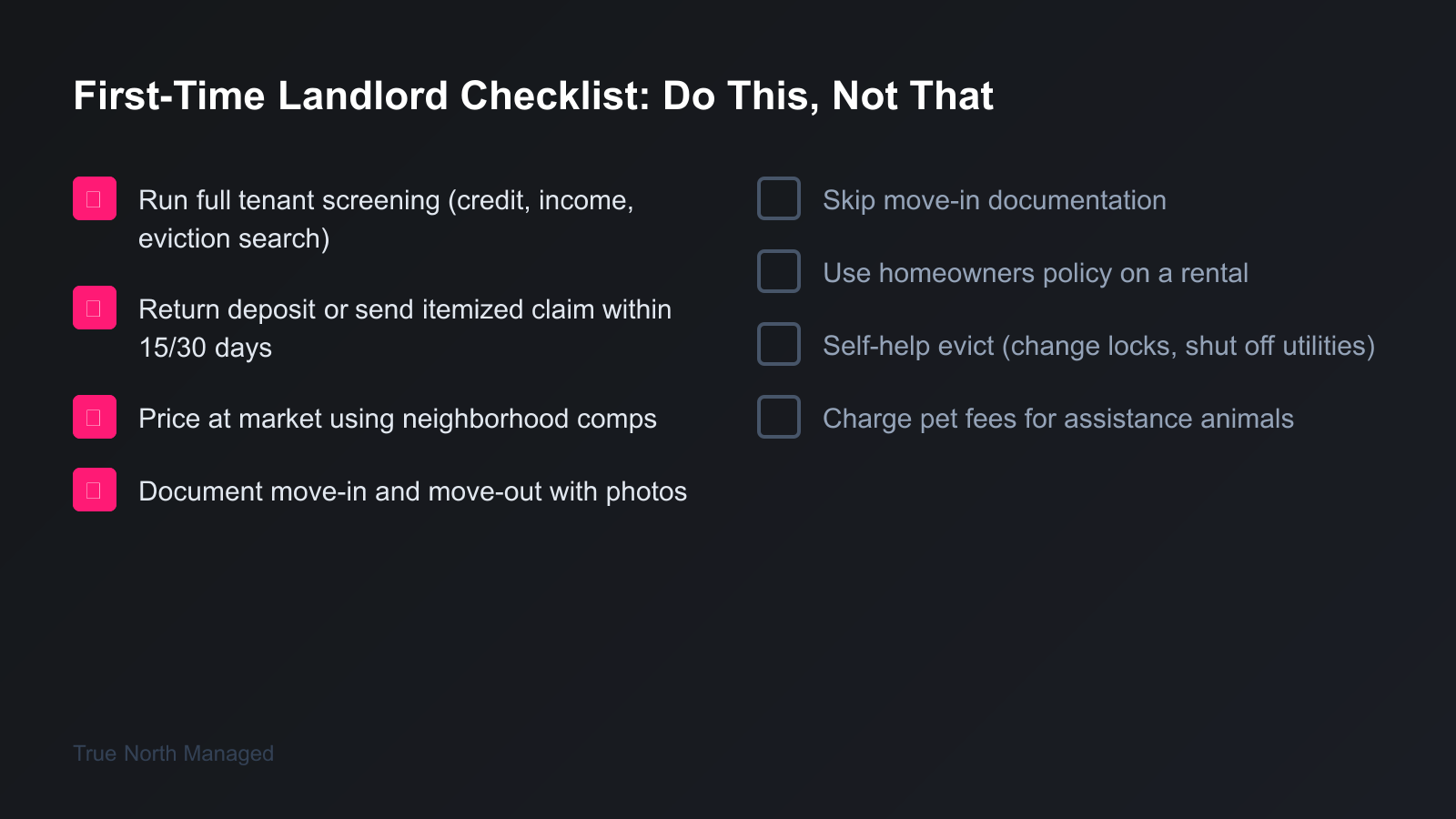
Before you list your first rental — or your next one — make sure you've got these basics covered. The checklist below captures the biggest "do this, not that" contrasts we see. Run full screening — don't skip it. Follow deposit deadlines — don't guess. Use landlord insurance — never homeowners. And never, ever charge pet fees for assistance animals. Each item connects to a deeper guide we've written for Orlando landlords.
Bottom Line
First-time landlord mistakes add up fast. A bad tenant can cost thousands. A security deposit slip-up costs the deposit plus attorney fees. Underpricing by $200/month costs $2,400 per year. Skipping landlord insurance can cost you everything when a claim gets denied.
The good news: every mistake on this list is avoidable. Screen tenants properly. Follow the deposit deadlines. Price at market. Document everything. Switch to landlord insurance. Know your legal obligations. And when self-management stops making sense, get help before the mistakes compound.
Orlando's rental market has room for landlords who do it right. The ones who struggle are usually the ones who skipped the fundamentals.