

The Tenant Onboarding Process: A Florida Landlord's Move-In Playbook
Approved is not moved in. Here's the five-step Florida onboarding sequence that turns a signed lease into a documented tenancy — and protects your deposit claim before the tenant unpacks.

You approved the tenant. The application checked out, the references called back clean, and you sent the good-news email. Now what?
This is the gap nobody warns first-time Florida landlords about. The tenant onboarding process is everything that happens between "approved" and "settled" — and it is not a formality. It is the one window where you either build the paper trail that wins a future deposit dispute, or skip it and find you can't defend a claim on that deposit when the tenant finally moves out. Onboarding feels like hospitality. In Florida, it is liability management wearing a welcome mat.
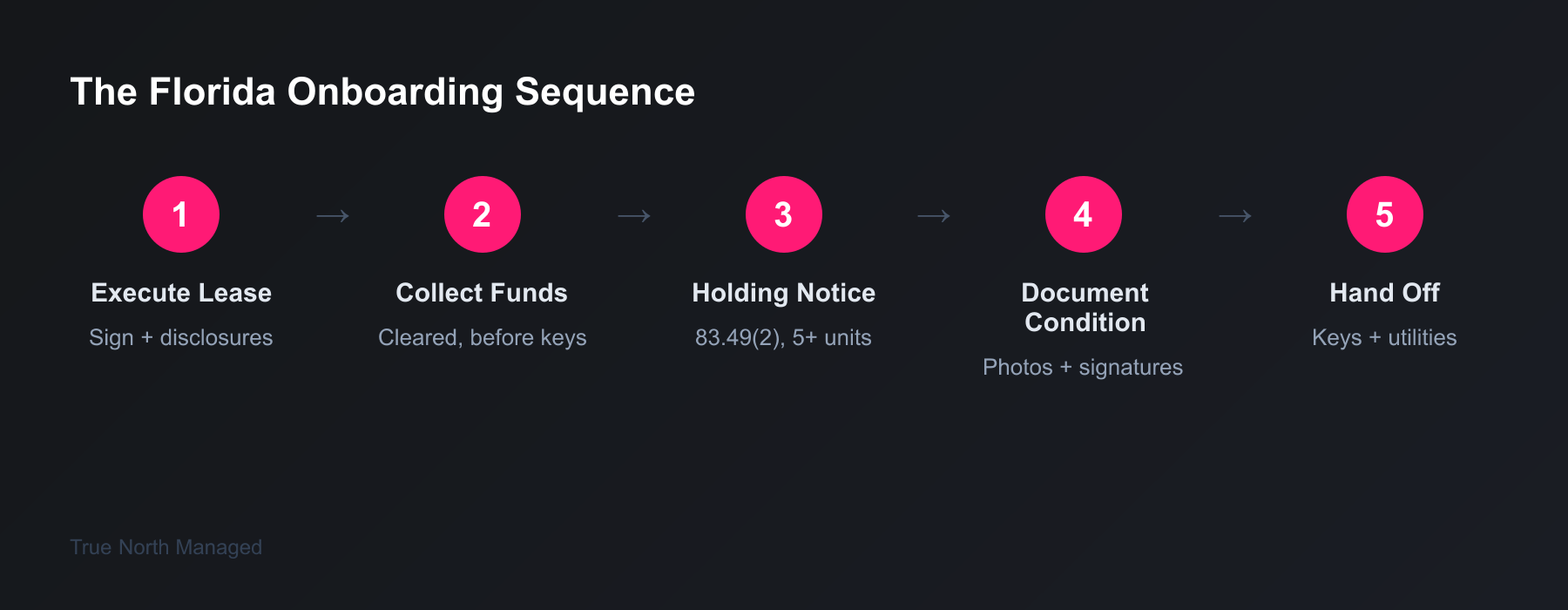
Here's the short version. Tenant onboarding is a five-step sequence: execute the lease with the required disclosures, collect the deposit and first month's rent in cleared funds, send the written deposit-holding notice if you rent five or more units, document the unit's condition at move-in, then hand over keys, utilities, and a welcome packet. Do those five in order and you've protected the property and the relationship. Skip the documentation and you've handed a future tenant a winning argument the day you try to keep part of the deposit.
What is the tenant onboarding process, and why does the order matter?
The tenant onboarding process is the move-in sequence that converts a signed lease into a documented, legally clean tenancy. It runs from lease execution to the day the tenant is settled with keys and working utilities. The order matters because each step protects the one after it — collect funds before keys, document condition before occupancy, disclose before disputes.
Screening is a different job. Screening happens before approval — it's how you decided to rent to this person at all. If you haven't built that part out, our tenant screening process for Florida landlords covers it end to end. Onboarding picks up where screening stops: the applicant is now your tenant, and the clock on several legal obligations has started.
The reason owners get burned is sequence. They sign the lease, hand over keys the same afternoon because the tenant is eager, and circle back to "the paperwork" later. Later is where deposit claims get forfeited and move-in damage becomes your problem. The fix is boring and it works: run the steps in order, and don't give up the keys until the steps before keys are done.
What goes into executing the lease in Florida?
Executing the lease means both parties sign a complete agreement that carries Florida's required disclosures. At minimum that's the radon gas disclosure (exact statutory language, required at or before signing) and, for any building constructed before 1978, the federal lead-based paint disclosure plus the EPA pamphlet. Sign, date, and give the tenant a copy.
Two disclosures trip people up because they're easy to leave out of a lease you downloaded online.
Radon is mandatory under Florida law. The disclosure has to use the exact language the statute prescribes — paraphrasing doesn't satisfy it — and it applies to essentially every rental except transient stays of 45 days or less. You can put it in the body of the lease or attach it as a separate page. It's an information requirement only; you don't have to test for radon or fix anything. You just have to disclose. The full text and scope live in Florida Statute 404.056.
Lead-based paint is a federal rule, not a Florida one, but it bites Florida landlords with older homes — and Central Florida has plenty of pre-1978 housing stock in the older Orlando and Tampa neighborhoods. If the building predates 1978, the tenant gets the lead disclosure and the EPA's hazard pamphlet, and you keep the signed copy for three years.
Execute the lease properly and the rest of onboarding has a foundation. Execute it loosely and every later step inherits the weakness.
How do you handle the security deposit and first month's rent?
Collect the security deposit and the first month's rent in cleared funds before the tenant takes possession. "Cleared" is the operative word: a personal check that bounces after the tenant already holds keys turns a clean onboarding into an eviction. Certified funds — a cashier's check or money order — or a confirmed electronic transfer remove that risk.
This is the step most one-property owners rush, because the tenant is standing there ready to move and the money feels like a detail to settle "this week." It isn't. Possession is your only hold on the deal. Once you hand over keys, you've given it away — and with it the one thing that guarantees payment. The standard, and the smart practice, is the same everywhere: deposit and first month's rent are due at or before move-in, and keys come after the funds clear, not before.
Set the amount in the lease and stick to it. Florida doesn't cap the security deposit, but whatever you collect, you're now holding the tenant's money — and the law has very specific things to say about how you hold it and what you have to tell them. That's the next step, and it's the one with teeth.
What does FS 83.49 require at onboarding — and which notice actually forfeits your deposit claim?
Florida Statute 83.49(2) requires a landlord who holds five or more units to give the tenant written notice — in the lease or within 30 days of receiving the deposit — of where and how the deposit is being held. But the forfeiture penalty most owners fear actually comes later: under 83.49(3)(a), if you don't send written notice of intent to impose a claim within 30 days after the rental agreement ends, you forfeit the right to impose a claim on the deposit — you'd have to return it, though you can still sue for damages after returning it. Onboarding is where you build the record that move-out notice will rely on.
The statute lists what the written notice must do: "(a) Be given in person or delivered by mail or e-mail in accordance with s. 83.505 to the tenant. (b) State the name and address of the depository where the advance rent or security deposit is being held or state that the landlord has posted a surety bond as provided by law. (c) State whether the tenant is entitled to interest on the deposit. (d) Contain the following disclosure:" The disclosure that follows is an all-caps paragraph printed in the statute, and you copy it word for word rather than summarizing it. If you hold the money in a Florida account rather than posting a surety bond, commingling isn't an option: under 83.49(1)(a) and (b), "The landlord shall not commingle such moneys with any other funds of the landlord or hypothecate, pledge, or in any other way make use of such moneys until such moneys are actually due the landlord." The deposit stays in its own separate account until it's actually owed to you. Send the notice in the lease or within 30 days of receiving the money, and notify the tenant again within 30 days if you ever change the manner or location in which you hold it.
Here's the part that catches owners off guard. The holding-notice requirement in 83.49(2) doesn't apply to a landlord who rents fewer than five individual dwelling units — so a single-property owner is technically exempt from this notice. But the deposit-return clock binds everyone. After the rental agreement ends, you have 15 days to return the full deposit if you're keeping nothing, or 30 days to send written notice of your claim and the reason for it, by certified mail or 83.505 e-mail, if you're withholding any of it. Miss the 30-day notice and you lose the right to deduct — you'd return the deposit and could still sue for the damage after returning it. Most one-property owners get this exactly backwards: they ignore the holding notice they could safely skip and blow the return deadline that would actually cost them.
If you hold five or more units, send the 83.49(2) holding notice every time, within 30 days of taking the deposit. But know exactly what that notice does and doesn't do. The statute says: "Failure to give this notice is not a defense to the payment of rent when due." A tenant can't skip rent over a missing holding notice, and missing it doesn't forfeit your claim on the deposit. The forfeiture trap lives one subsection down, in 83.49(3)(a): the notice of intent to impose a claim, due within 30 days after the rental agreement ends. Miss that one and you forfeit the right to impose a claim on the deposit, whether you own one unit or fifty — though you can still file an action for damages after returning the deposit. Read the statute yourself; it's short and unambiguous at Florida Statute 83.49.
How should you document the unit's condition at move-in?
Walk the unit with the tenant present, photograph every room with date-stamped images, fill out a written condition checklist, and have both of you sign it. This is the move-in record — and in Florida, the move-in record is the move-out defense. When a deposit dispute lands in small claims, the landlord bears the burden of proving the damage was real and the deductions reasonable. Undocumented, you can't.
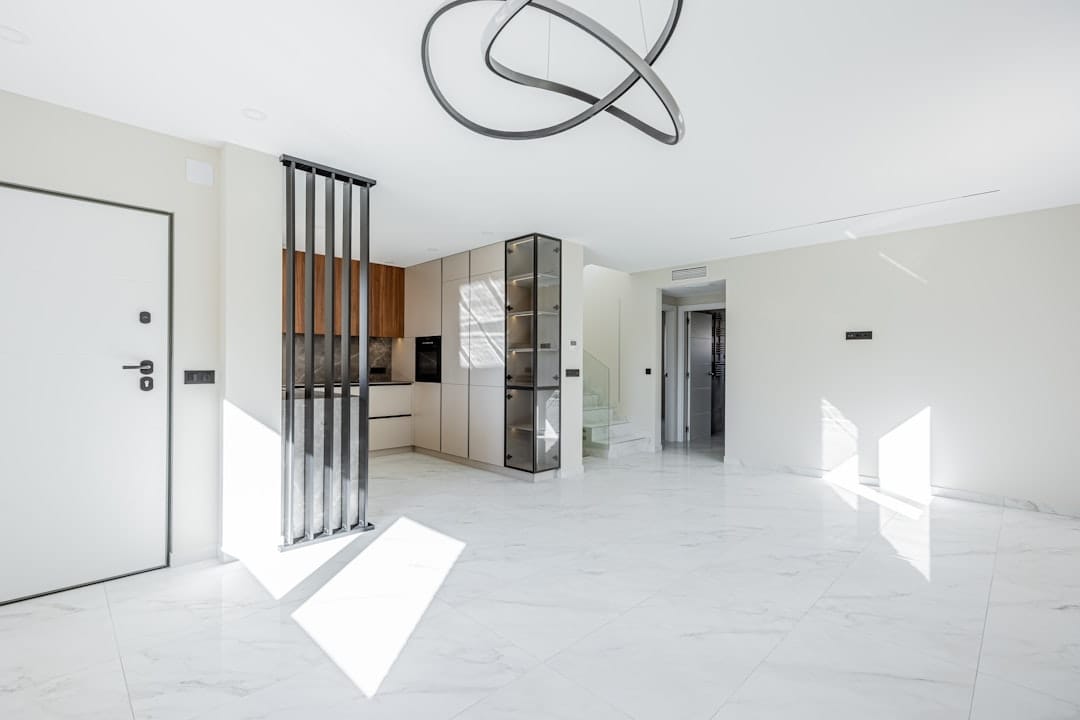
This step has a dedicated playbook of its own — our move-in inspection checklist for Florida landlords covers exactly what to photograph and how to structure the report, so I won't re-run all of it here. What matters for onboarding is when and why it happens: at move-in, before the tenant occupies, because once they've lived in the unit you can no longer prove what condition it was in when they got it.
The owners who lose deposit fights aren't usually the ones who never inspected. They're the ones who inspected casually — a few phone photos, no signatures, no dates — and then watched a tenant claim the scuffed floor and the broken blind were already there. A signed, dated checklist with photos both parties agreed to closes that argument before it starts. Keep the record for at least five years; Florida's contract statute of limitations runs that long, and disputes have a way of surfacing late.
Documentation isn't paperwork for its own sake. It's the paper you didn't collect that comes back to cost you.
What goes in the keys, utilities, and welcome handoff?
The final step hands the tenant everything they need to live in the property: keys and access, utilities transferred into their name, and a welcome packet with the lease copy, payment instructions, maintenance process, and emergency contacts. This is where onboarding shifts from protecting you to setting up the tenant — and a tenant who knows how to reach you and how to pay rent is a tenant who causes fewer problems.
Utilities are address-specific, and a generic "call your power company" isn't good enough. In Orlando, downtown and the core neighborhoods are served by OUC, while outlying parts of Orange, Seminole, and Osceola counties fall under Duke Energy — and natural gas is TECO Peoples Gas. In Tampa, electricity is Tampa Electric (TECO), natural gas is Peoples Gas, and water is municipal by city. Name the correct provider for this property in the packet. OUC's start, stop, or move service page is the kind of direct link a tenant can act on; give them the equivalent for their actual provider. Utilities should go into the tenant's name before move-in — if they stay in yours, you're liable for the unpaid bills.
The welcome packet is short by design. A one-page "how to reach us and what to do in an emergency" sheet does more than a glossy folder nobody reads. Include the lease copy, how and when rent is paid, how to submit a maintenance request, and who to call at 2 a.m. when a pipe bursts. That's the day-one foundation for everything that follows — and when the lease comes up for renewal, a tenancy that started organized is far easier to keep. Our lease renewal strategy for Florida landlords picks up that thread.
The onboarding sequence, start to finish
Onboarding isn't about effort or hospitality. It's about doing five things in the right order, with two of them on legal deadlines:
- Execute the lease — complete agreement, radon and (pre-1978) lead disclosures, signed and dated, copy to the tenant.
- Collect funds — deposit and first month's rent in cleared, certified funds before keys.
- Send the FS 83.49(2) holding notice if you hold five or more units — within 30 days, written, where the deposit is held. (The forfeiture deadline is separate: the 83.49(3)(a) claim notice, due within 30 days after the rental agreement ends, binds everyone.)
- Document condition — walkthrough with the tenant, dated photos, signed checklist, kept five years.
- Hand off — keys, address-specific utility transfer, one-page welcome packet.
A solid onboarding doesn't just start the tenancy well. It pre-builds the evidence and the goodwill you'll draw on for the next two years. The owners who treat the first 30 days as a checklist to rush are the same ones who, eighteen months later, can't prove a thing.
This is also the part of the business where a manager earns their fee — the deadlines don't move, the disclosures don't forgive, and the documentation either exists or it doesn't. If you'd rather not run the sequence yourself every time a tenant turns over, that's exactly the work we handle for owners across Orlando and Tampa. Start with the full Florida owner's guide to see how onboarding fits the larger picture.