
How to Handle After-Hours Maintenance Emergencies in Florida
It's 2 a.m. and your tenant says water is coming through the ceiling. How to triage the call, respond legally, and keep a $300 fix from becoming $9,000.

It's 2 a.m. Your phone lights up. The tenant in your Orlando rental says water is coming through the ceiling. You're half-awake, you don't have a plumber's number memorized, and you're not sure if this can wait until morning. This is the call every landlord dreads — and how you handle the next hour decides whether it's a $300 fix or a $9,000 one.
What you must do when the call comes in
- Acknowledge the tenant within 30–60 minutes. Florida sets no statutory deadline for the first response (a 7-day clock to fix it starts once the tenant gives written notice), but a documented prompt response is what protects you from a habitability claim under Florida Statute 83.51.
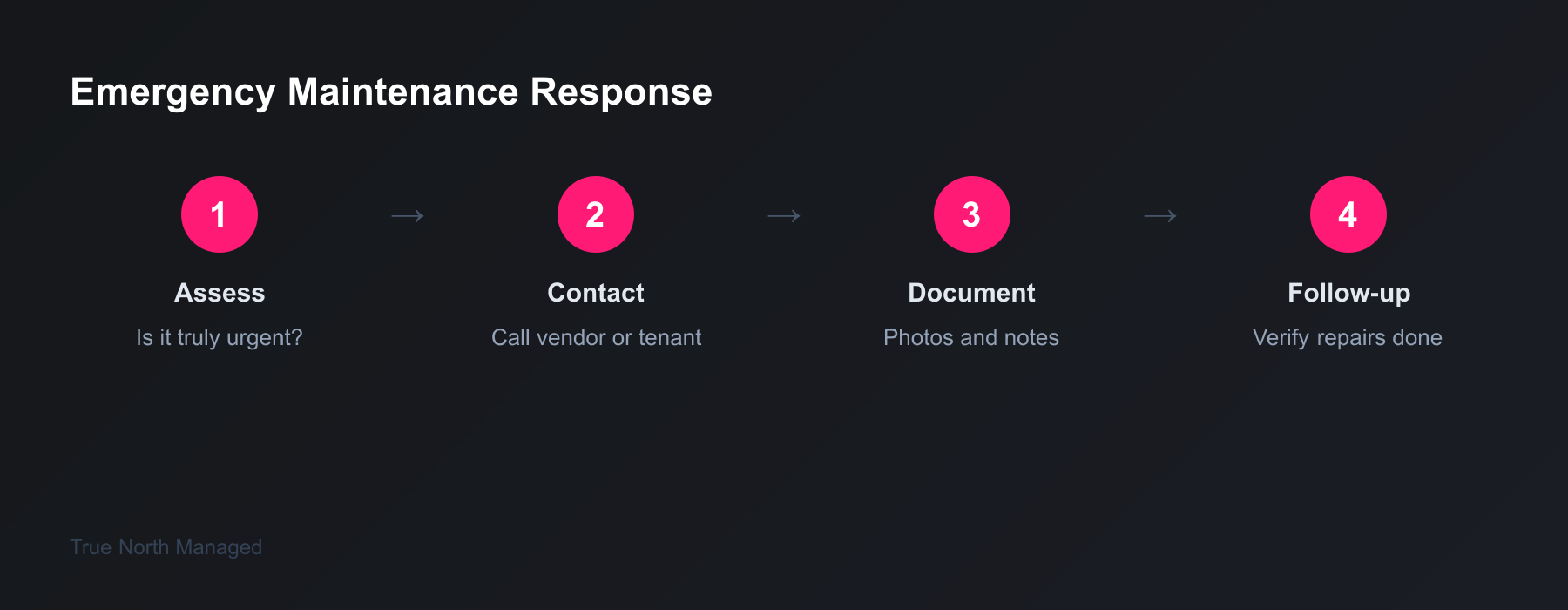
- Triage it: a true emergency threatens health, safety, or the building — dispatch a contractor that night. A non-emergency waits for the next business day.
- You may enter without notice in a genuine emergency (Florida Statute 83.53) to protect the property — a burst pipe, fire, or flood.
- Log everything: when you were notified, when you dispatched, when the repair was done. The log is your defense if the tenant later claims you ignored it.
What counts as an after-hours maintenance emergency in Florida?
An after-hours emergency in a Florida rental is anything that threatens health, safety, or the property and can't wait until morning: a burst pipe or flood, a gas leak, no power, a broken exterior lock, sewage backup, fire or smoke damage, or no AC in extreme heat when the lease includes it. A dripping faucet or a slow drain is not.
Florida law doesn't print a black-and-white definition of "emergency." What it gives you is the habitability standard. Under Florida Statute 83.51, you have to keep the dwelling fit to live in. When a problem makes the unit uninhabitable or genuinely dangerous, that's your emergency line.
True after-hours emergencies:
- A major water leak, burst pipe, or flooding
- A gas leak or gas odor
- No electrical power to the unit
- A broken exterior lock — the tenant can't secure the home
- Sewage backing up into the unit
- Fire or smoke damage
- No AC in extreme heat when the lease includes air conditioning
That last one needs a caveat. Florida law does not require a landlord to provide air conditioning. But the moment AC is written into your lease, keeping it working becomes a maintenance obligation — and in a Florida July, a dead AC unit becomes a real habitability problem fast. We cover exactly where that line sits in our guide to the Florida landlord's AC repair obligation.
What can wait until business hours: a dripping faucet, a slow drain, a burned-out bulb, a squeaky door, a broken dishwasher. Annoying — not an emergency.
How should you triage the 2 a.m. call?
Answer the phone, then ask three questions: Is anyone in danger? Is the building being damaged right now? Can it safely wait until morning? If danger or active damage is present, dispatch a contractor tonight. If not, log the request and schedule it for the next business day. Calm triage prevents both overspending and under-reacting.
The decision happens in the first few minutes. Walk the tenant through it on the phone:
- Is anyone at risk? A gas smell, no power, an exposed electrical hazard — that's a yes. Tell them to leave the unit if the situation is dangerous, then dispatch.
- Is the property taking damage as you speak? Water actively pouring in, sewage backing up — every hour multiplies the repair bill. Dispatch tonight.
- Can it safely hold until morning? A leaking faucet the tenant can shut off at the valve, a single broken outlet — log it and schedule the next business day.
For a water emergency, give the tenant one immediate instruction: find the shut-off valve. Stopping the flow before the plumber arrives is often the difference between a drywall patch and a gutted ceiling. Then make the dispatch call.
How fast do you have to respond to an emergency?
Florida law sets no statutory deadline for the first response. The practical standard most landlords treat as reasonable is acknowledging the tenant within 30–60 minutes and getting a contractor on site within a few hours for a true emergency. What courts actually weigh is whether you acted reasonably and in good faith. Written notice from the tenant changes that. Under Florida Statute 83.56(1), "If the landlord materially fails to comply with s. 83.51(1) or material provisions of the rental agreement within 7 days after delivery of written notice by the tenant specifying the noncompliance and indicating the intention of the tenant to terminate the rental agreement by reason thereof, the tenant may terminate the rental agreement." That's seven days to finish the fix, not to pick up the phone. The same notice period opens a rent defense under 83.60(1)(b): "The defense of a material noncompliance with s. 83.51(1) may be raised by the tenant if 7 days have elapsed after the delivery of written notice by the tenant to the landlord, specifying the noncompliance and indicating the intention of the tenant not to pay rent by reason thereof." A tenant who raises it when you sue for possession "shall pay into the registry of the court the accrued rent as alleged in the complaint or as determined by the court and the rent that accrues during the pendency of the proceeding, when due" (83.60(2)).
Don't confuse acknowledgment with completion. Responding within the hour means you picked up, assessed the problem, and dispatched help — not that the repair is finished. What protects you is the documented chain showing you moved.
If something makes the unit uninhabitable — no water, sewage intrusion, no AC in a heat wave with AC in the lease — same-day action is the expectation. A non-emergency like a slow drain is fine for the next business day. Alongside that 7-day written-notice clock, the reasonableness test is the real rule for how fast you move, and a clear timeline of your response is how you pass it.
Can a landlord enter the unit without notice in an emergency?
Yes. Florida Statute 83.53(2) says "The landlord may enter the dwelling unit at any time for the protection or preservation of the premises." A fire, a flood or a burst pipe is exactly that. For non-emergency repairs, the same subsection sets the rule: "'Reasonable notice' for the purpose of repair is notice given at least 24 hours prior to the entry, and reasonable time for the purpose of repair shall be between the hours of 7:30 a.m. and 8:00 p.m." So a routine repair needs a full day's notice and a daytime visit.
This matters when a tenant isn't home and the property is being damaged. Florida Statute 83.53 gives you a narrow right of emergency entry — narrow being the operative word. It covers genuine threats to life, safety, or the property. It is not a loophole for routine visits. Subsection (3) draws the line: "The landlord shall not abuse the right of access nor use it to harass the tenant." Calling a routine check an emergency is exactly what that sentence is there to stop. When the situation is real, though, you don't have to wait 24 hours and watch your ceiling come down.
Who should you call, and how do you line up vendors first?
You need an HVAC company, a plumber, an electrician, and a locksmith who take after-hours calls — lined up before the first emergency, not during it. Keep two contacts per trade so a no-answer doesn't leave you stuck. The 2 a.m. call is the wrong time to start Googling "emergency plumber near me."
Contractor relationships matter far more at 2 a.m. than at 2 p.m. Most contractors don't take after-hours calls at all, and the ones who do charge a premium. Build the roster in the off-season:
- Find two HVAC vendors, two plumbers, an electrician, and a locksmith who confirm they take after-hours calls.
- Get their after-hours rates in writing so a midnight invoice holds no surprises.
- Test the process — call a vendor at 8 p.m. and see what actually happens. If nobody answers, you've found a gap before it cost you.
- Pay your emergency vendors fairly and promptly. A contractor you treat well answers when you call on a holiday weekend.
For the full process of finding and vetting a reliable network, see our guide on vetting contractors for a Florida rental. The standing system that ties all of this together — the lease clause, the vendor list, the budget — is the subject of our emergency maintenance protocol for Florida rentals.
How do you document an after-hours emergency?
Log every emergency: the date and time the tenant notified you, what they reported, when and which vendor you dispatched, and when the repair was completed. Florida courts judge whether you acted reasonably — and a dated timeline is the proof. If a tenant claims you ignored a leak, your log decides the dispute.
The paper trail is your defense. A tenant who later argues you let a water leak run for days has a much weaker case against a record showing you dispatched a plumber within hours of the call. If you couldn't reach a vendor, log the attempts and times too — Florida courts look for good-faith effort, and documented attempts count.
Emergency response is one piece of a Florida landlord's broader duties. Habitability, security, and timely repairs all connect — see our overview of a Florida landlord's responsibilities for how they fit together.
When should you hand off the after-hours calls?
Hand off when you genuinely can't guarantee a 24/7 response — you travel, you have a demanding day job, or you live out of state. One mishandled emergency can cost more than a year of management fees, and the stress of being your own midnight answering service is real. A property manager carries the vendor network and the on-call rotation.
Owning one rental doesn't change the math here: when an emergency hits, you are the emergency line, the dispatcher, and the after-hours contact, all at once. If that's not realistic for your life, that's not a failure — it's a reason to get help.
A free rental analysis is a chance to see how full-service management handles the 2 a.m. call — the triage, the vetted vendors, the documentation — so you can sleep through it. You don't have to own a portfolio to want that. We manage single properties too. For the broader decision, our guide on when to hire a property manager in Orlando walks through the tradeoffs.