

Florida's Upcoming 5-Day Non-Payment Notice: What SB 716 Means for Landlords
SB 716 would extend Florida's non-payment notice from 3 days to 5 days. What changes, how to prepare, and when it might take effect.
Florida Senate Bill 716 is proposed legislation that would change the non-payment of rent notice period from 3 days to 5 days. As of mid-2025, the bill hasn't yet become law. Here's what landlords should know and how to prepare if it passes.
Current Law: The 3-Day Notice
Under Florida Statute 83. 56 , when a tenant fails to pay rent, the landlord must deliver a written 3-day notice to pay or vacate. The tenant has 3 days (excluding weekends and legal holidays) to pay the rent due or surrender possession. Under Florida Statute 83.56 , when a tenant fails to pay rent,
Under Florida Statute 83. 56 , when a tenant fails to pay rent, the landlord must deliver a written 3-day notice to pay or vacate. The tenant has 3 days (excluding weekends and legal holidays) to pay the rent due or surrender possession.
Under Florida Statute 83.56, when a tenant fails to pay rent, the landlord must deliver a written 3-day notice to pay or vacate. The tenant has 3 days (excluding weekends and legal holidays) to pay the rent due or surrender possession. If they don't, the landlord can file an eviction action.
The 3-day clock is strict. Mistakes in the notice (wrong amount, wrong dates, improper delivery) can delay or defeat an eviction. See our tenant not paying rent guide for the current process.
What SB 716 Would Change
SB 716 would extend the notice period from 3 days to 5 days for non-payment of rent. In Florida, The bill would give tenants 5 business days (excluding weekends and legal holidays) instead of 3. It also prohibits landlords from imposing fees or surcharges during that 5-day payment period. Supporters argue it gives tenants more
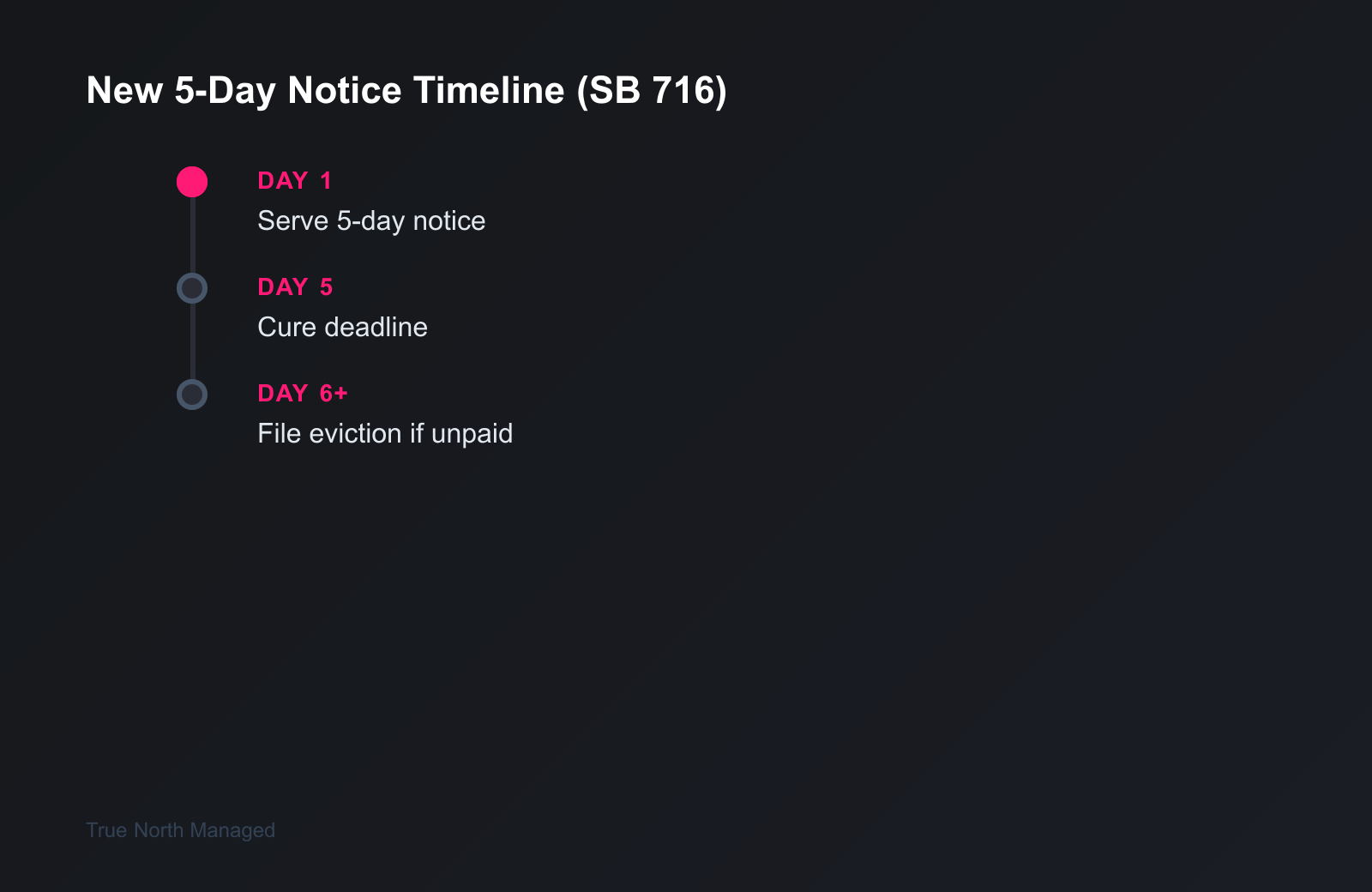
SB 716 would extend the notice period from 3 days to 5 days for non-payment of rent. In Florida, The bill would give tenants 5 business days (excluding weekends and legal holidays) instead of 3. It also prohibits landlords from imposing fees or surcharges during that 5-day payment period. Supporters argue it gives tenants more time to cure; opponents say it prolongs -- non-payment and delays relief for landlords.
SB 716 would extend the notice period from 3 days to 5 days for non-payment of rent. The bill would give tenants 5 business days (excluding weekends and legal holidays) instead of 3. It also prohibits landlords from imposing fees or surcharges during that 5-day payment period. Supporters argue it gives tenants more time to cure; opponents say it prolongs -- non-payment and delays relief for landlords.
How Landlords Should Prepare
Track the bill's progress at the Florida Legislature website. If it passes, update your notice templates and procedures. make sure your property manager or attorney uses the correct notice period. FL landlords in Orlando and Tampa should check local requirements. Track the bill's progress at the Florida Legislature website. If it passes, update your notice
Track the bill's progress at the Florida Legislature website. If it passes, update your notice templates and procedures. make sure your property manager or attorney uses the correct notice period. FL landlords in Orlando and Tampa should check local requirements.
Track the bill's progress at the Florida Legislature website. If it passes, update your notice templates and procedures. make sure your property manager or attorney uses the correct notice period. The effective date would be set by the legislation; it is immediate or delayed.
Until the law changes, continue using the 3-day notice. don't assume the 5-day period applies until the bill is signed and effective.
Other Eviction Notice Types Unchanged
In Florida, SB 716 as proposed affects only the non-payment notice. Other notices (lease violations, holdover, etc. ) would remain governed by existing law. FL landlords in Orlando and Tampa should check local requirements. SB 716 as proposed affects only the non-payment notice. Other notices (lease violations, holdover, etc.) would remain governed by existing law.
SB 716 as proposed affects only the non-payment notice. Other notices (lease violations, holdover, etc. ) would remain governed by existing law. FL landlords in Orlando and Tampa should check local requirements.
SB 716 as proposed affects only the non-payment notice. Other notices (lease violations, holdover, etc.) would remain governed by existing law. The eviction process in Orlando and Tampa would follow the same steps; only the initial notice period would change for non-payment cases.
Timeline Expectations
Legislation can move quickly or stall. In Florida, Bills are filed, heard in committee, voted on, and either signed or vetoed. Check the Legislature's site for current status. FL landlords in Orlando and Tampa should check local requirements. Legislation can move quickly or stall. Bills are filed, heard in committee, voted on, and either signed
Legislation can move quickly or stall. In Florida, Bills are filed, heard in committee, voted on, and either signed or vetoed. Check the Legislature's site for current status. FL landlords in Orlando and Tampa should check local requirements.
Legislation can move quickly or stall. Bills are filed, heard in committee, voted on, and either signed or vetoed. Check the Legislature's site for current status. If SB 716 passes, the effective date will be in the enrolled bill.
Stay informed. When the law changes, update your processes. For help with evictions and tenant issues in Orlando or Tampa, get a free rental analysis and we can discuss how property management handles non-payment and legal proceedings.
Timeline and Process if SB 716 Passes
If the bill becomes law, the 5-day notice would follow the same delivery rules as the current 3-day notice. In Florida, Weekends and legal holidays would still be excluded from the count. Landlords would need to update their notice templates and adjust their internal timelines. If the bill becomes law, the 5-day notice would follow
If the bill becomes law, the 5-day notice would follow the same delivery rules as the current 3-day notice. In Florida, Weekends and legal holidays would still be excluded from the count. Landlords would need to update their notice templates and adjust their internal timelines.
If the bill becomes law, the 5-day notice would follow the same delivery rules as the current 3-day notice. Weekends and legal holidays would still be excluded from the count. Landlords would need to update their notice templates and adjust their internal timelines. Eviction filings would occur on day 6 at the earliest, not day 4.
How to Prepare
Keep using the 3-day notice until the law changes. Monitor the Florida Senate bill tracker for SB 716 status. When and if it passes, update your lease templates and property management workflows. FL landlords in Orlando and Tampa should check local requirements. Keep using the 3-day notice until the law changes. Monitor the Florida Senate
Keep using the 3-day notice until the law changes. Monitor the Florida Senate bill tracker for SB 716 status. When and if it passes, update your lease templates and property management workflows. FL landlords in Orlando and Tampa should check local requirements.
Keep using the 3-day notice until the law changes. Monitor the Florida Senate bill tracker for SB 716 status. When and if it passes, update your lease templates and property management workflows. The change would affect only non-payment notices, not other termination types under FL 83.56. Our tenant not paying rent guide covers the current process in detail.
Court Costs and Filing
In Florida, Eviction filing fees vary by county. In Orange and Hillsborough, expect roughly $185 to $400 for the initial filing, plus service of process costs. A 5-day notice would add two business days to the timeline before you can file, which means slightly longer vacancy exposure. Eviction filing fees vary by county. In Orange
Eviction filing fees vary by county. In Orange and Hillsborough, expect roughly $185 to $400 for the initial filing, plus service of process costs. A 5-day notice would add two business days to the timeline before you can file, which means slightly longer vacancy exposure.
Eviction filing fees vary by county. In Orange and Hillsborough, expect roughly $185 to $400 for the initial filing, plus service of process costs. A 5-day notice would add two business days to the timeline before you can file, which means slightly longer vacancy exposure. Plan for that in your cash flow. See our eviction process guide for the full step-by-step.
Notice Template Updates
When the law changes, replace "3 days" with "5 days" in your pay-or-vacate notice. In Florida, The notice must still state the amount due, the due date, and the deadline to pay or vacate. Improper notices can delay or defeat eviction. When the law changes, replace "3 days" with "5 days" in your pay-or-vacate notice.
When the law changes, replace "3 days" with "5 days" in your pay-or-vacate notice. In Florida, The notice must still state the amount due, the due date, and the deadline to pay or vacate. Improper notices can delay or defeat eviction.
When the law changes, replace "3 days" with "5 days" in your pay-or-vacate notice. The notice must still state the amount due, the due date, and the deadline to pay or vacate. Improper notices can delay or defeat eviction. Have an attorney review your template when the bill passes. Our serving legal notices guide covers delivery requirements.
Impact on Chronic Late Payers
Tenants who habitually pay late would get two extra days before eviction is filed. In Florida, That extends the period you carry unpaid rent. Document every late payment and notice sent. FL landlords in Orlando and Tampa should check local requirements. Tenants who habitually pay late would get two extra days before eviction is filed.
Tenants who habitually pay late would get two extra days before eviction is filed. In Florida, That extends the period you carry unpaid rent. Document every late payment and notice sent. FL landlords in Orlando and Tampa should check local requirements.
Tenants who habitually pay late would get two extra days before eviction is filed. That extends the period you carry unpaid rent. Document every late payment and notice sent. If you eventually non-renew, that record supports your decision. See our chronic late rent guide for handling repeat offenders.
Electronic vs. Paper
SB 716 lets you serve notices via email or text if the tenant agreed in the lease. In Florida, But if your lease didn't include that opt-in, you're still stuck with traditional methods. For existing leases, you can't add electronic service without a lease amendment. SB 716 lets you serve notices via email or text
SB 716 lets you serve notices via email or text if the tenant agreed in the lease. In Florida, But if your lease didn't include that opt-in, you're still stuck with traditional methods. For existing leases, you can't add electronic service without a lease amendment.
SB 716 lets you serve notices via email or text if the tenant agreed in the lease. But if your lease didn't include that opt-in, you're still stuck with traditional methods. For existing leases, you can't add electronic service without a lease amendment.
Even when electronic service is allowed, keep a paper trail. Save screenshots of sent emails. If you use a portal, the system logs delivery. For eviction notices, many landlords still prefer certified mail or hand delivery because the proof is clearer.
How to Prepare for the Change
In Florida, When SB 716 takes effect, the 3-day notice becomes 5 days for non-payment. Update your lease templates and notice forms now. The change affects all evictions filed after the effective date—you'll need the new forms. Your process server and attorney will need to adjust. Make sure everyone on your team knows the new
When SB 716 takes effect, the 3-day notice becomes 5 days for non-payment. Update your lease templates and notice forms now. The change affects all evictions filed after the effective date—you'll need the new forms.
Your process server and attorney will need to adjust. Make sure everyone on your team knows the new timeline. The 5-day window gives tenants more time to pay—but it also means you wait longer before you can file. Plan your cash flow accordingly.
Updating Your Process
In Florida, When the law changes, update your notice templates. The 5-day notice will have different language than the 3-day. Your attorney or process server can provide the correct form. Train your team. If you use a property manager, make sure they know the new timeline. The 5-day window affects when you can file. Don't
When the law changes, update your notice templates. The 5-day notice will have different language than the 3-day. Your attorney or process server can provide the correct form.
Train your team. If you use a property manager, make sure they know the new timeline. The 5-day window affects when you can file. Don't file early—the court will dismiss. Wait for the full period to expire.
Bottom Line
Update your templates when the law changes. Train your team. The 5-day window affects your timeline. Plan accordingly.
The 5-day notice gives tenants more time to pay. That can reduce evictions—or it can delay them. Plan your cash flow.
When in doubt, document it. Florida landlords who follow the process and keep a paper trail protect themselves when disputes arise. A few minutes of documentation can save months of headaches.
Update your lease template to include an electronic notice opt-in if you want to use email or text for future notices. New leases can include it; existing ones need an amendment.
If you own a rental in Orlando or Tampa and want a clear picture of what it could earn, get a free rental analysis. No obligation—just real numbers.