
How to Find Your First Tenant in Orlando or Tampa
Finding your first tenant in Orlando or Tampa? Half your applicants are relocating sight-unseen. Here's how to list, market, and screen so your unit leases fast.

The unit's ready. Fresh paint, the AC serviced, keys in hand. Now you need a tenant — and the instinct for most first-time landlords is to snap a few photos on your phone, post them somewhere with "call to schedule a showing," and wait.
That works in a small town. It does not work in Orlando or Tampa.
Here's the quick version. To find your first tenant in Orlando or Tampa, list your property on the major rental syndication networks with a video walkthrough and an online application path, price it to current neighborhood comps, and screen every applicant against the same written criteria. The piece most new landlords miss: a large share of the people who will apply for your rental have never set foot in Florida. They're relocating, and they'll choose your property — or skip it — from a phone screen 1,000 miles away.
That changes the whole job. In these two markets, the listing isn't a notice that a unit exists. It's a sales tool aimed at someone who can't drive by.
Why Orlando and Tampa are different
Both metros run on in-migration. Tampa pulls a steady stream of relocations to MacDill Air Force Base, Tampa General Hospital, Moffitt Cancer Center, and the USF Health system. A lot of that growth comes from out of state.

For a landlord, that means a meaningful slice of your applicant pool is searching from a couch in New Jersey or Long Island. They found a job here, signed nothing yet, and need a place before the moving truck leaves. They are not going to fly down to tour your three-bedroom in Avalon Park. They'll decide from what you put online.
Call them the "Sight-Unseen Applicant." Once you build your listing for that renter, the local renter who can drive by gets an even better experience for free.
Where do Orlando and Tampa renters actually look for a rental?
They look on the big national platforms — mostly the Zillow Rentals Network (Zillow, Trulia, HotPads) and Apartments.com — and they look on their phones. Around 81% of renters search on a mobile website and the typical renter uses five different sites before signing. A Craigslist post or a Facebook group alone won't reach them.
So get your listing onto the major syndicators. You can post a single-family or small-multifamily rental directly to Zillow Rental Manager for free, with an optional premium upgrade around $39.99 that boosts visibility for 90 days. Apartments.com and the smaller portals pick up listings through feeds or direct posting. The goal is simple: be where renters are already looking, on the device they're looking with.
Don't scatter your effort across ten obscure sites. Three or four strong placements — the Zillow network, Apartments.com, and one or two regional listings — cover the search behavior of nearly everyone who'd rent your property.
Why does a video tour matter more than a lower price?
Because a lower price can't reach a renter who can't see the place. A video tour can.
This is the heart of it. About 41% of renters say they'd rent a property sight-unseen, and 64% want the option of a self-guided virtual tour. Nearly 9 in 10 prospects require some kind of walkthrough — in person or virtual — before they'll sign. Renters who watch a virtual tour are far more engaged than those who only see photos.
Now think about your out-of-state applicant. They've found two listings in Lake Nona at similar rent. One has eight photos and "call to schedule." The other has a three-minute phone video — front door, every room, the backyard, the street — and a link to apply online. Which one do they pursue? The video, every time. Not because it's cheaper. Because it's the only one they can actually evaluate.
First-time landlords reach for a rent cut when a listing goes quiet. Often the listing isn't priced wrong — it's just invisible to half its real audience. Shoot a walk-through video on your phone before you drop the rent.
How should I price my first rental so it doesn't sit empty?
Price it to current comps, not to your mortgage payment. Zillow's rent index, which covers houses as well as apartments, put the typical Orlando-metro rent at about $1,942 in August 2026 and Tampa's at about $2,001.
Those are starting points, not your number. Pull three to five active listings for properties like yours — same bedroom count, same submarket, similar condition and square footage — and price into that range.
Here's why precision matters. CoStar reported in January 2026 that Tampa Bay's apartment vacancy was climbing to a record 10.7% entering 2026, the highest since it began tracking the market in 2000. An overpriced unit doesn't earn you more. It sits. One extra empty month on a $1,800 rental costs you $1,800. To recover that, you'd have to charge $150 more a month for a full year — and a unit priced $150 over comps is exactly the one that sits. For more on getting the number right, see our guide to setting rent for an Orlando rental.
What goes into a listing that converts a remote applicant?
A listing that wins the Sight-Unseen Applicant gives them everything they'd get from an in-person visit — without the visit.
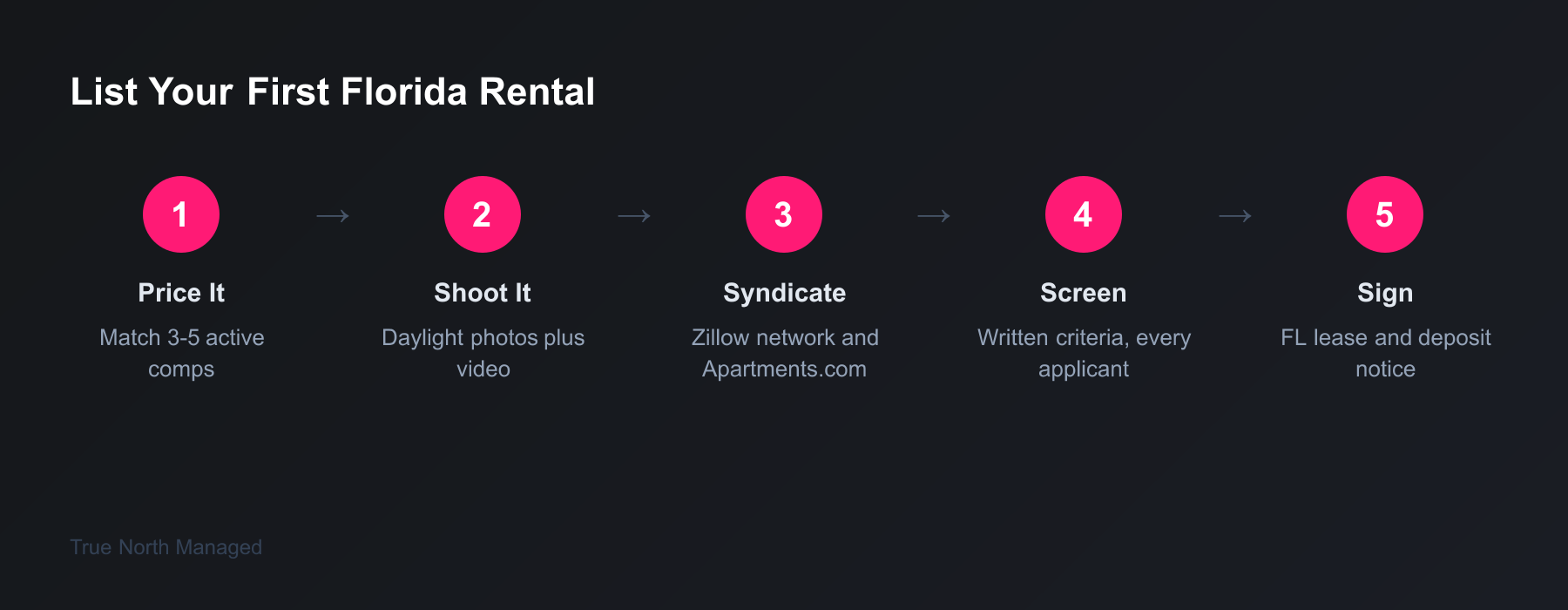
Start with the visuals. Professional photos aren't a luxury here; listings with them lease about 11% faster, rent for roughly 10% more, and pull 61% more views on Zillow. If you shoot it yourself, do it in daylight, every room, wide and level, plus the exterior and the street.
Then the elements that close the remote renter:
- A video walkthrough. Three to five minutes, narrated, every room and the yard. This is the single highest-impact thing you can add.
- A complete written description. Bedrooms, baths, square footage, parking, laundry, AC type, pet policy, lease term, and the move-in date.
- Neighborhood and commute context. A renter relocating to Tampa doesn't know Brandon from Westchase. Tell them the drive time to MacDill or downtown, the school zone, what's walkable.
- Every fee, stated up front. Application fee, security deposit, pet fee, any monthly add-ons. Surprises kill remote applications fast.
Write it for a phone screen. Short paragraphs, the essentials first, no walls of text.
What you must do — fair housing and Florida listing rules
Your listing has to follow the law before it follows your marketing instincts. Fair housing applies to every word of it.
What you must do before your listing goes live
- Scrub fair-housing language from the ad. The federal Fair Housing Act bars advertising that signals a preference based on race, color, religion, national origin, sex, disability, or familial status. Phrases like "perfect for a young couple," "ideal for professionals," "adults only," or "great for empty nesters" are violations — courts use an "ordinary reader" standard, so impact matters, not what you meant.
- Set written screening criteria first. Decide your income, credit, and rental-history standards before the listing goes up, and apply them to every applicant the same way. See our Florida tenant screening process guide for a workable standard.
- Keep the application fee separate. Florida sets no statutory cap on application fees, but the fee should reflect your actual screening cost and stay separate from rent and the security deposit.
- Process servicemember applications within 7 days. Florida Statute 83.683(1) says: "If a landlord requires a prospective tenant to complete a rental application before residing in a rental unit, the landlord must complete processing of a rental application submitted by a prospective tenant who is a servicemember, as defined in s. 250.01, within 7 days after submission and must, within that 7-day period, notify the servicemember in writing of an application approval or denial and, if denied, the reason for denial. Absent a timely denial of the rental application, the landlord must lease the rental unit to the servicemember if all other terms of the application and lease are complied with." Section 250.01 defines a servicemember as "any person serving as a member of the United States Armed Forces on active duty or state active duty and all members of the Florida National Guard and United States Reserve Forces," so Guard and Reserve applicants count too — a real risk near MacDill in Tampa.
- Plan for the security deposit. Once your first tenant pays it, Florida Statute 83.49 subsection (2) says "The landlord shall, in the lease agreement or within 30 days after receipt of advance rent or a security deposit, give written notice to the tenant which includes disclosure of the advance rent or security deposit," and adds, "This subsection does not apply to any landlord who rents fewer than five individual dwelling units." The move-out deadlines in subsection (3) — return within 15 days, or send a claim notice within 30 days after the lease ends — apply to every landlord, whatever the unit count.
A discriminatory phrase you didn't think twice about can turn into a HUD complaint. When in doubt, describe the property — never the tenant you're picturing. Our breakdown of fair housing mistakes Florida landlords make covers the wording traps in detail.
Common mistakes first-time Orlando and Tampa landlords make
A few patterns show up again and again with new landlords here.
Treating the listing like a classified ad. Three dark phone photos and "call to schedule" filters out your entire remote applicant pool. Photos and a video aren't optional in these markets.
Listing only on Craigslist or Facebook. Those reach a sliver of renters. The serious applicants — especially the ones relocating — are on the Zillow network and Apartments.com.
Pricing to the mortgage. Your loan payment isn't a market signal. Comps are. A unit priced above its comps sits empty, and an empty unit earns nothing.
Screening by gut feel. "He seemed nice on the phone" isn't a standard. Write your criteria down before the first applicant calls, so you apply them the same way every time.
If you're juggling all of this for the first time, our first-time landlord 30-day checklist for Florida lays the steps out in order.
Getting your first tenant right
Finding your first tenant in Orlando or Tampa comes down to one shift in thinking: you're not posting a notice, you're marketing to a renter who may never see the property in person until move-in day. Build the listing for them — strong photos, a video walkthrough, honest pricing, a clean online application — and the local renter benefits too. If you're new to all of this, our Florida owner's guide walks through the rest of the landlord basics in one place. And before the listing goes live, make sure the number itself is right — our guide to setting the right rent for your first Florida rental walks through the comp-based method that keeps a unit from sitting empty.
Get the price and the listing right and a good tenant usually follows within a few weeks. If you'd rather hand the pricing, the listing, and the screening to someone who does it every week in both markets, get a free rental analysis and we'll tell you exactly what your property should rent for and how to position it.