

The Annual Florida Landlord Checklist: A Month-by-Month Guide
The recurring yearly rhythm every Florida landlord needs—taxes in January, lease renewals in spring, hurricane prep in June, the property-tax appeal window in August—laid out one month at a time.

Search "annual landlord checklist" and you'll get a maintenance list. Change the air filters. Clean the gutters. Service the HVAC before summer, inspect the roof in fall. All of it useful, none of it wrong. But here's the thing nobody tells you: a clogged gutter is a Saturday and a ladder. The deadlines that actually cost you money aren't on those lists at all—and most of them have no second chance.
We see it every year. An owner keeps a tidy maintenance calendar, replaces the filters on schedule, and still loses four figures because the property-tax appeal window opened and shut in three weeks while they were focused on the roof. A 1099 deadline slips past, and now there's an IRS penalty. The maintenance you can catch up on. The dated tax and legal deadlines you can't.
That's the argument of this guide, and it's why it's built differently from the other checklists you'll find. An annual landlord checklist for Florida isn't a chore list—it's a deadline calendar. We've put each recurring task in the month it's due, and we've put the items with the shortest fuses and the highest penalties front and center, because those are the ones that quietly ruin an otherwise good year. This is the rhythm we run for Orlando, Tampa, and the rest of Central Florida. Own one rental or three, the calendar is the same; only the volume of paperwork changes.
If you're brand new to this and still setting up your first lease, start with the Florida Owner's Guide for the onboarding basics. This checklist picks up after that—it's the recurring annual cycle you'll repeat for as long as you own the property.
Why does a Florida landlord need an annual checklist?
A Florida rental runs on a yearly clock, and the most expensive deadlines on it are the ones a maintenance checklist never mentions. Tax forms are due in January. Lease renewals cluster in spring. The property-tax appeal window opens in August and closes 25 days later. Miss one and the cost is real—a penalty, a lapsed policy, an empty unit, or an over-assessed tax bill you're stuck paying for a full year before you can fight it again.
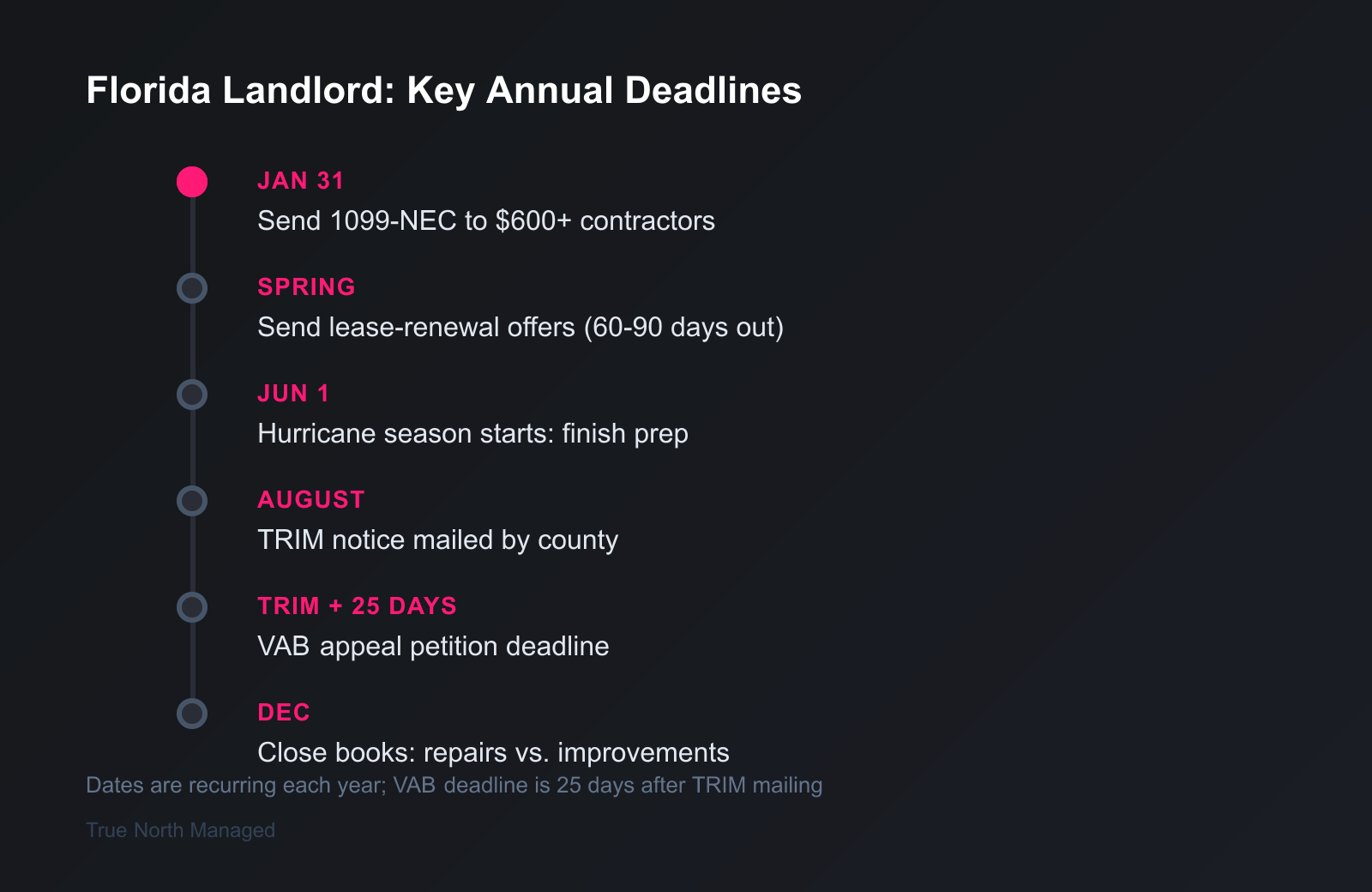
Look at the checklists ranking on the first page of Google and you'll notice the pattern: they're inspection schedules. Filters, gutters, water heaters, smoke detectors—the physical stuff. That work matters and it's in this guide. But the physical stuff is forgiving. You can change a filter a week late and nothing happens. The dated paperwork is not forgiving, and that's exactly the half most landlords blow. As one tax-resource put it bluntly, owners "often focus on property maintenance while neglecting critical tax deadlines and property tax appeal opportunities." We see the proof of that in the inbox every September: the owner who got a TRIM notice with a jump in assessed value, meant to look into it, and waited a year because the 25 days were already gone.
The fix isn't more effort. It's a system that treats the deadline calendar as seriously as the maintenance one. When you assign each recurring task to a month, the year stops feeling like a series of emergencies. You handle insurance once, in one month. You run rent comps once, in another. You stop discovering the VAB deadline three days after it passed. Managers running 200-plus doors don't pull this off by working harder than you—they do it by putting a calendar to work that has the tax and legal dates on it, not just the filter changes. Here's that calendar, one month at a time, with the high-stakes deadlines flagged where they fall.
January: Close the books and send your 1099s
Quick answer: January is tax-prep month, and it carries a hard deadline most owners learn about the year they miss it. Gather your income and expense records for Schedule E, and if you paid any single contractor $2,000 or more for services during the year (the threshold for payments made after 2025; it was $600 before), send them a Form 1099-NEC by January 31. The same January 31 date applies to filing that form with the IRS.
The year starts with paperwork, and the 1099 is the first deadline that bites. Pull together every rent payment received and every expense paid so your CPA—or your tax software—has clean numbers for Schedule E, the form where rental income and expenses live. A simple spreadsheet or property-management app that you've kept current all year makes this an afternoon, not a panic.
Then handle your contractors, because this is where owners get caught. If you paid a handyman, a landscaper, a plumber, or any unincorporated service provider $2,000 or more across the year (for payments made after December 31, 2025; it was $600 before that, and the IRS says the figure may be adjusted for inflation starting in 2027), you're required to issue them a Form 1099-NEC. The IRS sets that $2,000 threshold and the January 31 deadline for both furnishing the form to the contractor and filing it with the IRS. There's no maintenance equivalent to this—you can't "catch up" on a 1099 in March without a penalty already running. In our experience, the owner who misses it isn't disorganized; they just never had a W-9 on file for the vendor and couldn't issue the form in time. So make January the month you confirm a current W-9 for every contractor you paid—not the month you go chasing tax IDs from a landscaper who's stopped answering the phone.
February: Review your insurance before it renews
Quick answer: February is the month to review landlord insurance—dwelling, liability, wind, and flood—before your policy auto-renews. Confirm your coverage still matches replacement cost, and check whether you need separate flood coverage for your zone.
Florida's insurance market is tight, and premiums and terms shift year to year. Don't let your policy roll over on autopilot. Read the renewal, and ask three questions: Does the dwelling coverage still reflect what it would cost to rebuild today? Is your liability limit high enough for a rental? And are wind and flood actually covered?
Wind and flood are the two that trip up Florida owners. Many standard policies exclude or sub-limit wind, and flood is almost always a separate policy through the NFIP or a private carrier. If your property sits in or near a flood zone—and plenty of Tampa and Orlando rentals do without their owners realizing it—a gap here can wipe out a year of cash flow after one storm. Shopping the policy now, before hurricane season and before renewal, gives you room to compare instead of accepting whatever number lands in the mailbox. Our guide on what landlord insurance actually covers in Florida breaks down the coverage types worth paying for.
March: Open lease-renewal season
Quick answer: Most Florida leases end in late spring or summer, so March is when you start renewal conversations. Send renewal offers 60 to 90 days before the lease ends, and if your lease has a notice-before-vacating clause, remember that Statute 83.575 caps that window at 30 to 60 days and puts your own non-renewal notice inside it.
A good tenant who renews is worth far more than the rent bump you might squeeze from a new one—no turnover cost, no vacancy, no make-ready. So start the conversation early. Decide whether you want to renew, raise rent, or not renew, and put the offer in the tenant's hands with enough runway for them to plan.
Here's the part the generic checklists skip entirely. Under Florida Statute 83.575, "A rental agreement with a specific duration may contain a provision requiring the tenant to notify the landlord within a specified period before vacating the premises at the end of the rental agreement, if such provision also requires the landlord to notify the tenant in a manner prescribed by s. 83.56(4) within such notice period if the rental agreement will not be renewed. A rental agreement may not require less than 30 days' notice or more than 60 days' notice from either the tenant or the landlord." So if your lease has that clause and you're the one declining to renew, your written notice goes to the tenant within that same notice period. Under 83.575(2), "A rental agreement with a specific duration may provide that if a tenant fails to give the required notice before vacating the premises at the end of the rental agreement, the tenant may be liable for liquidated damages as specified in the rental agreement if the landlord provides written notice to the tenant specifying the tenant's obligations under the notification provision contained in the rental agreement and the date the rental agreement is terminated. The landlord must provide such written notice to the tenant in a manner prescribed by s. 83.56(4) within 15 days before the start of the notification period contained in the rental agreement. The written notice must list all fees, penalties, and other charges applicable to the tenant under this subsection." In other words, a liquidated-damages clause only works if that reminder goes out on time and lists every charge. If you're weighing a rent increase or a non-renewal, our Florida lease-renewal strategy guide walks through the exact notice mechanics and how to frame the offer so it counts.
April: Run your rent comps
Quick answer: April is pricing month. Pull current rent comps for similar units in your submarket so your renewal offers reflect the market, not last year's number.
Before you finalize renewal pricing, know what the market is doing. Look at what comparable units—same bedroom count, same submarket, similar condition—are actually leasing for. A unit in Lake Nona prices nothing like one in Carrollwood, and a renewal in South Tampa answers to a different curve than one in east Orlando. Zillow, Apartments.com, and local listing data give you a starting picture; a local property manager can sharpen it with what's really closing, not just what's being asked.
The math is simple. If you're 5 to 10 percent under market, you have room to raise without risking the tenant. If you're already above market, expect a longer vacancy if they leave, and price your renewal to keep them. Setting rent on a guess is how owners either leave money on the table for years or chase away a paying tenant over a number the submarket won't support.
May: Service the HVAC before summer
Quick answer: May is the month to service your air conditioning before peak Florida heat. A professional tune-up—coil cleaning, refrigerant check, drain-line clear—now prevents the July emergency call when the unit dies under full load.
In Florida, air conditioning isn't a comfort item. It's a habitability item written into the lease. When a unit fails in July, it's an emergency repair at emergency prices, with an unhappy tenant and possibly a code complaint. A professional service visit in the spring, before the system runs flat-out for four straight months, is the cheapest insurance you'll buy all year. A $150 tune-up beats a $5,000 mid-summer replacement every time—and this, unlike the tax deadlines, is one you genuinely can recover from if you slip a few weeks.
This is also a good month to handle the small, recurring item that protects the whole system: air filters. In Florida's humidity and year-round cooling load, filters should be changed every one to three months—closer to monthly in units with pets. Whether you do it or the tenant does, put it in writing and on a schedule. Building these recurring tasks into a preventive maintenance calendar for your rental keeps the small stuff from turning into the big stuff.
June: Get hurricane-ready
Quick answer: Atlantic hurricane season starts June 1 and runs through November 30. June is when you trim trees, confirm shutters or impact windows work, verify your wind and flood coverage is active, and make sure tenants have a storm plan.
Hurricane season doesn't wait for you to be ready. The season opens June 1, and the peak runs August through October—but the prep happens now, before the first watch goes up. Walk the property and handle the physical work: trim trees and branches that could come down on the roof, confirm shutters or impact windows are present and functional, secure or remove loose outdoor items, and clear drains and gutters.
Then handle the paperwork and the people. Confirm your wind and flood coverage is current—this is why February's insurance review matters—and photograph the property's condition now, so you have date-stamped documentation if you ever file a claim. We've watched claims drag for months because an owner had no "before" photos to prove a roof was sound the week before a storm. Finally, give your tenants a simple storm plan: who to call, where to find shut-off valves, and what to do if an evacuation order comes. A tenant who knows the drill is a tenant who won't make a bad situation worse.
July: Check in mid-summer
Quick answer: July is a maintenance and communication checkpoint. Confirm the AC is keeping up under peak load, respond fast to any heat-related repair requests, and stay in light contact with tenants you'll be renewing.
Mid-summer is when systems get tested. The AC you serviced in May is now running at full tilt, so a quiet check-in—or a quick response to any cooling complaint—keeps small issues from becoming habitability problems. If a tenant reports the unit isn't keeping up, treat it as urgent. Heat complaints in a Florida July escalate quickly.
It's also a relationship month. For tenants whose leases run into late summer or fall, a friendly touch now—not a renewal hard-sell, just contact—makes the eventual renewal conversation easier. Good tenant relationships are built in the quiet months, not negotiated in the tense ones. And it sets up the one deadline that's coming next month and catches more Florida owners than any other.
August: Watch for your TRIM notice and the VAB deadline
Quick answer: Florida county property appraisers mail the TRIM notice (your proposed property-tax notice) in mid-August. If you want to challenge your assessment, you must file a petition with the Value Adjustment Board within 25 days of the notice's mailing date. Miss that window and you wait a full year—with the inflated assessment compounding into higher bills the whole time.

This is the deadline most landlords don't know exists, and it's the one with the shortest fuse and the steepest cost. In our experience managing Orlando and Tampa rentals, it's the single annual item owners blow most often—not because they're careless, but because the maintenance-checklist mindset never told them to watch the mail in August. Your county property appraiser mails a TRIM notice—Truth in Millage, the notice showing your property's proposed assessed value and estimated taxes. It is not a bill. It's your one yearly chance to push back before the bill is set. If that assessment jumped and you think it's too high, you can fight it. But the clock is short, and it does not stop for "I meant to."
Under Section 194.011(3)(d), Florida Statutes, you must file a petition with your county's Value Adjustment Board (VAB) on or before the 25th day after the TRIM notice is mailed, using Form DR-486. The local mechanics differ between our two markets, and knowing them is the difference between filing and fumbling:
- Orlando (Orange County): you file with the Orange County Value Adjustment Board, administered through the Comptroller's office. The cutoff is hard—5:00 p.m. on day 25 for a paper filing, 11:59 p.m. if you file online. Miss it and you can still petition, but only by submitting a written explanation showing "good cause" for the late filing, with no guarantee the board accepts it.
- Tampa (Hillsborough County): you file with the Clerk of the Circuit Court through the county's online VAB portal at hcvab.hillsclerk.com. If the board charges a filing fee, state law caps it at $50 "for each separate parcel of property," and the same 25-day clock applies from the mid-August mailing.
In both counties, the TRIM goes out mid-August and the deadline typically lands in September—but you don't get to assume the date. The moment that TRIM notice lands, mark day 25 on your calendar and decide. For how the appeal itself works once you've filed, see our walkthrough on appealing your Florida property-tax assessment.
September: File your appeal and check the roof
Quick answer: September is when you follow through on any property-tax appeal you decided on in August, and when you inspect the roof, gutters, and exterior—fall storms expose weaknesses you want found before winter.
If August's TRIM review pointed to an over-assessment and you're still inside the 25-day window, this is where you complete the filing. Gather your evidence—recent comparable sales, photos of any condition issues that lower value, the prior year's assessment—before you submit. A petition backed by specifics beats one built on "it feels too high," and the appraiser's office has seen the second kind a thousand times.
On the maintenance side, September is roof-and-exterior month. Hurricane season is still running, so check the roof for lifted shingles or flashing damage, clear the gutters, and look at the exterior for anything a storm could turn into a leak. Catching a small roof issue now is a few hundred dollars. Finding it after water gets into the ceiling is a few thousand, plus a displaced tenant.
October: Do your fall maintenance
Quick answer: October is preventive-maintenance month. Service the water heater, seal pest entry points before they head indoors, and start lining up any tenants whose leases renew over the winter.
As the year cools, knock out the maintenance that's easy to forget. Service or inspect the water heater if it's due—a failing tank is a flood waiting to happen. Walk the property for pest entry points, because Florida's cooler months push rodents and insects looking for a way in. And start the renewal conversation for any leases ending in winter, applying the same notice discipline you used in spring—including any 83.575 notice window in the lease if you're declining to renew.
This is also a sensible month to test smoke and carbon monoxide detectors at any unit you're inside. For a house or duplex, Florida Statute 83.51(2)(b) says, "Unless otherwise agreed in writing, at the commencement of the tenancy of a single-family home or duplex, the landlord shall install working smoke detection devices." Carbon monoxide alarms turn on the building: under 553.885(1), a building "constructed on or after July 1, 2008, and having a fossil-fuel-burning heater or appliance, a fireplace, an attached garage, or other feature, fixture, or element that emits carbon monoxide as a byproduct of combustion shall have an approved operational carbon monoxide alarm installed within 10 feet of each room used for sleeping purposes in the new building or addition, or at such other locations as required by the Florida Building Code." Either way, "installed" and "working" aren't the same thing. A two-minute test per unit closes a liability gap that matters enormously if there's ever a fire.
November: Start your year-end financial review
Quick answer: November is when you begin reconciling the year's income and expenses, gather receipts, and build the list of contractors you'll need to 1099 in January.
Don't wait until January to face your books. In November, reconcile your income and expenses while the year is still fresh, and chase down any missing receipts now, while the vendors remember the job. The cleaner this reconciliation, the easier Schedule E becomes when tax season hits.
Build your 1099 list now, too. Go through the year's payments and flag every contractor you paid $2,000 or more, then confirm you have a current W-9 for each. Doing this in November—instead of scrambling on January 30th—turns that hard January deadline from a fire drill into a formality. It also surfaces deductible expenses you might otherwise forget to claim. This is the quiet work that keeps the year's one unforgiving tax deadline from catching you.
December: Close the year and plan the next one
Quick answer: December wraps the year. Categorize repairs versus capital improvements for depreciation, finalize your books, set next year's rent strategy, and replace any aging smoke or CO detectors.
The last month is about closing one year and setting up the next. Sort your spending into repairs (deductible this year) and capital improvements (depreciated over time)—the distinction matters for your taxes, and December is the time to get it right while the records are open. Finalize the books so January is just printing, not reconstructing.
Then look forward. Use the rent comps and renewal outcomes from earlier in the year to set a pricing strategy for next year. And handle one piece of safety housekeeping: replace any smoke or carbon monoxide detectors approaching the end of their service life, so you start the new year with working life-safety equipment and a clean slate.
How do I actually keep this checklist running every year?
Quick answer: Turn it into recurring calendar reminders, and weight them toward the deadlines you can't recover from. Set each month's tasks as repeating alerts, keep a single year-round ledger for income and expenses, and store the hard dates—January 31 for 1099s, the August TRIM-plus-25-day VAB window, any 83.575 notice window in your lease—where you'll actually see them.
The checklist only works if it's automatic, and the dates that matter most get their own alerts. Put each month's tasks into a calendar as recurring annual reminders so the system nudges you instead of relying on memory. Keep one running ledger for every dollar in and out, updated as it happens, so January's tax prep is a download rather than a reconstruction. And treat the unforgiving deadlines differently from the forgiving ones: a missed filter change is a Saturday; a missed VAB petition is a year of overpaying. Lock in the January 31 tax deadline, the 25-day VAB window after your August TRIM notice, and any 83.575 notice window in your lease as their own standing alerts, because those are the ones with no makeup date.
If keeping that rhythm alongside a job, a family, and a property 800 miles away sounds like more than you signed up for, that's exactly the work a property manager takes off your plate—the maintenance calendar and the deadline calendar both, including the tax and legal dates the other checklists never warn you about. Whether you run it yourself or hand it off, the goal is the same: a rental that's managed on a plan, not on a panic. Get a free rental analysis if you'd like to see what professional management would look like for your property.