
Orlando Rental Market Update — June 2026
Mortgage rates climbed two weeks running to 6.53%, and the metro is splitting into two markets. Here's the June 2026 picture for landlords.
The big move this month isn't in Orlando. It's in the rate sheet.
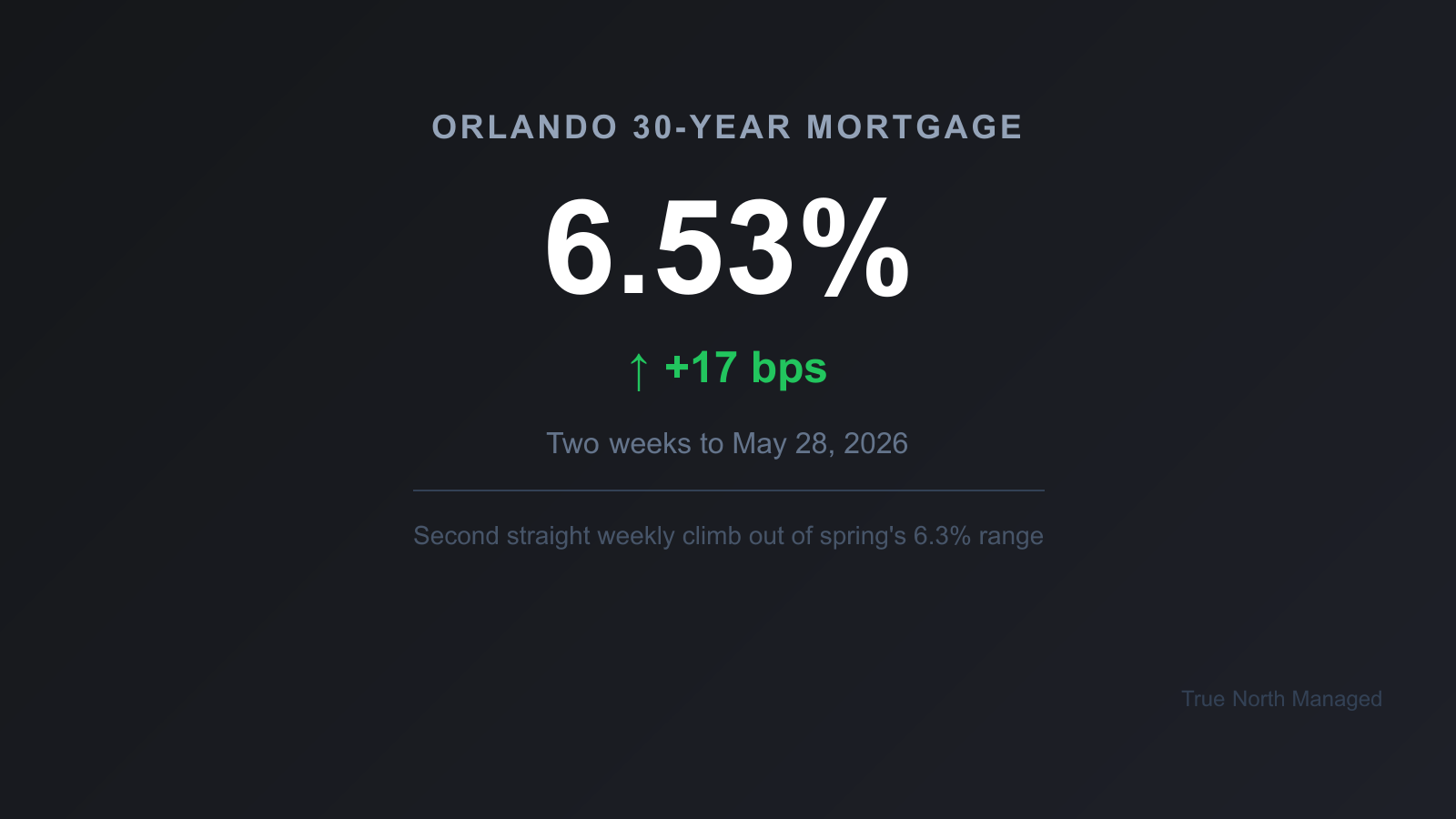
The 30-year fixed climbed for a second straight week — from 6.36% to 6.51% to 6.53% by Freddie Mac's May 28 print. Orlando's bigger story — apartments still cooling, Epic Universe pulling, single-family steady — hasn't changed. But the cost of money did, two weeks running. And the "Orlando rental market" you've been pricing against is quietly splitting into two markets.
What changed in Orlando's rental market this month?
Three things. The 30-year fixed climbed to 6.53% as of Freddie Mac's May 28 survey, up from 6.51% the week before and 6.36% two weeks earlier — the first real break out of the 6.30%–6.37% range that held all spring. Orlando apartment rents stayed negative year-over-year (about –3% across the metro per Yardi Matrix and RentCafe). And the construction pipeline kept thinning — 2025 deliveries came in below 2024 as the new-supply surge moderated.
Nationally, single-family rents grew just 1.3% year-over-year in March, per Cotality's Single-Family Rent Index — about a third of its pre-pandemic pace, with Florida metros leading the national slowdown. Zillow's national asking-rent index has slowed to its weakest pace since 2020. Houses are still outpacing apartments, but the whole rental market is decelerating, and Orlando is tracking the national pattern.
Why is Orlando splitting into two markets?
Up to now the headline numbers have read as one metro. They don't anymore.
CBD Orlando and Northwest Orlando — the urban core — are tightening fastest. Limited new supply has landed there in the past year, and what was delivered has mostly leased up. Occupancy here is the strongest in the metro, according to Northmarq's outlook, and rents are stabilizing.
Kissimmee/Osceola County, Ocoee-Winter Garden-Clermont, and South Orange County are still working through new deliveries. Concessions are common there. Two months free isn't unheard of in a Kissimmee lease-up. That's the same metro — same employment base, same Epic Universe tailwind — but a different submarket reality.
On the east and southeast, Lake Nona and Medical City keep doing what they've been doing. Demand there hasn't blinked.
So when you read "Orlando rent is down 3%," that's the metro average. It's not your house. It's not even one neighborhood. It's three or four different markets averaged into one number.
What does this mean if you rent out a house in Orlando?
Your house isn't the apartment market. The metro rent average — the one in every headline — describes apartment towers, where new lease-up specials are still being offered. It doesn't describe single-family homes, which rent at far tighter occupancy and have held rents through the apartment softening.

But your tenant has seen the headlines. They've also seen the apartment-community billboards offering a free month. Walking into your house, they're priced against that ad — even though the comparison doesn't hold. Price your house to real single-family comps in your specific submarket, not to the metro number and not to the apartment number. A Lake Nona house doesn't price like a Kissimmee one. The metro average isn't telling you anything about either.
What should Orlando landlords do now?
Four moves this month.
Price to submarket comps. Pull three or four recently leased single-family homes — actual signed prices, not asking — in your submarket. Lake Nona prices like Lake Nona. Kissimmee prices like Kissimmee. If you're looking at the metro number to set your rent, you're looking at the wrong number. For broader pricing benchmarks, see our breakdown of average rent across Orlando's neighborhoods.
Run renewal math before raising rent. Apartment concessions still shape what your tenant expects, even if your house has nothing to do with them. A $60/month renewal increase is $720 a year. One vacant month plus turnover costs runs past $2,000. The math usually favors keeping a good tenant at a modest renewal — but run the numbers on your house, not on a rule of thumb.
Ignore the 5-day-notice chatter. You may have seen blogs urging you to update your lease for a new 5-day eviction notice on July 1. That bill — SB 716 — died in committee this spring, so it never became law. Florida's 3-day pay-or-vacate notice under Statute 83.56 is unchanged. Don't rewrite your notice forms for a rule that didn't pass.
Read the rate move if you're buying or selling. At 6.53%, financing costs about $11 more per month per $100k borrowed than two weeks earlier. Orlando's sale market is around 4.5 months of supply per ORRA's most recent reading — tightening, but still pre-balanced. Buyers have negotiating room; the rate move just trimmed how much. For sellers, there's no distress signal — Orlando is stabilizing, not falling. A realistic price still moves a house. If you're weighing it, our take on when it actually makes sense to sell an Orlando rental walks through the math.
The throughline this month: the metro number is hiding the spread, and the spread is where your pricing decision actually lives. That's a harder read than the May picture, but it's the right one. If you'd like a clean read on what your specific Orlando house should rent for in your submarket today, our team's Free Rental Analysis walks it through, comp by comp. For the broader Orlando picture, last month's May market update holds the longer arc.