
Orlando Rental Market Update — July 2026
The June rate spike reversed to 6.49% — but the July 1 Citizens insurance reset and a loosening for-sale market are the moves that actually touch your Orlando numbers this month.
Last month the story was the rate sheet. The 30-year fixed had climbed two weeks running, to 6.53%, and it read like the start of something. It wasn't. By Freddie Mac's July 9 print the 30-year was at 6.49% — it had dipped to a seven-week low of 6.43% the week of July 2 before ticking back up. A year ago it was 6.72%.
So the rate isn't the July story. Two other things are: an insurance reset that landed July 1 and shows up on your renewal, and a for-sale market that's quietly loosening under everyone's feet. Here's the read.
What changed in Orlando's rental market this month?
Three things, and only one of them is the rate. The 30-year fixed settled at 6.49% — the June "spike" didn't hold, and financing costs are roughly flat to where they sat in spring. Orlando apartment rents stayed soft: the metro average is about $1,792, down 2.8% year over year per RentCafe and Yardi Matrix data, with occupancy holding near 94.5%. And the variable that actually moved your numbers is insurance — Citizens reset its rates on July 1, in opposite directions depending on what you own.
Underneath that, the for-sale market is shifting. Active listings across the metro are up roughly 18% from a year ago, days on market are stretching, and home values have softened 2% to 5% in most Orlando ZIPs. That doesn't change your rent today, but it changes who your competition is — and it's worth a landlord's attention.
How does the July 1 Citizens insurance change hit Orlando landlords?
It depends entirely on which policy you hold, and the two buckets moved opposite ways. If you own a single rental house or a small one-to-four-unit building and Citizens insures it, you're on a Citizens personal-lines policy, and Citizens' approved averages dropped: 8.8% for homeowners multiperil policies and 5.5% for wind-only policies. A dwelling policy's own change can differ, so check your renewal. If you own a five-plus-unit building, that's commercial residential, and Citizens' non-condo commercial-residential rates went up — about 7.2% on the main line and 14.4% on wind.
Two caveats: the cut lands at your renewal date, not all at once, and inland Orlando carries less wind exposure than the coast, so the wind line matters less here than in Tampa. Pull your declarations page and confirm your bucket before you budget — our breakdown of the Citizens rate split walks through how to read the form.
What are rents actually doing, by Orlando submarket?
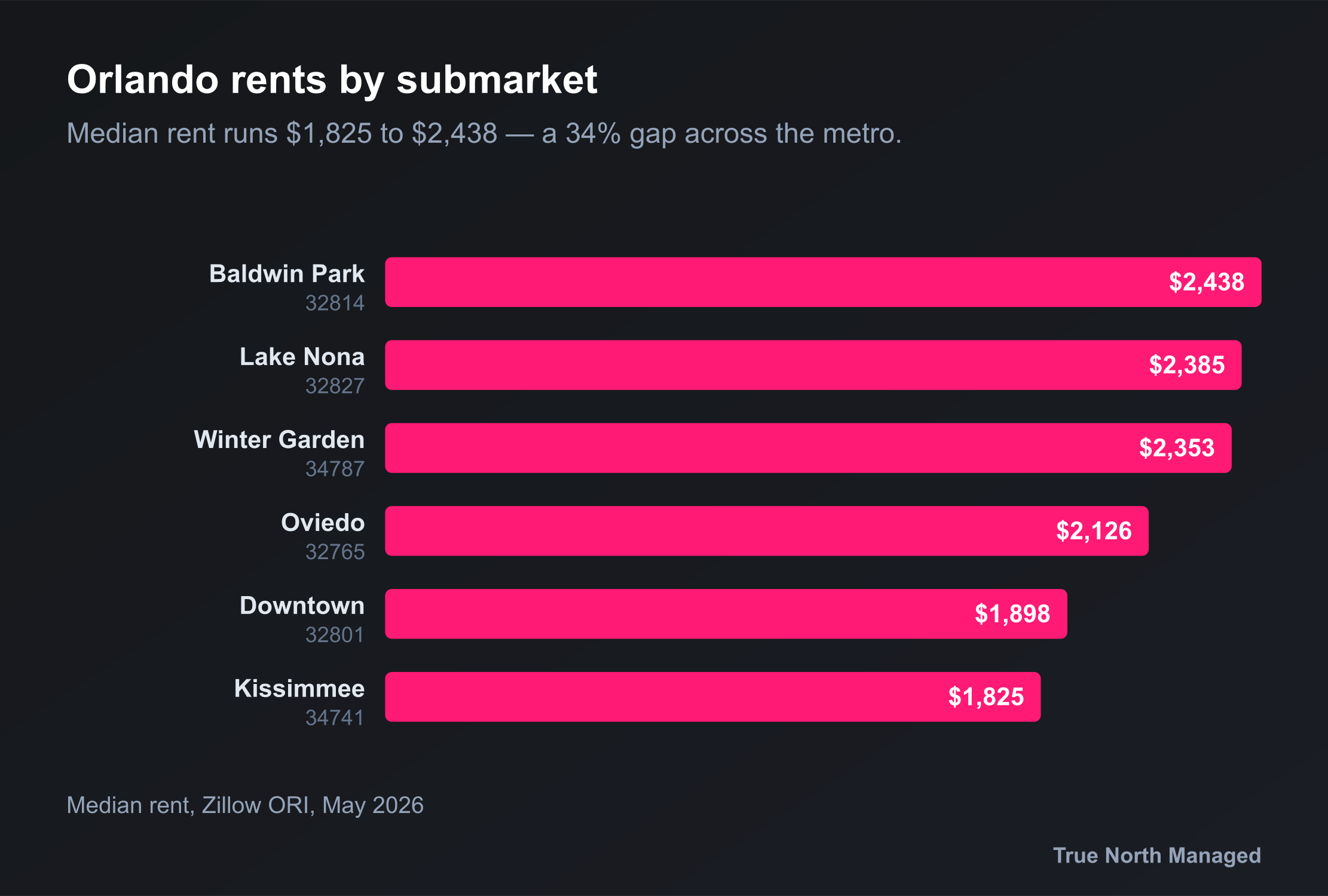
The "down 3%" headline is an apartment-tower average, and it hides a wide spread. Pulling Zillow's observed rents by ZIP — which include houses, not just apartments — shows the real picture: Baldwin Park (32814) leads the metro at about $2,438, up 6% on the year. Lake Nona and Medical City (32827) sit near $2,385, held up by Medical City jobs and the Lake Nona West retail center opening this summer. Winter Garden (34787) runs about $2,353. On the soft end, downtown's 32801 is near $1,898, down 2%, and Kissimmee (34741) sits around $1,825, down slightly, still working through the most new apartment supply in the metro.
And your house isn't the apartment market. Your tenant has seen the apartment billboards offering a free month, but that comparison doesn't hold against a single-family home. Price to real single-family comps in your specific submarket, not to the metro number and not to the apartment number.
Is Orlando's for-sale market loosening — and does it matter to a landlord?
Yes, on both counts. The metro median sale price is around $395,000, up about 2% year over year per ORRA's market reports, but inventory is up roughly 18%, homes are sitting longer, and sellers are giving concessions again. This isn't a crash — it's a market drifting back toward balance after years of scarcity.
Two things follow for landlords. First, more would-be sellers who can't get their price are renting the house out instead — that's both your new competition for tenants and, often, a future management client. Second, if you're the one buying, a 6.49% rate plus 18% more listings means more negotiating room than you've had in a while.
What should Orlando landlords do now?
Four moves this month. Price to submarket comps, not the metro average — pull three or four recently leased single-family homes in your area and use signed prices, not asking; our neighborhood-by-neighborhood rent breakdown is a starting point. Check your Citizens policy bucket before your renewal so you budget the right direction. Run renewal math before raising rent — a $60 bump is $720 a year, and one vacant month plus turnover runs past $2,000, so keeping a good tenant usually wins. And if you're buying, read the eased rate and rising inventory as room to negotiate — not a reason to hold out for a bottom the data isn't signaling.
The throughline: the rate scare passed, but your real July decisions are an insurance line you can now budget accurately and a for-sale market quietly handing buyers a little more room. For a clean read on what your specific house should rent for today, our free rental analysis runs it comp by comp. For the longer arc, June's update holds the prior month.