

Tenant Died in Your Florida Rental: What to Do Next
A tenant died in your Florida rental. The lease doesn't end with them — the estate does. Here's the calm, legally correct order to handle it, and the mistakes that cost landlords.
A tenant died in your Florida rental, and a person you may have known for years is gone. Maybe you got the call from a family member. Maybe a welfare check turned into something worse. Either way, take a breath before you do anything else — because the worst mistakes Florida landlords make in this situation come from moving too fast.
Quick answer: When a tenant dies in your Florida rental, the lease doesn't die with them. The deceased tenant's estate steps into their shoes and stays responsible for rent and obligations until the lease lawfully ends or you recover possession. You can't clear the unit, dispose of belongings, or re-rent on your own timeline. There's an order to this, and getting it wrong can cost you actual damages or three months' rent — whichever is greater — plus attorney's fees.
This is one of the few landlord situations where the right move is to slow down. Let's walk through it the way you'd want someone to walk you through it.
Why this isn't like any other vacancy
A death feels, at first, like a vacancy. The unit's empty, the tenant won't be paying, and your instinct says: clear it out, clean it up, get it re-rented. In almost any other case, that instinct serves you well.
Here, it's the trap.
Florida treats a deceased tenant's tenancy and belongings as legal property that runs through their estate — not as abandoned stuff you can sort and toss. This is a statewide rule, so it works the same whether your rental sits in Lake Nona, Seminole Heights, or anywhere in between. And the penalty for grabbing possession the wrong way is real: under Florida Statute 83.67 and Florida Statute 83.59, a landlord who recovers a unit improperly is liable to the tenant — meaning the estate — for actual and consequential damages or three months' rent, whichever is greater, plus costs and fees.
If you've read our guide on handling a tenant's abandoned property in Florida, put it aside for a moment. Abandonment law is for a living tenant who walked away. A death is a different path with different rules, and conflating the two is one of the most common — and expensive — errors here.
What happens to the lease when a tenant dies in Florida?
The lease survives. In Florida, a tenant's death doesn't cancel the rental agreement — the deceased tenant's estate becomes responsible for the lease, and rent keeps accruing until the lease term ends or the unit is lawfully surrendered back to you. You don't get to tear up the lease, and neither does the family.
That word — estate — matters. When someone dies, their debts and obligations don't vanish. They become claims against whatever the person owned, settled through Florida's probate process. The unpaid rent on your lease is one of those claims. If the estate has assets, you can file a claim in probate to recover what's owed. If the estate is small or insolvent, you may not collect everything, and that's a financial reality worth bracing for early.
A few situations change the picture:
- There's a co-tenant on the lease. If another adult signed the lease and is still living there, the lease continues and nothing about possession changes. Florida treats co-tenants as jointly and severally liable, which means the surviving tenant owes the full rent — not half — and can seek contribution from the deceased's estate on their own.
- There's a guarantor or co-signer. Whether their obligation continues depends on what the guaranty contract actually says. Pull the lease and the guaranty language, and have an attorney read it before you assume anything either way.
- It was month-to-month. The estate can typically terminate with proper written notice, and the practical timeline is shorter — but the same "don't touch the belongings" rules apply until possession is lawfully resolved.
What should a landlord do first when a tenant dies?
Secure the scene, document everything, and deal only with people who have legal authority. If the tenant is found on-site, law enforcement and the medical examiner control the property first — your access is limited until they release it. Don't enter, don't clean, don't move anything until you're cleared.
Here's the order that keeps you protected and respectful at the same time.
If you discover the tenant, call 911. Police and the medical examiner take over. They'll work to reach next of kin and can point you toward how to obtain a death certificate. You are not in charge of the scene, and you shouldn't try to be.
If a family member notifies you, ask for it in writing. A short email with the tenant's name, the property address, and a copy of the death certificate when it's available gives you the documentation you'll need to move forward lawfully. Be gentle about it — these are people in the middle of a loss — but you do need the paper.
Once the scene is released, secure the unit. Securing the property isn't cold; it protects the deceased's belongings from theft and protects you from a claim that something went missing on your watch.
Don't let family or friends in, and don't act on a will or a power of attorney. This one feels harsh, so here's the why: a power of attorney dies with the person, and under Florida Statute 733.103(1), "Until admitted to probate in this state or in the state where the decedent was domiciled, the will shall be ineffective to prove title to, or the right to possession of, property of the testator." A relative holding a will can't hand you authority over the unit or its contents. The only person you can safely take direction from is a court-appointed personal representative — more on that below. Letting a grieving relative grab "just a few things" feels kind. It also exposes you to liability if another heir later asks where those things went.
Write it all down. Every call, every visit, every action, with dates. If this ever lands in front of a probate judge, your record is your defense.
Think of the clock that starts now as "The 60-Day Clock." We'll get to why 60 days matters in a second — but the meter is running from the date of death, and what you do in the first week shapes everything that follows.
Can you remove the belongings or re-rent the unit?
Not on your own, and not right away. You cannot dispose of a deceased tenant's belongings at will. In most cases they pass through the estate, and you coordinate with the court-appointed personal representative — not the family, not the most assertive cousin. Re-renting before possession is lawfully recovered is a serious mistake.
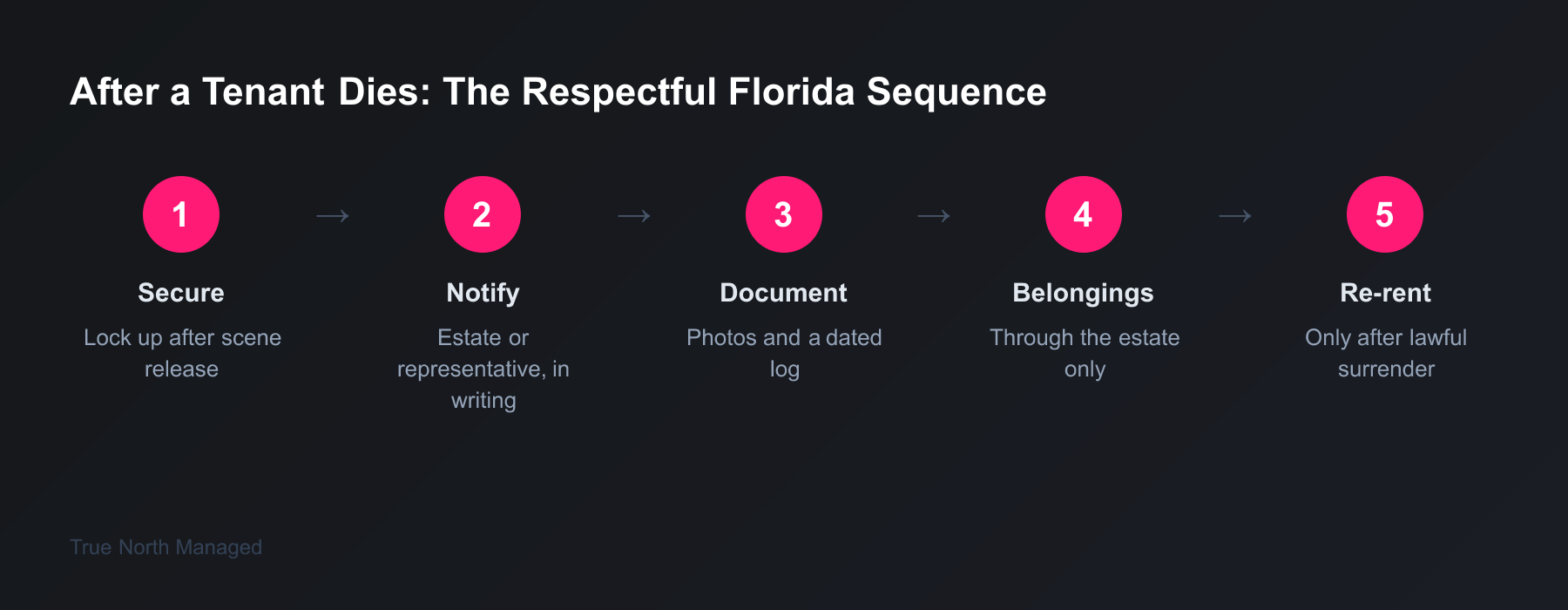
The personal representative is the person a probate court formally appoints to handle the estate, evidenced by Letters of Administration. Once they're appointed, they have authority roughly equivalent to the tenant: you arrange access, belongings, unpaid rent, and surrender of the unit through them. Getting those letters issued usually takes a few weeks in Florida, though the full probate process can run six to twelve months. Patience is part of the job here.
So what if no one ever opens a probate estate? Florida built a narrow path for exactly that. Under Florida Statute 83.59(3)(d), you may recover possession of the unit on your own "When the last remaining tenant of a dwelling unit is deceased, personal property remains on the premises, rent is unpaid, at least 60 days have elapsed following the date of death, and the landlord has not been notified in writing of the existence of a probate estate or of the name and address of a personal representative." All five conditions have to be true at the same time.
That's The 60-Day Clock. Meet all five conditions and you can take the unit back; Florida Statute 83.67(5) is what permits you to then remove the personal property after recovering possession this way. One important exclusion: "This paragraph does not apply to a dwelling unit used in connection with a federally administered or regulated housing program, including programs under s. 202, s. 221(d)(3) and (4), s. 236, or s. 8 of the National Housing Act, as amended." If the unit is tied to one of those programs, Section 8 included, this path isn't open to you.
Here's the part most articles skip. The moment you receive written notice of a probate estate or a personal representative, that 60-day self-help clock stops. You no longer get to run it out and clear the unit — you deal with the representative. Run the clock after a representative has appeared and you've stepped right onto that three-months'-rent liability.
One more wrinkle worth a lawyer's eye: some leases include a clause under 83.67(5) that changes whether you must follow the standard abandoned-property notice procedure. Whether your lease has it, and how it interacts with a death, is exactly the kind of question to put to a Florida landlord-tenant attorney rather than guess at. When the facts are murky — a relative claims to be "the executor" but has no letters, or you're unsure whether a notice counts — get counsel. This is genuinely unsettled ground in spots, and a wrong guess is expensive.
When you do need lawful access for an inspection or to coordinate with the representative, the normal entry rules still apply — see our breakdown of Florida's landlord right-of-entry rules for the 24-hour notice standard. And resist any urge toward shortcuts: the same reasons self-help eviction is illegal in Florida apply here. There's no shortcut version of this.
What happens to the security deposit when a tenant dies?
Once the tenancy lawfully ends, the deposit follows the normal Florida Statute 83.49 rules — but a death creates a problem the statute never quite anticipated. The standard process assumes a living tenant with a forwarding address. A deceased tenant has neither.
Under 83.49(3)(a), "If the landlord intends to impose a claim on the deposit, the landlord must, within 30 days after the termination of the rental agreement, provide the tenant written notice by certified mail to the tenant's last known mailing address or by e-mail in accordance with s. 83.505 of his or her intention to impose a claim on the deposit and the reason for imposing the claim." In practice that's certified mail to the last mailing address you have, unless you and the tenant signed an 83.505 e-mail addendum. The tenant gets 15 days to object, and you remit any balance within 30 days.
Now the snag: if no probate estate is ever opened, there's no personal representative to receive that notice. The clean statutory path simply breaks down. Florida attorneys who handle this point to a few imperfect options — petitioning the probate court yourself to open an estate (rarely worth the cost unless the deposit is large), or sending the notice to the last known address and making a careful, good-faith decision about any claim. Funds that genuinely belong to no one eventually escheat to the State of Florida as unclaimed property.
There's no tidy answer here, and I'd rather tell you that than invent one. If you're holding a meaningful deposit and there's no estate, this is a five-minute call to an attorney that can save you a five-figure headache.
Who handles cleanup after a death in a rental?
You arrange it, but you're not the one who decontaminates a scene. Police and EMS don't perform biohazard cleanup. Once the medical examiner releases the unit, arranging remediation falls to the property owner — and for an unattended death, that means hiring licensed biohazard remediators, not a regular cleaning crew.
Financial responsibility generally runs to the estate first, then to you if the estate is insolvent or unresponsive. Many landlord insurance policies cover this kind of remediation, so call your carrier before you pay out of pocket. Handle it quietly and professionally. This is someone's last footprint in a home, and the people who loved them may still be in the picture.
Common mistakes Florida landlords make
Most of the damage here comes from a handful of avoidable errors:
- Running The 60-Day Clock after a representative has appeared. The clock is only for cases with no probate notice. Once you're notified, deal with the personal representative — full stop.
- Letting family in on a will or power of attorney. Both are void or inert until a court acts. Only a court-appointed representative has authority.
- Treating it as ordinary abandonment. The abandoned-property statute is for living tenants. A death runs through the estate.
- Re-renting too soon. Until possession is lawfully recovered and belongings are resolved, the unit isn't yours to lease.
Handling this from a distance
If you own the property from out of state, you can't meet the medical examiner or sit across from a personal representative yourself. That's exactly when a local property manager earns their keep — securing the unit, documenting the scene, coordinating with the estate, and keeping you out of the liability traps above while you grieve or simply manage from afar. You don't have to work through a Florida probate process from a thousand miles away by yourself.
If you'd like a steadier hand on your Orlando or Tampa rental — for this or anything else — our Owner's Guide lays out how we think about protecting owners, and a free rental analysis is an easy place to start a conversation. No pressure. Just help, when you need it most.