

Short-Term vs. Long-Term Rental Tax: Florida's Two Tax Worlds
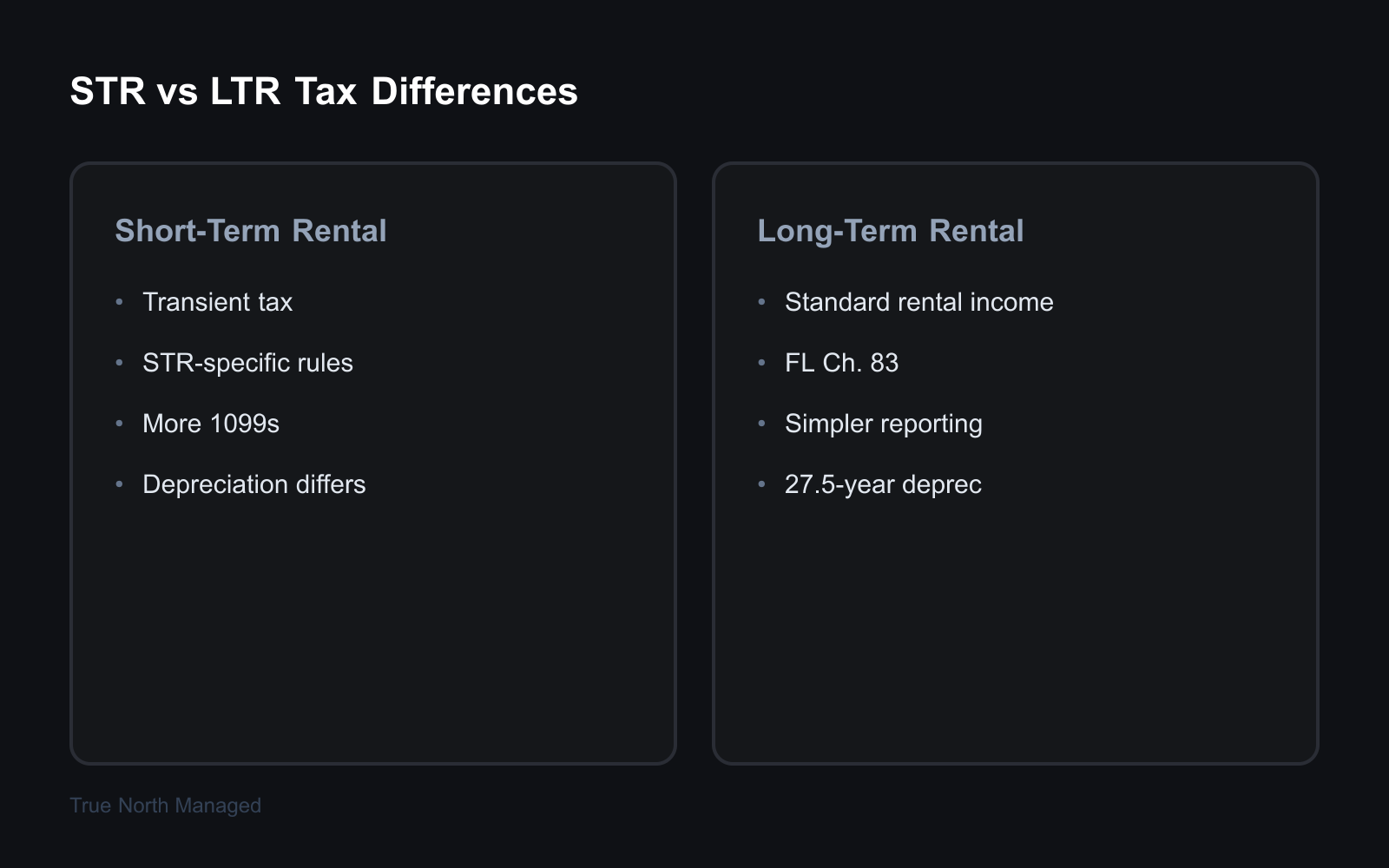
STR tax obligations: 6% FL sales tax plus tourist development tax by county. LTR: no sales tax. Platform collection, filing, and penalties for non-compliance.

Short-term rentals and long-term rentals are taxed differently in Florida. STRs face sales tax and tourist development tax; LTRs don't. If you're running both or considering a switch, understanding the tax split is essential. Non-compliance triggers penalties and interest—the state and counties are enforcing.
STR Tax Obligations
Florida short-term rentals (rentals of 6 months or less) are subject to:
- 6% Florida sales tax on the rental amount. The Florida Department of Revenue collects this.
- Tourist development tax (TDT)—a county-level tax. Rates vary by county. Orange County (Orlando) TDT is 6%; Hillsborough (Tampa) is also 6%. County TDT guides spell out registration and filing. Orange and Hillsborough each have their own rules.
- Transient rental tax—some counties use this term; it's often the same as or combined with TDT.
For a $2,000/week rental, that's $120 in state sales tax plus whatever your county charges. The TDT adds 5–6% in most Central Florida counties—so another $100–$120. Total tax can easily exceed 11% of gross rental revenue.
LTR Tax: No Sales Tax
Florida Statute 212.03(1)(a) draws the line: "any person who rents, leases, lets, or grants a license to others to use, occupy, or enter upon any living quarters or sleeping or housekeeping accommodations in any apartment house, roominghouse, tourist camp, trailer camp, mobile home park, recreational vehicle park, condominium, or timeshare resort and who exclusively enters into a bona fide written agreement for continuous residence for longer than 6 months in duration at such property is not exercising a taxable privilege." In plain terms, where every agreement you sign for the property is a bona fide written lease for continuous residence longer than six months, that rent carries no 6% state sales tax, while a stay of six months or less is taxable. County tourist development tax reaches rentals "for a term of 6 months or less", "unless such person rents, leases, or lets for consideration any living quarters or accommodations which are exempt according to the provisions of chapter 212" (FS 125.0104(3)(a)1.). You report rental income on Schedule E and pay federal income tax. Florida has no state income tax, so you're done at the federal level. Property taxes, insurance, and depreciation apply the same way regardless of STR or LTR. The difference is the sales tax and TDT burden on STRs.
Platform Collection
Airbnb, Vrbo, and other platforms collect and remit Florida sales tax on their own. You don't have to file separately for the platform portion—they handle it. But you're still responsible for your share if you have direct bookings or if the platform doesn't cover your county's TDT. Florida short-term rental laws cover the regulatory side; tax is a separate layer. Check your platform's tax collection settings and confirm they're remitting for your county.
County-by-County TDT Rates
Orange County (Orlando) charges a 6% tourist development tax on short-term rentals. The Orange County TDT applies to rentals of 6 months or less. Hillsborough County (Tampa) charges a similar rate. The Hillsborough County TDT applies to transient rentals. Other counties—Osceola, Polk, Pinellas—have their own rates. Check your county's tax collector website for the current rate and filing requirements.
Filing
Florida's e-file system is straightforward. You report gross rental revenue, applicable taxes collected, and remit the balance. Late filing triggers penalties and interest. The state and counties are actively auditing STR operators—don't assume you can fly under the radar.
Penalties for Non-Compliance
Failure to collect and remit sales tax or TDT can result in back taxes, interest, and penalties. The Florida DOR can assess penalties for negligence or intentional disregard. Counties can do the same. If you've been operating STRs without filing, consult a tax professional. Voluntary disclosure programs sometimes offer reduced penalties for coming into compliance.
STR vs LTR: The Tax Tradeoff
STRs generate higher gross revenue per night but carry the tax burden. LTRs generate lower per-night revenue but avoid sales tax and TDT. The math depends on your occupancy, rates, and operating costs. For many landlords, the simplicity of LTR—no platform fees—offsets the lower per-unit revenue. For others, the STR premium justifies the compliance work.
Next Step
Tax is one piece of the STR vs LTR decision. If you're evaluating a property or want to see what your numbers could look like, get a free rental analysis. We pull comps across Orlando and Tampa and help you position for the year ahead.
Income Reporting
Both STR and LTR income is reported on Schedule E. The IRS Publication 527 covers residential rental property. Personal use is what changes the rules, and it mostly comes up with a vacation home you also rent short-term. IRC 280A(d)(1): "a taxpayer uses a dwelling unit during the taxable year as a residence if he uses such unit (or portion thereof) for personal purposes for a number of days which exceeds the greater of— (A) 14 days, or (B) 10 percent of the number of days during such year for which such unit is rented at a fair rental. For purposes of subparagraph (B), a unit shall not be treated as rented at a fair rental for any day for which it is used for personal purposes." Cross that line and the property counts as your residence for the year, which can limit your rental deductions. If you use it for family visits or personal stays, track the days. LTRs have clearer boundaries. Keep detailed records of rental days and personal use.
Depreciation and Expenses
Depreciation works similarly for both, but STRs often have higher turnover costs—cleaning, supplies, management fees. Those are deductible. LTRs have lower turnover but may have longer vacancy. Our depreciation tax guide covers the basics. The Florida Department of Revenue administers the state sales tax on STRs; in Orange and Hillsborough, the county collects the TDT.
Which Makes Sense
STRs offer higher gross income but more work and tax complexity. LTRs offer stability and simpler reporting. Our Florida landlord tax guide covers annual filing.
Record-Keeping
For STRs, the IRS expects you to track personal use. If you rent your vacation home 14 days or fewer and use it yourself the rest of the time, you don't report rental income. But if you rent it more, you're in the rental rules.
Keep a log of rental days vs. personal days. The IRS can ask for it. For LTRs, the rules are simpler—you're reporting rental income and expenses on Schedule E. Either way, good records make tax time easier.