
Smart-Home Technology for Florida Rental Properties: What's Worth It
Most smart-home advice for landlords is a gadget list. In Florida, the right two devices fight heat, humidity, and water — and one popular device is a felony risk. Here's what actually earns its keep.
A landlord called us last summer, proud of the new video doorbell he'd put on his Winter Park rental. Package theft solved, he figured. What he didn't know: the doorbell had recorded six weeks of porch conversations with the microphone on by default. In Florida, that audio is the part that gets you sued — not the video.
That's the problem with most advice about smart home technology for a rental property in Florida. It reads like a shopping list. Buy a lock, buy a thermostat, buy a camera, charge more rent. The lists are not wrong, exactly. They're just aimed at the wrong target. A device is worth installing in a Central Florida rental when it fights the thing that actually costs you money here — heat, humidity, and water — or when it removes a headache you're already paying for. It is not worth installing because it photographs well on a listing.
So this guide does something different. Instead of a gadget rundown, we sort the four devices landlords reach for by what they actually do to your operating costs and your legal exposure. Two of them earn their keep in Florida specifically. One is genuinely useful with a few guardrails. And one — the camera with audio — is the single most expensive mistake on this list.
What's the smartest way to spend on smart home technology for a rental property in Florida?
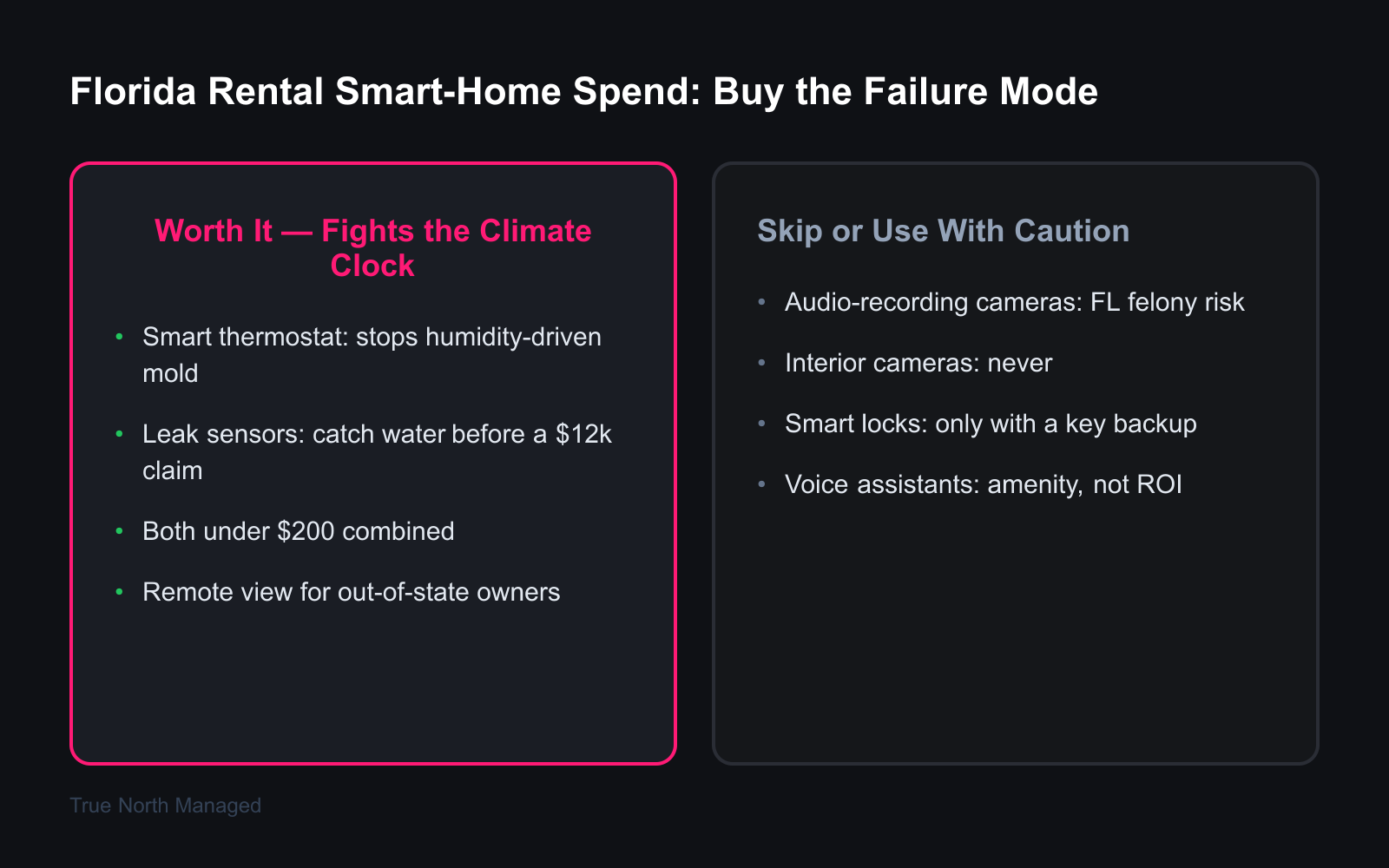
Spend on the failure you can't see. In Florida, that means a smart thermostat (fights humidity and AC abuse) and a leak sensor (catches water before it becomes a $12,000 claim) — together under $200. Smart locks help at turnover. Skip audio-recording cameras: they're a felony risk under Florida law.
Here's the reframe we use with owners: don't buy the feature, buy the failure mode. A leak sensor isn't exciting. It does one thing — chirp before a slow drip under the water heater becomes a soaked subfloor. That one thing is worth more in a humid climate than any voice assistant. Sort every device this way and the buying decision gets simple. The two cheapest items on the list are the two that pay you back.
Why do smart thermostats matter more in Florida than almost anywhere else?
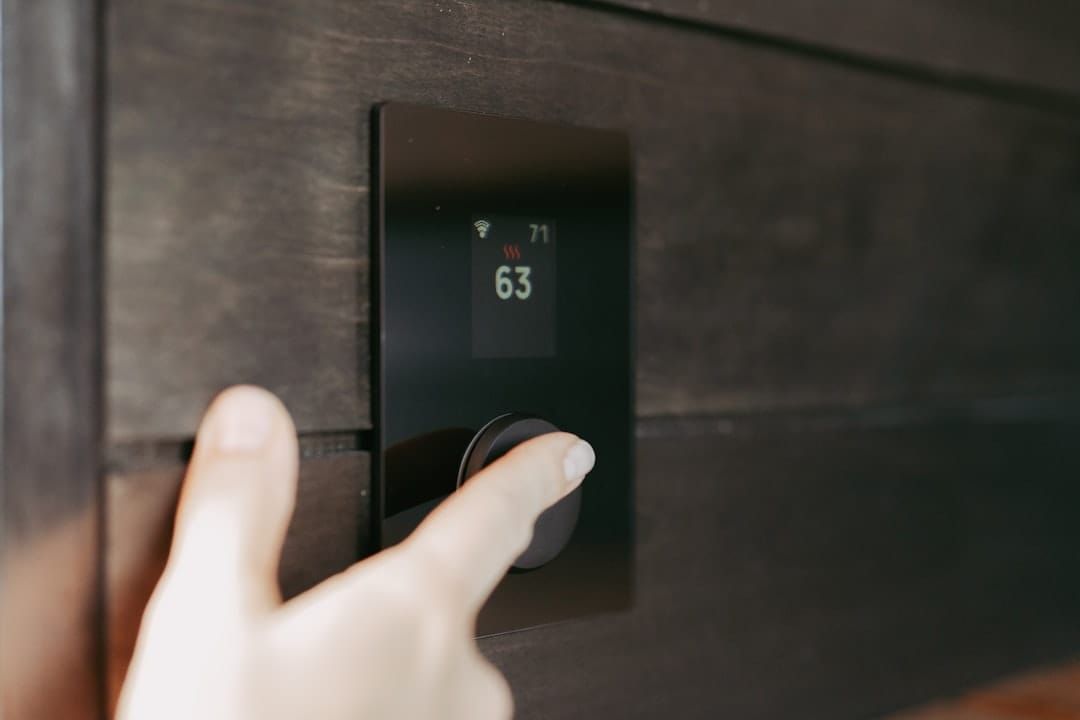
A smart thermostat earns its place in a Florida rental because the enemy here isn't cold — it's humidity. When indoor relative humidity climbs above 60%, drywall, carpet, and wood start growing mold. The AC is your dehumidifier. A thermostat that runs it on a sane schedule is the cheapest mold-prevention tool you own.
This is where Florida breaks the national advice. Up north, the smart-thermostat pitch is about heating bills and setbacks while you're at work. ENERGY STAR and the Department of Energy put the average savings around 8% of heating and cooling costs — roughly $50 a year. That's real, but it's not the Florida story. The Florida story is the humidity cycle that drives mold growth in rentals, and the AC is the only thing standing between your unit and a remediation bill.
Two things go wrong without a smart thermostat. First, tenants set the AC to 68 in August, the system runs nonstop, and the bill (or the wear) climbs. A smart thermostat lets you cap the range — disclosed in the lease — while still leaving the tenant comfortable. Second, and worse, is the vacant-unit trap. Owners trying to save a few dollars between tenants crank the thermostat to 85. The problem: at 85, the AC barely cycles, so it barely dehumidifies, and a closed-up Florida house turns into a terrarium. The right vacant setting is 76 to 78 degrees — cool enough that the system actually pulls moisture out of the air. A smart thermostat lets you set that and watch it remotely instead of driving over.
For an out-of-state owner running a Lake Nona or Carrollwood rental from New Jersey, that remote view is the whole point. You can't feel the humidity from a thousand miles away. The thermostat can. While you're at it, a thermostat that runs the system sensibly is also the cheapest thing you can do for HVAC longevity in a Florida rental — short-cycling and round-the-clock running are what kill compressors early.
The Florida climate clock runs on heat, humidity, and water year-round. A smart thermostat and a leak sensor are the two devices that let you keep an eye on that clock without being in the building.
Are smart leak detectors worth it for a rental property?
For about $20 to $35 a sensor, a leak detector is the highest-return device on this list. Water damage is one of the costliest claims a rental can generate — the Insurance Information Institute puts the average water-damage claim around $12,514. A sensor that alerts you to a slow leak before it spreads turns a four-figure repair into a fifteen-minute fix.
Think about where water actually starts in a rental: under the kitchen sink, behind the toilet, around the water heater, at the washing-machine hose. None of those are places anyone looks until the ceiling below them is stained. A small puck-style sensor in each of those spots costs less than a tank of gas and texts you the moment it gets wet. In a humid climate where a slow leak also feeds mold, catching it early does double duty.
This is also the device that protects you in the murkiest disputes — the ones about who pays when water damages a rental. When you have a timestamped alert showing exactly when a leak started and that you responded the same day, the conversation about responsibility gets a lot shorter. The sensor isn't just prevention; it's documentation.
For owners managing remotely, leak sensors are the closest thing to having eyes in the building. They don't film anyone, they don't raise a privacy question, and they catch the failure that does the most expensive damage. If you install nothing else from this list, install these.
Should landlords put smart locks on a rental, and what goes wrong?
Smart locks are genuinely useful — at turnover specifically — but only with guardrails. They let you issue a temporary code to a contractor, kill it remotely when a tenant moves out, and skip rekeying costs between tenants. The catch is that landlords who install them without a backup plan end up locked out by dead batteries, fire-code problems, or a unit they can't physically enter.
The turnover math is the real appeal. Instead of a key handoff, a 2 a.m. lockout call, or a locksmith between tenants, you rotate a code. That speeds up the part of the job everyone hates — and a faster, cleaner turnover is the whole game in a Florida tenant-turnover playbook. For an out-of-state owner, granting a cleaner or an inspector a one-day code beats overnighting a key.
But listen to the landlords who've done it. The recurring complaints are consistent: batteries die at the worst time and lock everyone out, some smart locks don't have a physical-key override, and not every model meets fire code for egress. There's even a documented scam where criminals exploited self-tour lock codes to run fake-rental cons. The fixes are simple if you build them in from the start: buy a lock with a real keyed override, keep a physical key, confirm the model allows interior egress during a power failure, and put the rules in the lease. That last point matters during storm season — a smart lock that fails locked with no key backup can shut you out of your own property during a post-hurricane check.
Here's the part nobody puts in the brochure, and it's the one we feel strongest about: the access log is for vendors, not for spying on your tenant. It's tempting to glance at the entry data and form opinions about who's coming and going. Don't. Florida gives tenants quiet enjoyment, and Florida Statute 83.53 already governs when and how you enter. Subsection (2) reads: "The landlord may enter the dwelling unit at any time for the protection or preservation of the premises. The landlord may enter the dwelling unit upon reasonable notice to the tenant and at a reasonable time for the purpose of repair of the premises. 'Reasonable notice' for the purpose of repair is notice given at least 24 hours prior to the entry, and reasonable time for the purpose of repair shall be between the hours of 7:30 a.m. and 8:00 p.m. The landlord may enter the dwelling unit when necessary for the further purposes set forth in subsection (1) under any of the following circumstances: (a) With the consent of the tenant; (b) In case of emergency; (c) When the tenant unreasonably withholds consent; or (d) If the tenant is absent from the premises for a period of time equal to one-half the time for periodic rental payments. If the rent is current and the tenant notifies the landlord of an intended absence, then the landlord may enter only with the consent of the tenant or for the protection or preservation of the premises." In plain terms, apart from protecting the property, a repair visit takes at least 24 hours' notice and a 7:30 a.m. to 8:00 p.m. window, and an inspection or showing takes the tenant's consent or one of those listed situations. Subsection (3) sets the limit on all of it: "The landlord shall not abuse the right of access nor use it to harass the tenant." Mining a lock log to track your tenant's life reads as harassment, and it can cost you a tenant or a lawsuit. The log exists to let a plumber in. Keep it there.
Are video doorbells and security cameras legal in a Florida rental?
This is where landlords get themselves in real trouble, so read it carefully. A video-only camera covering the exterior, the front porch, or a common area is generally fine. The moment a device records audio, Florida law treats it very differently — and a doorbell camera with its microphone on, capturing porch conversations, can expose you to felony charges.
The reason is a pair of statutes most landlords have never read. Florida Statute 934.03 makes it a crime to intercept an oral communication without the right consent. The hinge is the definition in Florida Statute 934.02(2): an "oral communication" is one spoken by a person who reasonably expects it to be private. A speech at a public rally isn't protected. A conversation two people have on your tenant's porch, believing no one's listening, is. That's why Florida functions as an all-party-consent state in practice — for any private conversation, you need everyone's consent to record. Capture that audio without it and you're looking at a third-degree felony as the default classification, on top of civil exposure.
Put plainly: the camera is fine, the microphone is the liability. If you install an exterior or doorbell camera for package theft and security — a reasonable thing to do — go into the settings and disable the audio recording, or buy a video-only model. That one toggle converts a felony-risk device into a clean one. And never, ever put a camera inside the unit. Interior surveillance of a tenant's home is a privacy and habitability disaster, and many places ban it outright. Your obligation is to keep the unit safe and private, which is the spirit of your broader landlord responsibilities in Florida — not to watch the people living in it.
Privacy guardrail: Disable audio on any exterior or doorbell camera, never install interior cameras, and never use smart-lock entry logs to monitor your tenant. In Florida, the microphone — not the camera — is what turns a $150 device into a third-degree felony, and surveillance-by-log is a quiet-enjoyment violation.
How should a Florida landlord actually roll this out?
Start small and buy in order of payback, not excitement. The smart thermostat and the leak sensors come first because they fight Florida's specific failures — humidity and water — for under $200 combined. Add a smart lock at turnover only if key handoffs are a real pain, and only with a key backup. Add an exterior camera last, with the audio off. Disclose every device in the lease.
That sequence is the whole strategy. You're not building a smart home; you're installing two pieces of cheap insurance, one convenience tool, and one optional security device — in that order. Disclosure in the lease isn't a formality, either: it's what keeps a thermostat range from feeling like a power grab and a doorbell camera from feeling like surveillance. Tell the tenant what's installed, what it does, and what data it touches. A tenant who knows the leak sensor exists to protect them, not watch them, is a tenant who leaves it plugged in.
None of this requires turning your rental into a wall of gadgets. The owners who get smart-home tech right in Orlando and Tampa treat it the way they treat the rest of operations — as a set of tools that prevent the expensive, invisible failures the Florida climate keeps throwing at a building. If you want the full picture of how these pieces fit the rest of the job, our Florida owner's guide lays out the operations playbook around them.
Two devices fight the climate clock. One speeds up turnover. One needs its microphone off. Buy in that order, write it into the lease, and you'll have spent your money where it actually comes back.