
HVAC Maintenance for Florida Rentals: What to Schedule
A Florida rental's AC runs ten months a year and is the system most likely to trigger a tenant complaint. Here's the maintenance calendar that keeps it off your phone.
You own a rental in Orlando or Tampa, and you live somewhere else. When something goes wrong on that property while you're a thousand miles away, nine times out of ten it's the air conditioning.
Not the roof. Not the plumbing. The AC. A Florida rental's cooling system runs close to ten months a year, and when it quits in July, you don't hear about it in a calm email. You hear about it as an angry phone call, or worse, a written notice that starts a legal clock.
Here's the good news. Almost every one of those calls is preventable, and prevention runs on a calendar — not on luck. HVAC maintenance for a Florida rental property isn't a chore you do when you remember. It's the cheapest insurance a remote owner can buy. Get the schedule right and the AC mostly disappears from your life, which is exactly what you want from 1,200 miles away.
Why is HVAC the riskiest system on a Florida rental?
Your AC is the riskiest system on a Florida rental because it runs almost year-round and a failure can be a legal problem, not just a comfort one. Under Florida Statute 83.51, the landlord "at all times during the tenancy shall: (a) Comply with the requirements of applicable building, housing, and health codes". The statute never mentions air conditioning, so a dead AC is an 83.51 problem only where an applicable code covers it; if your lease provides working AC, keeping it working is a lease obligation too. Either way, a hot home in a Florida August gets treated as urgent, and you should treat it that way.

Central Florida runs cooling roughly from March through October. That's eight to ten months of constant load. The Florida Climate Center tracks just how long the hot season stretches, and 2025 was brutal — Tampa hit 100°F for the first time on record, and heat indices across the region climbed past 110°F.
Now the legal part. If a broken AC breaks an applicable code requirement or a material provision of your lease, and your tenant gives you proper written notice, Florida Statute 83.56 gives you seven days to comply, not to make an effort. Subsection (1): "If the landlord materially fails to comply with s. 83.51(1) or material provisions of the rental agreement within 7 days after delivery of written notice by the tenant specifying the noncompliance and indicating the intention of the tenant to terminate the rental agreement by reason thereof, the tenant may terminate the rental agreement." So the seven days are for having the AC working again, not for getting a tech on the calendar. The same subsection carves out one exception: "If the failure to comply with s. 83.51(1) or material provisions of the rental agreement is due to causes beyond the control of the landlord and the landlord has made and continues to make every reasonable effort to correct the failure to comply, the rental agreement may be terminated or altered by the parties, as follows: (a) If the landlord's failure to comply renders the dwelling unit untenantable and the tenant vacates, the tenant shall not be liable for rent during the period the dwelling unit remains uninhabitable. (b) If the landlord's failure to comply does not render the dwelling unit untenantable and the tenant remains in occupancy, the rent for the period of noncompliance shall be reduced by an amount in proportion to the loss of rental value caused by the noncompliance." Withholding rent is a separate route, 83.60(1)(b): "The defense of a material noncompliance with s. 83.51(1) may be raised by the tenant if 7 days have elapsed after the delivery of written notice by the tenant to the landlord, specifying the noncompliance and indicating the intention of the tenant not to pay rent by reason thereof." So a withholding tenant needs a seven-day notice that says so, and the defense reaches only an 83.51(1) failure; if you file for possession and the tenant raises that defense, 83.60(2) also has the tenant pay into the court registry "the accrued rent as alleged in the complaint or as determined by the court and the rent that accrues during the pendency of the proceeding, when due." We cover the full repair obligation in our guide to what Florida landlords must do when the AC fails. The point here is simpler: a maintenance calendar is really a complaint-prevention calendar. Call it that. The Complaint-Prevention Calendar is the schedule that keeps your AC from ever becoming a seven-day notice in the first place.
How often should a Florida rental's AC be serviced?
A Florida rental's AC should get a professional tune-up twice a year — once in spring before the cooling season peaks, once in fall. Florida systems run two to three times the hours of a system up north, so the twice-a-year cadence isn't overkill. It's the baseline for equipment under this much strain.
The best window for the spring visit is late April. That timing is deliberate. It's before the May rains, before hurricane season opens on June 1, and — this part matters most for a remote owner — before HVAC contractors are slammed. Book a tune-up in late April and a tech shows up on schedule. Wait until a unit dies in July, and you're competing for the same crews as every other property in town.
That's the case for a maintenance agreement. For roughly $150 to $300 a year, most Florida HVAC companies bundle two visits with priority scheduling, which moves you to the front of the line during the exact weeks you can't afford a delay. If you own from out of state, the agreement also gives you a known local contractor — someone who's already been to the property and has it on file.
The cost math is hard to argue with. A basic tune-up runs $75 to $200; a fuller service with a drain flush runs $300 to $500. A $150 spring tune-up that catches a weak capacitor saves you a $600 emergency call on a July Saturday. That's the trade.
What should be on the HVAC maintenance calendar?
A Florida rental's HVAC calendar has four recurring items: filter changes every 90 days, condensate drain line flushes through cooling season, two professional tune-ups a year, and an annual condenser rinse. Each one prevents a specific, expensive failure — and skipping any of them is how a quiet system turns into a phone call.
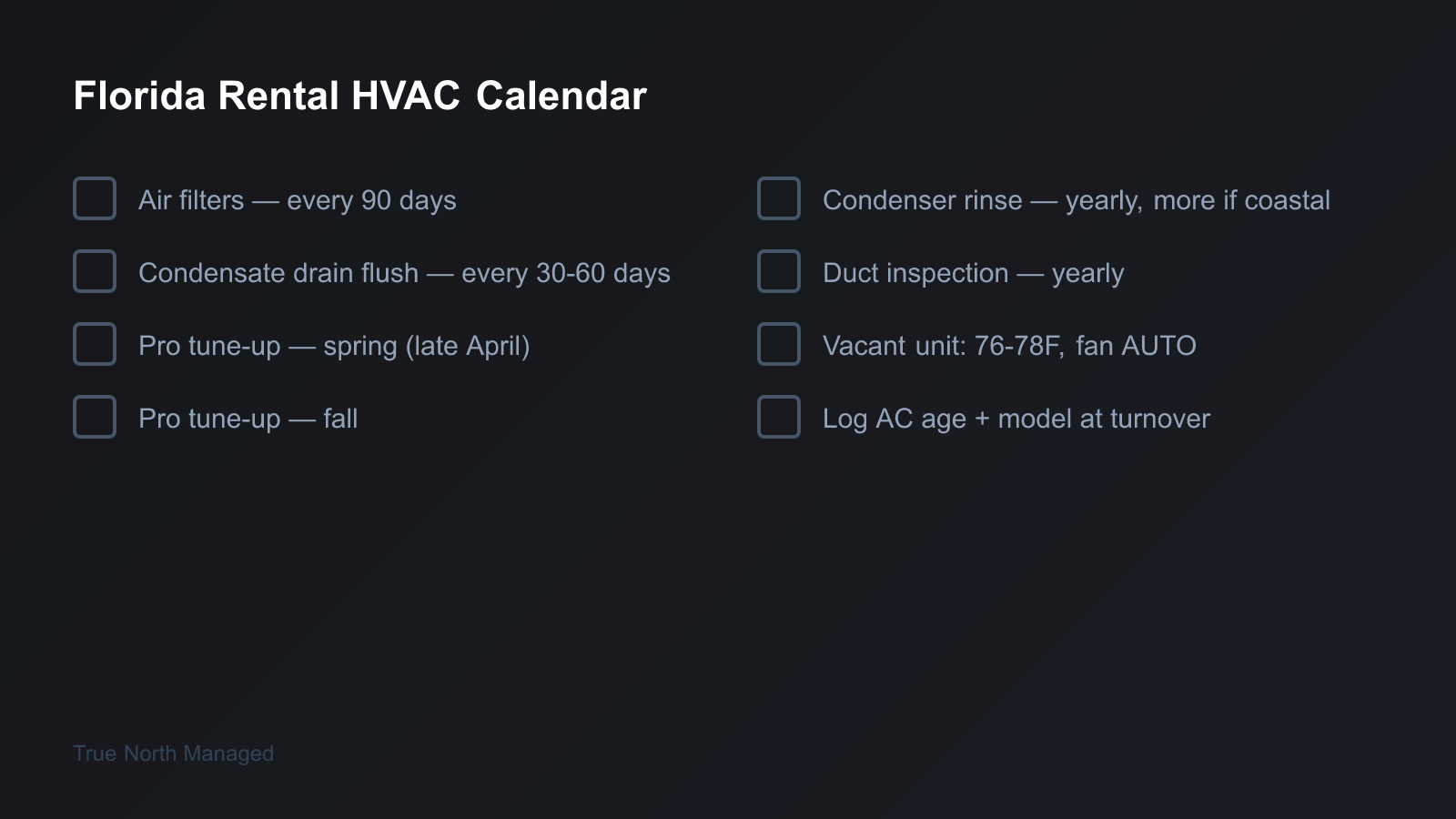
Here's the calendar, item by item, with the failure each one heads off.
Air filters — every 90 days. A clogged filter chokes airflow, ices the coil, and eventually kills the compressor. Standard cadence is every 90 days, tighter with pets — every 60 days with one, as often as every 30 to 45 with several. On a single-family home or duplex, you can assign filter changes to the tenant in writing; Florida law specifically lets you modify maintenance duties for those property types. But put it in the lease clearly, and treat it as a backstop, not a guarantee — plenty of tenants forget. Many remote owners just mail a year's supply of filters at move-in so there's no excuse.
Condensate drain line flush — every 30 to 60 days, April through October. This is the sleeper. Your AC pulls gallons of water out of Florida's humid air every day, and that water runs through a narrow drain line. In summer humidity, algae can fully block that line in 30 to 60 days. A blocked line backs up, overflows the drain pan, and soaks the ceiling or floor below. A routine $75 maintenance item becomes a four-figure water-damage claim — and a mold problem on top of it. Flush it monthly in the hot months.
Professional tune-up — twice a year. Spring and fall. A real tune-up checks refrigerant, cleans the coils, tests the capacitor and electrical connections, and clears the drain. This is where a tech catches the part that's about to fail while it's still a cheap fix.
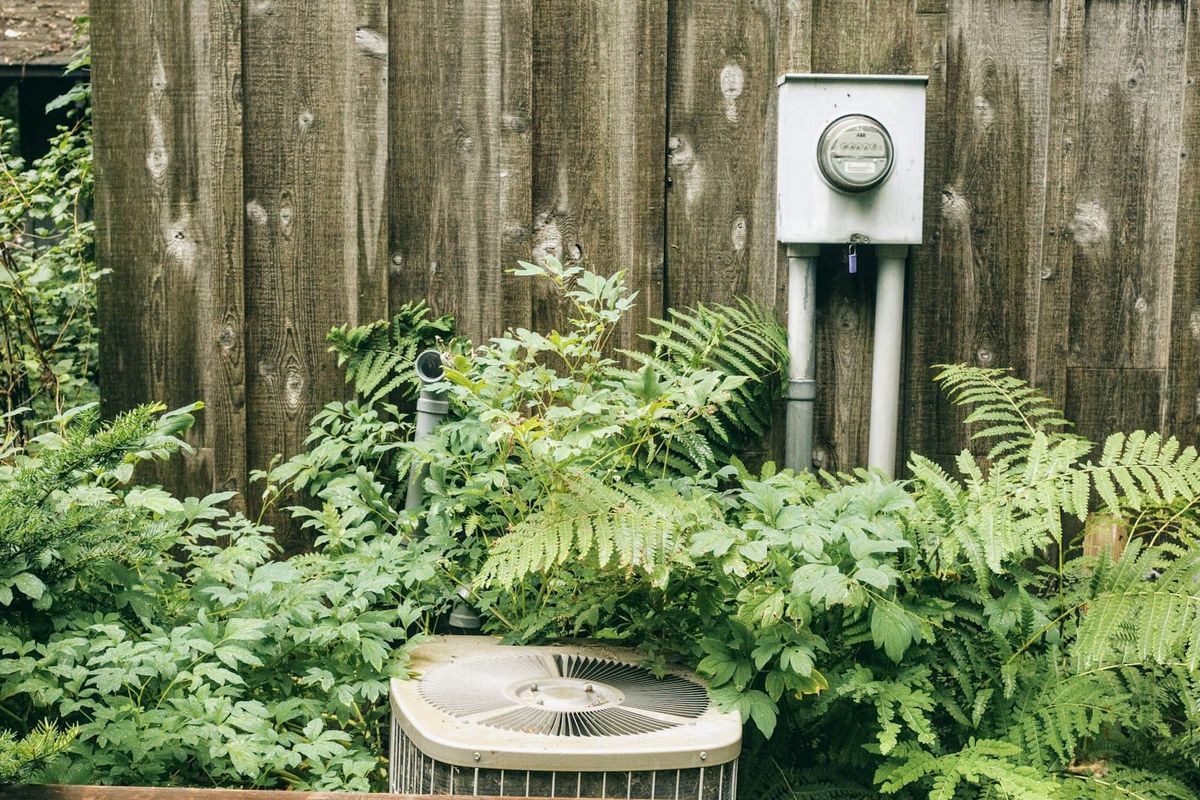
Condenser rinse — at least once a year, more if coastal. The outdoor unit collects dirt, pollen, and — near the coast — salt. Tampa Bay and Pinellas units take real salt-air corrosion. A light hose rinse every month or two clears it. For a coastal property, this is not optional.
One more, less often: have the ducts inspected annually and cleaned every three to five years. Florida humidity loads ductwork with dust and mold faster than a drier climate does.
What does the AC need between tenants?
Between tenants, the AC's job changes from cooling a home to protecting an empty one from mold. A vacant Florida property with the AC off — or set too high to "save money" — lets indoor humidity climb past 60%, and at that point mold starts growing on drywall and baseboards within days.
The fix costs almost nothing. Leave the AC running at 76°F to 78°F while the unit is empty, set the fan to AUTO (never ON — ON pushes moisture off the coil back into the house), and if the property has a humidistat, set it around 58%. The few dollars of electricity is nothing next to a mold remediation bill, and a mold problem in a Florida rental is exactly the kind of thing a remote owner discovers far too late.
Turnover is also the moment to document the system. Photograph the air handler, the condenser, and the thermostat, and write down the unit's age and model. If you don't know how old the AC is, find out — a 14-year-old system in Florida is living on borrowed time, and you'd rather plan that replacement than get surprised by it. Florida units typically last 10 to 15 years, shorter than the national average, because they simply run more.
How does a remote owner stay ahead of an HVAC problem?
A remote owner stays ahead of HVAC trouble by wiring the property so the system reports to you before the tenant does. The goal is to never learn about a problem from an angry call — to see it first, while it's still a small fix.
The single best tool is a smart thermostat with humidity alerts. Models built for landlords will text you when a unit runs unusually hot or when indoor humidity creeps above a threshold you set. A jump in humidity often means the AC is struggling or the drain is backing up — and now you know on a Tuesday afternoon instead of after the ceiling stains. For an absentee owner, that early warning is the whole game.
The rest is relationships. Have one local HVAC contractor under a maintenance agreement so somebody reliable already knows the property. Pre-approve a repair cap — say, $400 — so your contractor or property manager can fix a dead capacitor on a Saturday without waiting on you to wake up and answer the phone. Speed is what protects you here. Every hour an AC stays broken in July is an hour closer to a written notice. If running all of this from out of state feels like more than you signed up for, our playbook for out-of-state Florida landlords walks through the rest of the remote-ownership setup.
Common mistakes Florida landlords make with HVAC
A few patterns show up again and again, and every one of them is avoidable.
Waiting for the tenant to report a problem. By the time a tenant calls, the system has usually been struggling for weeks. A scheduled tune-up and a smart thermostat both catch trouble earlier — and earlier is cheaper and quieter.
Skipping the tune-up to save money. A $150 tune-up feels optional right up until it isn't. Deferred maintenance doesn't save money; it moves the cost to a worse day and adds an emergency surcharge. This is the same deferred-maintenance trap that drives most emergency repair calls on Florida rentals.
No filter clause — or relying on one too hard. If the lease is silent on filters, that responsibility lands on you. But even with a clause, a tenant who forgets is still your problem. Assign it in writing and back it up by supplying filters.
Buying the cheapest unit at replacement. When the system finally dies, the bottom-shelf replacement is a false economy. Federal efficiency rules already set a SEER2 minimum for Florida (14.3 SEER2 for a split-system air conditioner under 45,000 Btu/hr installed on or after January 1, 2023), and on a coastal property a corrosion-resistant coil coating pays for itself. A new system runs $6,000 to $9,500 — it's worth getting right.
A working HVAC calendar isn't complicated. It's four recurring tasks, two phone numbers, and one thermostat that talks to you. Build it once and your Florida rental's AC stops being a thing you worry about — which, for a remote owner, is worth more than the maintenance itself.
For the full picture on running a Florida rental from a distance, start with our Florida Owner's Guide — and the broader preventive maintenance calendar for Florida rentals covers the systems beyond the AC. If you'd rather hand the whole calendar to someone local, get a free rental analysis and we'll show you what that looks like.