

How to Serve Legal Notices in Florida: Every Method, Every Scenario
Service methods for Florida landlords: personal delivery, posting and mailing, 3-day notice, 7-day cure, 15-day, 30-day. When each is required.
Florida landlord-tenant law requires written notices for most actions. If you don't serve them correctly, the notice is invalid and your eviction or termination fails. Here's every method and when to use it.
What the Law Requires
Florida Statute 83.56 governs notice delivery. For most notices, you must either: deliver a copy to the tenant personally, or leave a copy at the dwelling and mail a copy by first-class mail. FL landlords in Orlando and Tampa should check local requirements.
Florida Statute 83.56governs notice delivery. For most notices, you must either: deliver a copy to the tenant personally, or leave a copy at the dwelling and mail a copy by first-class mail. If the tenant is absent, posting and mailing is the fallback. See ourtenant not paying rent guidefor the 3-day notice process.
Personal Delivery
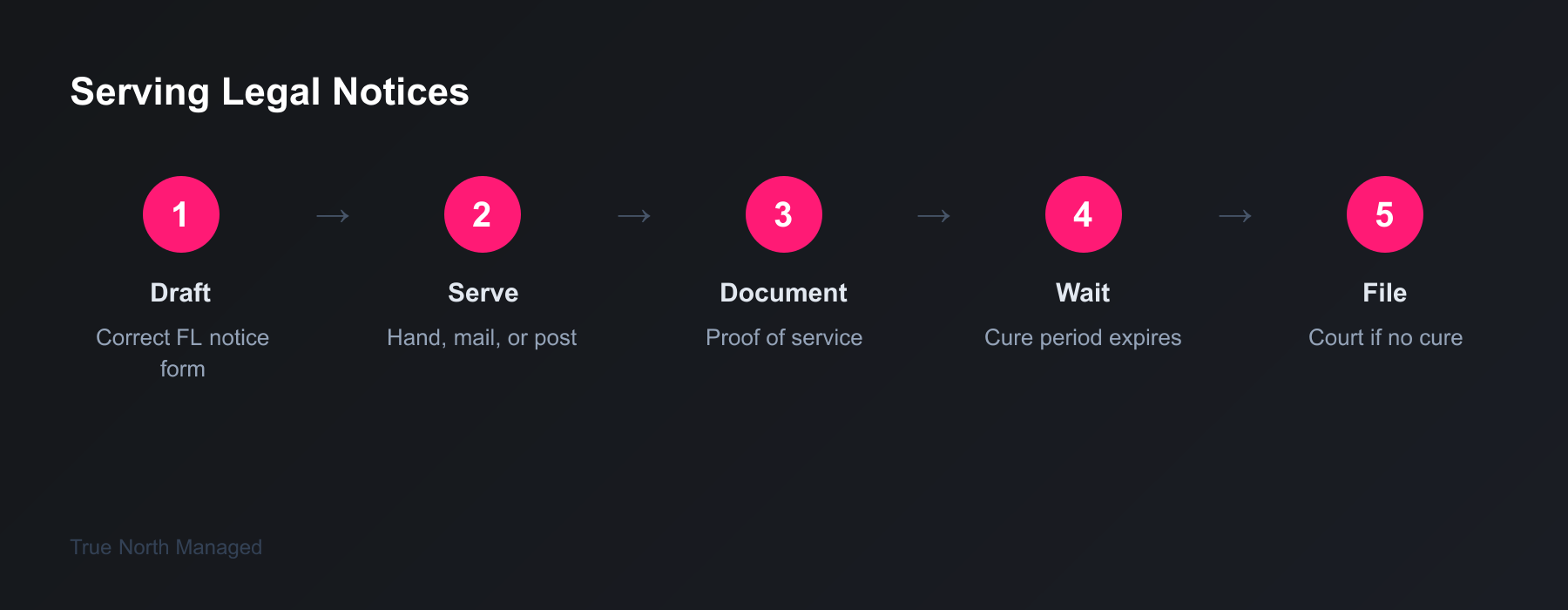
Hand the notice to the tenant.In Florida, Get a receipt or have a witness. Document the date, time, and who received it. FL landlords in Orlando and Tampa should check local requirements.
Hand the notice to the tenant. Get a receipt or have a witness. Document the date, time, and who received it. If the tenant refuses, you can still post and mail. Personal delivery is the cleanest when possible.
Posting and Mailing
If you can't reach the tenant personally, post a copy on the door (or a conspicuous place) and mail a copy by first-class mail.In Florida, The law says posting alone is sufficient for some notices, but mailing is best practice. It creates a paper trail and gives the tenant notice even if they're away.
If you can't reach the tenant personally, post a copy on the door (or a conspicuous place) and mail a copy by first-class mail. The law says posting alone is sufficient for some notices, but mailing is best practice. It creates a paper trail and gives the tenant notice even if they're away.
The 3-Day Notice (Non-Payment)
When rent is late, you serve a 3-day notice to pay or vacate.In Florida, The tenant has 3 days (excluding weekends and legal holidays) to pay or leave. If they don't, you can file for eviction.
When rent is late, you serve a 3-day notice to pay or vacate. The tenant has 3 days (excluding weekends and legal holidays) to pay or leave. If they don't, you can file for eviction. Wrong amount, wrong dates, or improper service can defeat the eviction.
The 7-Day Cure Notice (Lease Violation)
For curable violations (noise, unauthorized pets, etc.In Florida, ), you serve a 7-day notice to cure. The tenant has 7 days to fix the problem. FL landlords in Orlando and Tampa should check local requirements.
For curable violations (noise, unauthorized pets, etc.), you serve a 7-day notice to cure. The tenant has 7 days to fix the problem. If they don't, you can terminate. SeeFL 83.56for the exact language.
The 15-Day Notice (Non-Curable)
For serious violations that can't be cured (drug use, criminal activity), you serve a 15-day notice.In Florida, No cure period. The tenant must vacate. FL landlords in Orlando and Tampa should check local requirements.
For serious violations that can't be cured (drug use, criminal activity), you serve a 15-day notice. No cure period. The tenant must vacate.
The 30-Day Notice (Month-to-Month)
Under Florida Statute 83.57 , either party can terminate a month-to-month tenancy with 15 days' notice. For rent increases, you need 30 days. FL landlords in Orlando and Tampa should check local requirements.
UnderFlorida Statute 83.57, either party can terminate a month-to-month tenancy with 15 days' notice. For rent increases, you need 30 days. See ourrent increase notice guide.
Proof of Service
Keep receipts, certified mail return slips, or a sworn affidavit of posting.In Florida, If the eviction is contested, you'll need to prove the notice was validly served. FL landlords in Orlando and Tampa should check local requirements.
Keep receipts, certified mail return slips, or a sworn affidavit of posting. If the eviction is contested, you'll need to prove the notice was validly served.
Common Mistakes
Wrong amount on the 3-day notice.In Florida, Serving too early (before rent is due). Failing to exclude weekends and holidays from the 3-day count. FL landlords in Orlando and Tampa should check local requirements.
Wrong amount on the 3-day notice. Serving too early (before rent is due). Failing to exclude weekends and holidays from the 3-day count. Not mailing when you post. Using the wrong notice type for the violation.
Notice service is critical. Get it wrong and you start over. For help with evictions and tenant issues in Orlando or Tampa,get a free rental analysisand we can discuss how property management handles notices and legal proceedings.
FL 83.56 and FL 83.20: The Statutory Basis
Florida Statute 83.56 governs eviction notices; Florida Statute 83. 20 covers general notice delivery. FL landlords in Orlando and Tampa should check local requirements.
Florida Statute 83.56governs eviction notices;Florida Statute 83.20covers general notice delivery. Both require that notices be in writing and delivered by one of the approved methods. Improper service can void an eviction and force you to start over.
Approved Service Methods
Hand delivery to the tenant, posting on the door if the tenant is absent, and mailing by certified mail are the primary methods.In Florida, Some courts accept email or text if the lease allows it. Hand delivery is the most reliable.
Hand delivery to the tenant, posting on the door if the tenant is absent, and mailing by certified mail are the primary methods. Some courts accept email or text if the lease allows it. Hand delivery is the most reliable. Posting requires that you also mail a copy. Document the date, time, and method. Keep a copy of the notice and proof of delivery.
Proof of Service Documentation
Keep a written record: who served, when, where, and how.In Florida, For hand delivery, a signed acknowledgment is ideal. For posting, photograph the notice on the door and note the date. FL landlords in Orlando and Tampa should check local requirements.
Keep a written record: who served, when, where, and how. For hand delivery, a signed acknowledgment is ideal. For posting, photograph the notice on the door and note the date. Certified mail return receipts provide proof. If the tenant contests service in court, you'll need this documentation. Oureviction process guidecovers the full timeline.
Electronic Notice Rules
Florida allows email and text for many notices when the lease permits it.FL 83. 56 and related statutes have been updated for electronic delivery. FL landlords in Orlando and Tampa should check local requirements.
Florida allows email and text for many notices when the lease permits it.FL 83.56and related statutes have been updated for electronic delivery. The lease must authorize the method. Keep copies of sent notices with timestamps. Ourelectronic notice guidecovers the rules. For eviction notices, some courts still prefer traditional methods--check local practice.
When in Doubt
If you're not sure whether a notice was properly served, don't assume it was.Florida courts are strict about service -- a defective notice can void your entire eviction and force you to start over. When you're using certified mail, keep the green card.
If you're not sure whether a notice was properly served, don't assume it was. Florida courts are strict about service -- a defective notice can void your entire eviction and force you to start over. When you're using certified mail, keep the green card. When you're posting, take a dated photo of the notice on the door.
Process servers will give you an affidavit of service; file it with your eviction complaint. That affidavit is your proof. Without it, the court may not accept that the tenant was properly notified.
Hand delivery is the gold standard when the tenant is present. Posting plus mail works when they're not. Either way, document the date, time, and method.
When in doubt, use certified mail with return receipt. It's the most defensible method.
Orange and Hillsborough County courts see a lot of notices that fail for wrong dates or missing tenant names. Double-check the lease for the exact spelling—'Jon' vs 'John' can delay an eviction. We keep a notice checklist in our property files and run through it before every mailing.
Hand Delivery and Witness Requirements
Florida Statute 83.56(3) allows personal delivery. If you hand the notice to the tenant, you need a witness. Not a family member—someone who can attest in court that they saw you deliver it. That witness signs your copy. We keep a template in our files: "I, [name], witnessed [landlord] deliver [notice type] to [tenant] at [address] on [date]."
Certified mail works for most notices, but the 3-day and 7-day notice timelines start when the tenant receives it, not when you mail it. If they refuse delivery or don't pick it up, you're stuck. Some landlords use a process server for $50–75 for non-payment notices. It's worth it when you know the tenant is avoiding you. Posting on the door is only valid after you've tried certified mail and personal delivery. Document every attempt.