
Seasonal Maintenance for Florida Rentals: A Month-by-Month Guide
Florida's weather sets the maintenance rhythm for your rental, not the calendar. Here's a clean month-by-month plan built around AC season, hurricane season, and the humidity that never quits.
Pull up any "rental maintenance calendar" the search results hand you and you'll get the same northern template: winterize the pipes in fall, inspect for snow-load damage in spring, prep the furnace before the cold. None of that is the job in Orlando or Tampa. Here, your air conditioner runs almost every day of the year, hurricane season hangs over five straight months, and the humidity works on your property around the clock whether anyone's home or not.
That's our whole argument with this guide. A generic maintenance calendar misses what actually makes Florida different — the AC, humidity, hurricane, and pest cycle a Central Florida operator plans the entire year around. The standard checklists give you a list of tasks. They almost never give you the Florida reason behind each line, which is exactly why an owner can follow one to the letter and still get blindsided by a flooded ceiling in August or a denied roof claim in September. The tasks aren't really the point. The timing and the cause are.
So here's the year as one clean pass, January through December, with each job tied to the weather that makes it matter — and why a Florida rental can't run on anybody else's schedule.
Why does Florida need its own maintenance calendar?
A Florida rental faces a different set of pressures than a property in a four-season climate, and the maintenance plan has to match. Your AC carries the cooling load nearly year-round — and in this climate it's doing double duty, because it's also the main system pulling moisture out of the air. Hurricane season runs June 1 through November 30. Humidity sits high enough to grow mold in a couple of days if a unit goes empty with the air off. Pests stay active well past the months a northern landlord would expect. Plan around those four forces and you're rarely caught off guard.
Here's where the national checklists fall short. They'll tell you to "service the HVAC in spring," and they're not wrong — but they treat it as a line item, not a cause-and-effect. They don't explain that a Florida AC runs eight-plus months, that it's the one thing standing between your walls and a mold problem, or that the spring service is really about getting ahead of the summer repair queue and flushing the condensate line before clog season. Same task, completely different stakes. Drain-line flushing barely registers on a national calendar, yet it's the single most common source of water damage we see in Florida rentals. That's the gap this guide is built to close.
The thread that ties all of it together is timing. Most Florida maintenance problems aren't surprises. The AC that fails in summer was overdue for service in spring. The roof leak that shows up during a September storm was a loose section of flashing in February. The mold complaint in August started as a clogged condensate line in June. A month-by-month plan lets you handle each of these on a calm weekday instead of as a 9 p.m. emergency call from your tenant.
One quick note on what this guide is and isn't. This is the seasonal, weather-driven version: what to do and why the climate demands it then. If you want the full task-by-task schedule with service intervals for every system in the house, pair this with our preventive maintenance calendar for Florida rentals — the two work together.
Winter (December–February): the mild-season reset
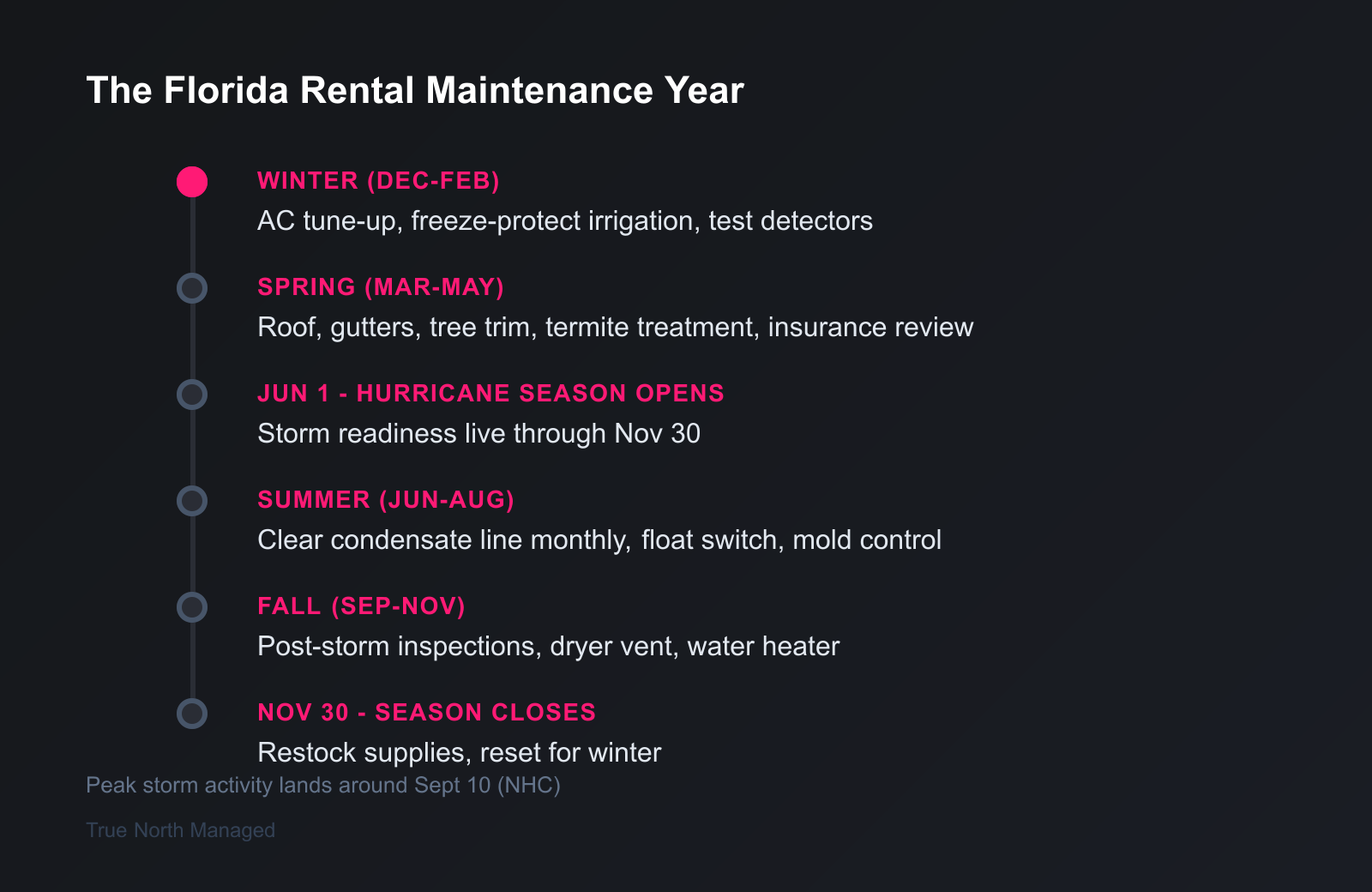
Central Florida winters are mild, not absent. You'll see daytime temperatures in the 70s and maybe five to ten freezing nights across the whole season, usually dipping into the 30s after a cold front. That mildness is exactly why winter is the best window for the calm, unglamorous work — the property isn't fighting the heat, and you're months out from storm season.
Start with the air conditioner. Change the filter, and if the system hasn't had a professional tune-up in the last year, book one now while HVAC companies aren't slammed. This is the first place the Florida calendar diverges from the northern one. Your AC doesn't get an off-season here — even on a cool winter evening the humidity sits high, so the system is still running, still pulling moisture, still wearing down quietly. Winter is when a technician can catch a weak capacitor or low refrigerant before the summer load exposes it the hard way. Always use a licensed pro for any refrigerant work.
Next, watch the cold snaps. You don't need to winterize the way a northern landlord would, but a hard freeze can still crack exposed irrigation PVC and split a backflow preventer. When a freeze warning lands, shut the irrigation off and drain the lines, and remind your tenant to leave a cabinet door open under any exterior-wall sink. The University of Florida's guide to cold protection for landscape plants is a solid reference for the handful of nights it actually matters. Winter is also a quiet time to walk the interior, test smoke and carbon monoxide detectors, and knock out any small repair you've been putting off before the busy seasons hit.
Spring (March–May): pre-storm prep and the pest surge
Spring is the most important stretch on the whole calendar, because everything you do here is in front of June 1. Here's the practitioner reality nobody warns first-time owners about: the moment the first tropical system spins up in the Gulf, every good roofer and tree crew in Central Florida is booked solid, prices jump, and your options narrow to emergency tarping. We've watched owners wait until June to line up a tree service and find there's simply no one available. Do the heavy prep on a slow March or April weekend, not when a storm is in the cone.
Get up on the roof first — or send someone who does this for a living. Look for loose or missing shingles, lifted tiles, and damaged flashing, and repair anything you find. And do it for two reasons, not one. The obvious reason is keeping water out. The reason owners learn the hard way is the paper trail: when a storm hits and you file a claim, Florida insurers lean hard on "deferred maintenance" and wear-and-tear exclusions to deny roof damage — an adjuster will point to cracked flashing or lifted edges and argue it predated the storm. A dated spring roof inspection is the documentation that survives that fight. Then clean the gutters and downspouts so water actually drains during a downpour. A clogged gutter during a storm backs water up under the soffit and fascia, and that turns into a slow leak you won't see inside the house for weeks. Have a licensed tree service cut back any branches hanging over the roofline, ideally to about ten feet of clearance, so a wind gust doesn't turn a limb into a battering ram.
Spring is also when the pests wake up. Termites swarm in Florida from roughly March through June, often at dusk and after a rain, and the subterranean and Formosan species in this state do real structural damage fast. This is another trigger a four-season calendar never accounts for — it runs on biology and warm rainy nights, not a date. A preventive pest treatment now is cheap compared to a termite repair bill later. While you're in planning mode, review your insurance — confirm your wind and flood coverage is current, check whether your property's FEMA flood zone has changed, and ask your agent about anything that's shifted since last year. Aim to have the roof, trees, gutters, and insurance all squared away by the end of May.
Summer (June–August): hurricane season and the AC peak
Now both big forces are live at once. Hurricane season is open as of June 1, and your air conditioner is carrying its heaviest load of the year. Summer maintenance is about keeping the AC alive and keeping water — from storms and from the humidity itself — out of the building.
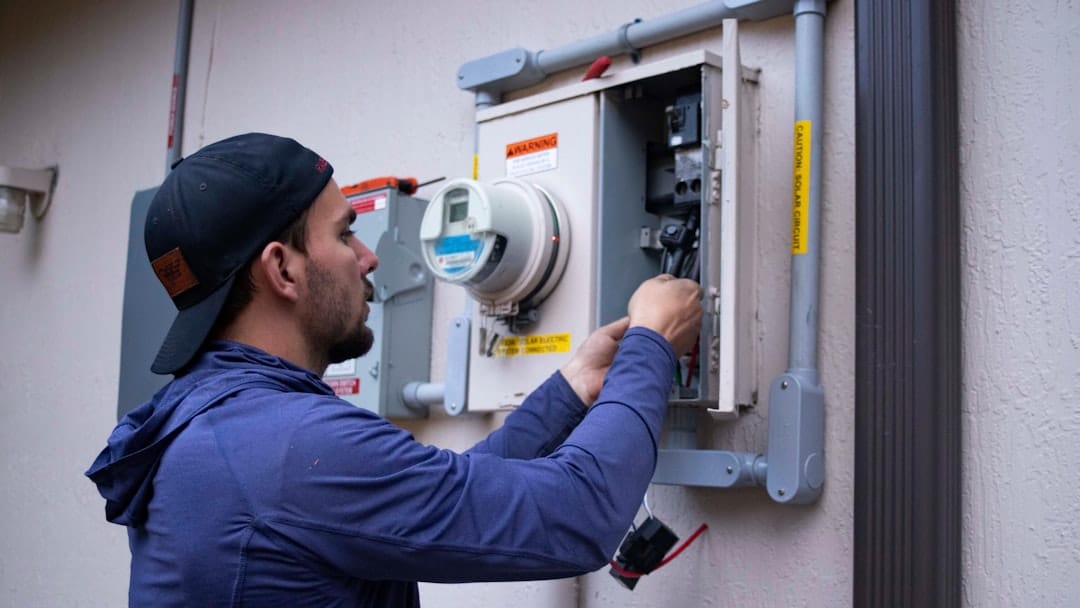
Your single most expensive silent problem in a Florida summer is the AC condensate drain line. The system pulls gallons of water out of humid air every day, and that water leaves through one narrow line. When it clogs — and in this humidity it will — the overflow shows up as a stained ceiling, warped flooring, or a float-switch shutdown that leaves your tenant with no cooling. We see this one constantly: a slow drip from the air handler in a closet or attic turns into a brown stain spreading across the living-room ceiling below, and it shows up late, long after the clog started, by which point it's a four-figure repair. Clear the line monthly by pouring a cup of white vinegar through it, and if the unit doesn't already have a float switch on the drain pan, have one installed. It's a small part that turns a flood into a harmless shutoff. Keep the filters fresh too — monthly in summer if your tenant won't handle it — because a choked filter makes a strained system fail faster.
Here's the practitioner gotcha that costs owners the most, though, and it has nothing to do with a part. It's turning the AC off in a vacant unit. In our experience managing Orlando and Tampa rentals, the seasonal miss that does the real damage is treating an empty unit the way you would up north — shut everything down to save on the power bill. In Florida that's an own-goal. The same humidity that clogs the drain line grows mold, and the AC is the only thing holding it back. The EPA's guide to mold and moisture says to keep indoor relative humidity below 60% and to dry any wet material within 24 to 48 hours, because past that window mold can start to grow. Florida's outdoor air sits far higher. So keep the AC running even between tenants — set it around 78°F rather than shutting it off — and add a dehumidifier in trouble spots like a laundry room or an enclosed garage. No tenant is in there to notice the musty smell before it becomes a visible, expensive remediation bill. If you want the full playbook here, our guide to preventing mold in Florida rental properties goes deeper than we can in one section. And keep your storm readiness current all summer — your tenants should know where to shelter, how to report damage, and what's in the building's emergency plan.
One more thing about summer: if your AC does quit in July, you're now at the back of a very long line. Every HVAC company in the metro is buried when it's 95 degrees, and a dead AC in an occupied unit isn't a convenience problem — it's a habitability one, especially with elderly tenants or young kids. That's the whole case for the spring tune-up. The work you skip in March is the emergency you can't get a tech for in July.
Fall (September–November): peak storms and the wind-down
September is statistically the busiest part of hurricane season — the climatological peak lands around September 10 per the National Hurricane Center — so fall maintenance is part storm response and part getting the property ready for the cooler, drier months ahead.
If a storm does pass through, build a simple post-storm inspection habit. Once it's safe, walk the property and document the roof, windows, soffits, fences, and any standing water with timestamped photos. Catching a small wind-lifted shingle now keeps it from becoming a leak during the next rain, and good photos make any insurance claim far smoother — and given how aggressively Florida insurers reach for the "pre-existing damage" argument, that timestamped record is doing real work for you. Keep your tenant looped in on how to report anything they notice from inside.
As the weather finally eases, take on the jobs that don't fit anywhere else. Have the dryer vent cleaned and inspected — lint is the leading cause of dryer fires, and Florida's humidity packs the vent line faster than a drier climate would, so once a year is the floor. Check the water heater for sediment, corrosion, and the age of the unit. And refresh your hurricane supplies and documents so you're not starting from scratch next spring — the Florida Division of Emergency Management's supply checklist and Ready.gov's hurricane guidance are the references to keep on file. By the end of November, the season closes and you're back to the winter reset.
The Florida rental maintenance cheat sheet
Here's the full year on one page. Pin it somewhere you'll see it.
| Season | Months | Climate driver | Core tasks |
|---|---|---|---|
| Winter | Dec–Feb | Mild, occasional freeze | AC tune-up + filter, freeze-protect irrigation, test detectors, small repairs |
| Spring | Mar–May | Pre-storm + pest surge | Roof/gutter/flashing, tree trimming, termite treatment, insurance review (done by May 31) |
| Summer | Jun–Aug | Hurricane season + AC peak | Clear condensate line monthly, float switch, humidity/mold control, storm readiness |
| Fall | Sep–Nov | Peak storms, then cooldown | Post-storm inspections, dryer vent + water heater, restock storm supplies |
The point of the table isn't to do everything yourself. It's to know what the weather is going to ask of the property before it asks, so nothing lands on you as a surprise. Notice what's driving every row — not the temperature on a thermometer, but humidity, AC load, storm timing, and the pest swarm. That's the Florida clock, and it's the part a borrowed northern calendar leaves out.
Who actually handles all of this?
Honestly, that depends on how many doors you own and how close you live to them. If you've got one rental fifteen minutes away, a lot of this is a few weekends a year plus a couple of service calls. If you're managing from out of state, or juggling three or four properties, the seasonal cadence gets hard to track — and we hear the same worry from out-of-state owners again and again: they can't see the slow stuff. A humidity creep, an early drain backup, a roof edge starting to lift. By the time someone local lays eyes on it, the cheap preventive fix has already become the expensive emergency.
That's the real value of a maintenance calendar tied to the climate: it turns reactive panic into a routine you can hand off. A good property manager runs this rhythm for you — the spring roof check, the monthly summer condensate clear, the post-storm inspection — so you're not the one finding out about a clogged drain line when your tenant calls about a wet ceiling. If you'd rather not be on the roof in May or chasing an AC tech in July, a free rental analysis is a low-pressure way to see what hands-off management would look like for your Orlando or Tampa property.
Whatever you decide, the principle holds: in Florida, you don't maintain on the calendar's schedule. You maintain on the weather's. Stay a season ahead of it and the property mostly takes care of itself. For the deeper version of any single piece here — storm prep, mold, or the full system schedule — start with our Florida Owner's Guide and work outward from there.