

Rental Property Tax Deductions: The Complete Florida Checklist
The full checklist of Florida rental property tax deductions — mortgage interest, depreciation, repairs, insurance, mileage — and the ones owners miss.

Florida landlords get the same federal rental deductions as landlords everywhere. The difference is what happens after: no state income tax means every deduction you claim saves you more, because you keep all of it. Here's the full checklist of what you can deduct on a Florida rental and how to document each one.
Action: Report rental income and expenses on IRS Schedule E, attached to your Form 1040. Keep every receipt, the closing statement that sets your cost basis, and a mileage log.
Deadline: Schedule E is filed with your federal return — due April 15 after the tax year ends (October 15 with an extension). If you receive a county Tangible Personal Property (TPP) return for a furnished rental, that is due to the county property appraiser by April 1.
Authority: IRS Publication 527 governs residential rental income and deductions. There is no Florida state income tax return for rental income.
What can Florida landlords deduct on a rental property?
Florida landlords can deduct mortgage interest, property taxes, insurance, repairs, maintenance, depreciation, property management fees, professional services, and travel to the property. Rental income and expenses go on IRS Schedule E; you report gross rent, subtract allowable expenses, and land on net rental income or loss.
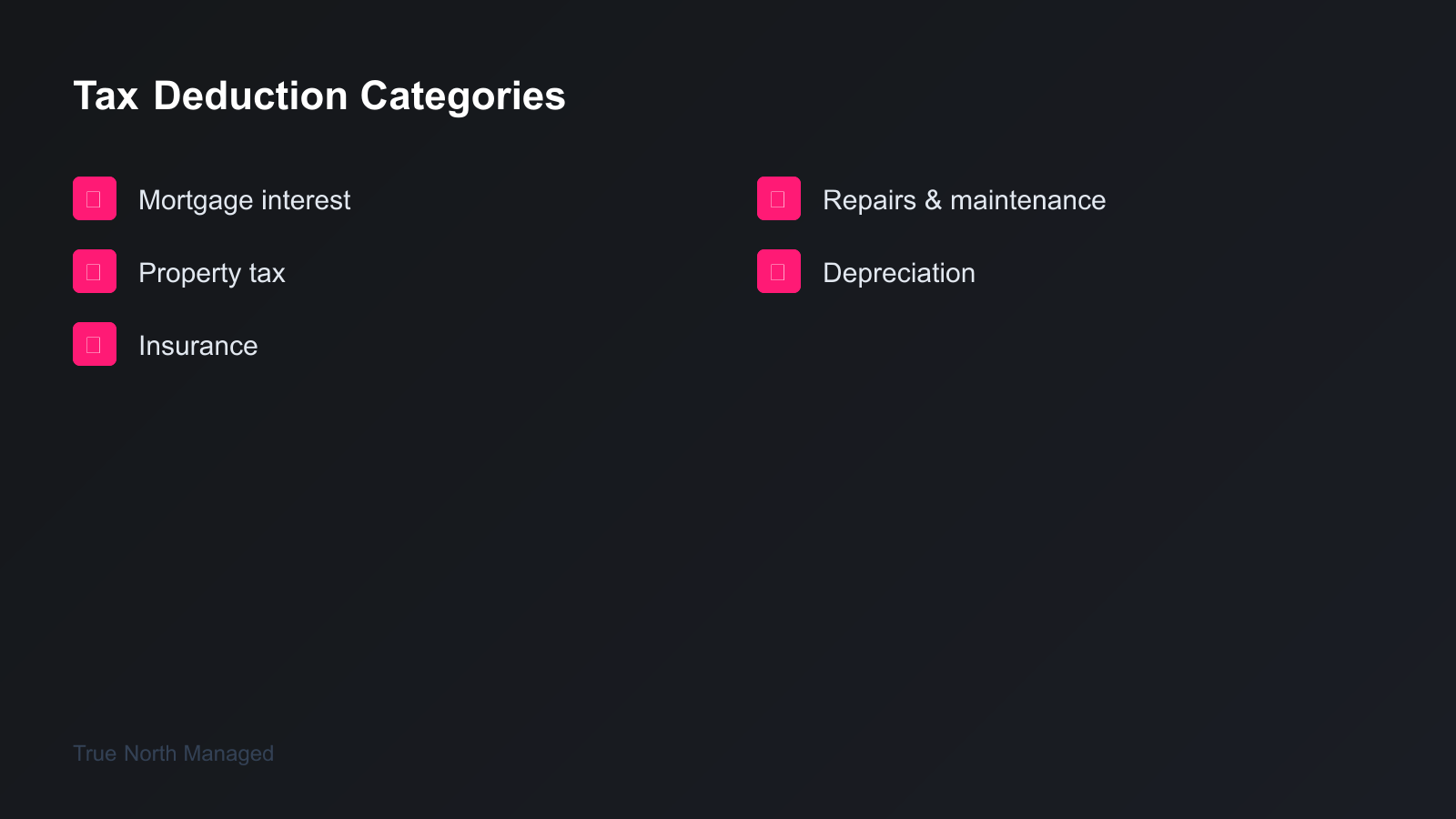
IRS Publication 527 is the official guide for residential rental property, and the IRS recordkeeping tips for rental real estate spell out what to keep. The deductions break into eight categories, and we'll walk each one. The thread that runs through all of them: a deduction you can't document is a deduction you can't safely claim.
Is there a Florida renter tax credit?
No. Florida has no state income tax, so there is no Florida renter tax credit and no landlord tax credit at the state level. Some other states give renters a credit on their state return. Florida doesn't have a state return at all. Every rental tax benefit a Florida landlord claims is a federal deduction taken on Schedule E.
This catches people coming from states like New York or California, where renters and landlords are used to state-level breaks. In Florida, the "benefit" is structural: you skip the state income tax entirely. That's worth more than most credits — but it means your tax planning is 100% federal.
Can Florida landlords deduct mortgage interest and property taxes?
Yes. Mortgage interest on a rental property is fully deductible on Schedule E, and so are the county property taxes you pay. Florida has no state income tax, but you still pay county property tax — and, on a furnished rental, possibly tangible personal property tax — and all of it is deductible against rental income.
This is usually a landlord's two biggest line items. Pull the interest figure from your lender's Form 1098 and the tax figure from your county tax bill. Our Florida rental property tax guide covers how Orange and Hillsborough County assessments work and why losing the homestead exemption changes your bill when a home becomes a rental.
How does depreciation work on a Florida rental?
Residential rental property is depreciated over 27.5 years. You don't deduct the purchase price in year one — you deduct a fraction of the building's value each year. Land is never depreciable. On a $275,000 property with $75,000 of land value, you depreciate $200,000, which works out to roughly $7,273 a year.
Depreciation is the deduction most first-time landlords miss, and it's often the largest. It's a paper deduction: it reduces your taxable rental income without costing you cash. The catch comes at sale — the IRS recaptures depreciation at a rate up to 25%, so plan for that bill or defer it with a 1031 exchange. Keep your closing statement and records of every improvement; they set the cost basis your CPA depreciates. Our Florida depreciation guide walks the math in detail.
Repairs vs. improvements: what's the difference for taxes?
A repair restores the property to its prior condition and is deductible in full the year you pay for it. An improvement adds value or extends the property's life and must be depreciated over time. Fixing a broken AC is a repair. Replacing the whole HVAC system or remodeling the kitchen is an improvement.
The line matters because of timing. A $500 repair is a $500 deduction this year. A $15,000 kitchen remodel spreads across 27.5 years — about $545 a year. Neither is better or worse; they're just taxed differently. When a job sits in the gray zone, ask your CPA before you file. Getting it wrong in either direction invites an IRS adjustment.
What about insurance, travel, and professional fees?
Landlord insurance, flood, windstorm, and umbrella premiums are all deductible. Mileage and travel to the property for management, repairs, or tenant meetings are deductible. Property management fees, attorney fees, accountant fees, and eviction costs are deductible. These three categories are easy to overlook and add up fast.
Insurance. Florida's market is volatile, so premiums climb — keep records for every policy year. If you bundle a rental with a personal policy, only the rental share is deductible.
Travel and mileage. The IRS standard mileage rate for 2025 is 70 cents per mile (it rises to 72.5 cents for 2026, and to 76 cents for miles driven on or after July 1, 2026). Log the date, miles, and purpose of every trip — hardware-store runs, contractor meetings, inspections. Missing mileage is money left on the table.
Professional services. If you use a property manager in Orlando or Tampa, the monthly fee, leasing fees, and maintenance coordination are all fully deductible.
Can a Florida landlord claim a home office deduction?
Yes, if you use a space in your home regularly and exclusively for rental management. You can use the simplified method — $5 per square foot, up to 300 square feet, so a $1,500 maximum — or deduct a portion of actual home expenses. The exclusive-use rule is strict: a desk in the corner of a bedroom you also sleep in usually won't qualify.
A separate room used only for the rental business is the safe version. Document how you use the space. The home office deduction is legitimate, but it's also a spot the IRS examines, so the exclusive-use standard has to actually hold up.
What is Florida's tangible personal property tax for rentals?
Florida counties assess tangible personal property (TPP) tax on business-use assets — appliances, furniture, and equipment in a furnished rental. If the county property appraiser sends you a TPP return, you must file it, generally by April 1. The TPP tax you pay is itself a deductible rental expense.
Most owners of a single unfurnished home rental never deal with TPP — there's a $25,000 exemption, and an empty house has little taxable business property. It matters more for furnished or short-term rentals. If a TPP return shows up in your mail, don't ignore it; check with your county property appraiser.
Common Florida landlord deduction mistakes
A handful of errors show up again and again, and each one either costs you money or invites an audit.
- Skipping depreciation. You don't get to choose. The IRS treats depreciation as taken whether you claim it or not, and recaptures it at sale either way. Not claiming it is pure loss.
- Mixing repairs and improvements. Deducting a capital improvement in one year, or depreciating a simple repair, both draw IRS attention.
- Claiming personal expenses. Only the rental share counts. A bundled insurance policy or a personal trip with one rental errand attached gets prorated.
- Forgetting mileage. Without a log, the deduction is hard to defend. Use an app or a spreadsheet from day one.
- Mixing tax years. 2025 expenses go on the 2025 return, based on when you paid — not when the work was done.
For a fuller walkthrough of filing season, see our Florida landlord tax filing guide. And if you're buying or renovating, ask a CPA about a cost segregation study — it accelerates depreciation and can create a first-year paper loss, though the study itself runs $1,500–$3,000.
Keeping records — and getting help
Keep receipts for at least seven years. The IRS's usual window is shorter, three years from filing, or six if you leave out income worth more than 25% of the gross income shown on your return, so seven leaves a margin. Keep purchase and improvement records longer, until that window closes for the year you sell. Organize everything by property and by year. A shoebox of real receipts beats a spreadsheet you rebuilt from memory the night before the deadline.
Clean records make tax season predictable whether you self-manage or hand it off. If you own one rental in Orlando or Tampa and you'd rather have someone else handle the operations — the leasing, the maintenance, the paper trail — so tax time is just a tidy export, that's exactly what we do. You don't need a portfolio. Get a free rental analysis and we'll walk through what a managed single property looks like on paper.
Frequently asked questions
What can Florida landlords deduct on a rental property?
Florida landlords can deduct mortgage interest, county property taxes, insurance, repairs, maintenance, depreciation, property management fees, legal and accounting fees, eviction costs, and travel to the property. Everything is reported on IRS Schedule E, attached to the federal Form 1040.
Is there a Florida renter tax credit?
No. Florida has no state income tax, so there is no Florida renter tax credit and no state-level landlord credit. Every rental tax benefit a Florida landlord claims is a federal deduction on Schedule E. The structural benefit is that Florida rental income is never taxed at the state level.
How is a Florida rental property depreciated?
Residential rental property is depreciated over 27.5 years under IRS rules. You depreciate the building value, never the land. On a $275,000 property with $75,000 in land value, you depreciate $200,000 — roughly $7,273 per year. The IRS recaptures depreciation at up to 25% when you sell.
What is the difference between a repair and an improvement for taxes?
A repair restores the property to its prior condition and is fully deductible the year you pay for it. An improvement adds value or extends the property’s life and must be depreciated over 27.5 years. Fixing a broken AC is a repair; replacing the whole HVAC system is an improvement.
What is the IRS mileage rate for rental property in 2025?
The IRS standard mileage rate for business and rental activity is 70 cents per mile for 2025, rising to 72.5 cents per mile for 2026 and to 76 cents for miles driven on or after July 1, 2026. Florida landlords should log the date, mileage, and purpose of every trip to the property to support the deduction.
Can a Florida landlord claim a home office deduction?
Yes, if a space in the home is used regularly and exclusively for rental management. The simplified method allows $5 per square foot up to 300 square feet, a $1,500 maximum. A desk in a shared bedroom usually fails the exclusive-use test; a dedicated room is the safe version.
Do Florida landlords pay tangible personal property tax?
Florida counties assess tangible personal property tax on business assets like appliances and furniture in a furnished rental. There is a $25,000 exemption, so most single unfurnished home rentals owe nothing. If the county property appraiser sends a TPP return, it must be filed, generally by April 1.