
Which Renovations Actually Increase Rent in Florida?
Most renovation lists rank upgrades by resale value, not rent. Here is which projects actually raise the monthly check in Florida, by how much, and how fast they pay back.
You can spend twenty thousand dollars on a renovation that adds twenty thousand dollars to your sale price and not one extra dollar to your rent. That sentence is the whole problem with most advice on renovations that increase rent. The lists rank projects by resale recoup, then quietly let you assume the same upgrade bumps the monthly check. It does not. Resale value and rent value are two different currencies, and the exchange rate between them is brutal.
We manage single-family rentals across Orlando and Tampa, and the renovation question comes up on almost every turn. Owners want to know what to spend on before they relist. The honest answer is short: a small number of upgrades reliably raise rent, a larger number raise resale value only, and a few raise nothing at all while feeling like progress. The trick is knowing which bucket each project lives in before the money leaves your account.
What's the difference between a rent-mover and a resale-mover?
A rent-mover raises the monthly rent a tenant will pay and recoups its cost through that higher rent within a defined window. A resale-mover raises the eventual sale price but barely touches the monthly rent. The two overlap less than you'd think, and confusing them is the most expensive mistake a landlord makes before relisting.
Here's where the confusion comes from. Almost every renovation ROI article leans on the annual Cost vs. Value Report, which is a fine document for sellers. It tells you a minor kitchen remodel recoups about 112% of its cost and refinishing hardwood floors recoups around 147%. Those are real numbers. They are also resale recoup numbers, measured at the closing table, not on the rent roll. A floor that returns 147% when you sell the house can return zero extra dollars a month while you rent it.
So before any project, run it through one filter we call the rent-payback window: does the monthly rent increase recoup the cost inside roughly twelve to twenty-four months, and does the new rent still sit under what comparable units in that neighborhood actually fetch? If a renovation fails either half, it is a resale-mover or a vanity project wearing a rent-mover's costume. Treating renovation spend with the same discipline you'd bring to any other line item is the same mindset behind tracking the hidden costs that quietly erode rental returns — the money you can't see leaving is the money that kills the deal.
Which renovations actually increase rent the most?
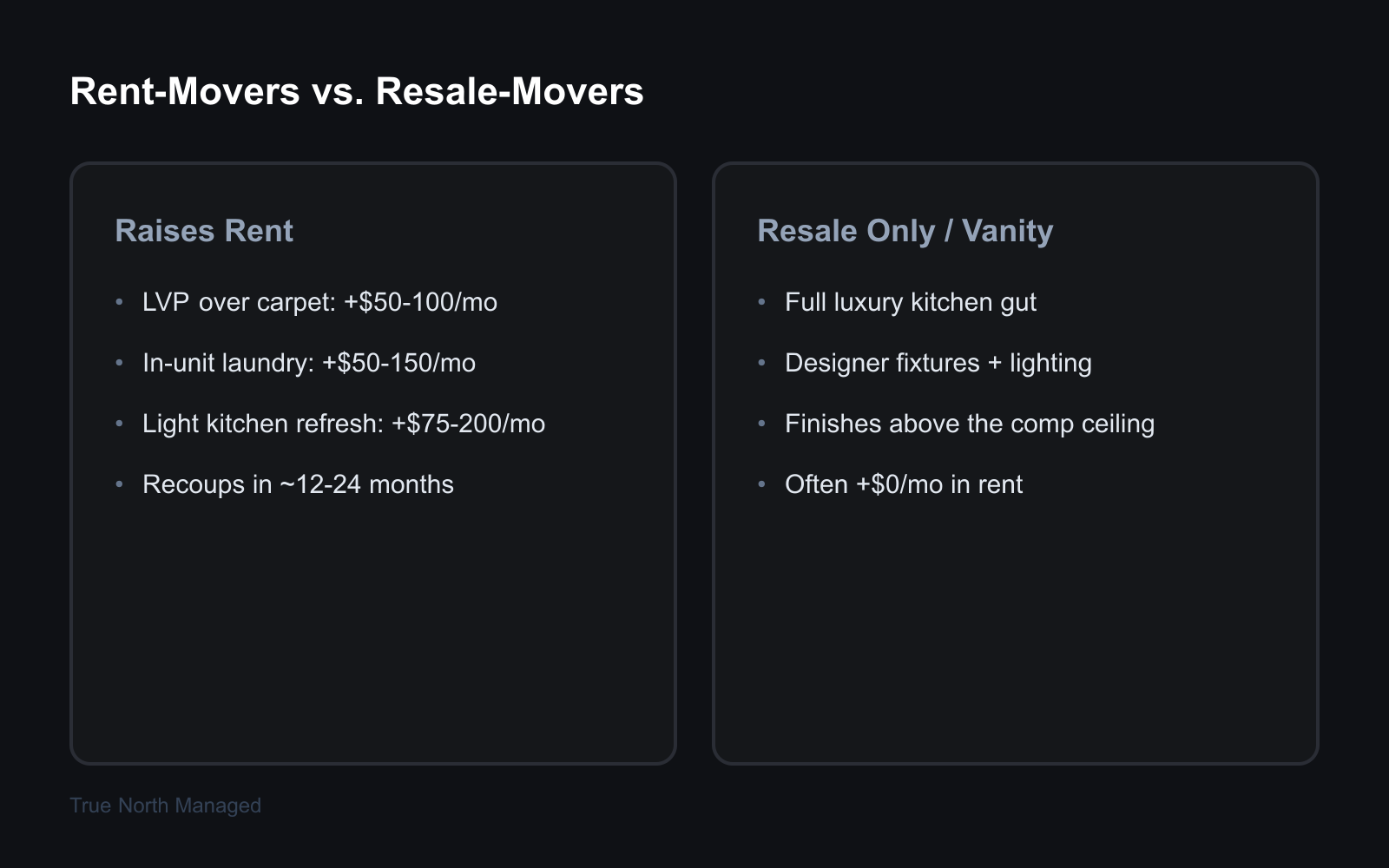
In Florida, the upgrades that most reliably raise rent are flooring that survives humidity, in-unit laundry, and a light kitchen refresh — in that order of dependability. Each one solves a problem a tenant feels every day, each one stays under the comp ceiling, and each one recoups its cost through rent within a couple of years.
Start with flooring, because it's the one Florida changes most. Carpet traps moisture, and in a climate where the air sits at 70% humidity for months, that means mold, mildew, and a floor that looks tired by the second tenant. Luxury vinyl plank repels water, shrugs off humidity, and survives turnovers that would shred carpet. That durability is why LVP has become the default in Florida rentals, and the rent math supports it: replacing worn carpet in main living areas with LVP can support roughly $50 to $100 a month more, on an installed cost of about $3.50 to $9 per square foot versus $3 to $7 for carpet. On a typical living-room-and-hallway run, that's a payback inside a year or two — and you stop replacing carpet every turnover, which is its own quiet savings. HomeGuide's carpet versus LVP cost breakdown shows the per-square-foot spread if you want to model your own square footage.
In-unit laundry is the second dependable rent-mover, and it's underrated. A washer and dryer command roughly $50 to $150 a month more — about a 6% premium, and higher in dense urban submarkets where laundromats are the only alternative. A mid-range set runs $800 to $2,000, so most owners recoup the appliance cost through rent in twelve to eighteen months. After that, it's pure margin and a sticky amenity tenants renew for. In an Orlando single-family home renting in the $1,876 to $2,384 range that mid-2025 Zillow rental data put as typical, an extra $75 a month is real money that compounds across a multi-year tenancy.
Then the kitchen — but the light version, not the gut. A minor refresh (cabinet refacing at $1,000 to $5,000, a new laminate or modest quartz counter at $1,500 to $7,000, fresh hardware, a clean backsplash) can support $75 to $200 a month more, depending on the submarket. The full luxury remodel is a different animal, and we'll get to why it usually fails the rent test.
Does fresh paint and curb appeal raise rent?
Paint rarely raises the rent number directly, but it's still one of the highest-return things you can do — because it pays through speed, not premium. A freshly painted, neutral unit leases faster, shows better, and signals a property that's cared for. The payback shows up as filled days, not a bigger check.
This is the part owners undervalue. A vacant month on a $2,000 unit costs you $2,000. Fresh paint in a neutral tone — soft gray, warm beige, classic white — is the cheapest upgrade on this entire list and routinely shaves days off your time on market. Most rental turnovers run 25 to 35 days when managed well; sloppy presentation pushes that longer, and every extra week is rent you never collect. We paint on essentially every turnover unless the walls are genuinely clean, and we treat it as vacancy insurance rather than a rent lever. If cutting vacancy is the goal, paint works alongside the rest of a tight turnover playbook that minimizes the gap between tenants.
Curb appeal works the same way: trimmed landscaping, a clean entry, a fresh front door. It doesn't add a line to the lease, but it wins the drive-by and gets the showing booked. Speed-to-lease is a financial outcome even when it never touches the rent figure — a point worth modeling the same way you'd weigh any return, the way you'd compare cap rate against cash-on-cash on the underlying deal.
How much does AC and energy efficiency matter for Florida rentals?
In Florida, working air conditioning isn't a rent-mover so much as table stakes — but efficiency and reliability protect your rent and your margins. Central air carries a modest premium of roughly 2.8%, about $40 a month nationally, and in Florida's heat a unit without functional cooling barely competes for applicants at all.
The nuance is what AC does to the rest of your numbers. Once air conditioning is part of the lease, keeping it working becomes a habitability and maintenance obligation under Florida's landlord-tenant law — the same chapter, Florida Statute 83.51, that defines what landlords must maintain. A serviced, efficient system means fewer emergency calls in August, lower tenant utility bills (which makes renewals easier), and a unit that holds its rent against newer competition. We've written separately about the AC repair obligation Florida landlords actually carry, because the line between "amenity" and "legal duty" trips up a lot of owners.
So efficiency upgrades — a properly sized condenser, sealed ducts, a smart thermostat — rarely show up as a rent premium on their own. They show up as a third kind of payback: preventing future costs. In Florida, that's a legitimate reason to spend, alongside raising rent and cutting vacancy.
Which renovations don't pay off in higher rent?
The renovations that don't pay off are the ones that push a unit above its neighborhood comp ceiling: full luxury kitchen guts, designer fixtures, high-end lighting packages, and over-personalized finishes. They recoup at resale or not at all — the rent stays capped by what comparable units in that submarket actually command.
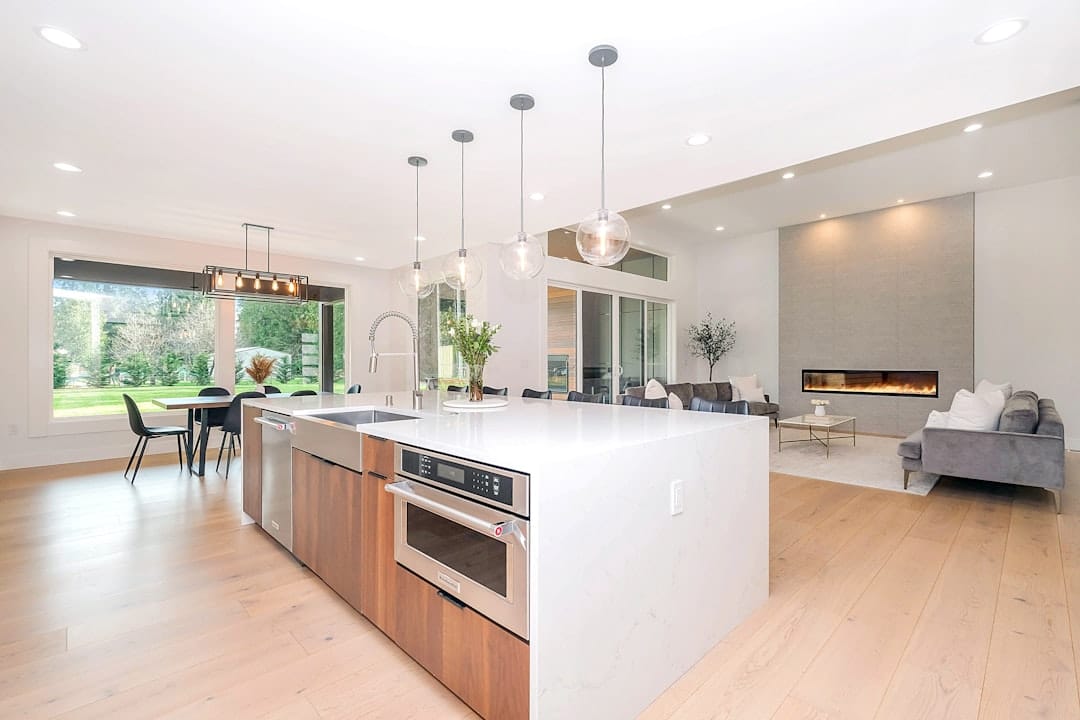
This is the gotcha that sinks well-meaning owners. The market sets the rent, not the finish. Drop $30,000 of quartz, stainless, and custom cabinetry into a duplex in a neighborhood where comparable units rent for $1,900, and you will not rent it for $2,600. The comp ceiling holds. You've built a beautiful unit that returns the same rent as the dated one next door — and you've tied up capital that could have gone toward two or three genuine rent-movers across your portfolio. A renovation should do at least one of three things: raise the rent, cut the vacancy, or prevent a future cost. If a project does none of those, it's spending dressed up as investing.
Over-improvement has a quieter cousin: spending on finishes while ignoring the systems tenants actually rely on. Granite counters over a 20-year-old AC, a new backsplash above plumbing that's on borrowed time. Tenants notice the system that fails far more than the surface that sparkles, and deferred core maintenance doesn't just fail to raise rent — it generates the emergency calls and turnover that erode it.
How should I decide what to renovate before relisting?
Decide by working backward from the comp ceiling. Pull what comparable units in your submarket actually rent for, find the gap between that number and your current rent, then spend only on the rent-movers that close the gap and clear their cost inside the payback window. Anything past the ceiling is resale spending, not rent spending.
A practical sequence we use on our own managed turns:
- Set the target rent first. Find three to five honest comparables in the same submarket, same bed/bath count, and let them define the ceiling. Your renovation budget answers to that number.
- Fix the systems that fail. AC, plumbing, roof, electrical. These don't raise rent, but their failure destroys it. Habitability comes before finishes.
- Buy the dependable rent-movers, in order. LVP over carpet in living areas, in-unit laundry if the unit lacks it, then a light kitchen refresh — each checked against the comp ceiling and the twelve-to-twenty-four-month payback window.
- Paint and clean, every time. The cheapest vacancy insurance there is.
- Stop at the ceiling. When the next dollar would push rent above the comps, that dollar is a resale-mover. Save it or spend it on another unit.
If you want the broader framework — how renovation budgets fit alongside taxes, financing, and the rest of the numbers that decide whether a Florida rental actually performs — our owner's guide pulls the financial pieces together in one place.
The discipline is simple to state and hard to follow: name the upgrade, name the rent delta, name the months to recoup, and check it against what the neighborhood actually pays. Do that, and you'll spend less, raise rent more, and stop funding renovations that look like progress on the way to the bank but show up as zero on the rent roll.