
Florida Rent Control: Why Cities Can't Cap Your Rent
Florida is one of the most landlord-friendly states on rent. State law stops cities and counties from capping it — and in 2023 the last exception was sealed shut. Here's what that means for your property.

A first-time investor in Tampa asks it. An accidental landlord in Winter Park asks it at midnight after reading a scary headline. So does the out-of-state owner deciding whether Florida is a safe place to put another $300,000: can a city council or county commission cap my rent?
No. They can't.
Florida is one of the most landlord-friendly states in the country on this exact question, and it isn't an accident. State law flat-out blocks cities and counties from imposing rent control. There used to be one narrow escape hatch — a housing-emergency exception almost nobody could ever use. In 2023, the state welded it shut. Here's the law, the one real-world attempt that crashed against it, and what "no rent control" actually means for the way you price your property.
Is rent control legal in Florida?
No. Florida has no statewide rent control, and state law bars local governments from creating their own. Two statutes do the work: Florida Statute 166.043 covers cities, and Florida Statute 125.0103 covers counties. Both say a local government "may not adopt or maintain in effect any law, ordinance, rule, or other measure that would have the effect of imposing controls on rents."
That's the whole ballgame for rent control in Florida. The ban dates back to 1977, when the Legislature decided that capping rents would choke off the supply of rental housing rather than fix affordability. Almost fifty years later, that judgment still stands — and it got stronger.
So when you renew a lease or raise rent on a month-to-month tenant, no Orlando ordinance or Hillsborough County rule sets a ceiling on the number. The number is yours to set, as long as you follow the notice and fair-housing rules that do apply. More on those below, because "no cap" and "no rules" are not the same thing.
Can a Florida city or county cap your rent?
Generally, no. The legal term is preemption — the state has taken this subject for itself and forbidden local governments from legislating on it. A city or county can't pass rent control, a rent freeze, or a rent-stabilization ordinance, because the state already occupied the field and slammed the door.
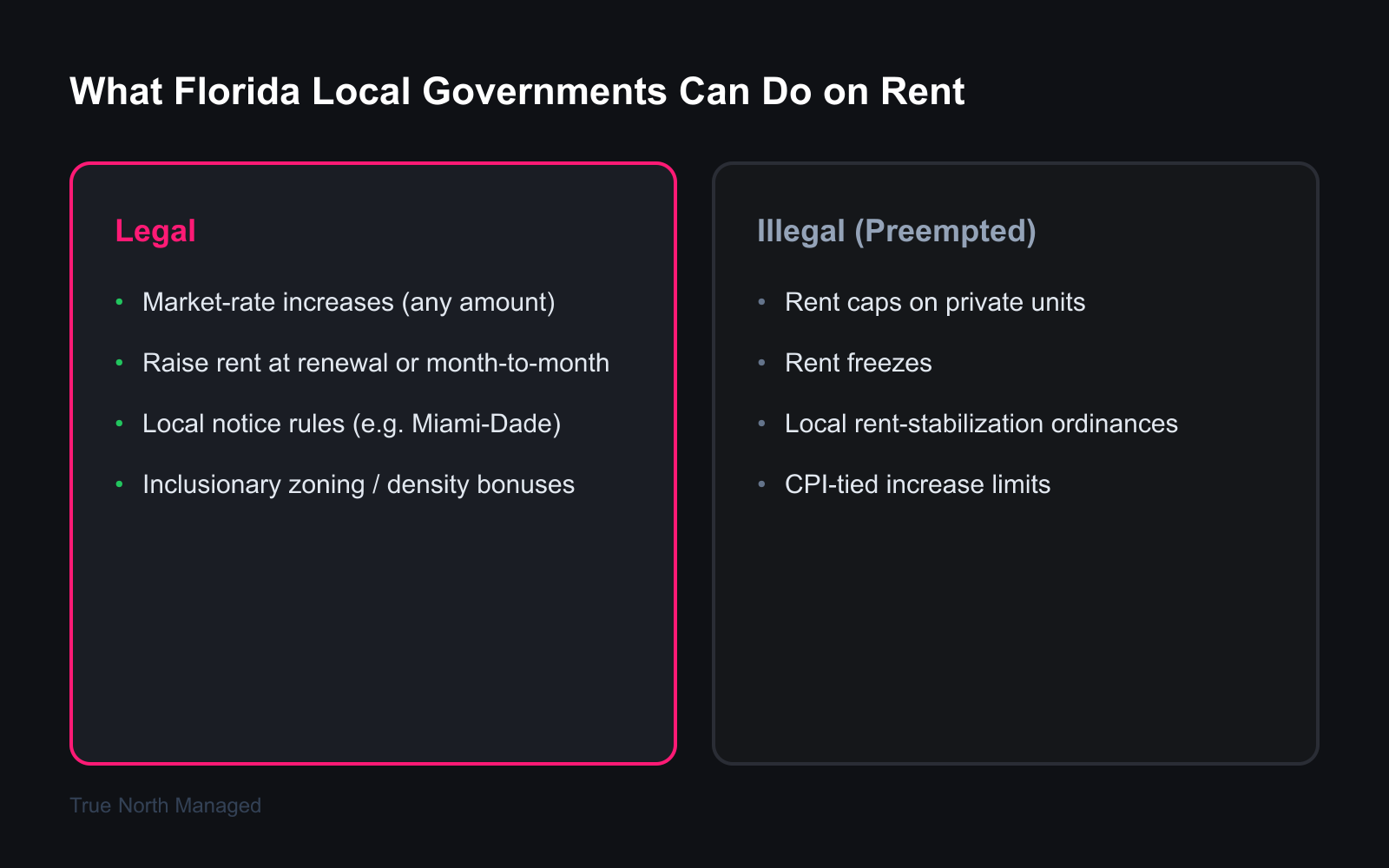
Here's the plain-English version: even if your county commission wanted to cap rent increases at, say, three percent a year, it has no legal authority to do it. The state took that power off the table.
There's one thing local governments can still do on housing, and it's worth not confusing with rent control. Under subsection (3) of both statutes, they "may adopt and maintain in effect any law, ordinance, rule, or other measure which is adopted for the purposes of increasing the supply of affordable housing using land use mechanisms such as inclusionary housing ordinances." Those touch what gets built and where. They don't cap what you charge an existing tenant. The line is supply versus price, and only the supply side is open to local action.
Wasn't there a rent-control loophole in Florida?
There was — until July 1, 2023. The old version of the statutes carried a housing-emergency exception that let a local government impose temporary rent control, but only if it cleared a stack of conditions that made the exception nearly impossible to use in practice.
Under the pre-2023 rule, a city or county had to:
- Hold a public hearing and formally adopt the measure
- Make findings of "a housing emergency so grave as to constitute a serious menace to the general public," and that controls were "necessary and proper" to end it
- Win approval from the voters at the ballot box
- Accept a one-year sunset — the controls expired within 12 months and couldn't be extended without starting the whole process over
- Exempt seasonal and tourist units, second homes, and luxury apartments
Read that list again. You had to prove a near-catastrophe, survive a public vote, and watch the whole thing self-destruct in a year. It was a legal exception that functioned more like a dare.
Then the 2023 Live Local Act (SB 102) took the dare away. Signed in March 2023 and effective July 1, 2023, it stripped the housing-emergency exception out of the statutes. The result: a flat, no-exceptions ban on local rent control. And while most of the Live Local Act's provisions are set to sunset in 2033, the rent-control ban is permanent. There's no longer an emergency path, a referendum path, or any path at all for a Florida city or county to cap your rent.
What happened when Orange County tried rent control?
Orange County is the cautionary tale, and the timing is almost cinematic. In 2022 — before the Live Local Act closed the exception — the county tried the emergency route, and it still failed.
Here's how it played out. In August 2022, the Orange County Board of County Commissioners put a rent-stabilization charter amendment on the November ballot. It would have capped annual rent increases on non-exempt units at the rate of inflation — roughly 9.8 percent at the time — covering about 104,000 rental units. Single-family homes, duplexes, luxury units, and newer buildings were carved out.
The Florida Association of Realtors and the Florida Apartment Association sued before a single vote was counted. Their argument: the county never proved an actual housing emergency, and the ballot language was misleading. The trial court let the measure stay on the ballot. Then Florida's Fifth District Court of Appeal stepped in and ruled 2-1 that the ordinance was unconstitutional and the ballot summary was misleading — the challengers had a "substantial likelihood of success on the merits."
The vote happened anyway. About 59 percent of Orange County voters said yes. It didn't matter. The court ruling blocked the county from certifying or enforcing the result. The county appealed, and in April 2023 the Florida Supreme Court declined to hear the case, leaving the lower ruling in place. The ordinance never took effect. Not for a day.
Three months later, the Live Local Act removed the emergency exception entirely. So the path Orange County tried to walk no longer exists for any county or city in Florida. If you own in Orlando, Kissimmee, Tampa, or anywhere else in the state, that's the bottom line: the one local mechanism that could have capped your rent is gone.
No rent cap doesn't mean no rules — so what still applies?
No cap is not a blank check. You can raise rent by any amount at renewal or when a month-to-month term advances, but you still have to give proper written notice, and you can't raise rent for an illegal reason. On a fixed-term lease the rent cannot change mid-term at all unless the lease itself says so, and at the end of the term it is your lease that decides whether non-renewal notice is owed at all — though where it does require it, Florida Statute 83.575(1) caps that period at no less than 30 and no more than 60 days. Florida controls the how and the why of an increase, just not the how much.
What still shapes the increase:
Notice. Florida's residential landlord-tenant law, Part II of chapter 83, has no provision requiring notice of a rent increase as such. What it has is Florida Statute 83.57, Termination of tenancy without specific term, and that is the machinery an increase runs on: a rent change on a month-to-month tenancy rides on that same notice — at least 30 days' written notice before the end of a monthly period, stating the new rate from the next period. A tenant who stays and pays it has generally accepted the new term. The 30 days is real — it just comes from the termination statute. Get the timing or the delivery wrong and the increase can be unenforceable, no matter how legal the amount is. Our guide to Florida rent increase notices walks through the timing, delivery methods, and sample wording.
No retaliation or discrimination. You can't raise rent to punish a tenant for requesting a repair or filing a complaint, and you can't target a protected class. The amount isn't capped, but the motive can sink you.
A notice ordinance is not a rent cap — but since 2023 it may not be enforceable either. This trips people up. Miami-Dade County adopted a 60-day notice requirement for rent increases over five percent in 2022. That's a notice rule, not a cap — it tells you when to send the letter, not how big the number can be. But the 2023 preemption statute, Florida Statute 83.425, supersedes local regulation of everything covered by the Residential Landlord and Tenant Act "including, but not limited to … notice requirements" — the same session law that set the 30-day period above. So a local notice ordinance and a local rent cap fail for different reasons: the cap was never permitted, while the notice rule was lawful when it was adopted and now sits squarely inside what 83.425 preempts. That is a live question, not a settled one, so if you own in Miami-Dade get advice before you rely on either reading. While we're on what's capped and what isn't, our breakdown of Florida late fee limits covers another spot where landlords assume more freedom than the law allows.
Why does Florida ban rent control in the first place?
Florida bans local rent control because the Legislature concluded it backfires — a price ceiling on rent tends to shrink the supply of rental housing instead of making it more affordable. When landlords can't charge a market rate, some sell, some stop investing in upkeep, and fewer new units get built. The cap meant to help renters ends up squeezing them.
This isn't just a political talking point. The most-cited study on the question, by Stanford economists Diamond, McQuade, and Qian, tracked San Francisco from 1990 to 2016 and found that rent control cut the supply of rental housing by about 15 percent and pushed citywide rents up 5.1 percent — the opposite of the intended effect. Florida's 1977 ban was built on exactly that logic, and the 2023 reinforcement doubled down on it.
For you as an owner, the takeaway is simple. Florida has decided, as a matter of state policy, that the rent you can charge stays a market decision. That's the structural reason the state keeps showing up on "most landlord-friendly" lists — and a big part of why out-of-state investors keep buying here.
What does Florida's rent-control ban mean for your property?
It means predictability. You can underwrite a Florida rental knowing no future local ordinance can freeze your rent or cap your increases. For an out-of-state owner running the numbers from New York or Chicago, that removes a whole category of political risk that exists in California, Oregon, and parts of the Northeast.
It also means the responsibility for pricing is yours. There's no cap forcing restraint, which is freedom and a trap at once. The smart move isn't to max out every renewal — it's to price to the market. A good tenant paying slightly under top-of-market beats a vacancy and a turnover every time. Set the number where the comps support it, give proper notice, and keep the people who pay on time and treat the place well.
For the local owner-landlord with one property, the message is the same with less drama: you're free to raise rent to market, you just have to do it the right way and for the right reasons.
Common rent control mistakes Florida landlords make
A few misreadings come up again and again:
Assuming "no cap" means "no rules." It doesn't. On a month-to-month tenancy, the increase rides on the written notice Florida Statute 83.57 requires to end the tenancy — "not less than 30 days' notice prior to the end of any monthly period" (83.57(3)) — so skip it or get the timing wrong and the increase can be unenforceable. On a fixed-term lease, follow the lease. The amount is free; the process isn't.
Believing the old emergency exception still exists. Plenty of articles online — some written after 2023 — still describe Florida's housing-emergency rent-control path as if it's live. It was removed July 1, 2023. There is no usable exception anymore.
Confusing a notice ordinance with rent control. Miami-Dade's 60-day rule and a rent cap are different animals: a notice rule tells you when to mail the letter, a rent cap tells you how big the number can be. That distinction is real and worth keeping — but do not read it as meaning the notice rule still binds you. See above on what the 2023 preemption statute did to local notice requirements. Read past the headline before you panic that your county capped your rent.
Frequently asked questions about Florida rent control
Is there rent control in Florida? No. Florida has no statewide rent control, and state law prohibits cities and counties from creating any. Florida Statutes 166.043 and 125.0103 bar local rent control measures across the state.
Can a Florida city pass rent control during a housing crisis? No. A housing-emergency exception used to exist, but the 2023 Live Local Act removed it effective July 1, 2023. There is no longer any emergency or referendum path for a Florida city or county to cap rent.
How much can a landlord raise rent in Florida? By any amount. There's no cap on the size of a Florida rent increase. Chapter 83 has no separate rent-increase-notice provision. On a month-to-month tenancy the increase rides on the notice Florida Statute 83.57 requires to end that tenancy — at least 30 days' written notice before the end of a monthly period, stating the new rate. On a fixed-term lease your lease decides whether non-renewal notice is owed, within the 30-to-60-day bounds Florida Statute 83.575(1) sets. And you can't raise rent in retaliation or in a discriminatory way.
Did the Live Local Act ban rent control permanently? Yes. The Live Local Act's rent-control ban is permanent, even though most of the law's other provisions are scheduled to sunset in 2033.
What happened to Orange County's rent control vote? Orange County voters approved a rent-stabilization measure in November 2022, but courts blocked it — the Fifth District Court of Appeal found it unconstitutional, and the Florida Supreme Court declined to hear the appeal in April 2023. The ordinance never took effect.
Pricing to a market with no cap
Florida won't cap your rent — which means the number you choose is the whole game. Set it too high and you trade a good tenant for a vacancy. Set it too low and you leave money on the table every month. The right rent is the one the comps actually support, delivered with proper notice to a tenant worth keeping.
That's where a free rental analysis earns its keep. We pull real comps for your Orlando or Tampa property, tell you what it should rent for today, and help you set an increase that holds the tenant and the income. No cap means the pricing decision is yours — let's make sure it's the right one.
For more on the law behind every move you make as a Florida landlord, start with our Florida owner's guide.