
Landlord Insurance in Florida: What Property Owners Need
What Florida landlord insurance actually covers, what it doesn't, and the coverage gaps that catch property owners off guard.
Florida doesn't require landlord insurance. Your lender probably does.
If you own a rental in Orlando, you've likely heard that landlord insurance is "recommended." Here's the reality: Florida law doesn't mandate it. But if you have a mortgage, your lender almost certainly does — and even if you own outright, going without it's a gamble you probably don't want to take. Hurricanes, sinkholes, water damage, and liability claims are part of the deal in Central Florida. The right policy protects your property, your income, and your assets.
Here's what Orlando landlords need to know about landlord insurance — what it covers, what it doesn't, and how to avoid the gaps that leave rental owners exposed.
Landlord Insurance vs. Homeowners: Why the Right Policy Matters
Your homeowners policy is built for the house you live in. Landlord insurance — often called a dwelling fire policy or rental dwelling policy — is built for the house you rent out. They're not interchangeable.
Homeowners policies cover your dwelling, personal property, liability, and additional living expenses. They're underwritten for owner-occupied homes. If you rent out the property and file a claim, insurers can deny it. The policy wasn't designed for tenant occupancy, and the pricing doesn't account for that risk.
Landlord policies focus on the structure, liability for injuries on the property, and loss of rental income when the unit becomes uninhabitable. They typically cost 20–30% more than homeowners for similar rebuild values — but they're the only appropriate coverage for a rental. Using a homeowners policy on a tenant-occupied property is a coverage gap waiting to bite you.
DP-1, DP-2, and DP-3: The Three Dwelling Policy Tiers
Landlord insurance usually comes in one of three dwelling policy forms. The difference is what's covered and how you're paid.
DP-1 (Basic Form). Named perils only — fire, lightning, windstorm, hail, smoke, and a few others. Pays out on actual cash value (depreciated), so you cover the difference between what you get and what repairs actually cost. It's the cheapest option. For an older Orlando rental where you're okay with minimal coverage, it might work. For most landlords, it's too thin. See our windstorm insurance for landlords for more.
DP-2 (Broad Form). Covers 18 named perils — everything in DP-1 plus freezing pipes, falling objects, water damage, electrical damage, and collapse. Pays replacement cost instead of ACV. Mid-range price. A solid step up from DP-1.
DP-3 (Special Form). Open perils — it covers everything except what's explicitly excluded (flood, earthquake, wear and tear, mold from neglect). Pays replacement cost. It's the most complete protection and what most Orlando landlords should aim for. Yes, it costs more. But when a pipe bursts at 2 a.m. or a storm tears off part of the roof, you want DP-3. See our flood insurance for Florida rentals for more.
What Landlord Insurance Actually Covers
A solid landlord policy gives you three core coverages:
Property damage. Repairs to the structure from covered perils — fire, lightning, wind, hail, vandalism, burst pipes, and more. DP-3 covers "all risk" except exclusions. The dwelling limit should match your replacement cost, not your purchase price. Construction costs in Florida have risen; underinsuring leaves you short when you need to rebuild.
Liability. Medical and legal costs if someone is injured on your property — a tenant, a guest, a delivery person. Standard recommendations for Florida landlords run $300,000–$500,000 in underlying liability. Many agents suggest $1 million as a baseline. A single serious injury or wrongful-death claim can exceed that fast. Umbrella policies add another $1–5 million on top and typically cost $250–$550 per year for $1 million. If you hold property in your name, an umbrella is worth serious consideration.
Loss of rent. When a covered loss makes the unit uninhabitable, loss of rent coverage reimburses you for the income you'd have collected. Most policies provide 20–25% of your dwelling limit. For a $300,000 dwelling policy, that's $60,000–$75,000 in potential rent replacement — usually enough for 6–12 months depending on your rent. It doesn't cover eviction, tenant abandonment, or lease violations. It only kicks in when the damage is from a covered peril and the unit is legitimately uninhabitable.
What It Doesn't Cover (And What You Need to Add)
Landlord insurance has gaps. In Florida, several of them matter a lot.
Flood. Standard policies exclude flood. If your property is in a FEMA Special Flood Hazard Area and you have a federally backed mortgage, flood insurance is required. Citizens Property Insurance — Florida's insurer of last resort — now requires flood coverage for dwelling replacement costs of $600,000 or more (dropping to $400,000 by 2026). Even if you're not in a high-risk zone, Orlando sees heavy rain and localized flooding. Private flood policies can include loss-of-rent coverage; the federal NFIP typically doesn't. Check your zone and your lender's requirements.
Sinkhole loss. Orlando sits in one of the nation's most active sinkhole zones. Florida law distinguishes between "catastrophic ground cover collapse" (sudden, dramatic, usually covered under standard policies) and "sinkhole loss" (gradual damage — foundation cracks, stuck doors, uneven floors). Sinkhole loss coverage is optional and must be added as an endorsement. Florida Statute 627.706 requires insurers to offer it. If you're buying or own a rental in Central Florida, get a quote for sinkhole coverage. The geology here makes it relevant.
Wind and hurricane deductibles. Florida uses percentage-based "named storm" deductibles — typically 2%, 5%, or 10% of your dwelling limit. On a $300,000 policy with a 5% deductible, you pay $15,000 out of pocket before coverage kicks in. That's separate from your standard all-peril deductible. One silver lining: you only pay one hurricane deductible per calendar year per insurer, even if multiple storms hit. Still, budget for that out-of-pocket hit. Impact windows, hurricane straps, and a newer roof can sometimes reduce your premium or deductible options.
Water damage and mold. Sudden, accidental water damage — burst pipes, appliance overflows — is usually covered. Gradual leaks, deferred maintenance, and mold from neglect typically aren't. Many Florida policies cap mold coverage at around $10,000. Document maintenance, fix leaks promptly, and require tenants to report issues quickly. Your landlord responsibilities under Florida law include maintaining habitability; letting problems fester can void coverage.
Vacancy. Standard landlord policies often limit or exclude coverage if the property sits empty 30–60 days. If you're between tenants, renovating, or waiting to sell, you may need vacant property insurance. It costs more — often 10–20% above standard rates — but an unoccupied Orlando rental is a target for vandalism, undetected leaks, and mold. Don't assume your policy covers a vacant unit.
What a Typical Orlando Policy Costs
Orlando landlord insurance runs $1,000–$3,000 per year on average — lower than coastal Florida because we're inland and face less hurricane and flood exposure. Statewide, the average is closer to $2,288��$2,800. Miami and other coastal areas can hit $10,000+.
Annual Premium Breakdown
For a typical Orlando single-family home with $300,000 in dwelling coverage, here's how the annual premium often breaks down:
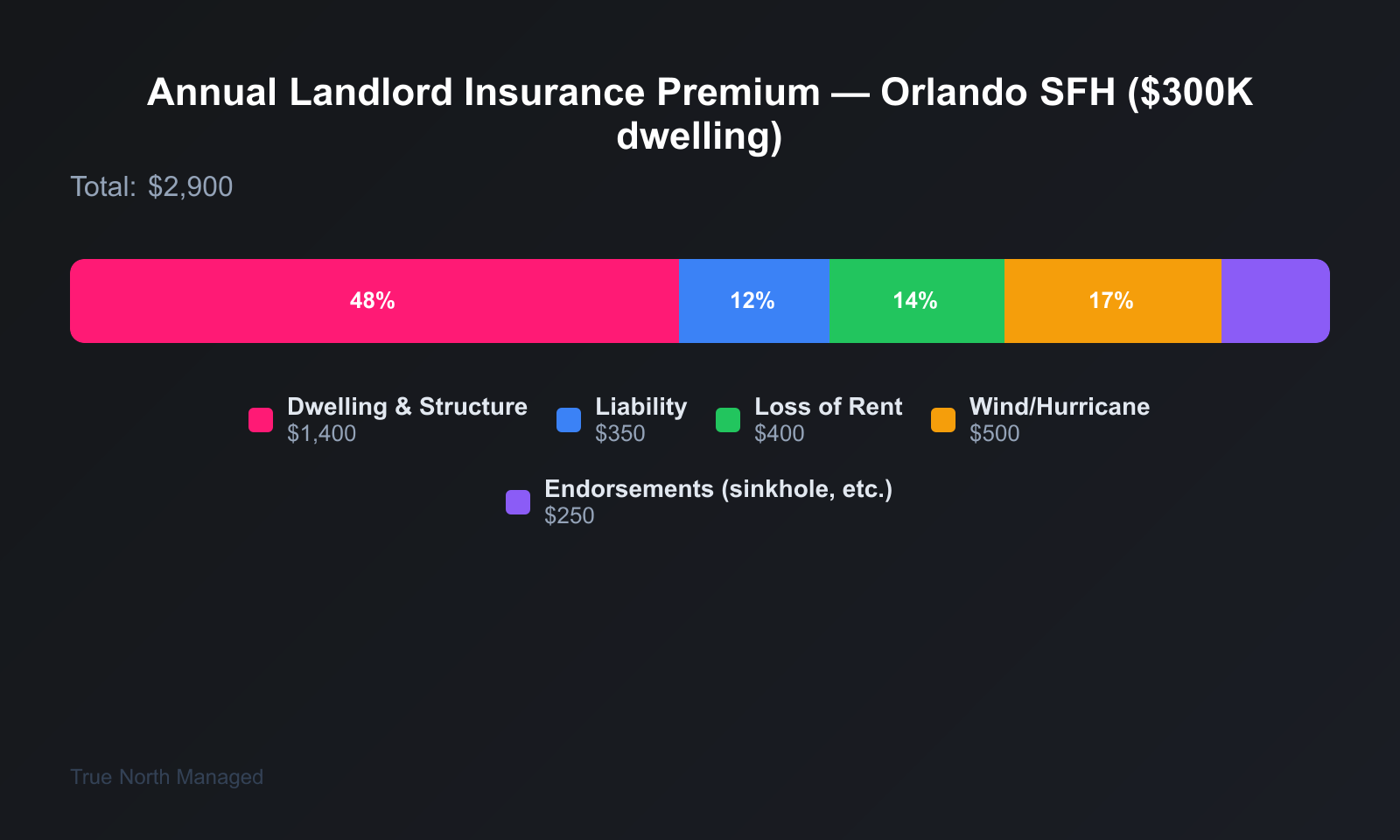
- Dwelling and structure: The bulk of the premium — replacement cost for the building
- Liability: Usually bundled; $300K–$1M limits
- Loss of rent: Often 20–25% of dwelling limit
- Wind/hurricane: Reflected in the premium and deductible structure
- Optional add-ons: Sinkhole, ordinance or law, water backup
Older homes (15+ years) often face higher rates or inspection requirements. Storm-resistant upgrades — impact windows, reinforced doors, hurricane straps — can qualify you for discounts. Insurers are increasingly asking for maintenance records on roofs, plumbing, and electrical. Having that documentation ready can smooth the process.
Ordinance or Law Coverage: Why It Matters in Florida
Florida has strict building codes, updated every three years. If damage exceeds 50% of your building's value, you may have to bring the entire structure — including undamaged portions — into compliance with current codes. Standard insurance pays to repair the damage. It doesn't automatically pay for the extra cost of code upgrades.
Ordinance or law coverage pays for that gap: demolition of undamaged portions when codes require it, and increased construction costs to meet current standards. Florida insurers must offer it; many policies include it at 25% of the dwelling limit unless you refuse in writing. For homes built before 2010 — especially pre-1992 or pre-2000 — this coverage is worth keeping. Without it, a partial loss could force you to pay tens of thousands out of pocket to rebuild to code.
Pets, Liability, and Coverage Gaps
If you allow pets — and many Orlando landlords do — tenant dog bites can create liability. Landlords can be held liable if they had actual knowledge a dog was dangerous and had the power to remove it. Standard landlord policies often don't include specific pet liability. Require tenants to carry renters insurance with adequate liability limits, and consider asking to be listed as an additional insured on their policy. Your pet policy should spell out breed restrictions and requirements; that reduces risk and supports your defense if something happens.
How to Compare Quotes
Get at least three quotes. Rates vary by carrier, property age, location, and coverage choices. Compare:
- Dwelling limit — Does it match your replacement cost?
- Deductibles — Standard and hurricane/named storm
- Loss of rent — Amount and duration
- Liability limits — $300K minimum for umbrella eligibility; $1M is common
- Exclusions — Flood, sinkhole, mold, vacancy
- Optional endorsements — Sinkhole, ordinance or law, water backup
Companies that write landlord policies in Florida include Olympus Insurance, American Integrity, and regional carriers. If you can't find coverage in the standard market, Citizens offers dwelling fire policies for tenant-occupied homes — though they don't cover short-term rentals (more than three rentals per year under 30 days). Work with an agent who specializes in investment property. They'll know which carriers are writing in Orlando and what documentation you need.
The Bottom Line
Landlord insurance isn't optional in practice — lenders require it, and going without it exposes you to catastrophic loss. Orlando's inland location keeps premiums lower than the coast, but you still need the right policy: DP-3 for broad coverage, adequate liability, loss of rent, and add-ons for flood, sinkhole, and ordinance or law where they make sense. Review your policy annually. When you inherit a property or add a new rental, get it covered correctly from day one. And when you're comparing property management costs, remember that a good manager will help you maintain the property and document repairs — which supports your insurance position when you need to file a claim.