

Illegal Activity in My Rental: What Florida Landlords Can Do
Drug activity, prostitution, stolen property in your rental? Florida's 7-day non-curable notice lets you act fast — here's the process, step by step.
Neighbors report suspicious traffic. Unfamiliar cars sit outside at odd hours. Maybe the police have already knocked on a door. Illegal activity in your rental puts you, your property, and your other tenants at risk — and the longer it runs, the more exposure you carry. Florida gives landlords a fast, specific tool to end it. Here's how to use it.
What you must do — and by when
- Document the activity before you act — dates, what you observed, neighbor statements, police report numbers. A single rumor is not a basis to terminate.
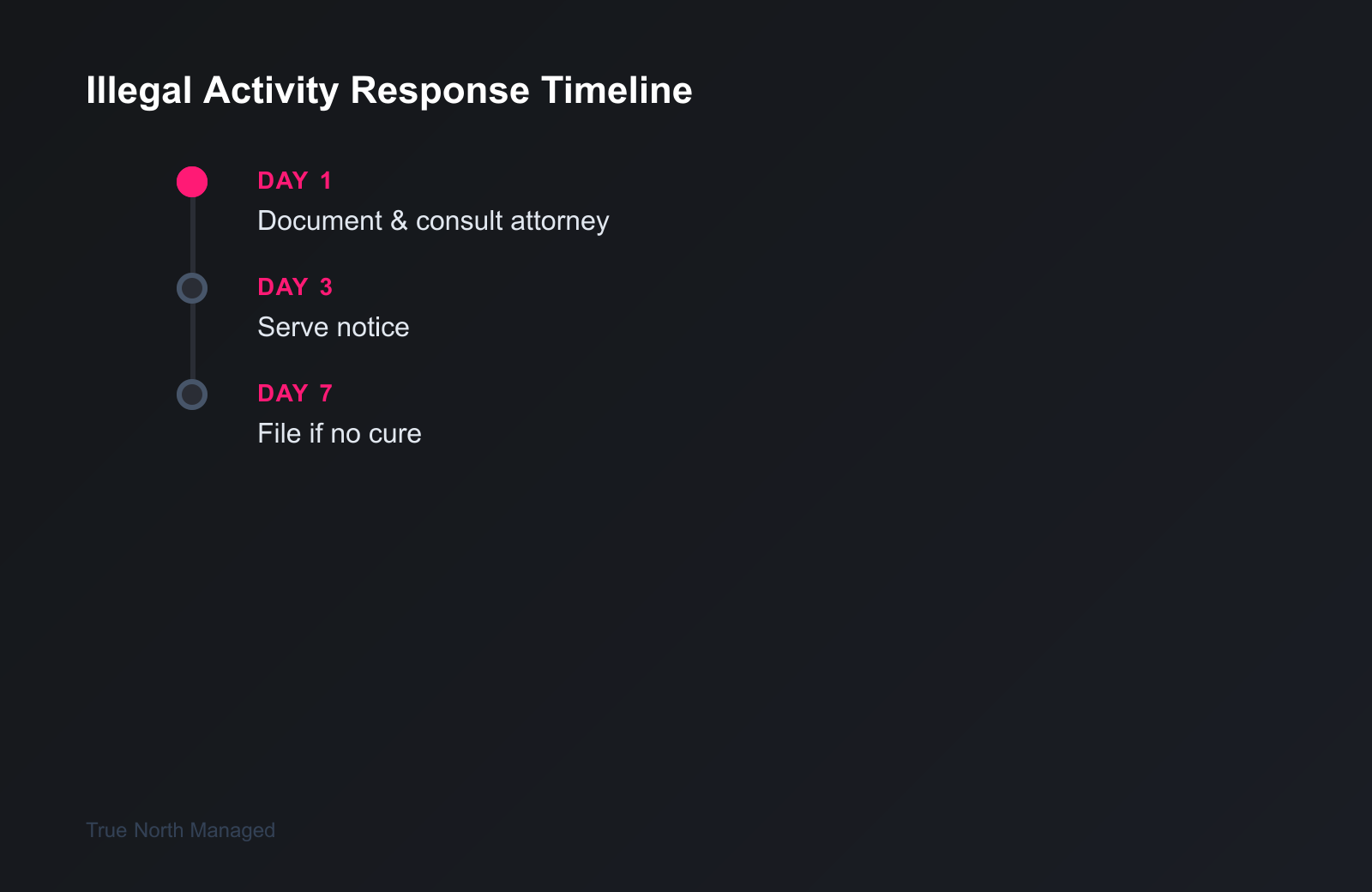
- Serve a 7-day notice to vacate under Florida Statute 83.56(2) — the non-curable version. It terminates the lease; the tenant has 7 days to leave, no cure period.
- If the tenant doesn't leave after 7 days, file an eviction action with the county court. Don't accept rent after serving the notice — it can waive your right to proceed.
- Never use self-help. No lock changes, no utility shutoffs — illegal in Florida regardless of what the tenant is doing.
What can a Florida landlord do about illegal activity in a rental?
A Florida landlord can terminate the lease with a 7-day notice to vacate under Florida Statute 83.56(2) when a tenant uses the property for illegal activity. The notice is non-curable — there's no second chance. If the tenant doesn't leave within 7 days, the landlord files an eviction action in county court.
Illegal activity is one of the few situations where Florida law lets you move fast. Nonpayment gives the tenant a chance to pay and stay. Drug activity, prostitution, or harboring stolen property does not. But "fast" still means following the statute exactly — the notice, the service method, the documentation. Skip a step and you hand the tenant a way to challenge it.
What is the 7-day non-curable notice under Florida Statute 83.56?
Florida Statute 83.56(2) allows a landlord to deliver a 7-day notice that terminates the lease without any cure period when the tenant's noncompliance can't reasonably be cured — including intentional destruction or damage, misuse of property, or a continued unreasonable disturbance. The tenant has 7 days from delivery to vacate.
The statute splits noncompliance into two kinds. A curable violation — say, an unauthorized pet — gets a 7-day notice with a chance to fix it. A non-curable violation gets a 7-day notice that simply terminates the lease. Florida Statute 83.56(2) lists these as examples of noncompliance the tenant gets no chance to cure: "destruction, damage, or misuse of the landlord's or other tenants' property by intentional act; an act of fraudulent entry of a residential dwelling unit which violates s. 817.537(2), regardless of whether criminal proceedings have commenced; or a subsequent or continued unreasonable disturbance."
Illegal activity — drug dealing, prostitution, harboring stolen goods — falls squarely in the non-curable bucket. The notice has to state that the lease is terminated, give the tenant 7 days from delivery to vacate, and cite the specific conduct. The Florida Bar publishes a model form for this. And you must have a real basis: hearsay from one neighbor isn't enough. Police reports, arrests, or code-enforcement citations are what hold the notice up.
How do you document illegal activity before you act?
Keep a dated incident log: the date and time, what was observed, and who reported it. Get written statements from neighbors who complain. Request police report numbers by calling the non-emergency line. Florida courts expect a reasonable, corroborated basis — a single neighbor's complaint, on its own, won't carry an eviction.
Your paper trail is the case. Build it like this:
- An incident log — date, time, what happened, who saw or reported it.
- Written neighbor statements — signed and dated, in their own words.
- Police documentation — incident report numbers, arrest records. Call the non-emergency line and ask for the report number.
- Code-enforcement records — any citations the city or county has issued on the property.
What not to do: don't investigate the tenant yourself, don't confront them about criminal conduct, and don't enter the unit without proper notice. Your job is the property and the tenancy — not police work. For a related situation where complaints are the trigger, see our guide on handling neighbor complaints about a tenant in Florida.
How should a landlord work with law enforcement?
Cooperate fully and ask for documentation — incident reports, arrest records, search warrants — which supports both your notice and any eviction. You aren't required to involve police, but a police report strengthens your case. Don't wait for a criminal conviction; the civil eviction runs on its own separate track.
If law enforcement is already investigating, that works in your favor — the records they generate become your evidence. Some landlords notify the local sheriff or police department before serving the notice, simply so officers are aware of the situation.
Two things to hold onto here. First, the police may have their own timeline for a criminal case — yours doesn't have to wait for it. A civil eviction for illegal use of the premises is separate from any criminal prosecution and can proceed in parallel. Second, courts tend to move faster on illegal-activity cases than on routine nonpayment, so have your documentation organized and ready for the hearing.
What are Florida's nuisance abatement rules, and why do they matter?
Florida law lets local governments declare a property a public nuisance when it's repeatedly used for drug activity, prostitution, or other illegal purposes. A nuisance designation can bring fines, remediation orders, or in extreme cases forfeiture. Terminating the tenancy quickly is how a landlord stays ahead of that.
This is the part that turns a tenant's crime into the landlord's problem. If a property generates enough police calls or documented illegal activity, the city or county can act against the property — and the owner — not just the tenant. The exposure is real: fines, mandatory remediation, and the cost and stress of a city action against your asset.
The defense is speed and a paper trail. A landlord who documents every complaint, serves the 7-day notice promptly, and moves to eviction can show the local government a clear record of acting in good faith. Act before the city gets involved, not after.
What is a landlord's liability to neighbors and other tenants?
A landlord who knows about illegal activity and does nothing can face liability to other tenants and neighbors harmed by it. The protection is prompt, documented action: serve the notice, pursue eviction, and keep records showing you moved as soon as you had credible evidence.
You have a duty to the other people connected to that property — the tenant next door, the family across the street. Knowledge plus inaction is where liability lives. If you knew and sat on it, that's exposure. If you knew and acted, your records prove it.
Keep affected neighbors informed that you're taking action — without sharing details that could compromise a police investigation. And document every step: when you learned of the activity, what evidence you had, when you served the notice. For a tenant whose conduct has escalated to threats or violence, our guide to handling a dangerous tenant in Florida covers the added safety steps.
What mistakes should landlords avoid with illegal activity cases?
The costly mistakes: taking self-help action (lock changes, utility shutoffs), acting on rumor without corroboration, accepting rent after serving the notice, and confronting the tenant directly. Each one either exposes the landlord to liability or hands the tenant grounds to fight the eviction.
- Self-help is illegal. Changing locks, removing the tenant's belongings, or shutting off utilities is unlawful in Florida no matter what the tenant has done — and it can get you sued. See what counts as an illegal self-help eviction in Florida.
- Don't act on a single rumor. One neighbor's suspicion isn't a reasonable basis. Get corroboration before you serve anything.
- Don't accept rent after serving the notice. Taking a rent payment can waive your right to proceed on that termination.
- Don't confront the tenant about criminal activity. It creates a safety risk and a liability risk. Let law enforcement handle the crime; you handle the tenancy.
- Don't guess on the statute. If you're unsure whether the conduct qualifies as non-curable noncompliance, consult an eviction attorney before serving — a defective notice delays everything.
Get help ending the tenancy
Illegal activity demands a swift, documented response. Serve the 7-day notice under Florida Statute 83.56(2), work with law enforcement, and move to eviction if the tenant doesn't leave. The full court process — once you file — usually runs two to four weeks in most Florida counties. Our walkthrough of the Florida eviction process covers the court steps in detail; the notice grounds differ for illegal activity, but the court process is the same.
If you own one rental in Orlando or Tampa and a crisis like this lands on you, you don't have to handle it alone — and you don't have to grow a portfolio to want it off your plate. A free rental analysis is a chance to walk through your situation with someone who manages these cases every week. We manage single properties too.