
Emergency Maintenance Protocol for Florida Rental Properties
The best time to handle a maintenance emergency is months before it happens. How to build the written protocol — definition, vendors, response, budget.
The best time to handle a maintenance emergency is months before it happens. A landlord with a written protocol — a clear definition, a vendor list, a response policy in the lease — turns a 2 a.m. crisis into a phone call and a dispatch. A landlord without one improvises, overpays, and ends up explaining themselves to a tenant's attorney.
What your emergency protocol must include
- A written definition of "emergency" in the lease — so tenants know what to call about and when.
- A vendor roster: two HVAC, two plumbers, an electrician, and a locksmith who take after-hours calls, with rates confirmed in writing.
- A single emergency contact number for tenants and a response policy — acknowledge within 30–60 minutes. No Florida statute sets an emergency response time, but a tenant's written notice starts the 7-day clock in Florida Statute 83.56(1) (see response times below).
- A budget line of roughly 1–2% of annual rent for emergency repairs, and a documentation habit for every call.
What is an emergency maintenance protocol, and why do you need one?
An emergency maintenance protocol is a written plan that defines what counts as an emergency, lists your on-call vendors, sets your response policy, and tells tenants how to reach you. You need one because Florida Statute 83.51 requires you to keep the unit habitable — and a protocol is how you do that consistently, under pressure, at 2 a.m.
This is the standing system. The actual 2 a.m. phone call — how to triage it in the moment — is its own subject, covered in our guide to handling after-hours maintenance emergencies. This post is about the work you do in advance so that call is manageable: the definition, the roster, the lease language, the budget.
Without a protocol, every emergency starts from zero — Googling vendors, guessing at what's urgent, hoping a tenant doesn't escalate. With one, you have a script and a phone list. The difference shows up in your repair bills and in whether a habitability dispute ever reaches a courtroom.
How do you define an emergency in the lease?
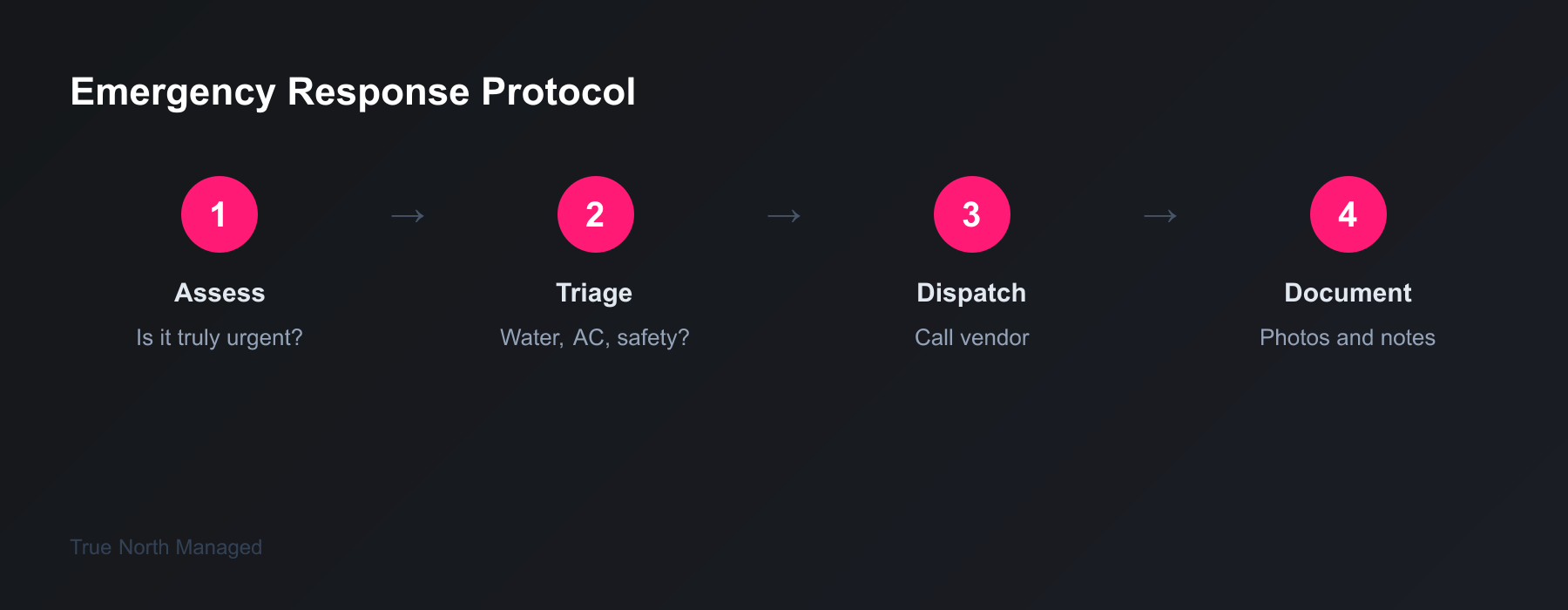
Spell it out in plain terms in the lease: an emergency is a condition that threatens health, safety, or the property and can't wait for business hours — no water, no power, a gas leak, an active leak or flood, sewage backup, a broken exterior lock, or no AC in extreme heat. Everything else is a standard request.
A written definition does two jobs. It tells a tenant when a 2 a.m. call is warranted, and it gives you a clean basis to redirect the call that isn't. Put language like this in a lease addendum:
- An emergency means no running water, no electrical power, a gas odor, an active water leak or flood, sewage backing up, a non-working exterior lock, fire or smoke damage, or no air conditioning when outdoor temperatures are extreme.
- A non-emergency — a slow drain, a dripping faucet, a broken appliance, a burned-out bulb — goes through the standard maintenance request channel during business hours.
Florida law does not legally require a landlord to provide air conditioning. But the moment AC is in your lease, keeping it working is a maintenance obligation, and a dead unit in a Florida heat wave becomes a genuine habitability problem. Our guide to the Florida landlord's AC repair obligation covers exactly when AC failure crosses into emergency territory.
How do you build the on-call vendor roster?
Build a roster of at least two HVAC vendors, two plumbers, an electrician, and a locksmith who confirm they take after-hours calls — with after-hours rates in writing. Two contacts per trade means a no-answer doesn't strand you. In Orlando and Tampa, the pool of true 24/7 contractors is short, so build it in the off-season.
The roster is the heart of the protocol. A few rules for building one that holds up:
- Two per trade, minimum. When your first HVAC company is booked solid on a 95-degree afternoon, the second number is what saves the day.
- Rates in writing. After-hours work runs a premium. Knowing the number in advance keeps a midnight invoice from becoming a fight.
- Test the line. Call a vendor at 8 p.m. before you ever have an emergency. If nobody answers, you've found a gap on your schedule, not the tenant's.
- Pay fairly and fast. A vendor you treat well prioritizes your call on a holiday weekend. One you nickel-and-dime does not.
For the full process of finding, vetting, and screening contractors, see our guide on vetting contractors for a Florida rental.
What response times should your protocol set?
No Florida statute sets an emergency response time, but there is a repair clock. Under Florida Statute 83.56(1), the tenant may terminate the rental agreement "If the landlord materially fails to comply with s. 83.51(1) or material provisions of the rental agreement within 7 days after delivery of written notice by the tenant specifying the noncompliance and indicating the intention of the tenant to terminate the rental agreement by reason thereof". Put plainly: once a tenant puts a material problem in writing and says they'll end the lease over it, you have seven days to fix it. A reasonable protocol commits to acknowledging the tenant within 30–60 minutes and dispatching a contractor within a few hours for a true emergency — so write a standard and meet it consistently.
Set the policy and put it in the lease so expectations are clear on both sides. A workable standard:
- Acknowledge within 30–60 minutes. That means you picked up and assessed — not that the repair is finished.
- Dispatch within a few hours for a genuine emergency; same-day for anything making the unit uninhabitable.
- Next business day for standard requests routed through the maintenance channel.
The number that matters here is that 7-day written-notice clock. A landlord who set a clear standard and has the timeline to show they hit it is in a strong position if a tenant ever claims neglect.
How much should you budget for emergency repairs?
Budget roughly 1–2% of annual rent for emergency and after-hours repairs. On a $2,000/month rental, that's about $240–480 a year. After-hours work costs more than daytime work, so a small reserve keeps a single midnight repair from blowing your cash flow for the month.
Track emergency spending by category — HVAC, plumbing, electrical — and by property. The patterns are useful: a unit that keeps generating plumbing emergencies is telling you it needs preventive work, and catching that early is cheaper than another 2 a.m. call. Florida's heat is hard on AC systems and the plumbing in older homes, so the budget isn't optional padding — it's a line item you will use.
What are the most common emergency protocol mistakes?
The four that cause the most damage: no defined emergency in the lease, no vendor list, no backup vendors, and no documentation habit. Each one turns a routine after-hours problem into an overpriced scramble or a habitability claim the landlord can't defend.
- No written definition. Without it, a tenant calls at midnight about a dripping faucet — and you have no clean basis to redirect them. Define "emergency" in the lease.
- No vendor list. Searching for an emergency plumber at 2 a.m. wastes the hour that matters most and usually costs the most.
- No backups. One number per trade fails the moment that contractor doesn't pick up. Two per trade is the rule.
- No documentation. If you don't log the call, the dispatch, and the completion, you have nothing to show a court that you acted reasonably.
Emergency response is one piece of a Florida landlord's larger duties. Habitability, security, timely repairs, lawful entry under Florida Statute 83.53 — they all connect. See our overview of a Florida landlord's responsibilities for how the protocol fits the bigger picture.
Get the protocol handled for you
A written protocol — the definition, the roster, the response policy, the budget — is what separates a landlord who sleeps through a tenant's crisis from one who's awake and improvising. Build it once, in calm conditions, and it works every time the phone rings.
If you own one Florida rental, building and staffing a 24/7 protocol on your own is a real ask — and you don't have to. A property management company already has the vendor network, the on-call rotation, and the documentation system in place. A free rental analysis shows you how full-service management runs the emergency protocol so you don't have to. We manage single properties too — no portfolio required.