
2026 Florida Landlord Laws: What Actually Changed (and What Didn't)
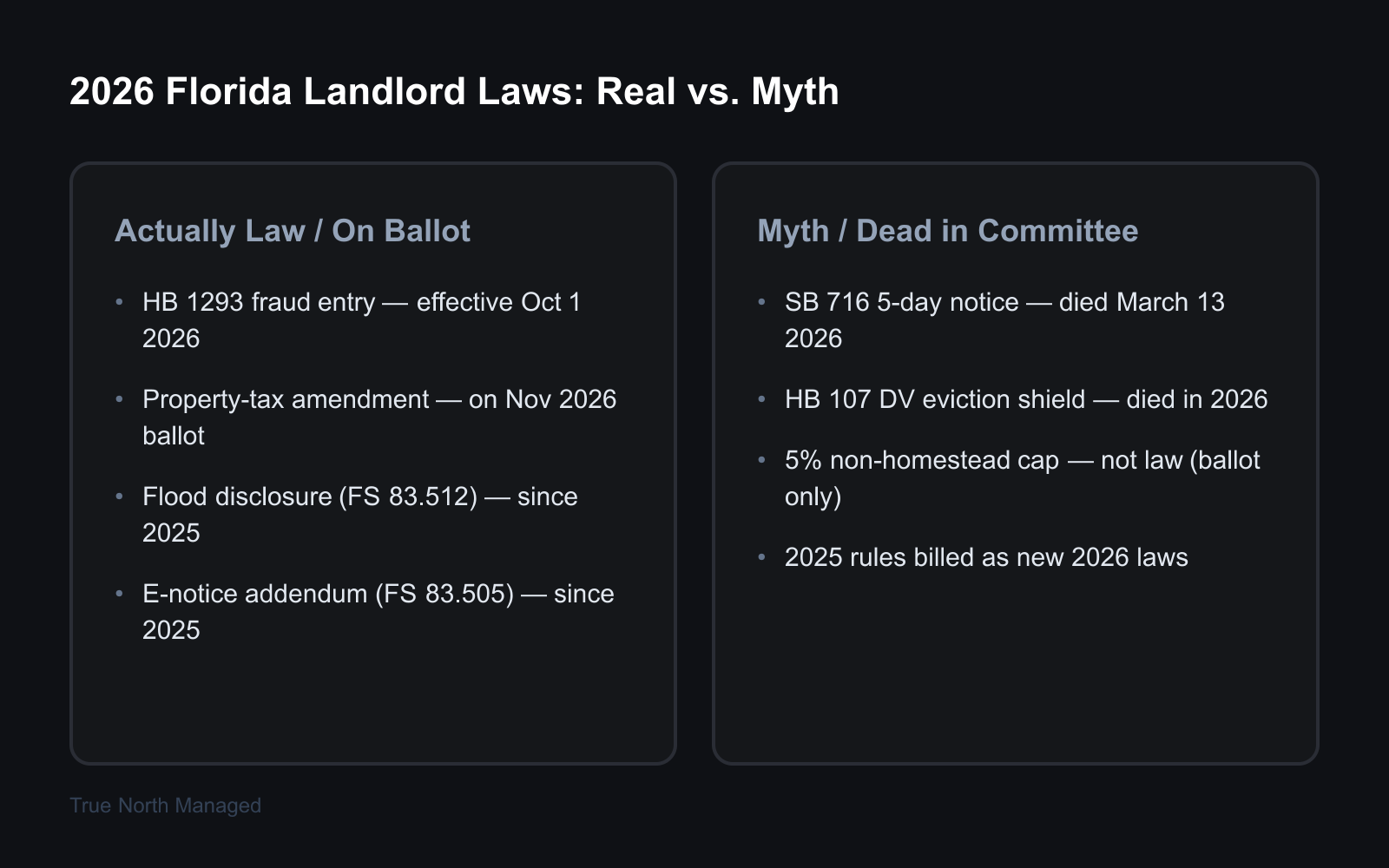
The 2026 Florida landlord laws, sorted from the myths. One bill passed, one's on the November ballot, and two big ones died — but you'd never know it from most blogs.
If you've Googled "Florida landlord laws 2026" lately, you've probably read that Florida now requires a 5-day notice before you can start an eviction for unpaid rent. A lot of property management blogs are saying it. It's wrong. That bill died in committee, and you'd be making a real mistake if you changed how you serve notices because of it.
So let's clear the air. The 2026 Florida landlord laws are simpler than the internet makes them sound — one bill actually passed, one is sitting on the November ballot, and two of the headline bills landlords were watching are dead. On top of that, half the "new 2026 laws" you'll see listed are really 2025 changes that got recycled. Here's the honest sort.
Did Florida pass a 5-day eviction notice in 2026?
No. Florida did not pass a 5-day nonpayment notice in 2026. The bill that proposed it — SB 716 — died in committee on March 13, 2026, when the legislative session ended. The 3-business-day notice under Florida Statute 83.56 is still the law. Nothing about how you serve a pay-or-quit notice changed this year.
This is the single most repeated myth in the "2026 Florida landlord laws" roundups online, so it's worth being precise. SB 716 would have stretched the nonpayment notice from three business days to five, and it would have blocked you from charging fees during that window. It never made it out of the Senate Judiciary Committee. The House version died the same day. Neither one became law.
That means your process is unchanged. You still serve a 3-business-day notice for unpaid rent, counting from the day after delivery and excluding Saturdays, Sundays, and legal holidays. If a national blog tells your remote property manager to wait five days, that's an extra two days of lost rent on a bad month — built on a bill that doesn't exist. If you own from out of state and lean on whatever a search result tells you, this is the kind of thing that quietly costs you. We track the bill's full history in our SB 716 five-day notice explainer if you want the paper trail.
What Florida landlord law actually passed in 2026?
One law passed in 2026 that affects landlords: HB 1293, the Fraudulent Entry of Residential Dwellings act. The Governor signed it June 12, 2026 as Chapter 2026-143, and it took effect October 1, 2026. It makes moving into a rental on forged documents or a fake identity a third-degree felony and gives you a faster way to remove that person.
Here's what the bill does. If someone takes possession of a dwelling by lying about their identity on a rental application, impersonating another person, or handing you forged documents, that's now a crime — a third-degree felony, punishable by up to five years in prison and a $5,000 fine. It passed the House 110-0 and the Senate 34-0, so this wasn't a close or partisan fight. You can read the full text and vote history on the Florida Senate's HB 1293 bill page.
The part that matters day-to-day: fraudulent entry counts as noncompliance the tenant cannot cure. You don't have to give them a chance to fix it. You terminate the agreement with a 7-day notice to vacate, and you're not stuck in the slower process you'd use for a normal lease violation. Think of it as a tool for the "this person isn't who they said they were" situation — the applicant who used a stolen identity to clear screening, or the occupant who moved in on documents that turned out to be forged. It does not replace the regular eviction process for ordinary nonpayment or lease breaches. It's a narrow, sharp tool for fraud.
What's the 2026 Florida property tax amendment, and is it law?
It's not law. It's a proposed constitutional amendment headed to the November 2026 ballot, and it takes effect only if at least 60% of voters approve. The Legislature placed it on the ballot June 2, 2026. For landlords, the piece to watch is the non-homestead assessment cap: if it passes, the annual cap drops from 10% to 5% on January 1, 2027.
That non-homestead cap is the landlord-relevant part because your rental properties, vacation homes, and any commercial real estate are non-homestead. Right now the assessed value on those can climb up to 10% a year. Cut that ceiling to 5% and your assessment — and the tax bill that follows it — grows more slowly over time. On a property you plan to hold, that compounds into real money. The House passed it 75-26 and the Senate 30-9 to put it on the ballot, but a legislative vote only puts a constitutional amendment in front of voters. It still needs that 60% supermajority in November. Ballotpedia's rundown of the amendment lays out every provision and the vote counts.
The same amendment also raises the homestead exemption for owner-occupants — from $25,000 to $150,000 in 2027, then $250,000 in 2028 — and adds a longer residency requirement for people who move to Florida after the end of 2026. That side is more about your own home than your rentals. The honest takeaway: don't budget around any of it yet. None of it is law until voters say so. When the amendment is decided, our Florida rental property tax guide walks through what your numbers actually look like.
Which 2026 Florida landlord bills died?
Two bills landlords and tenants were watching both died on March 13, 2026, the day the session ended. SB 716, the proposed 5-day nonpayment notice, died in the Senate Judiciary Committee. HB 107, which would have protected domestic violence survivors from eviction tied to the abuse against them, died in the Civil Justice and Claims Subcommittee. Neither is law.
SB 716 you already know about — it's the source of the 5-day myth. HB 107 is the one that gets miscounted the other way. Some "2026 law" lists call it effective this year. It isn't. The bill would have barred you from evicting or refusing to renew a tenant solely because that tenant or their minor child is a victim of domestic violence, dating violence, sexual violence, or stalking. It would have let documented survivors break a lease early without forfeiting money already paid, and required lock changes in certain situations. It's a serious topic, and similar bills tend to come back, but right now there's no such protection written into Florida statute. You can confirm the death of either bill on the Florida Senate's SB 716 bill page, which shows the committee where it stalled.
Why does this matter to you? Because acting on a law that doesn't exist cuts both ways. Hold a tenant to a 5-day window that isn't real and you slow your own eviction. Assume a protection that isn't on the books and you might mishandle a sensitive situation. Knowing what died is as useful as knowing what passed.
Which "new Florida landlord laws 2026" lists are really from 2025?
Two of the changes you'll see filed under "2026 Florida landlord laws" actually took effect in 2025: the flood disclosure requirement and the electronic notice rule. They're real and you have to follow them — they're just not new this year, and treating them as 2026 news means you might be a full year late catching up.
The flood disclosure rule (Florida Statute 83.512) took effect October 1, 2025. For any residential lease of one year or longer, you have to give the tenant a written flood disclosure before signing — whether you know of past flooding that damaged the unit, whether you've filed a flood-damage insurance claim, and whether you've received flood-damage assistance. Skip it, and a tenant who later suffers a major flood loss can terminate the lease and walk. In a state where flood risk is part of the underwriting, that's not a box to forget. The statute text is on the Florida Legislature site.
The electronic notice rule came from HB 615, which created Florida Statute 83.505 and took effect July 1, 2025. It lets you and your tenant exchange legal notices by email — but only if you both sign a written addendum using the statutory form, with valid email addresses on file. No addendum, no valid email notice. You can't just start emailing pay-or-quit notices and assume they count. We cover the addendum mechanics in our electronic notice guide for Florida landlords, and the broader set of recent changes — squatter removal, deposit alternatives, the 30-day month-to-month rule — lives in our Florida rental law changes breakdown.
What should Florida landlords do right now?
Not much has to change — and that's the point. The biggest 2026 risk isn't a new rule you missed. It's acting on a rule that doesn't exist. Here's the short list of what's worth your attention.
- Keep serving the 3-day notice. There is no 5-day nonpayment notice in Florida. Don't let a blog or a remote PM stretch your timeline based on SB 716, which is dead.
- HB 1293 has been in force since October 1, 2026. If you ever face a fraudulent-entry situation — a fake identity that cleared screening, forged move-in documents — you have a 7-day uncurable notice and a felony statute behind you, for fraud on or after October 1, 2026. HB 1293 has no retroactivity clause, so the conservative read is that an occupant who got in before then goes the ordinary route; ask your eviction attorney before you serve anything.
- Confirm your 2025 paperwork is already in place. The flood disclosure on year-plus leases and the electronic-notice addendum aren't optional, and they're not new — they've been required since 2025. If your lease template predates them, fix it before the next renewal.
- Don't budget around the property tax amendment. The 10%-to-5% non-homestead cap is a maybe, not a done deal. It needs 60% of voters in November.
A common mistake we see, especially with out-of-state owners, is treating a national "2026 landlord laws" article as gospel for Florida. Those roundups blend dead bills, pending bills, and old laws into one list, and Florida's statewide rules don't match the patchwork you'll read about other states. When in doubt, the bill's status on the Florida Senate site is the source of truth, and the Owner's Guide keeps the practical Florida picture in one place.
Keeping one rental compliant in a year of noisy headlines is its own job — sorting what passed from what merely got proposed, and updating your lease only when you actually have to. If you own a property in Orlando or Tampa and you'd rather hand that off, that's exactly what we do. Get a free rental analysis and we'll check your lease and notice process against what's actually law in 2026 — not what the internet says it is.