

First 90 Days as a Florida Landlord: The 2026 Playbook
You didn't plan to become a landlord — but here you are. This is the operational playbook for your first 90 days renting out a Florida home in 2026.

You didn't plan to be a landlord. Maybe you inherited the house. Maybe you moved for work and couldn't sell, or the offers weren't worth it. Either way, you've got a property, a tenant to find, and a stack of Florida rules you've never had a reason to read. The first 90 days are where new landlords either set themselves up or set a trap they won't notice until it springs.
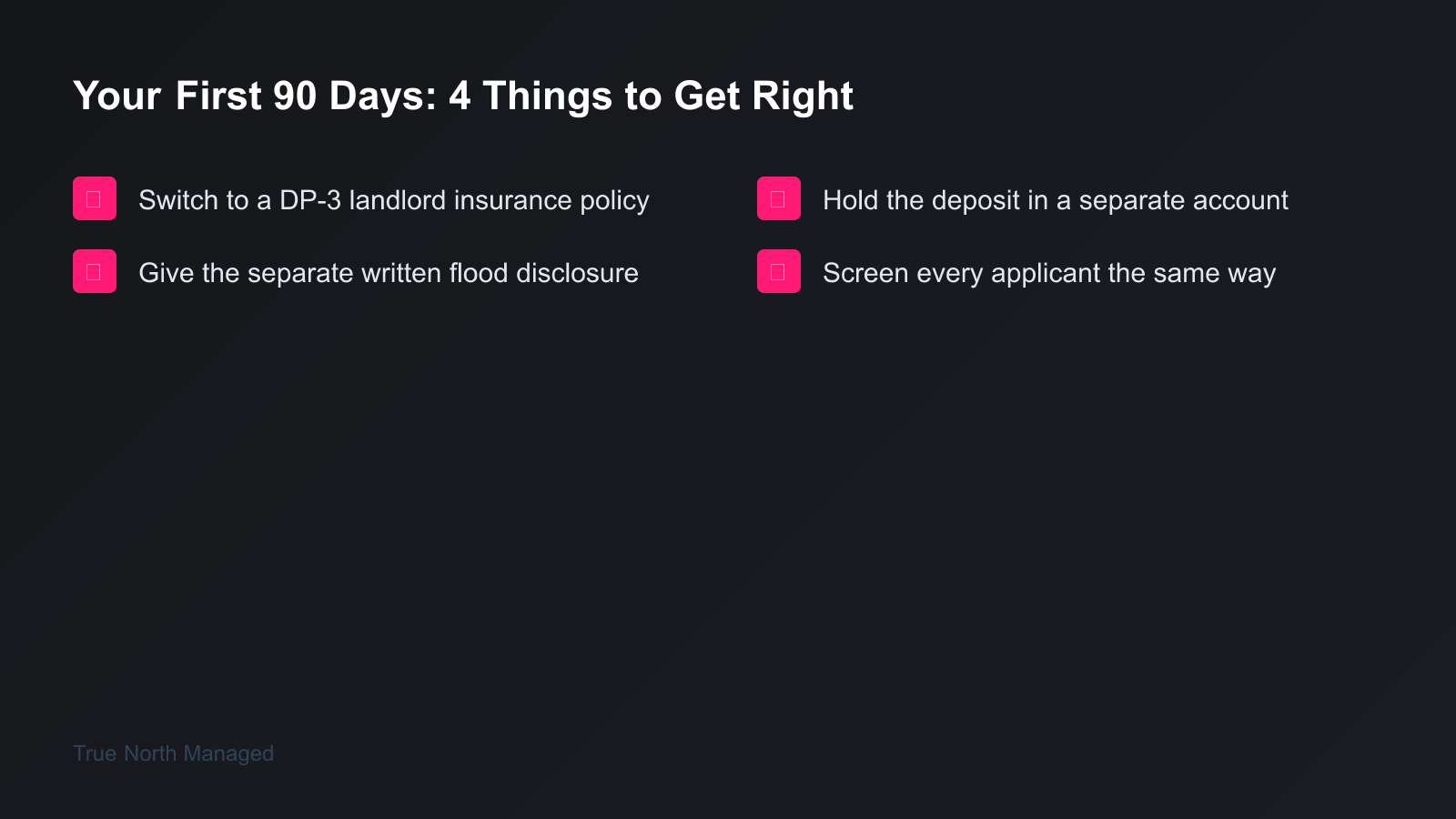
Here's the short version. Your first 90 days as a Florida landlord come down to four things done right: the correct insurance policy, a compliant lease that includes the state's new flood disclosure, a security deposit handled exactly the way the law requires, and consistent tenant screening. Miss one and it can cost you thousands. Let's take them in the order they actually matter.
What's different about becoming a landlord in 2026?
One thing changed recently, and a brand-new landlord is exactly the person most likely to miss it. Florida's flood disclosure law took effect on October 1, 2025 — it adds a required document to every lease of one year or longer. And one widely reported change never happened: SB 716, which would have lengthened the nonpayment notice, died in the Senate Judiciary Committee on March 13, 2026, so the 3-day notice still stands. Both are covered below.
This guide is written for the one-property owner — the accidental landlord — not the investor building a portfolio. If you want the quick, task-by-task version to keep on the fridge, our first-time landlord 30-day checklist is the companion to this, and our guide to your first Florida rental property covers the bigger decision of whether to rent at all. This is the playbook behind both: the why and the how.
Get the right insurance — before anything else
Call your insurance agent the day you decide to rent the house out. This is first for a reason: the gap is catastrophic and invisible until you need the policy.
Here's the problem. The homeowner's policy on your house — an HO-3, in insurance terms — is built for an owner-occupied home. The day a tenant moves in, that policy likely stops protecting you. If a claim happens and the insurer learns the home was rented, they can deny it. You'd be uncovered on what's probably your largest asset.
What you need instead is a DP-3, often just called a landlord or dwelling policy. It covers the structure, and — this part matters — it covers loss of rental income if a covered event like a fire or storm makes the home unrentable while it's repaired. One thing to watch: a base DP-3 doesn't include personal liability coverage, so add it. If a tenant or their guest is hurt and sues, liability is the coverage that stands between them and your savings.
Landlord coverage costs more than a homeowner's policy, and Florida premiums run high because of hurricane risk. It's not optional. Budget for it before you set the rent.
What does Florida's flood disclosure law require?
Since October 1, 2025, Florida law requires landlords to give every prospective tenant a separate written flood disclosure before signing a lease of one year or longer. It's found in Florida Statute 83.512, and it's new enough that plenty of landlords haven't heard of it.
The key word is separate. The disclosure can't be a paragraph buried in the lease — it has to be its own document. On it, you tell the tenant whether you know of any flooding that damaged the home during your ownership, whether you've filed a flood insurance claim (including through the National Flood Insurance Program), and whether you've received any flood-damage assistance, including from FEMA.
Skipping it has teeth. Florida Statute 83.512(2): "If a landlord violates this section and a tenant suffers a substantial loss or damage to the tenant's personal property as a result of flooding, the tenant may terminate the rental agreement by giving a written notice of termination and surrendering possession of the premises to the landlord no later than 30 days after the date of the damage or loss. Termination of a rental agreement under this section is effective upon the tenant surrendering possession of the dwelling unit. For the purpose of this section, the term 'substantial loss or damage' means the total cost of repairs to or replacement of the personal property is 50 percent or more of the personal property's market value on the date the flooding occurred." In plain terms, if a flood ruins at least half the value of their belongings and you skipped the disclosure, the tenant can give written notice and move out within 30 days of the flood, and the lease ends the day they hand back possession. And 83.512(3) adds: "A landlord shall refund the tenant all rent or other amounts paid in advance under the rental agreement for any period after the effective date of the termination of the rental agreement." That means any rent they prepaid past their move-out comes back to them. Florida Realtors has a plain-English summary if you want more background. The fix is simple: download a compliant form, fill it out honestly, and hand it over before the lease is signed.
How do you handle the security deposit legally?
This is where do-it-yourself landlords get sued, and the rules under Florida Statute 83.49 are specific.
First, where the money goes. You may not drop the deposit into your personal checking account. Florida gives you three legal options: a separate non-interest-bearing account, an interest-bearing account in a Florida bank, or a surety bond. Pick one — and keep that money separate from your own.
Second, tell the tenant. Within 30 days of receiving the deposit, give them written notice of where it's held and which method you chose. Strictly, 83.49(2) says: "This subsection does not apply to any landlord who rents fewer than five individual dwelling units." So if you rent out fewer than five units the law doesn't require this notice, but send it anyway: it costs nothing and it's the paper trail you'll want if the deposit is ever disputed.
Third, the move-out math. When the tenant leaves, you have 15 days after the rental agreement terminates to return the full deposit if you're taking no deductions. If you are deducting, you have 30 days after that termination to send an itemized written claim listing every deduction, its amount and the reason for it, "by certified mail to the tenant's last known mailing address or by e-mail in accordance with s. 83.505" — the e-mail route needs a lease addendum you both signed agreeing to e-mail notices, with each of your addresses. Miss that 30-day notice and the penalty is severe: "If the landlord fails to give the required written notice within the 30-day period, he or she forfeits the right to impose a claim upon the security deposit and may not seek a setoff against the deposit but may file an action for damages after returning the security deposit to the tenant." Miss either deadline and a court can make you pay the tenant's attorney fees on top.
Picture a landlord who held back $600 for carpet cleaning but sent the itemized letter on day 34. That landlord doesn't owe $600 back — they owe the entire deposit back, and the only way to recover the carpet cleaning is to sue for it after returning the deposit. If the tenant takes the deposit to court and wins, legal costs come on top. The deadlines are not suggestions.
How do you screen a tenant the right way?
The most expensive mistake a new landlord can make is putting a tenant in the house on a good feeling. A bad placement means missed rent, an eviction that can drag on, and a property to repair at the end — easily thousands of dollars gone.
Screening prevents most of that, and it isn't complicated. Set written criteria before you advertise: a credit threshold, verified income of roughly three times the rent, a clean rental history, and a background check. Then apply that exact standard to every applicant who applies. That consistency isn't just good practice — it's how you stay on the right side of Fair Housing law. You can't run a tougher check on one applicant than another; the criteria have to be the same for everyone.
Run the credit and background reports, call the previous landlord (not the current one — the current one may want them gone), and verify income with pay stubs or bank statements. The application fee covers the cost of the reports. Twenty minutes of screening is the cheapest insurance you'll ever buy. Our Florida tenant screening guide walks through each check in detail.
Did Florida's 3-day notice change in 2026?
One more thing to have on your radar, because you will read otherwise. If a tenant doesn't pay rent, Florida lets you serve a 3-day notice to pay or vacate — and that count excludes weekends and legal holidays. That did not change in 2026. It is still the rule today.
Senate Bill 716 would have stretched the count to five business days. It died in the Senate Judiciary Committee on March 13, 2026, and its House companion, HB 811, died the same day — so FS 83.56(3) still requires 3 days, excluding Saturdays, Sundays and legal holidays. A number of property-management blogs never updated and still present the five-day version as law. Serving that notice is how an eviction case gets thrown out and you start over. Keep an eye on our roundup of Florida rental law changes for 2026 so nothing catches you off guard.
Correction, September 6, 2026. An earlier version of this section said Florida’s 3-day pay-or-vacate notice would become a 5-day notice in July 2026. That was wrong, and it stayed on this page after the bill died. SB 716 died in the Senate Judiciary Committee on March 13, 2026 and never became law. The notice period is unchanged. For the full account of the bill and why the July 1 date kept circulating, read why the 5-day eviction notice didn’t become law. For the notice you actually serve, and how to fill it out, see the Florida 3-day notice to pay rent.
Common first-90-days mistakes
- Keeping the homeowner's policy. It's the single most dangerous shortcut. Switch to a DP-3 before the tenant moves in.
- Using a generic lease off the internet. A non-Florida lease misses state-specific terms — and won't include the required flood disclosure as a separate document.
- Parking the deposit in personal checking. Commingling the deposit violates the statute. Separate account, every time.
- Screening on instinct. "They seemed nice" is not a screening process. Written criteria, applied the same way to everyone.
You don't have to learn this the hard way
The first 90 days feel like a lot because they are — but they're also finite. Get the insurance, the lease and flood disclosure, the deposit, and the screening right, and you've built the foundation that makes everything after it routine.
If you'd rather not carry all of this yourself, that's exactly what a property manager handles day to day. Our Free Rental Analysis is a no-pressure place to start — it tells you what your home should rent for and what managing it actually involves. For the full picture, our Owner's Guide covers the rest of the Florida landlord playbook.