

Documents Every New Florida Landlord Needs Before Listing
Before your rental listing goes live, Florida law requires a specific set of disclosures. Here's the paperwork that protects you — and what happens if it's missing.

Ask a new Florida landlord what document protects them, and almost everyone says the lease. It's the thick one. It has all the rules in it. It feels like the answer.
It's not.
Here's the short version. The documents a new Florida landlord needs before listing aren't really about the lease — they're the state-mandated and federal disclosures that must travel with it: a radon notice, a lead-based paint disclosure for older homes, the new flood disclosure, a security deposit notice, and a written statement of who you are and how to reach you. Each one has to exist before your first listing photo goes live. Skip one and the lease still stands — but you've handed your future tenant an argument they can use against you.
That's the part nobody tells the accidental landlord. A disclosure isn't paperwork you do to be thorough. It's a defense you build before you ever meet the tenant. Miss it, and months later it becomes their lease-termination right, their damages claim, or your forfeited deposit. So before you call a photographer, run what we call "The Pre-Listing Paper Test": every required document, in the right form, signed and dated, before the property is advertised.
Let's go through what that test actually includes.
What disclosures does Florida actually require before you rent?
Florida and federal law together require a specific set of disclosures on most residential rentals: a radon gas notice, a lead-based paint disclosure for pre-1978 homes, a flood disclosure on leases of a year or longer, a security deposit notice, and written identification of the landlord or their agent. Each has its own form and its own deadline.
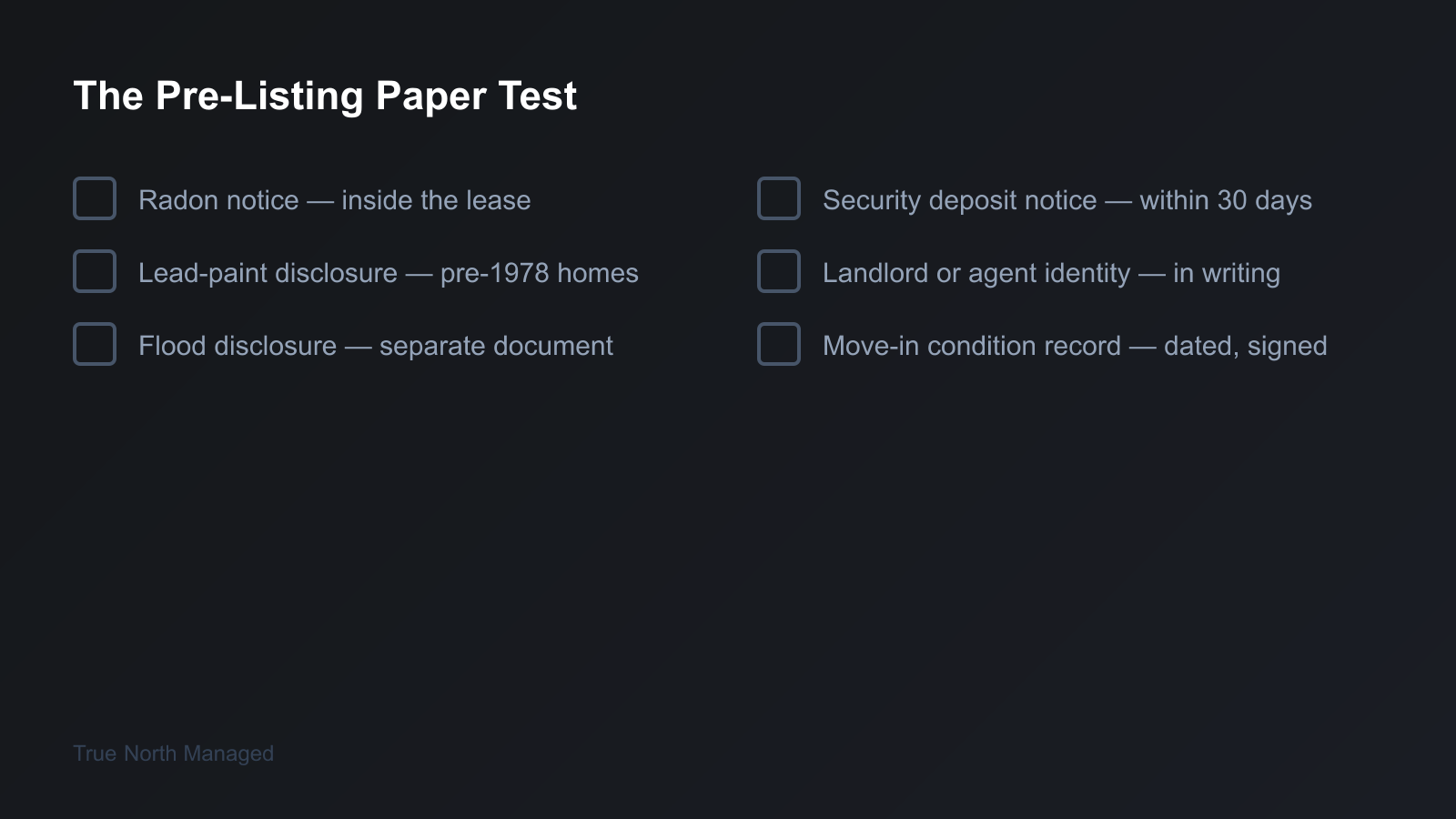
The trap is thinking of these as one thing. They're not. Some belong inside the lease. One has to be a separate document. Another is a signed addendum that comes with a government pamphlet. Get the format wrong and you can technically have the document and still not be compliant.
There's also one piece of paper Florida doesn't require but you'd be foolish to list without: a move-in condition record. We'll get to why at the end. For now, here's the test in order — radon, lead, flood, deposit, identity. Five disclosures, plus the condition record. Walk through each before the listing goes live, and you've passed.
Why does the radon disclosure have to come with every Florida lease?
Florida Statute 404.056(5) says: "Notification shall be provided on at least one document, form, or application executed at the time of, or prior to, contract for sale and purchase of any building or execution of a rental agreement for any building." In practice, the radon notice has to appear on a document signed no later than the lease, and the lease itself is the usual place for it. It uses language the state spells out word for word. The one exception is short-term transient occupancy of 45 days or less — a standard 12-month lease never qualifies, so for a normal rental, the notice is mandatory.

Radon is a radioactive gas that occurs naturally in the ground, and Florida has measured elevated levels in buildings across the state. Florida Statute 404.056 prescribes the exact wording the notice has to carry:
"RADON GAS: Radon is a naturally occurring radioactive gas that, when it has accumulated in a building in sufficient quantities, may present health risks to persons who are exposed to it over time. Levels of radon that exceed federal and state guidelines have been found in buildings in Florida. Additional information regarding radon and radon testing may be obtained from your county health department."
Here's the good news for a nervous first-timer: this is an information requirement, not a testing requirement. The radon notice does not obligate you to test the property or fix anything. You're telling the tenant the gas exists as a general risk in Florida — that's it. This disclosure can simply sit inside the lease, which is why most Florida-specific lease forms already include it. The mistake is assuming the other disclosures work the same way. They don't.
Do you need a lead-based paint disclosure for your rental?
You need a lead-based paint disclosure only if your home was built before 1978 — but if it was, the requirement is federal, strict, and expensive to ignore. It's not a Florida rule; it comes from Title X, Section 1018 of federal law, and it applies to almost all pre-1978 "target housing."
This matters a lot in Florida depending on where your property sits. Newer suburban Orlando — Lake Nona, Avalon Park, Horizon West — is overwhelmingly post-1978, so the rule often won't apply. But a large share of Tampa's housing stock is older. Older Orlando cores like College Park and parts of Winter Park are the same. Check your build year first. If it's 1978 or later, you can skip this one entirely.
If it's pre-1978, this is the disclosure landlords most often get wrong, because it isn't one document — it's three things working together:
- The pamphlet. You give the tenant the EPA booklet "Protect Your Family from Lead in Your Home." The EPA's real estate disclosure rules explain it.
- The signed disclosure form. A separate addendum where you disclose any known lead-based paint or hazards, hand over any records you have, and include a Lead Warning Statement. The tenant signs it.
- The records. Keep that signed acknowledgment for three years after the lease starts.
This is the part that catches people: lead is not the radon line. It is not a sentence you tuck into the lease. It's a separate signed addendum plus a government pamphlet, and a missing one is a real federal penalty — up to $22,263 per violation under current EPA figures, with the door open to far worse if a tenant is harmed. A first-time landlord who treats lead like radon — "it's in my lease, I'm fine" — has the cheapest possible mistake to avoid and the most expensive one to make.
What is Florida's flood disclosure, and does it apply to you?
Since October 1, 2025, Florida Statute 83.512 requires landlords to give every prospective tenant a separate written flood disclosure before signing any lease of one year or longer. The word that trips people up is separate — it cannot be a clause buried in the lease. It has to stand alone as its own document.
On the disclosure, you tell the tenant whether you know of flooding that damaged the home during your ownership, whether you've filed a flood insurance claim, and whether you've received flood-damage assistance. It's a knowledge disclosure — you're not certifying the property will never flood, only sharing what you actually know.
The remedy for skipping it has teeth. If you don't provide the disclosure and the tenant later suffers a substantial loss or damage to their personal property from flooding, they can terminate the lease by giving written notice and moving out within 30 days of the loss. We walk through the exact mechanics, the form, and the penalty in our guide to Florida's flood disclosure law — if your property is anywhere near a flood-prone area, read it before you list. For the Pre-Listing Paper Test, the takeaway is simple: this is a separate document, and it gets handed over before the lease is signed.
What document covers the security deposit?
If you're collecting a security deposit or advance rent, Florida Statute 83.49 requires a written notice telling the tenant how and where that money is being held. You can put it in the lease itself, or deliver it separately within 30 days of receiving the deposit.
That notice has to carry the statutory disclosure paragraph — the one that starts "YOUR RENTAL AGREEMENT REQUIRES PAYMENT OF CERTAIN DEPOSITS." The statute writes out the full text; your job is to include it accurately, not paraphrase it.
There's one wrinkle worth knowing. Florida exempts landlords who rent fewer than five dwelling units from that written holding-method notice. So if you own a single rental, you may not technically owe the holding-method disclosure. But don't read that as "the deposit rules don't apply to me." The move-out deadlines absolutely do, for every landlord: 15 days to return the full deposit if you're keeping nothing, or 30 days to send an itemized claim if you're deducting. The forfeiture rule is tied to the 30-day claim notice. Florida Statute 83.49(3)(a): "If the landlord fails to give the required written notice within the 30-day period, he or she forfeits the right to impose a claim upon the security deposit and may not seek a setoff against the deposit but may file an action for damages after returning the security deposit to the tenant." Put plainly: miss the 30-day window after the lease ends and the whole deposit goes back to the tenant, and any real damage becomes a separate lawsuit rather than a deduction.
And here's the document that protects those deductions — the one Florida doesn't even require. A dated, signed move-in condition record. Photos, a written inspection, the tenant's initials confirming what the place looked like the day they got the keys. Without it, you can have every deadline right and still lose a deposit dispute, because you can't prove the damage wasn't already there. Treat the move-in record as part of your pre-listing package even though no statute names it.
Who do you have to tell the tenant to contact?
Florida Statute 83.50 requires you to disclose, in writing and at or before the start of the tenancy, the name and address of the landlord — or of a person authorized to receive notices and demands on your behalf. It's a small document, and it's the one out-of-state and hands-off owners skip most.
Think about why it matters. If a tenant needs to send a legal notice — a repair demand, a notice they're withholding rent — they have to know where to send it. If you've never given them that in writing, you've created a gap, and a gap in a legal process always favors the person who didn't create it.
If you live in New York and own a rental in Orlando, this disclosure is also where you name your local property manager as the authorized contact. The tenant deals with someone reachable, and you're compliant. One short paragraph, handled before the lease is signed, closes a hole most new landlords don't know they have.
Common pre-listing document mistakes
After 20-plus years in Orlando and Tampa real estate, the same handful of paperwork mistakes show up again and again with new landlords:
- Treating lead like radon. Radon can be a single lease line. Lead is a separate signed addendum plus the EPA pamphlet plus three years of records. They are not interchangeable, and only one of them carries a five-figure federal penalty.
- Burying the flood disclosure in the lease. Florida law says separate document. A flood paragraph inside the lease doesn't satisfy 83.512.
- Skipping the deposit notice because "it's in the lease somewhere." If you collect a deposit, the holding notice and the statutory language need to be there on purpose — not assumed.
- Listing with no move-in condition record. No statute requires it, so it's the first thing a rushed landlord drops. It's also the document that decides every deposit dispute.
Notice the pattern. Every one of these is a landlord assuming the lease does a job the lease doesn't do.
Get the paper right before the photo goes up
The lease matters. But it's the disclosures around it that determine whether you're protected when something goes wrong a year from now. Radon, lead for older homes, flood, the deposit notice, the identity disclosure, and a move-in record you keep on your own — that's the Pre-Listing Paper Test, and it should be done before a single photo is taken.
If that feels like a lot to assemble for your first rental, that's a fair reaction — and it's exactly the part of the job a property manager handles before a listing ever goes live. Our Free Rental Analysis is a no-pressure place to start: it tells you what your home should rent for and what getting it listed correctly actually involves. For the wider picture, our first 90 days as a Florida landlord guide covers what comes after the paperwork, the first-time landlord 30-day checklist gives you the task-by-task version, and the Owner's Guide ties the whole Florida playbook together. One more worth a look before you list: landlord coverage is its own pre-listing document, and our Florida landlord insurance guide explains why the policy you have now probably isn't the one you need.