
Orlando Rental Market Update — February 2026
Orlando's rental market cooled in February 2026 — rents down 2.9% year-over-year. Here's what's driving it and where to find opportunity.

Orlando's rental market has shifted. After years of double-digit rent increases, you're now looking at a cooler, more balanced market—and that changes how you price, market, and manage your properties.
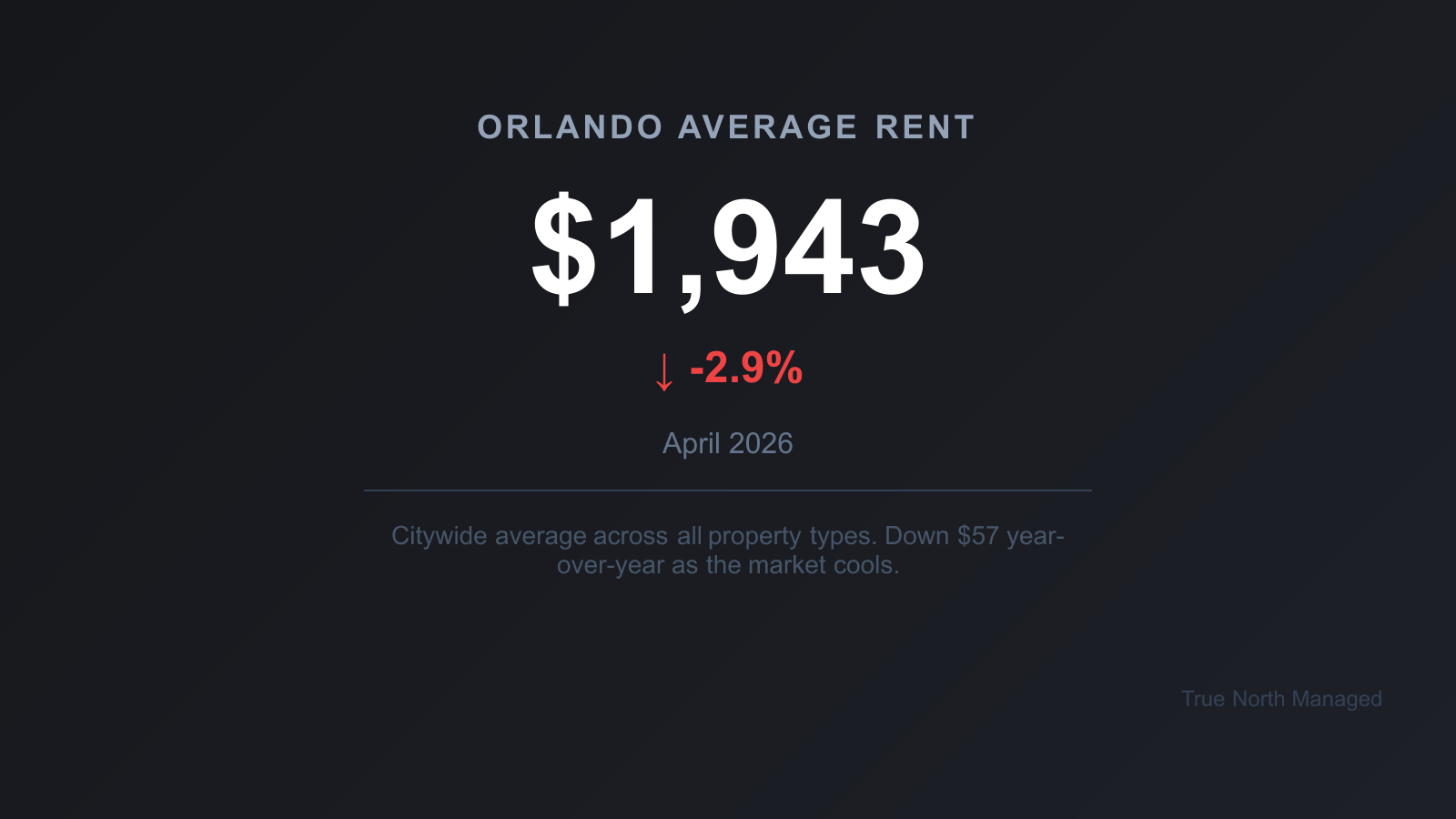
Here's the headline: Orlando's average rent is $1,943, down about $57 year-over-year (roughly 2.9%). The construction pipeline has slowed. Renters have more options; landlords need to price realistically and compete on condition and service.
Let's break down what's driving the numbers, where rents stand by neighborhood, and what to expect through summer.
Headline Numbers: Rent, Vacancy, and YoY Trends
Zillow's Orlando rental data puts the citywide average at $1,943/month across all property types—down $8 month-over-month and $57 year-over-year. The median for 0–2 bedroom units fell 1.8% year-over-year as of late 2025, landing around $1,650. Realtor.com's Orlando market report shows median rent at $2,075 with a 0.95% YoY decline and 3,269 active listings—up 4.5% from a year ago.
Vacancy tells the same story. Northmarq projects vacancy holding nearly flat at 8.9% through 2026—strong population growth and net absorption of about 8,000 units in the past 12 months are offsetting new supply.
What's Driving the Cooldown
Three factors are pulling rents down:
1. New supply. Orlando added thousands of apartment units over the past few years. The construction pipeline has slowed—units under construction are down roughly 40% from a year ago—but deliveries from 2024–2025 are still working through the market. Creative Village, Lake Nona, and the I-4 corridor have seen heavy new construction. Newer properties are competing with move-in incentives and upgraded amenities, which puts pressure on older stock.
2. Renter pushback. Rents are still about 17% higher than pre-pandemic levels, while wage growth hasn't kept pace. Census data for Orlando shows median gross rent around $1,650 (2019–2023). At $1,975 median rent, you need roughly $79,000 annual income to stay within the 30% affordability rule—above Orlando's median household income of $77,597. Renters are stretching; they're also more selective.
3. Mortgage rates and buy vs. rent. Higher mortgage rates have kept some would-be buyers in rentals longer, but they've also slowed investor purchases and new construction financing. The net effect: more rental supply, more competition, and rent growth that's modest instead of explosive. Renters who might have bought in 2021–2022 are staying put—but they're also shopping around when leases renew. You're competing for tenants who have options.
Neighborhood Breakdown: Where Rents Stand
Rent varies sharply by neighborhood. On the higher end:
- Lake Eola Heights: ~$3,300/month
- Lake Nona / Lake Nona South: ~$2,899–$2,950
- Eagle Creek: ~$2,900
- Baldwin Park: ~$2,332
- Downtown Orlando: ~$1,854
If you own in Lake Nona or Dr. Phillips, you're in premium territory—but you're also competing with newer builds and amenities. Winter Park sits in the middle: 1-bedrooms around $1,487, 2-bedrooms around $1,771, 3-bedrooms around $2,076.
On the lower end, neighborhoods like Oak Ridge Manor ($940), Lake Sunset ($1,030), Lorna Doone ($1,050), and Holden-Parramore ($1,050) run 30–45% below the city median. Those areas attract budget-conscious renters but often have older inventory and different maintenance expectations. A 2-bedroom in Lake Sunset might rent for $1,030—requiring only about $41,200 annual income at the 30% rule—while the same unit in Lake Nona could run $2,200+. Location drives the spread.
By bedroom count, studios average around $1,400–$1,752, 1-bedrooms $1,450–$1,809, 2-bedrooms $2,048–$2,187, and 3-bedrooms $2,100–$2,451 depending on source and property type. Houses generally command a premium over apartments for larger units (4-bedroom houses average about $3,074 vs. $2,752 for apartments). Use comps in your specific zip and property type—citywide averages are a starting point, not a pricing target.
Supply: New Construction and the Pipeline
Orlando's multifamily pipeline has moderated. That's good news for landlords—less incoming supply means less downward pressure on rents over the next 12–18 months.
Deliveries in 2026 include Creative Village's Parcel H (122 market-rate units), the Beacon affordable project (106 units), and the Aperture student housing community near UCF (680 beds). The Rosemont RoseArts District, approved in February 2026, will eventually add 2,500 apartments—but that's phased over several years.
Orange County issued 8,052 building permits in 2024, down from 8,690 in 2023. The Orlando-Kissimmee-Sanford MSA authorized 2,471 housing structures in October 2025. Supply is still coming online, but at a slower clip than 2022–2023.
Demand: Population, Jobs, and Tourism
Orlando's fundamentals remain strong. The metro area grew 12.7% over the five years through 2024, adding roughly 76,000 residents between mid-2023 and mid-2024 alone. International migration has driven most of that growth—about 65% of gains since 2020, and 88% in the year ending July 2024.
Employment is projected to grow 1.3% in 2026—above Florida's 0.8% and the national 0.5%. Education and healthcare added 10,300 jobs in 2025; retail and hospitality softened. Unemployment stood at 4.4% in December 2025, up from 3.0% a year earlier, reflecting a broader slowdown.
Tourism is humming. Orange County tourist tax collections hit record levels in early 2026, with January at $35.3 million. Universal's Epic Universe, which opened in May 2025, is driving hotel demand. That supports hospitality jobs and spillover demand for rentals—especially in areas near the theme parks and convention center. The Orange County Convention Center's $560 million Grand Concourse expansion, starting in 2026, will add 44,000 square feet of meeting space and a 100,000-square-foot ballroom by 2029—more midweek demand for the region.
The Orlando-Kissimmee-Sanford MSA is one of the fastest-growing large markets in the country. Net absorption of about 8,000 units in the past 12 months shows renters are still moving in. The question isn't whether demand exists—it's whether your property is positioned to capture it.
What It Means for Landlords
You can't rely on automatic rent bumps anymore. The market favors landlords who:
- Price to comps. Use Zillow's Orlando trends, Realtor.com, and the MLS. Our Orlando rent pricing guide walks through how to run comps and avoid overpricing.
- Compete on condition. Well-maintained properties with modern features, energy efficiency, and responsive maintenance lease faster. Tenants are choosier.
- Keep renewal increases modest. About 66% of Orlando renters renewed leases in 2024 to avoid competition. A 3–4% renewal bump is often enough to retain good tenants without pushing them to shop around.
- Lean into retention. Vacancy costs more than a small rent concession. A reliable tenant who pays on time is worth more than chasing an extra $50/month.
If you're in a premium submarket like Lake Nona or Winter Park, you're still commanding strong rents—but you're competing with newer inventory. If you're in a more affordable area, you're competing on price and condition. Either way, real-time data beats assumptions. See our Avalon Park rental investment profile for more.
2–3 Month Outlook: What to Expect Through Summer
Northmarq projects Orlando rent growth of about 1.2% by year-end 2026. Zillow forecasts single-family rents up 1.1% and multifamily rents roughly flat (-0.2%) nationally. Orlando should track close to that—modest growth, not a spike.
Through June, expect:
- Rents: Flat to slightly up. Spring leasing season typically brings a bump, but the cooldown will keep it small.
- Vacancy: Holding around 8.9%. Strong absorption and slower construction should prevent a big jump.
- Competition: Newer properties will keep offering incentives. Older, well-maintained units that price right will still lease—they just won't lease in 48 hours like they did in 2022.
The bottom line: Orlando's rental market has normalized. It's not crashing—population growth, job growth, and tourism support demand. But the days of 10%+ annual rent increases are over. Price realistically, maintain your properties, and focus on retention. That's how you win in this market.
What should you do if you own one Orlando rental?
If you own a single Orlando rental — the home you couldn't sell, the place you inherited, the condo you moved out of — a cooler market changes one thing: you can't price on hope anymore. Run comps in your exact ZIP and property type within the last 30 days, list at the market rather than above it, and at renewal, hold a good tenant with a modest 3–4% bump instead of chasing the top of the range.
A 45-day vacancy at $1,975/month costs you roughly $2,960 in lost rent — more than a year of a $50/month rent concession. Retention is the cheapest move you have. Keep the property in good condition, respond fast to maintenance, and the right tenant stays.
This update covers February 2026. For where the market stands now, see our latest Orlando rental market update, and the Orlando market hub for neighborhood-by-neighborhood guidance.
Not sure your rent is right for this market — or whether you even want to keep managing the property yourself? We manage single properties across Orange County. We'll run a free rental analysis with current comps for your specific home, no obligation.