
Orlando Rental Market Update — March 2026
Orlando's average rent slipped to about $1,943 in March 2026 as listings surged and vacancy rose. What the March data meant for landlords.

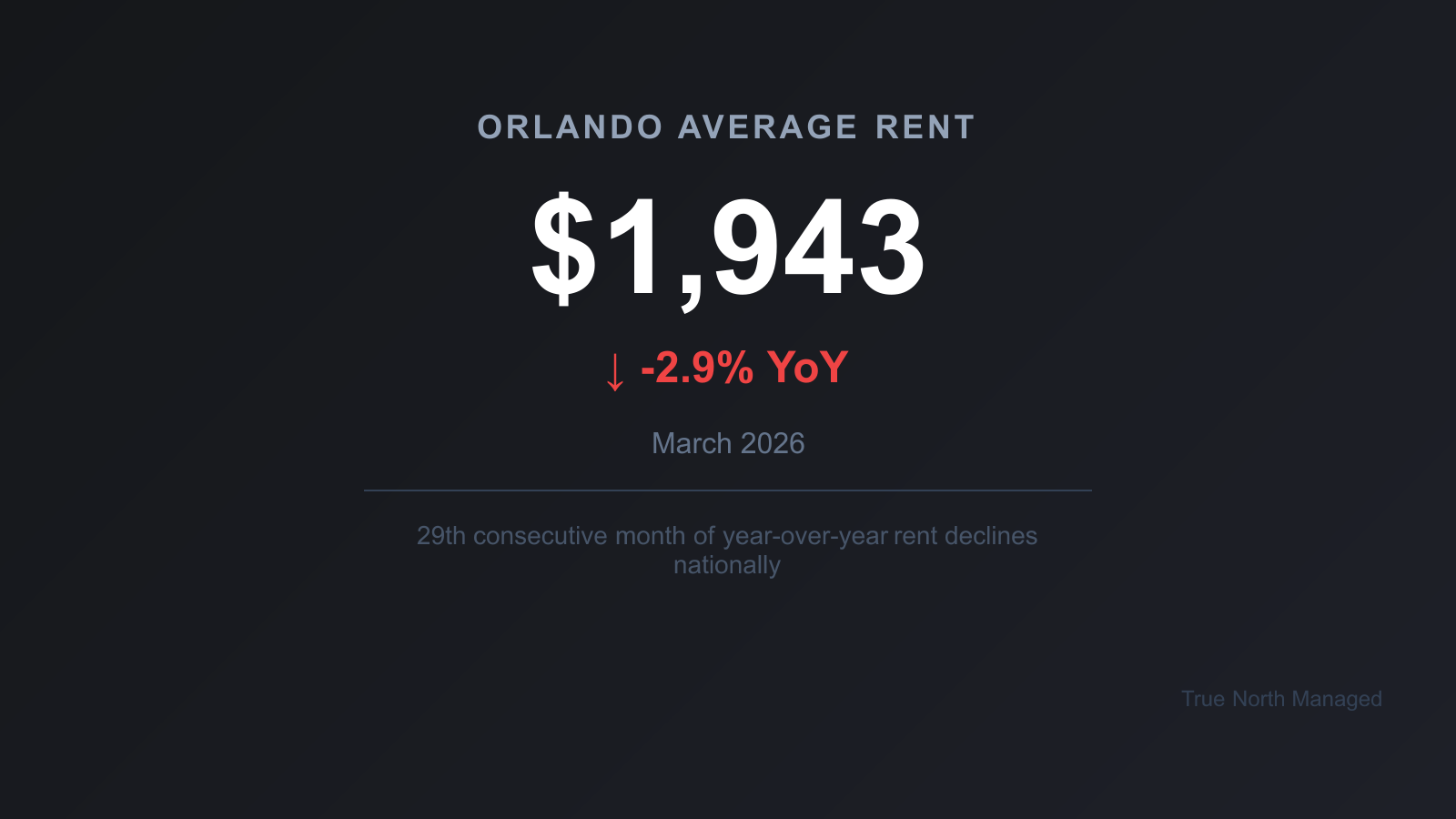
$1,943. That's your average Orlando rent right now.
Down $57 from this time last year. Down $8 from last month. That's the 29th consecutive month of year-over-year rent declines nationally, and Orlando is tracking right with the trend.
This isn't a crash. But it's a market that has clearly shifted from the landlord-friendly conditions of 2021-2023 to something more balanced -- and in some pockets, tenant-friendly.
Quick answer: The average rent across all unit types in Orlando was about $1,943 a month in March 2026 — down roughly $57 year over year and $8 from the prior month. Available listings climbed to around 3,463, up from under 2,000 two years earlier, shifting Orlando from a landlord's market toward a balanced, in places tenant-friendly, one.
What Changed
- Average rent: $1,943/month across all unit types in Orlando. That's 3% below the national average, which classifies Orlando as a "cool" market according to Zillow's temperature index. A year ago, Orlando was running slightly above the national number.
- Available inventory: roughly 3,463 rental listings on the market as of early March. That's a lot of competition for your tenant's attention. Two years ago this number was under 2,000. More supply, same demand -- rents come down. Even in premium submarkets like Lake Nona, where rents sit around $2,800, vacancy windows are stretching.
- Affordability gap is razor-thin. Orlando's median rent of roughly $1,975 for a standard unit requires an annual household income of about $79,000 to meet the 30% housing cost rule. The metro's median household income sits at $77,597. That $1,400 gap means the average Orlando household is right at the edge of affordability -- and any rent increase pushes qualified tenants out of your price range.
What It Means for Landlords
The days of listing a property $150 above last year's rent and getting 20 applications in a weekend are over. At least for now. Here's what this data actually means for your rental.
Pricing needs to be precise. Overprice by $50-100/month and you'll sit vacant while the unit down the street -- the one priced at market -- fills in two weeks. In a market with 3,400+ competing listings, tenants will compare. They're checking Zillow, Apartments.com, and Facebook Marketplace. They know what things cost. Price at market or slightly below if you want fast lease-ups.
Tenant retention is worth more than a rent increase. Turning a unit costs $2,500-4,000 in Orlando when you factor in vacancy days, make-ready costs, leasing time, and the risk of getting a worse tenant. If your current tenant is paying $1,800 and market rent is $1,850, pushing for that extra $50/month isn't worth the risk of losing them. A 2-3% increase on renewal is reasonable. A 10% jump in a cooling market is how you create vacancies. And when you do need to fill a unit, a solid screening process is the difference between a good tenant and a $7,500 mistake.
Longer vacancy windows are the new normal. Don't panic if your listing doesn't get an application in the first 48 hours. But do review your pricing and photos after 14 days with no qualified leads.
What to Do Now
- Run a market comp right now. Check what similar properties in your zip code rented for in the last 30 days -- not 90 days, not what your neighbor said. Zillow, Rentometer, and the Orange County Property Appraiser site will give you a range. Price within that range.
- Lock in your good tenants. If your tenant's lease renews in the next 60 days, reach out now. Offer a modest increase (2-3%), a small incentive for a longer lease term, or just a straightforward renewal at the same rate. Keeping a paying tenant is cheaper than finding a new one.
- Improve the listing, not the price. If you're getting views but no applications, the problem is usually photos or condition -- not price. Professional photos cost $150-250 and pay for themselves in reduced vacancy. A fresh coat of paint on the front door and clean landscaping make the first impression that gets people through the door.
March 2026 Orlando rental market: quick questions
What was the average rent in Orlando, Florida in March 2026?
The average rent across all unit types in Orlando was about $1,943 per month in March 2026 — roughly $57 lower year over year and $8 lower than the prior month. That put Orlando about 3% below the national average, classifying it as a 'cool' rental market.
Were Orlando rents going up or down in early 2026?
Down. March 2026 marked a continued year-over-year decline, in line with a national trend of falling rents. A surge in available listings — around 3,463, up from under 2,000 two years earlier — gave tenants more options and pulled rents lower.
Should an Orlando landlord raise the rent in a cooling market?
Usually not aggressively. With turnover costing $2,500–$4,000, keeping a solid tenant at a modest 2–3% renewal increase often beats pushing a larger jump that risks a vacancy. Florida sets no cap on increases, but the lease's notice requirement must be honored.
Is the Orlando rental market still a good place to own a rental?
Yes. Orlando's fundamentals stayed strong through the March 2026 cooling — Disney, a growing UCF, and an expanding tech corridor keep demand steady. The market simply rewarded landlords who priced precisely, retained tenants, and presented their property well.
Next Steps
Orlando's fundamentals are still strong -- Disney isn't leaving, UCF is still growing, and the tech corridor keeps bringing jobs. But the market has shifted from "any landlord can succeed" to "landlords who pay attention will succeed." Pricing, retention, and presentation matter more now than they have in years. For a deeper look at what's working across the Orlando market, including neighborhood-level data and landlord resources, start there.
Renewal and vacancy strategy for a cooling market
For renewals, consider a modest increase if your tenant has been solid, but check your lease for notice requirements. Florida law doesn't cap increases, and Part II of chapter 83, Florida's residential landlord-tenant law, sets no rent-increase notice period for a month-to-month tenancy. What chapter 83 does set is the notice to end one. Florida Statute 83.57: "A tenancy without a specific duration, as defined in s. 83.46(2) or (3), may be terminated by either party giving written notice in the manner provided in s. 83.56(4), as follows:" and "(3) When the tenancy is from month to month, by giving not less than 30 days' notice prior to the end of any monthly period". So the safe practice for a month-to-month increase is written notice at least 30 days before the end of a monthly period, or longer if your lease requires it; on a fixed-term lease, follow the lease's renewal terms.
Vacancy is up, but that doesn't mean you should panic-drop your price. Instead, stage the property, fix deferred maintenance, and get professional photos. A $1,800/month home that sits 45 days costs you more than a $1,750/month home that leases in 12. Run the math before you cut.
Finally, if you're holding multiple units, diversify your lease expirations. Don't let everything roll in the same quarter. Stagger renewals so you're not re-leasing three units in August when everyone else is too.
Want to know exactly where your property sits in this market? We'll pull the comps, look at your lease terms, and tell you whether you're priced right or leaving money on the table. Takes about 15 minutes of your time.