

When Should You Hire a Property Manager in Orlando? (And How to Pick the Right One)
Not sure if you need a property manager in Orlando? Here's how to decide — and what to look for when you're ready to hire one.

You're juggling tenant calls at dinner, coordinating an AC repair from 800 miles away, or Googling "how to evict a tenant in Florida" at midnight. Sound familiar? A lot of Orlando landlords start out self-managing and hit a wall. The question isn't whether property managers exist—it's whether you actually need one, and if so, how to find one that won't let you down.
Here's the short answer: You should hire a property manager when self-management is costing you more (in time, stress, or money) than the 8–12% management fee. That threshold looks different for everyone—some landlords need help with one property; others handle five before they crack. The real work is knowing the signs, understanding what a good manager actually does, and vetting them before you sign.
Let's walk through it.
Signs You Need a Property Manager
You're Out of State or More Than an Hour Away
If you live in New York or Chicago and own a rental in Orlando, you're not just managing a property—you're managing it across time zones. Emergencies don't wait. A burst pipe at 2 AM, a tenant lockout, or a maintenance request that needs a same-day response—those are hard to handle from 800 miles away. Local property managers have vetted contractors, emergency protocols, and can be on-site when you can't. Out-of-state landlords typically spend 5–10 hours per month on a single property, and that doubles during tenant turnover. A property manager turns that into a few hours of reviewing reports.
You're Drowning in Time
Self-managing takes real hours. Industry estimates range from 4–12 hours per month per property for routine tasks: tenant issues, maintenance coordination, rent collection, inspections, marketing, and paperwork. During turnover or repairs, that can easily double. Landlords with 11 or more properties spend nearly 78 hours per month—roughly two full-time jobs. If you're already stretched thin and your primary income is suffering, you've hit the threshold.
You've Got Legal Jitters
Florida landlord-tenant law is specific. Florida Statute 83 governs everything from security deposits to eviction notices. Fair housing violations can cost you thousands—even when they're unintentional. If you're unsure about screening tenants within fair housing rules, handling eviction timelines, or staying compliant with Florida landlord responsibilities, a property manager who does this every day reduces your risk. See our tenant screening in Orlando for more.
You're Scaling Up
There's no magic number—some landlords hire help at one property; others manage five before they crack. The real question: Are you overwhelmed? If adding another rental means you're losing sleep, missing deadlines, or letting maintenance slide, it's time to get help. Professional managers cut vacancy rates by roughly 40% compared to self-managed properties (4.5–5.5% vs. 8–9%). For a $1,500/month Orlando rental, each 1% reduction in vacancy saves you about $180 per year. A 4% improvement (from 9% to 5% vacancy) means roughly $720 less lost rent annually—over five years, that's $3,600. Add in faster tenant placement (67% of professional managers fill vacancies within four weeks), fewer evictions from better screening, and the time you get back, and the ROI starts to make sense.
What a Property Manager Actually Does
A good property manager handles the full lifecycle of your rental. Here's what that looks like in practice.
Marketing and leasing. They list your property on the right sites, schedule showings, and handle applications. Orlando is the 13th most competitive rental market in the U.S., so placement speed matters.
Tenant screening. Credit checks, income verification (typically 2.5–3x rent), rental history, eviction search, and criminal background—all done within fair housing rules. Poor screening can cost you $7,500–$33,000 per bad tenant. Good screening is the difference between a smooth tenancy and an eviction.
Rent collection and accounting. They collect rent, chase late payments, and send you monthly financial statements. Most owners want monthly accounting and financial reports; 65% expect monthly statements, and 55% want vacancy updates as soon as they're available.
Maintenance coordination. Tenants submit requests through a portal or direct contact. The manager triages (emergency vs. routine vs. preventative), dispatches licensed contractors, and tracks work orders. Emergencies get same-day response; routine repairs typically within 48 hours. They maintain a vetted vendor list so you're not scrambling for a plumber at midnight. Good managers also do preventative maintenance—catching small issues before they become expensive. Reactive-only management (fixing things only when they break) is a red flag.
Legal compliance. Florida doesn't have a standalone property management license—managers must hold a real estate broker's license through the DBPR. That means they're trained on landlord-tenant law, eviction procedures, and fair housing. They handle notices, lease renewals, and when things go wrong, they know the eviction process. You stay compliant without having to memorize Florida landlord responsibilities yourself.
Owner communication. You should get regular updates: monthly financials, maintenance summaries, and vacancy alerts. A good manager responds within 24 hours for routine matters and has a clear emergency protocol. Ask about their communication frequency before you sign. Most owners want monthly accounting statements and real-time vacancy updates—not quarterly summaries that arrive after the fact.
How to Evaluate and Interview Property Managers
Don't just pick the first company that shows up in a Google search. Interview at least two or three. Here's what to ask.
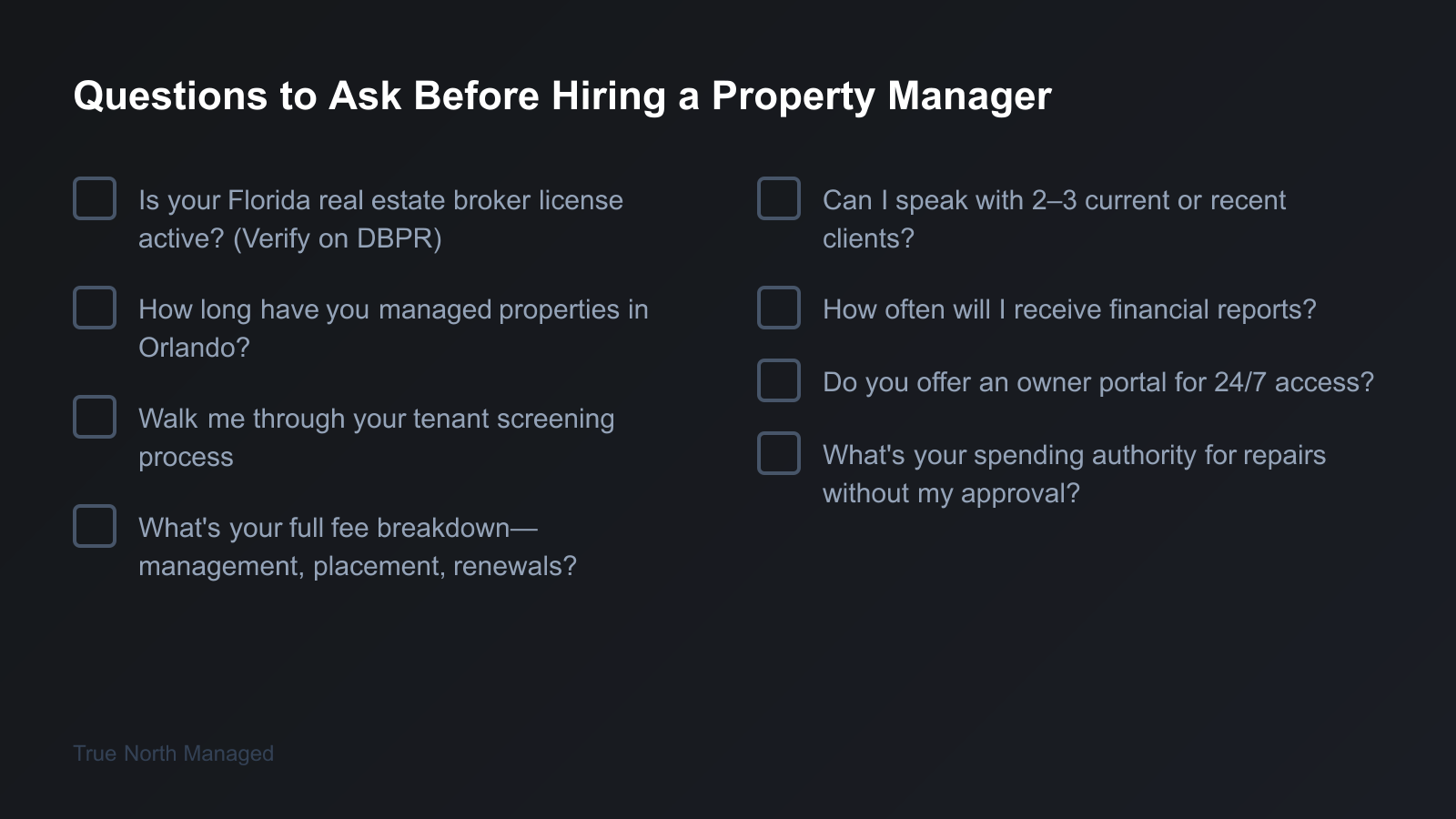
License and credentials. Verify their Florida real estate broker license is active and in good standing. Search the DBPR by name or company. If they're managing properties for others for compensation, they must be licensed. Ask if they belong to NARPM (National Association of Residential Property Managers)—membership signals professional development and adherence to industry standards.
Local experience. How long have they been managing in Orlando? What neighborhoods do they know best? Orlando's submarkets behave differently—Lake Nona isn't Winter Park. You want someone who knows local rent trends, seasonal patterns (snowbirds, theme park workers), and neighborhood dynamics.
Screening process. Walk through their tenant screening step-by-step. Do they run credit, background, eviction search, and income verification? Do they apply criteria uniformly? Lax screening leads to late payments, damage, and evictions. A bad tenant costs $3,000–$4,000+ in Florida eviction costs alone.
Fee structure. Orlando property managers typically charge 8–12% of monthly rent. Get a full breakdown: management fee, placement fee, lease renewal fee, maintenance markup, and any other charges. Flat-fee options exist (e.g., $150/month) but may not include all services. Compare apples to apples.
References. Ask for two or three current or recent clients. Call them. Ask about communication, responsiveness, vacancy rates, and whether they'd hire the company again.
Technology. Do they offer an owner portal? Can you see financials, maintenance records, and reports online? Most owners want at least some digital access—95% want some processes handled digitally. A company that's still faxing statements is a red flag.
Company size. Small firms often offer more personalized attention and may charge less; large firms typically have 24/7 support and bulk vendor discounts. Neither is inherently better—what matters is whether they deliver on the services you need. A small local shop with strong references can outperform a national brand that treats you like a number.
Red Flags to Watch For
Communication gaps. If they're slow to respond during the sales process, they'll be slower when you're a client. 59% of renters consider prompt communication very important; the same applies to owners. Avoid companies that take days to return calls or emails.
Hidden or vague fees. You should get a clear fee schedule before signing. Watch for unexplained charges, high maintenance markups without justification, or "guaranteed tenant in 30 days" offers—those can pressure managers to place unqualified tenants.
No references or reluctance to share. A manager who won't provide references or gets defensive about past clients is hiding something. Check Google, Yelp, and BBB for patterns—a few bad reviews are normal; a pattern of complaints indicates serious problems.
High tenant turnover. If their current clients have tenants moving out every year, something's wrong. National average turnover is roughly every two years. Turnover costs $1,000–$2,500 per unit in lost rent, marketing, repairs, and make-ready. A manager who can't retain tenants isn't doing their job.
Lack of local knowledge. If they can't speak to Orlando-specific rent trends, vacancy rates, or neighborhood nuances, they're not local enough. Orlando's vacancy rate is around 8.8%; professionally managed properties often run 4.5–5.5%. You want someone who knows how to achieve that.
Contract Terms to Negotiate
Before you sign, review these key areas.
Scope of services. What's included? Tenant placement, rent collection, maintenance, evictions, inspections, accounting? What's extra? Get it in writing.
Fees and payment. How is the management fee calculated? When are placement fees due? What's the lease renewal fee? Are there maintenance markups? Clarify payment terms—when do you receive disbursements?
Spending authority. How much can the manager spend without your approval? Typical ranges: $250–$500 for routine repairs. Emergencies may have higher thresholds. You want enough flexibility for them to act quickly, but not so much that you're surprised by large bills.
Term and termination. How long is the contract? One year? Two? What's the early termination clause? Some require 60–90 days notice. Know what happens if you're unhappy.
Liability and insurance. Does the company carry general liability ($1M–$2M is standard) and professional liability (E&O)? Are they bonded? Ask for proof of insurance before signing. See our Orlando landlord insurance for more.
Owner obligations. What do you need to provide? Maintain liability insurance? Fund a reserve for repairs? Not sign tenants without manager approval? Get clear on your responsibilities.
Common Mistakes When Hiring a Property Manager
Picking the cheapest option. Orlando management fees typically run 8–12% of monthly rent. A company charging 4% might be cutting corners on screening, maintenance, or staffing. The goal isn't the lowest fee—it's the best return. A manager who fills vacancies faster, retains tenants longer, and handles repairs properly often pays for themselves through lower vacancy and fewer evictions.
Skipping the reference check. It's tempting to move fast when you're overwhelmed. Don't. Call the references. Ask: "How quickly do they respond?" "Have you had any surprises on your statements?" "Would you hire them again?" References reveal what marketing materials hide.
Not clarifying the scope. "Full-service" means different things to different companies. Some include eviction representation; others charge extra. Some handle all maintenance coordination; others expect you to approve every repair over $100. Get a written list of what's included and what triggers additional fees. Ambiguity becomes conflict later.
The Bottom Line
Hiring a property manager isn't a one-size-fits-all decision. It depends on your situation: how far you live from the property, how much time you have, what you're comfortable handling legally, and what your portfolio looks like. If you're on the fence, compare the cost of management against the hours you're spending and the stress you're carrying. For many Orlando landlords, the math works out—and the peace of mind is worth more than the fee.
Ready to see what your property could earn with professional management? Get a Free Rental Analysis →