
How to Write a Rental Listing That Gets Applications (Florida)
Everyone says 'good photos.' But the listing that rents fast and keeps you out of a fair-housing complaint is one whose copy pre-screens applicants and describes the property, not the ideal tenant. Here's how we write them.
Search "how to write a rental listing" and you'll get the same advice ten times over: shoot bright photos, use natural light, lead with curb appeal, write a punchy description. All true, all worth doing, and all missing the part that actually decides how your month goes. Photos get people to click. The copy decides who clicks — and whether the ad you wrote can land you a fair-housing complaint. After years of writing listings for Orlando and Tampa rentals, that's the lesson we'd put first, not last: the listing that rents fast and stays out of legal trouble is one whose words pre-screen the applicant pool and describe the property, never the ideal tenant.
That's the angle most "perfect listing formula" posts skip. They treat the ad as a marketing exercise — make it pretty, make it sell. We treat it as a filter and a legal document that happens to also sell. A gorgeous gallery on a sloppy description brings you a flood of applicants who can't qualify and a couple of phrases that an enforcement agency could read as a preference. This guide is about getting the words right: what to lead with, how the first 100 words do your filtering for you, how the photos back up the copy, and the one mistake that gets Florida landlords in real legal trouble — advertising the tenant instead of the property. If your unit has been listed for weeks and nothing's biting at all, the problem may be price or timing rather than copy, and that's a different fix — read our guide on what to do when your rental isn't renting in Florida. Here, we assume the price is right and the listing just needs to do its job.
What makes a Florida rental listing get applications?
A Florida rental listing gets applications when it's specific, honest, and easy to scan — and when its copy filters before anyone applies. Lead with a concrete standout feature, post a full set of bright photos, list real amenities, and state your screening criteria up front. Vague listings ("nice home for rent") attract nobody useful. Specific ones ("renovated 3/2 with a screened lanai, 3x income, 620+ credit") attract the right people and quietly turn away the rest.
Think about what a renter is doing when they find your ad. They're scrolling a feed of forty other units that all blur together — underexposed photos, copy-paste descriptions. Your job is to stop the scroll and answer their questions before they have to ask. Specificity does that. "Walking distance to the Lake Nona town center" tells them something. "Great location" tells them nothing. The more your listing reads like a person who actually knows the property wrote it, the more it stands out from the wall of generic posts around it.
Here's the part the pretty-photo advice glosses over, and it's the part that decides whether your inbox is manageable. Go read any landlord forum thread about listings and the same two complaints surface over and over: "I got buried in applicants who don't qualify," and "people apply, then ghost me before the showing." Both trace back to copy. A vague ad brings volume — but it's the wrong volume, and you'll burn evenings fielding inquiries from people making half the income you need. A precise listing pre-qualifies. When the rent, the income floor, the pet policy, and the no-smoking rule are all in the ad, the folks who can't meet those terms move on before they ever hit "apply," and you spend your hours on people who can actually close.
How do you write a rental listing headline that stops the scroll?
Write a headline with three things: bed/bath count, location, and one standout feature. "Updated 3/2 in Westchase — Top Schools, Fenced Yard" works. "Beautiful Home Available Now" doesn't. Renters search and skim by beds and area, so put those first, then earn the click with a real selling point.
The headline is the whole ballgame on most platforms, because it's what shows in the search results before anyone opens the listing. Use the formula and resist the urge to pad it with adjectives. "Spacious," "gorgeous," and "stunning" are filler — every other listing uses them, so they've stopped meaning anything. A concrete detail does more work than three superlatives. Compare these:
- Weak: "Lovely 3 Bedroom Home for Rent — Must See!"
- Strong: "Renovated 3/2 in Seminole Heights — Lanai, 2-Car Garage, $2,250"
The second one tells a renter the size, the neighborhood, two features they care about, and the price, all before they click. It does the filtering for you. Notice it leads with the renovation and the neighborhood, not "must see." Nobody searches for "must see." They search for three-bedroom, Seminole Heights, under $2,400. Speak their search language and your listing surfaces for the people most likely to apply.
Lead the first sentence of the description the same way you lead the headline — with the single best thing about the unit. If it's a brand-new kitchen, open with the kitchen. If it's the location, open with the location. Don't bury the strongest feature in paragraph three. Most readers never get there.
What should the first 100 words of your listing say?
The first 100 words should answer the renter's top questions: what it is, where it is, what's special, what it costs, when it's available — and what it takes to qualify. Front-load the hook in sentence one, then hit price, availability, a standout amenity, and your criteria. By word 100, a qualified renter knows whether this is worth a tour, and an unqualified one knows it isn't.
Here's a structure that works for almost any Florida single-family or condo rental. Open with the hook — the one feature that makes this unit better than the three others a renter is comparing it to. Follow with the practical anchors: rent, available date, lease term. Then the specifics that build a picture, and the criteria that draw the line. Something like:
Renovated 3-bed, 2-bath in Carrollwood with a screened lanai and fenced backyard. $2,350/month, available July 1, 12-month lease. New 2024 kitchen with quartz counters and stainless appliances. Tile throughout the main living areas, washer/dryer included, two-car garage. Quiet street, minutes from the Veterans Expressway. Qualifications: income 3x rent, 620+ credit, no smoking, one small pet considered with deposit.
That's it. No fluff, no "this won't last long." Every line gives the renter a real fact they can act on — and the last line does the work that saves your evenings. We've watched owners write a beautiful description, leave the criteria off "to keep it friendly," and then drown in applications from people who never had a chance of qualifying. The discipline of writing tight forces you to name actual features instead of leaning on adjectives, and tight copy reads as competent — which makes a renter trust you'll be a competent landlord too. If your description rambles for six paragraphs and never says what it takes to qualify, the wrong applicants assume the door is open and the right ones can't tell.
How many photos should a Florida rental listing have, and what should they show?
Use a full set of bright, daytime photos that cover every room, with the kitchen and bathrooms shown clearly. Renters consistently treat interior photos as one of the biggest factors when they shortlist a unit, and a thin or dark gallery gets a listing skipped. Four murky photos signal a landlord with something to hide, even when there's nothing to hide.
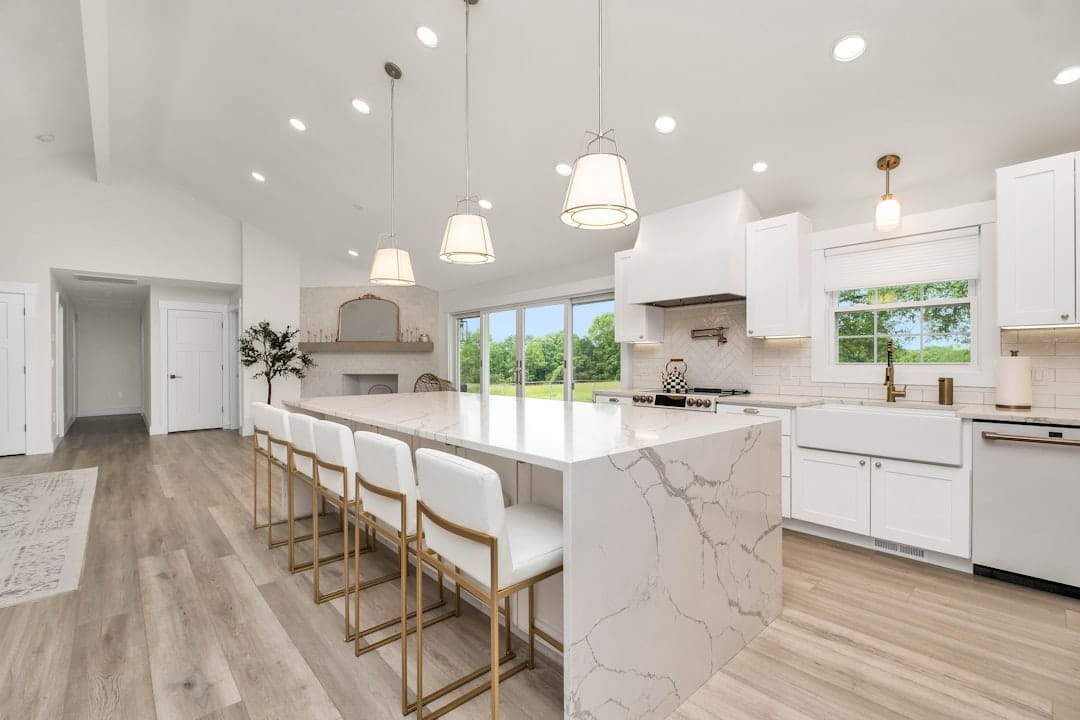
Here's where we part ways with the "photos are everything" crowd — not because they're wrong, but because they stop too early. Yes, photos do a lot of selling, and a renter will forgive a plain description if the pictures are clear and complete. But clear photos with no stated criteria just bring you more of the wrong applicants faster. Photos sell the unit; copy qualifies the buyer. You need both pulling in the same direction. So shoot it right: during the day, blinds open, every light on. Wide angles, clutter cleared, nothing in the frame you wouldn't want a stranger to see. Cover every room, then add the exteriors and the selling features — the lanai, the yard, the garage, the community pool.
A few rules that hold up across the listing platforms:
- Show the kitchen and bathrooms in detail. These are the rooms renters scrutinize most. Multiple angles each.
- Lead with your strongest image. The first photo is your thumbnail — make it the living room or the curb appeal, not the laundry closet.
- Don't skip rooms. A missing bedroom reads as a hidden problem. If it's empty and plain, photograph it anyway.
- Consider a pro for vacancies. A photographer runs roughly $150 to $300 in the Orlando and Tampa markets, and on a unit losing you $75 a day in vacancy, that pays for itself if it shaves a few days off your time on market.
Match the photo set to the words. If the description promises a renovated kitchen, the kitchen photos had better show a renovated kitchen. Mismatched expectations are the other half of the ghosting problem — they pull people to a showing, then lose them on arrival, and you've spent a Saturday for nothing.
What screening criteria should you put in the listing?
State your screening criteria in the ad: income minimum (most Florida landlords require monthly income of at least three times the rent), credit standard, rental-history expectations, and any no-smoking or pet rules. Posting criteria up front filters out applicants who can't qualify and — critically — keeps you applying the same standard to everyone.
This is the step most first-time landlords skip, and it's the one that saves the most grief. In our experience managing Orlando and Tampa rentals, the listing mistake that bites owners isn't a weak headline — it's leaving the criteria off the ad entirely. They think stating a 3x-income rule sounds cold, so they omit it, and then they're shocked when forty inquiries come in and thirty-five can't pass screening. When your listing says "minimum income 3x rent, 620+ credit, no smoking, one small pet considered with deposit," three things happen. People who can't meet those terms don't apply, so your applicant pool is cleaner. The people who do apply already know the bar. And you've put your standard in writing before a single application arrives, which is exactly what fair-housing best practice asks of you — a consistent, written set of criteria applied identically to every person who applies.
Keep the criteria objective and apply them the same way every time. The actual evaluation — pulling reports, verifying income, running the background check with written consent under the Fair Credit Reporting Act — comes after applications arrive, and we walk through that end to end in our complete tenant screening process for Florida landlords. The listing's job is just to set expectations and start the filter. One caution on source of income: as of 2025, a few Florida localities have ordinances protecting source of income (including housing vouchers), so check your city or county rules before writing anything that excludes voucher holders — this is a local question, not a statewide Florida ban.
How do you keep your listing fair-housing compliant?
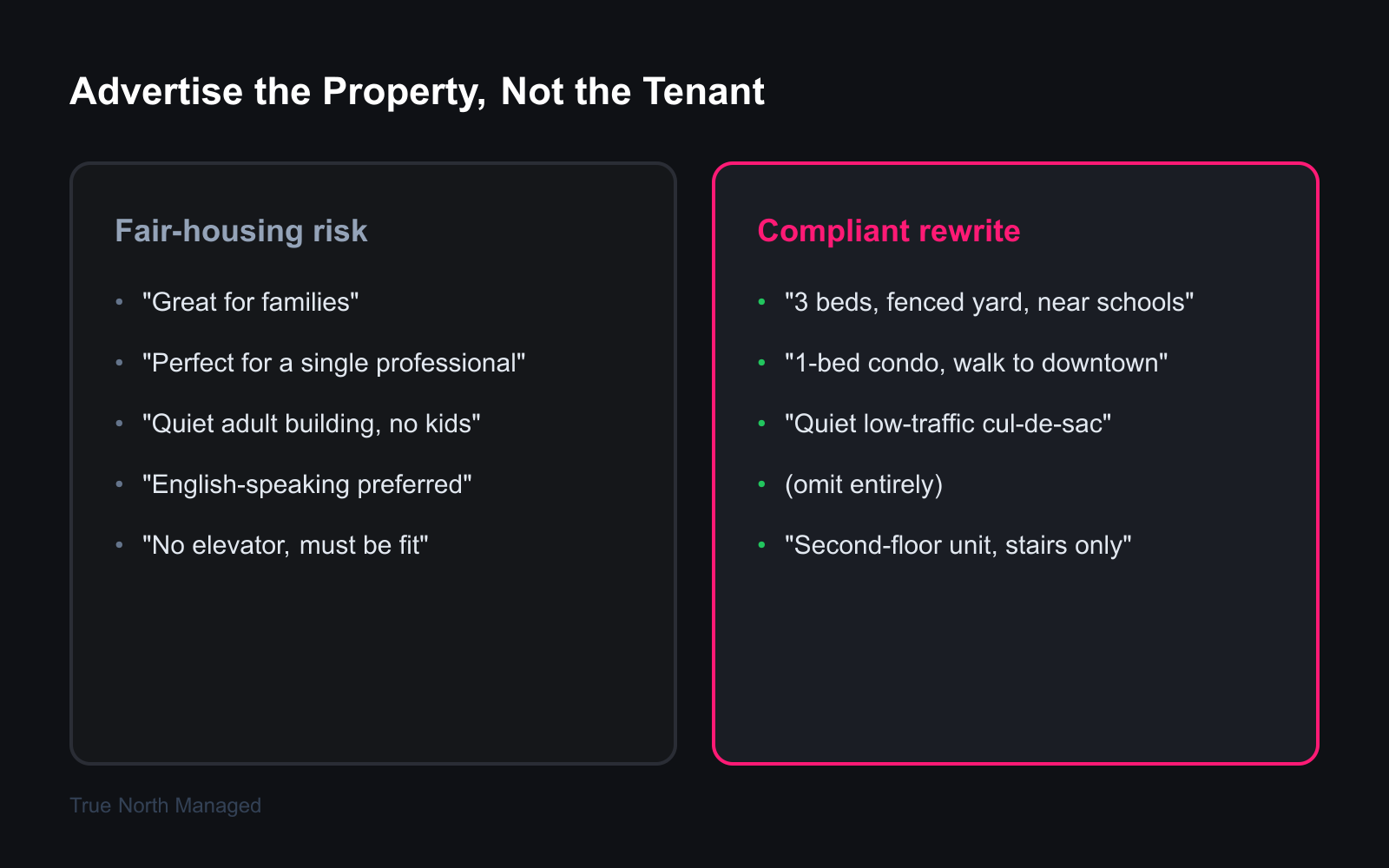
Advertise the property, not the ideal tenant. The federal Fair Housing Act prohibits any listing language that signals a preference based on race, color, national origin, religion, sex, familial status, or disability. "Great for families," "perfect for a single professional," and "no children" all violate it. Describe rooms and features; never describe who should live there.
This is the angle the generic listing guides barely touch, and it's the one that turns a good month into a bad year. Search the same landlord forums for listing pain and, right alongside "too many unqualified applicants," you'll find people who got a complaint over a single phrase they thought was friendly. Familial-status wording is one of the most common fair-housing complaint categories, precisely because it sounds harmless. The legal standard isn't whether you meant to discriminate — it's whether an ordinary reader could interpret your ad as expressing a preference about a protected class. Intent is irrelevant. "Great for a young couple" feels welcoming. Under the federal Fair Housing Act, it's a familial-status problem, because it signals that families with children or older renters are less welcome. The U.S. Department of Justice enforces these rules, and the Fair Housing Act's advertising provisions apply to every listing, on every platform, no matter how small your operation.
The fix is simple once you internalize it: every line of your ad should describe the home, not the person you imagine living in it. Here's how the common slip-ups translate:
| Don't write | Write instead |
|---|---|
| "Great for families" / "family-friendly" | "Fenced backyard, three bedrooms, near A-rated schools" |
| "Perfect for a single professional" | "One-bedroom condo, walk to downtown, in-unit laundry" |
| "Quiet adult building, no kids" | "Quiet street, low-traffic cul-de-sac" |
| "Christian community" | (omit — describe the home, not the residents) |
| "Must be physically fit, no elevator" | "Second-floor unit, stairs only" |
| "English-speaking tenants preferred" | (omit entirely) |
The pattern is always the same. Swap the description of a person for a description of a thing. "Fenced yard" is a fact about the property; "great for families" is a preference about the tenant. State the fact, drop the preference, and you've removed the risk while giving renters better information anyway. Notice that none of this conflicts with stating your screening criteria — an income floor or a credit standard describes a financial qualification applied to everyone, not a preference about a protected class. That distinction is the whole game. If you want a fuller breakdown of the slip-ups that trip up real Florida landlords, our guide on the fair housing mistakes Florida landlords actually make covers the showing and application stages too, not just the ad.
It's also worth adding the "Equal Housing Opportunity" line to your listing. It signals that you take fair housing seriously and it's a small, free trust marker for applicants.
Where should you post your Florida rental listing in 2025?
Post on Zillow first — it's the largest U.S. rental marketplace and syndicates your listing to Trulia and HotPads automatically. Add Apartments.com for reach and Facebook Marketplace to catch renters who don't browse the big portals. Cross-posting across two or three channels covers most of the Orlando and Tampa renter pool.
Zillow is the anchor. One listing there fans out to its partner sites, so you get multiple placements from a single post. Apartments.com is the other heavyweight and worth doing for any unit. Facebook Marketplace reaches a different crowd — renters who scroll their feed rather than a rental portal, often moving quickly and locally, which is useful for filling a vacancy fast. The trade-off with Marketplace is more low-quality inquiries, so lean on your stated screening criteria to filter them.
Channel choice is also where the Orlando and Tampa renter pools stop being abstract. Who you're writing for shapes where you post and when. In Orlando, two engines run most of the year-round demand: the UCF and east-side student pool, which moves on an early, summer-heavy lease cycle, and the theme-park workforce around Disney and the Osceola corridor, which fills steadily and skews toward value and commute. In Tampa, South Tampa and the MacDill orbit carry a constant churn of military renters cycling in and out on PCS orders — a pool that knows how to read a listing and rewards one that states terms plainly. Layer the snowbird season on top of all of it: Central Florida demand climbs from roughly October through April as seasonal residents arrive, so a unit you list in the fall is competing in a thicker, faster market than the same unit in July. None of that changes the copy rules — it changes how hard your stated criteria have to work and how quickly a good listing moves.
If you're managing more than a property or two, a syndication tool saves real time by letting you write the listing once and push it everywhere; you can compare the main rental listing sites and how they syndicate before picking one. Whatever channels you choose, keep the listing identical across all of them. Mismatched rent or terms between platforms confuses renters and looks careless.
One last point: refresh or repost a stale listing every week or two while it's active. Most platforms sort by recency, and a listing that's been up for a month sinks below the new ones. If your ad has gone quiet, refreshing it — and revisiting your vacancy and turnover strategy — usually does more than rewriting the copy again.
The listing is your first impression — make it count
A rental listing is a sales document and a legal document at the same time, and most advice only covers the first half. The sales side wants specificity: a sharp headline, a hook in the first sentence, a complete photo set, concrete amenities. The filtering side — the part that saves your evenings — wants your screening criteria stated up front so the right applicants self-select and the wrong ones bow out before they ever apply. The legal side wants discipline: describe the property, never the tenant, and let the Fair Housing Act guide every word about who the home is "for" (the answer is always "anyone who qualifies").
Get all three right and the listing does the heavy lifting for you — it draws qualified applicants, screens out the rest, and protects you while it works. Get them wrong and you're either staring at an empty unit, drowning in applications that go nowhere, or fielding a complaint you never saw coming. The good news is that none of this is about writing talent. It's about saying true, specific things in the right order, stating your bar before the applications start, and resisting the urge to advertise the renter instead of the rental. Do that, and the right applications follow.
For more on filling vacancies, screening well, and running a Florida rental without the headaches, browse the Florida Owner's Guide.