

When to Raise Rent vs. When to Hold: A Florida Cash Flow Framework
A framework for rent increase decisions: market comps, tenant quality, turnover cost math, and when holding flat makes more money.

Raising rent feels like the obvious move when the market is up. But a turnover can cost two months of rent or more. Sometimes holding flat makes more money. Here's how to decide.
What Does the Market Say?
Run comps first (Florida has no rent control—FS 125.0103prohibits local rent control except during declared emergencies).What are similar units in your submarket renting for? Orlando and Tampa rents vary by neighborhood. FL landlords in Orlando and Tampa should check local requirements.
Run compsfirst. What are similar units in your submarket renting for? Orlando and Tampa rents vary by neighborhood. A Lake Nona 3-bed might command $2,200 while a Dr. Phillips 3-bed goes for $2,500. UseOrlando rent pricingorTampa rent pricingas a starting point. If you're $100 below market, you've room. If you're at or above market, a raise may push the tenant out.
The Tenant Quality Factor
A good tenant who pays on time, maintains the property, and doesn't call at 2 AM is worth money.In Florida, Replacing them costs vacancy, turnover, and screening risk. A $50/month raise that triggers a move is $600/year.
A good tenant who pays on time, maintains the property, and doesn't call at 2 AM is worth money. Replacing them costs vacancy, turnover, and screening risk. A $50/month raise that triggers a move is $600/year. If you lose two months of rent ($4,400) and spend $1,500 on turnover, you're behind $5,300. It takes 106 months of $50 raises to break even. Sometimes the math says hold.
Turnover Cost Math
Vacancy loss, cleaning, painting, repairs, marketing, screening, admin time.A realistic Florida turnover runs $2,000 to $4,000 for a single-family. See our cost of tenant turnover guide. FL landlords in Orlando and Tampa should check local requirements.
Vacancy loss, cleaning, painting, repairs, marketing, screening, admin time. A realistic Florida turnover runs $2,000 to $4,000 for a single-family. See ourcost of tenant turnoverguide. If a $75/month raise has a 30% chance of triggering a move, your expected cost is 0.3 × $3,000 = $900. Your expected gain is 0.7 × $900 = $630. You're net negative. Hold.
When Insurance and Taxes Rise
Florida insurance and property taxes have gone up.Passing some of that through is reasonable. A 5% increase to cover $150/month in higher expenses is defensible. FL landlords in Orlando and Tampa should check local requirements.
Florida insurance and property taxes have gone up. Passing some of that through is reasonable. A 5% increase to cover $150/month in higher expenses is defensible. Tenants understand costs go up. But communicate it. A sudden 15% jump with no explanation feels punitive.
Florida Notice Requirements
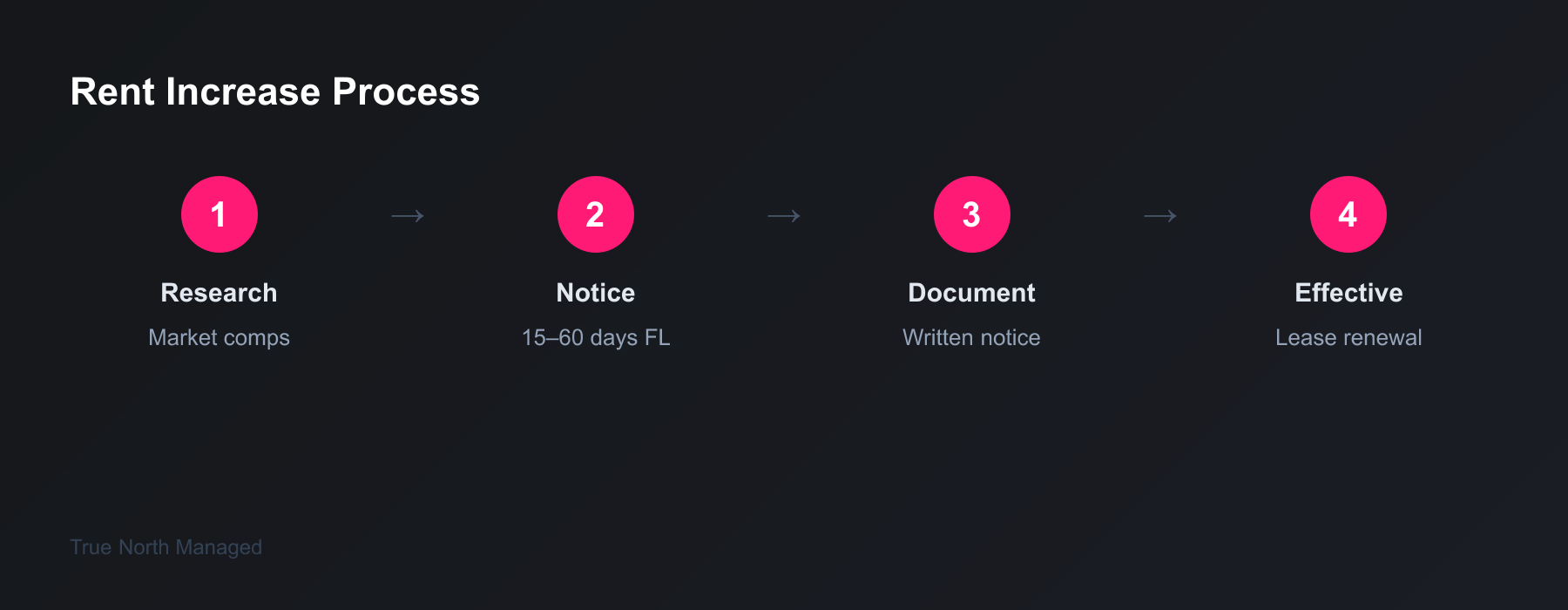
Under Florida Statute 83.57 , you must give at least 30 days' written notice for a rent increase on a month-to-month tenancy. For a fixed-term lease, the increase takes effect at renewal unless the lease allows mid-term increases.
UnderFlorida Statute 83.57, you must give at least 30 days' written notice for a rent increase on a month-to-month tenancy. For a fixed-term lease, the increase takes effect at renewal unless the lease allows mid-term increases. See ourrent increase notice guidefor templates and timing.
When Holding Flat Makes More Money
Florida law and local practice set specific timelines for this.In Florida, Raise when: you're 10%+ below market and the tenant is month-to-month; insurance and taxes have jumped; or you're willing to accept turnover for a higher rent.
Hold when: you're within 5% of market and the tenant is good quality; turnover costs would eat the raise for 18+ months; the market is softening; or you're in a lease renewal negotiation and a small concession keeps them. Raise when: you're 10%+ below market and the tenant is month-to-month; insurance and taxes have jumped; or you're willing to accept turnover for a higher rent.
Rent pricing is one piece of the investment picture. For more on Florida rental strategy, see ourOwner's Guide. If you're in Orlando or Tampa and want help with pricing and market analysis,get a free rental analysis.
Market Data Sources
Zillow, Realtor.In Florida, com, and Rentometer show local rents. For deeper data, CoStar and local property managers have actual lease comps. FL landlords in Orlando and Tampa should check local requirements.
Zillow, Realtor.com, and Rentometer show local rents. For deeper data, CoStar and local property managers have actual lease comps. Check 3-5 comparable properties within a mile. Same bedroom count, similar square footage. If you're 10% below market, you've room. If you're at market, a 3-5% increase is typical for renewals.
Lease Renewal Timing
Florida doesn't cap rent increases, but you must give proper notice.Month-to-month typically requires 15-30 days depending on the lease. Annual renewals: send the new terms 60-90 days before expiration. FL landlords in Orlando and Tampa should check local requirements.
Florida doesn't cap rent increases, but you must give proper notice. Month-to-month typically requires 15-30 days depending on the lease. Annual renewals: send the new terms 60-90 days before expiration. See ourrent increase notice guidefor rules and templates. A good tenant is worth more than an extra $50/month. Balance revenue with retention.
When Not to Raise
If the unit has deferred maintenance, fix it first.In Florida, If the tenant has been a model renter, consider a smaller bump. If you're already above market, you'll lose them. FL landlords in Orlando and Tampa should check local requirements.
If the unit has deferred maintenance, fix it first. If the tenant has been a model renter, consider a smaller bump. If you're already above market, you'll lose them. Track yourturnover costs. A $100/month increase that triggers a $2,000 turnover may not pencil out. Forlease renewal strategy, see our guide.
Tenant Retention Calculation
Compare the cost of a vacancy vs a smaller increase.In Florida, One month vacant at $2,000 is $2,000 lost. A $50/month increase is $600/year. FL landlords in Orlando and Tampa should check local requirements.
Compare the cost of a vacancy vs a smaller increase. One month vacant at $2,000 is $2,000 lost. A $50/month increase is $600/year. If a $100 increase causes a move-out, you've lost more than you gained. Good tenants are worth keeping. Raise rent at renewal, and give 60 days notice per the lease.
Market Timing
Check comps before each renewal.In Florida, If similar units are renting for 5-10% more, you've room to raise. If the market is flat, a modest increase or no increase may retain the tenant.
Check comps before each renewal. If similar units are renting for 5-10% more, you've room to raise. If the market is flat, a modest increase or no increase may retain the tenant. Don't raise rent in the middle of a lease unless the lease allows it -- most don't.
The Retention Calculation
Before raising rent, calculate what tenant turnover actually costs you.A typical Florida turnover runs $2,500-$4,000 when you add vacancy time (average 21-30 days), cleaning and repairs, listing costs, and screening expenses. If your proposed rent increase is $100/month, that's $1,200/year in additional revenue -- but if the tenant leaves, you lose that plus the turnover cost.
Before raising rent, calculate what tenant turnover actually costs you. A typical Florida turnover runs $2,500-$4,000 when you add vacancy time (average 21-30 days), cleaning and repairs, listing costs, and screening expenses. If your proposed rent increase is $100/month, that's $1,200/year in additional revenue -- but if the tenant leaves, you lose that plus the turnover cost. Sometimes a $50 increase that keeps a good tenant is worth more than a $150 increase that triggers a move-out.
How Much to Raise
Market rent is the ceiling. Pull comps from the last 90 days in your submarket. If you're 5–10% below market, you've room. If you're at market, a raise might push turnover. Run the math.
A good tenant is worth a discount. If they pay on time, don't damage the property, and don't complain—consider keeping rent flat. Turnover costs $1,500–$2,500 in Orlando and Tampa. A $50/month raise might not cover that.
Lease Renewal Timing
Give 60 days' notice for a rent increase in Florida. That's standard—check your lease. The tenant needs time to decide. If they're month-to-month, 30 days might apply. Know your lease.
Offer a 12-month renewal at the new rate. If they balk, you've time to market the property. Don't spring a big increase at the last minute. It creates bad will and rushed decisions.
Bottom Line
60 days' notice. Pull comps. A good tenant can be worth a discount. Run the turnover math.
Turnover costs $1,500–$2,500 in Orlando and Tampa. A $50/month raise might not cover that. Run the math.
Consider a longer lease in exchange for a smaller increase. A tenant who signs for 18 months at 3% may cost you less than a 5% increase that triggers a move. A good tenant is worth more than a marginal rent increase. Balance revenue with retention. Track yourturnover costsbefore you decide.